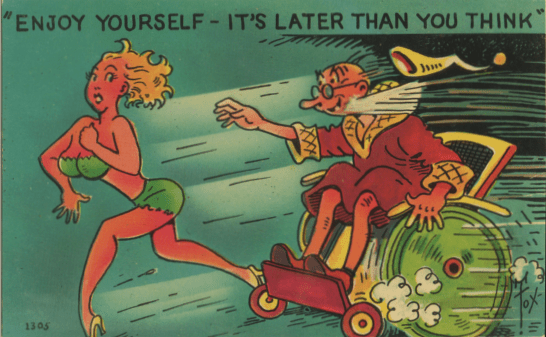
We have discussed this hereintofore, but more cards come into the inventory and I need to venture anew into the fact that the cartoonists who produced pictures had the whole of pop culture to draw upon. One of the easiest ways to get a grin or a nod from a prospective buyer was to refer to a popular song. By 1949, when Guy Lombardo premiered THIS number, the custom was dying away. Were music publishers getting more pugnacious about not getting any royalties for this, or was the radio public switching to new number ones too fast for the postcard companies to keep up?
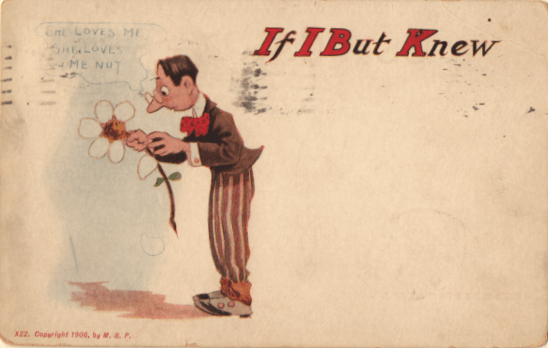
In the earliest part of the century, listeners had to rely on sheet music and their phonograph records, which resulted in a slower turnaround. (Can you imagine an age when you had to PAY to listen to new songs? Yeah, I thought you could.) This sad, uncertain chap rode his postcard in 1907, but the song “If I But Knew” made its debut in 1903.
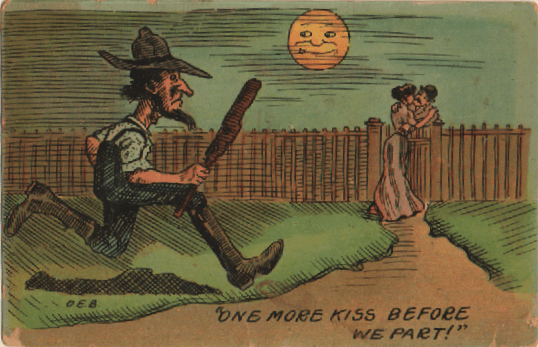
The previous postcard uses the song pretty much the way the lyricist intended, but the real fun came in repurposing a lyric. The scene would NOT have appeared in the original song. (If there was one. The only song I can find with this title was written by Stephen Sondheim around 1970. It WAS, however, written for a musical which takes place about the time this postcard was published. Now, I am NOT suggesting Sondheim was inspired by the couple on this postcard. And yet….)
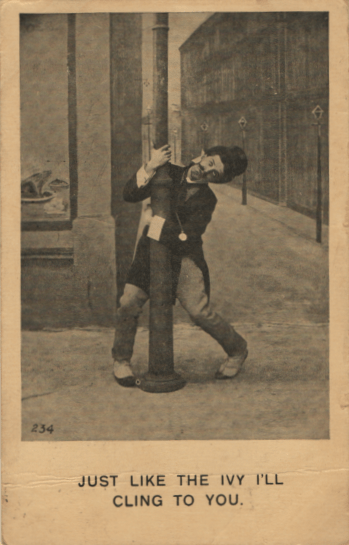
This is a better illustration of the principle. THIS song, popular for a decade or more after its introduction around 1902, is a sentimental tale of devotion to an elderly relative. But the humorists at Bamforth couldn’t resist this application. (Though they also published a series showing the lyrics of the original illustrated by a little girl and her Grandpa. This was another thing about pop songs: you could market to those that wanted it straight as well as buyers who liked a joke.)
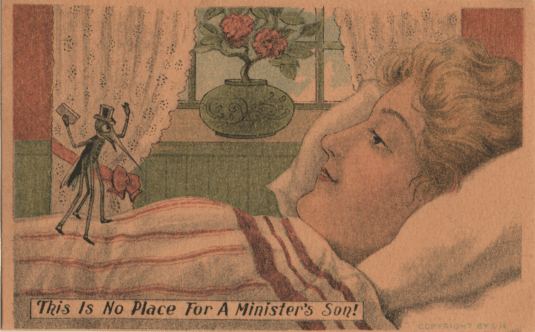
And this was a comic song of 1909 or thereabouts, about a “preacher and Sunday Schoolteacher” who keeps finding himself in the wrong place. In the song, however, he is NOT a mosquito.
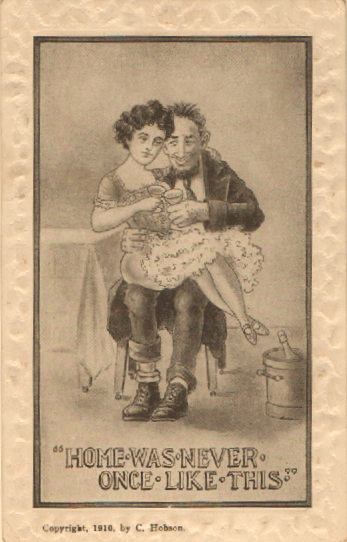
This card, too, expresses pretty much what the song is about. (I refer specifically to the song where a farmer named Hiram goes to the big city and encounters club life, determined to stay so long as he can still write home and say “Sell another cow”. There are several songs with this title: figuring out which comes first, the song or the catchphrase, is work for dissertation writers.)
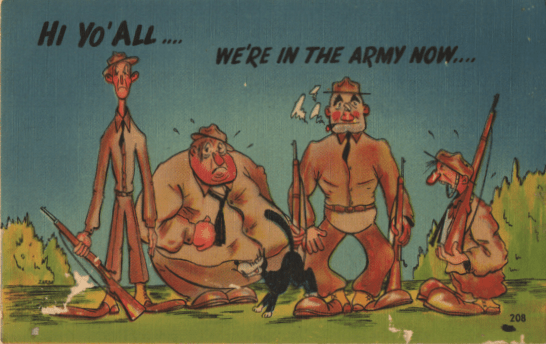
Speaking of home not being like this AND dissertation topics, this refers to a song popular during both World Wars. However, there are subtle differences between the versions sung during the two conflicts. The 1917 original was “We’re In the Army Now” and uses a melody subtly different from the one you’re humming now.
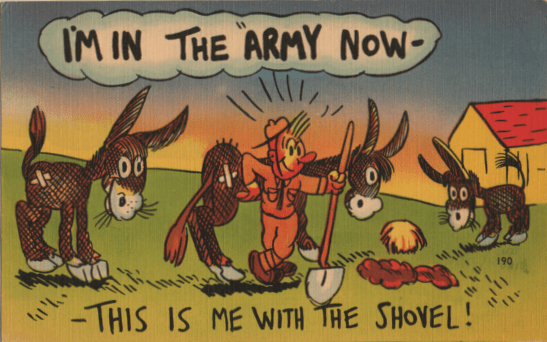
By World War II, though the lyrics stayed the same, the melody had become the one we know from the cartoons and movies of the time, and the title had changed to “YOU’RE In the Army Now.” (And yes, in the sheet music of both, the line is “never get rich while digging a ditch” and NOT the version that was so well known that at least one animated cartoon assumed everyone knew the other version by simply going instrumental for that passage.)

Let us conclude with the work of Albert Carmichael, who doesn’t so much alter the context of the 1908 standard “Cuddle Up a Little Closer, Lovey Mine” as ADD to it. The original lyrics simply neglect this, but it adds tension to the chorus if we see the song COULD be about how much a woman wants chocolate. Or does it? Maybe that’s why my country album hasn’t found buyers yet. Or is it just that no one’s making postcards for MY lyrics?

