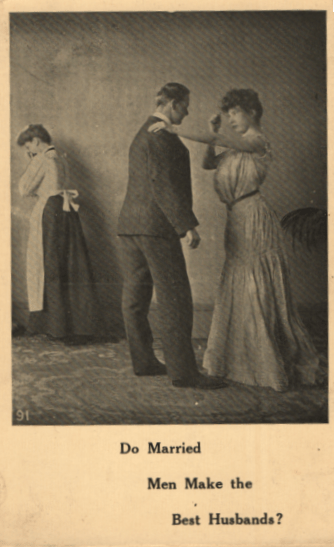
It occurred to me, looking over the postcards dealing with the, um, difficult bits of married life for our series on couples of contrasting size that I had ONE more size issue to examine. It was a popular genre once, the tales of what happened in some of those cases where a married couple became a trio. No, not the Baby makes Three jokes or even the large collection dealing with marital infidelity. We need to take a quick look over the Mother-In-Law joke.

The mother-in-law joke is traced by a number of scholars to the Roman writer Juvenal, who made a couple of wisecracks about mothers-in-law about 2200 years ago. The jokes are international, and so traditional that we find writers in the 1870s complaining about how stale and unfunny these jokes are. So complaining about mother-in-law jokes is nearly as traditional as the jokes themselves.

What we wanted to talk about, though, is how the postcard artists almost always show the Mother-in-law as bigger, in every way, than the straight man and his wife. This is symbolic, as the main problem of the Ma-In-Law, we are told, is that she is nosy, intrusive, and dictatorial. She looms large in the household.

The husband in these gags is generally shown as a confused and gormless chap, already finding it difficult to understand his wife, suddenly outnumbered two-to-one by these mysterious female creatures. The viewer knows he hasn’t got a chance now; this is a joke of the “Better you than me” variety (i.e. schadenfreude.)
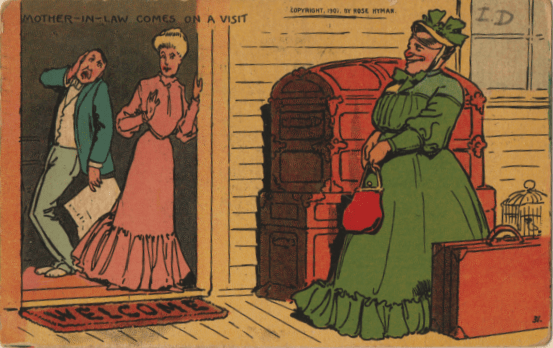
Women, we are told by social scientists, find these gags inoffensive but also unfunny; the “That’s Not Funny” folks who infest the Interwebs nowadays deem them both sexist and ageist. AND every now and then a professional humorist will establish credentials by noting “I don’t DO Mother-In-Law jokes.”
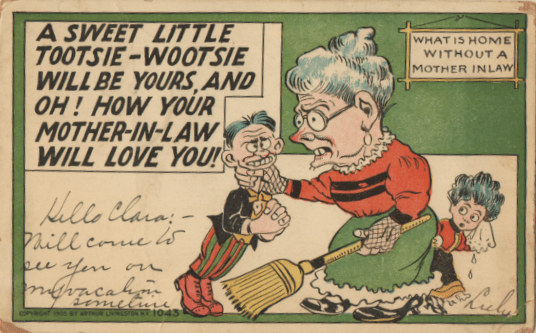
Somehow, the phenomenon of women telling jokes about their HUSBAND’S mother, which goes back at least as far as the 1950s (and, if you like, could be traced into the Finnish folk epic the Kalevala, in which one bizarrely heroic man informs his household that he expects his new wife to be treated with the same respect as his mother.) And, out of curiosity, why is there no tradition of FATHER-In-Law jokes. As far as I can tell from the postcards in stock, HIS role ends after he attends the wedding (generally toting a shotgun.) He has to pay SOME role in this drama: after all: his wife keeps going off to spend a month or so with his daughter.
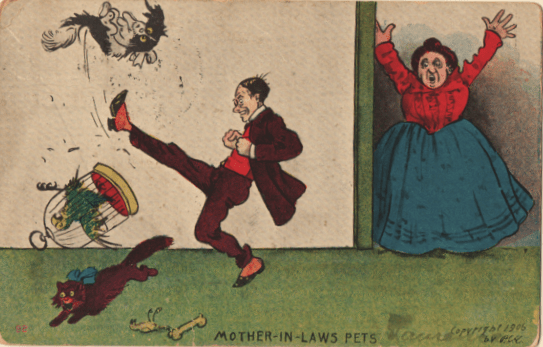
In any case, here are some frequently round and often tall women against whom the poor male involved has very little recourse. The joke is old and perhaps passe, but traditional. (Who, by the way, named a variety of the Dragon Plant also known as St. George’s Sword, “Mother-in-law’s Tongue”? Is that still permitted?)

