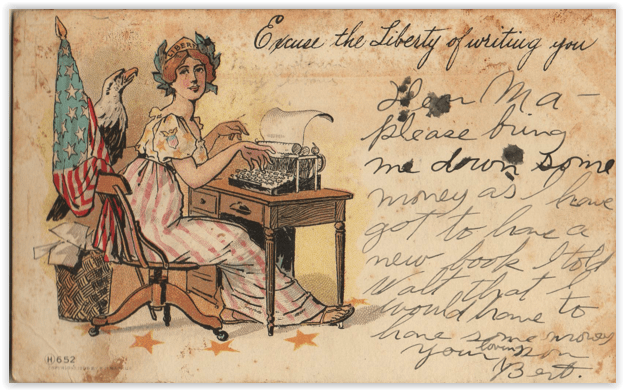
I’m used to hearing that the things I spent time learning in school are now obsolete, irrelevant or offensive. I was proud of my ability to identify British Guiana, French Guiana, and Dutch Guiana on the map of South America (they were in alphabetical order from left to right) but that’s a little less than useless with Guyana and Suriname now in the picture.
I still put two spaces after the period in all my manuscripts. Twenty years ago or thereabouts, someone told me “You know you don’t need to do that any more, right? The reason for it no longer exists.”
Reason? Nobody told me there was a reason beyond the typing teacher taking off points if we didn’t do it.
AND my instructors fought hard to teach us how to write. It is with sorrow that I compare what I write now with what I wrote, say, thirty years ago. The older I get, the more I slip back into those inviolable rules I was taught and had sense enough to ignore when I was young and adventurous.
“Don’t be dramatic.” This started with “Never use exclamation points” and went on with an admonition never to put a scene in a story or a report on the Battle of Bunker Hill that was designed to frighten, alarm, or indeed, excite the reader in any way. This MAY have been an attempt to discourage stealing scenes from, say, an episode of Batman, or it might have been a nod to a literary style which involved detachment and neutrality in working literature out of mundane events.
“Don’t be predictable in your dialogue.” I remember the sneer with which one teacher warned us “Don’t just said ‘he said’ or ‘she said’. Say ‘he chuckled”, or ‘she hissed’. It makes the scene more interesting.” Assignments were handed in typed, and one day I finished a story and noticed I had mistyped the line “’Of course,’ he laughed” as “he kaughed.” I decided I did not want to redo the whole story for one mistake and landed it in.
When the teacher failed to mark this as an error, I was encouraged. As the year went by, my characters maughed, naughed, paughed, raughed, saughed, and taughed, with never a complaint from the long-suffering young woman. Later, I checked up on authors I read for pleasure, and got no farther than The Lord of the Rings, in which J.R.R. Tolkien almost NEVER used anything but “he said”, even when “he asked” would have been permissible. It wasn’t so much that I decided Tolkien was the be-all and end-all of writing technique as that I had never noticed this until I checked. I now think it possible that the only people who notice what you do in this regard are editors. Years later, I began to see articles in which editors wrote with sneering typewriters of rookie writers who thought their work was improved with the “said substitute”, wasting time thinking of ways their heroes could cough a sentence, chortle a sentence, or snarl a sentence when they COULD just say something and get on with it. (They reserved such scorn for people who wrote “Get out’,” she hissed,” explaining that you cannot hiss a sentence which has no s sounds in it that I was tempted to…but I always was that way.)
“Explain everything in detail so the reader doesn’t get confused.” Of all the advice I was given…. Even at the time I would seethe as one more instructor explained what was wrong with “As she left, she turned and waved her hand.” The reader would get quite the wrong idea from so stupid a remark. Waved her hand, did she? Were we writing about a one-handed heroine? “Her hand” implies that she has no more than that one: MUCH better to clarify by writing “She waved her left hand”, or even, “She waved one of her hands.” This way the reader will not rear in indignation when the heroine is using both hands to steer the steamroller.
In fact, we were directed to describe everything about our characters fully the first time each appeared. Quality unconfusing narrative required “John Smith, six foot two, with brown hair and blue eyes, weighing about two hundred thirty pounds, was dressed in a brown suit with a white shirt and blue socks over black shoes. His complexion was tanned and thick bristling eyebrows contracted to point at a wrinkled snub nose.” In the next paragraph, we should meet “Juliet Jones, four foot two, with red hair and green eyes, weighing about ninety-three pounds, was dressed in a shiny silver gown, with sheer blue stockings and shining red slippers. Her complexion showed heavy use of powder and rouge, and plucked eyebrows rose far from a nose pale and aquiline.” I read, in a real live magazine, a story in which every single character, from the lead to the woman who appeared briefly to lead the dancing bear through the library, was introduced in exactly this format. And the editor published it that way. Of course, this chap rejected everything I sent him, so, who, in the end, was the silly kitten?
And I find that the older I get, the more I remember all these things and write stuff like “John ‘Jumping Jack’ Nimblestick was a serious three foot tall second grader with bright blue eyes, ash blond hair, and a double major in Dodgeball and Dinsoaurs. On a bright warm, but not humid summer’s day, he met Juliana ‘Jill’ Gildensturm, who, being one month and nine days older than Jack, was some two inches taller and, at seventy-nine and one half pounds, a good deal heavier than her small neighbor. She wore pink dungarees with orange tulips over the pockets, in contrast to Jack’s (much smaller) blue denim equivalent. She carried a very large grey bucket of zinc which belonged to her grandmother, Gloria Gildensturm, a sixty-eight year old woman who stood five foot ten when she stood up, which was almost never, due to the muscle pains attendant on age and a general disinclination to get out of bed and face the realities of living in a wolf-infested forest where her only visitor, on a busy day, might be her granddaughter by her second son, Jacob, ‘Jake’, Gildensturm, a six foot seven woodcutter who generally wore buckskin and scuffed black boots, and had sired a daughter Gloria, whom everyone in the neighborhood called ‘Red Riding Hood”, because she favored that garment above all others, though, to be sure, sometimes she wore yellow chintz and sometimes blue and silver organdy.”
“’This bucket,’ Jill snorted, watching Jack get both hands on the handle to lift the dark brown wooden utensil bound with black iron bands, ‘Will be too heavy for me to carry alone once we have filled it, not too full, of course, since we have to carry it back down Hefty Hill, the third hill from the left once we turn north by northwest at the dry run, where your grandfather, John ‘Little John” Johnson, a man of short stature but long dreams who also wore a black frock coat over his orange trousers, for some reason dug the well up at the highest elevation, a matter of some sixty-eight meters.”
“You’re right,” mumbled Jack, his two pale hands gripping more tightly on the seven-inch long wooden handle as he directed size two black shoes with bronze buckles in the shape of….”
I’m exhausted. I need to rest up before I figure out how these two can tumble down a hill without seeming dramatic, and make sure Mom can complain about using up her vinegar and brown, but not too brown, paper on what is obviously not REALLY a broken crown without giving way to exclamation points. And, looking over the story, I think it would do with some local color. I may set it in French Guiana.

