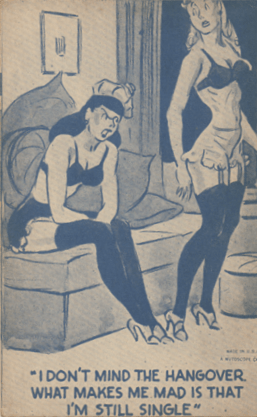
Last week, we looked into the role played on postcards of couches, sofas, davenports, and settees, concentrated on postcards which showed the usefulness of this type of furniture for courting couples. However, postcard artists were also alive to the possibilities of the couch as a setting for women sitting by themselves.
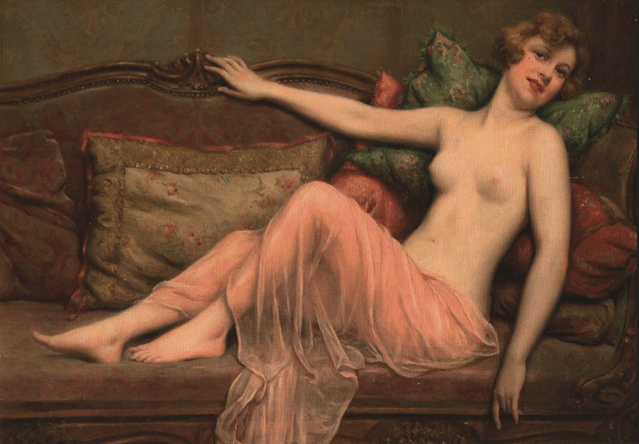
The word we’re looking for here is “display”. Painters were aware for centuries of the potential for long furniture to let a model stretch out and offer broader vistas (so to speak) to the viewer. Of course, you and I are really more interested in the evolution of the sofa itself, from this sort of Empire Style….
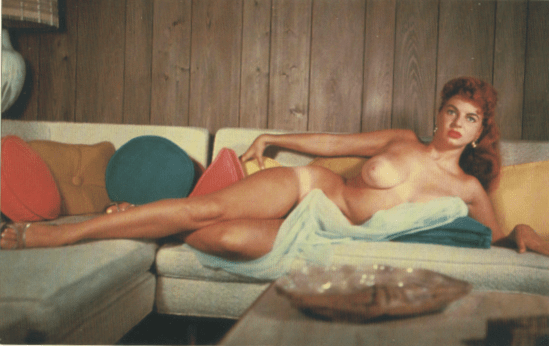
To this mid-century sectional sofa, similar to the one seen in the arcade car at the top of this column. (This may or may not be the place to tip our hats to the small joke of that day where any characters inclined to get their words wrong would refer to this as a “sexual sofa”. This would, depending on whether the censors were listening, might lead to a designer suggesting that the proper accent to a sexual sofa would be an end table or “an occasional piece”. The world of off-color furniture jokes has not really been studied. For good reason.)
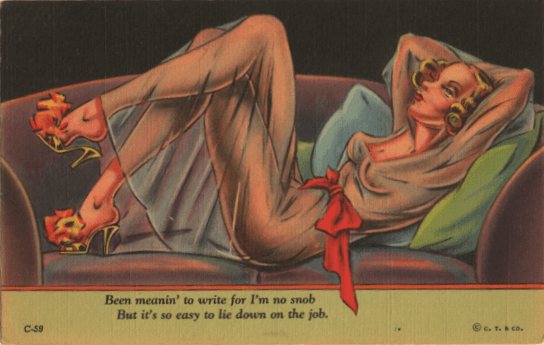
The major era of humorous postcards preferred to focus on the solid state sofa, like this one, which MAY be a settee, or couch designed for just two people at a time. We could simply be dealing with a very tall model.
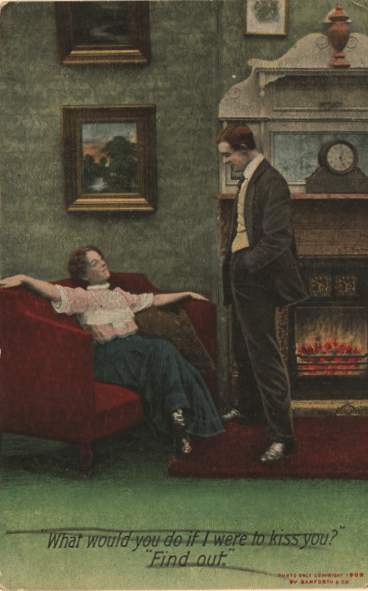
This card from a generation earlier shows the settee at its best and most characteristic. Like a hammock, a settee sort of dictated that two people could not sit very far from each other, which could be convenient in a strait-laced society.
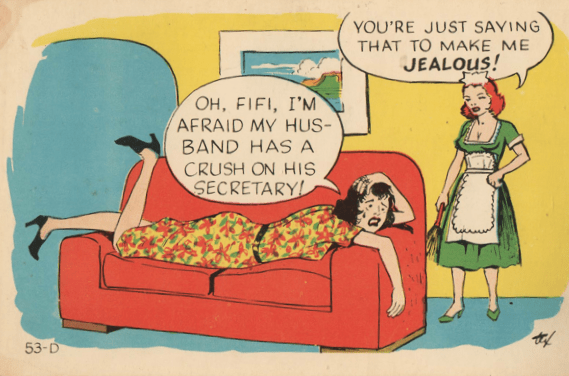
More homes at mid-century favored a longer sofa which could accommodate more people. (Or, again, one very tall model. Compare the wife’s apparent seat width against that of the couch, and her obvious height with the maid’s dimensions.)
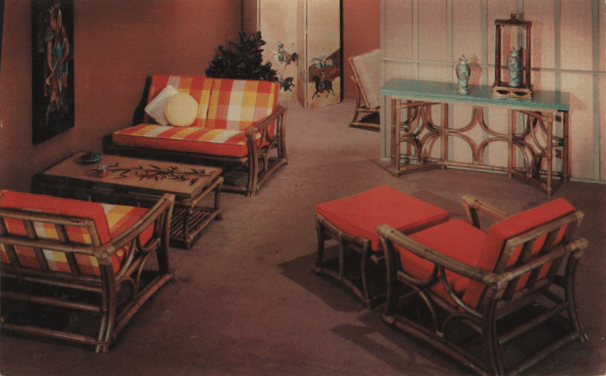
Yes, mid-century designers frequently went for something less cushiony. A whole-hearted determination to do away with the comfy arm at each end did not sit well with pin-up cartoonists, who largely ignored this trend or threw in a lot of souvenir pillows from Funicello Beach to make up for it. But take note of that other piece of furniture at the lower right.
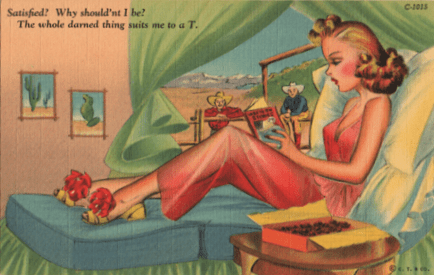
This comes very close to becoming another favorite of the pin-up cartoonist, the chaise longue. (Yes, I KNOW your family always called it a chaise lounge, because you lounged in it but trust me, it’s a chaise longue: just think “long chair” and all becomes clear. Just because everybody says it the other way doesn’t make it right, like “safety deposit box” instead of “safe deposit box”. And who decided that “concerning” was an adjective? The…. Where were we?)
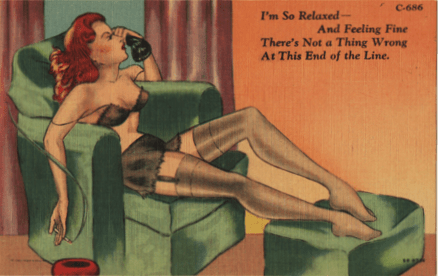
I would have to hunt around among the experts to learn whether the chaise lounge…longue is considered a couch or a chair. This brings us dangerously close to discussing the role of CHAIRS in pinup postcards. This is a whole nother problem, not to mention w hole nother series of blogs. The chair, see, has a LOT more different parts to play on postcards: not only a place for underclad females but also the place where tacks can be set for the unsuspecting sitter. Chairs can swivel, or recline, or fly through the air in a bar or living room, or be tied on the top of the moving van. Couches have a more relaxed life. (And there: I got through two blogs about couches without even mentioning the French verb ‘coucher’ and its possible connection with cootchy-coo.)

