He Is Us, Pt. 3

     Oh, very well.  If you have to hear how the story finishes up, we can put the joke column off until Wednesday.  How the millions of joke column fans will…what was that?  Don’t be rude.

     I hope everyone who read the first two installments has tuned in for the conclusion and was not thrown off by what may have seemed an unnecessarily crude detail in our second installment.  Those who had been reading may have remembered vaguely that this was a story about the immigrant experience, and how my grandfather felt there was a lesson to be learned in the story of HIS grandmother about how to treat The Other, the stranger who wasn’t like you.

     Yes, we ARE going to get to the story,  We left sixteen year-old Magdalena “Lena” Ruppel lying in the straw at the livery stable, afflicted by the pangs of cholera, a deadly disease that was seasonal throughout the civilized world at this time.  No one wanted tyo have anything to do with the German-speaking waif who was obviously sick: half a dozen white people hurried past and a black man turned and ran.

     Well, if you think of Galena as Oz, and Lena as Dorothy, she had just encountered her three main allies.  The freedman who turned and ran was going to serve as her Scarecrow, Tin Woodman, and Cowardly Lion.  Like the Woodman, he had a heart, and it went out to anyone dying on a sunny day in Galena.  Like the Lion, he had courage, and did not fear the disease that was going around.  But like the Scarecrow, he also had a brain.  This was Galena, Illinois, it was 1843, and he knew what would happen to a black man seen carrying a white woman through the streets of town.  He would be no use to Lena once he’d been pummeled to pulp.

     So when he ran, it was home to his wife, where he called “Ma, there’s a little Dutchy girl with the cholera lying in the straw at the livery stable, and she;s going to die if we don’t help!”  His wife did not pause to take off her apron, but hurried down to carry Lena to safety.

     Lena received the care she needed to recover, and also got some advice from the couple who had carried her away from death.  “You’ll always catch the cholera when it comes back, now you’;ve had it once,” she was told.  :What you want to do is cross the river and go to Dubuque, Iowa.  They never have the cholera there.”

     Dubuque was a lead-mining town well-known in a lead-shipping city like Galena.  And it had grown up in one of the hilliest sections of Iowa.  (It ain’t all flat fields of corn and hallucinatory baseball diamonds.)  Because of all the hills, sewage ran down into the Mississippi River before it had time to contaminate the drinking water supply (except for those who drew directly from the Mississippi) and it thus had an accidental but true reputation of being healthy.

     So when she was well enough to travel, Lena hit the road again.  She had learned a modest bit of English by this time, and was able to find work in the home of an old woman who lived alone.  Lena, you need not guess, did the laundry, washed the dishes, washed the floors…Lena’s life was a soap opera in more ways than one.

     Iowa had not even become a state at that point, and life was still on the frontiersy rugged side: they had absolutely NO WiFi.  So the lady of the house amused herself by taking an interest in the lives of those around her.  There was a sturdy young man from Alsace doing the yardwork and carpentry and other heavy chores around the house, and the lady never lost a chance to drop a hint to Lena about what a fine husband Heinrich would make for some lucky girl.

     Lena and Heinrich (later Henry) were married, and had four children, whom she tried to teach, among other things, that people who didn’t look like you or talk like you were not necessarily evil.  Henry died young (trying to build a better house than his brother’s, he lifted a stone that was just THAT much too heavy.)  Lena fretted about her youngest child, a ne’er-do-well who hopped freights around the country, learning about more people who didn’t look or talk like him, until she finally bought stock in a furniture company so she could make the supervisors give the boy a job.  He was named Jacob, after Lena’s brother, but legally switched his first name with his middle name, August, so people would call him Gus, which sounded less foreign.  (Lena did not live to see World War I, when speaking German in public eas banned in Iowa, but there were already those who looked on foreigners with suspicion.)

     My grandfather preferred to end this tale by pointing it out that it happened in 1843, and noting that in 1943, just one hundred years after Lena decided she was going to die in a pile of straw, he was leader of a Boy Scout troop.  The local Scout supervisor came to him and asked if he could add one more boy to the troop.

     The troop was already about as big as he could efficiently manage, but he said, “I suppose so.”

     The Scoutmaster said, “I should warn you.  This boy has been turned down by three other troops.”

     My grandfather thought it over.  “Does he smoke?’

     “No.”

     “:Does he drink?”

     “No.”
     “:Is he crazy?”

     “No,  He’s a Negro.”

     <y grandfather kept asking questions.  “Is he over twelve?”

     “Yes.”

     “Does he want to be a Scout?”

     “Yeah, that’s the problem.  He….”

     “Will he take the Boy Scout oath?”

     “I suppose.”

     My grandfather nodded.  “My manual says if ha boy is over 12, wants to be a Scout, and will take the oath, he can be a Scout,.  It doesn’t say anything about being a Negro.”

     “You’ll take him?”

     My grandfather never mentioned  this Scout’s name, but mentioned he was a good Scout: not the best and far from the worst, and lost to the world of Scouting when  high school started.  (The Boy Scouts lost a lot of them at high school age in Dubuque because baseball practice night was the same night as Scouting night, and each boy had to make a choice.)  But in his own way, he felt he had lived up to Lena’s story about a man who rescued a stranger who spoke a different language and was a different color.

He Is Us, pt. 2

     As you may recall from our last episode, we are glancing in the direction of immigrants to the United States through the experiences of the Ruppels, four Hessians in their mid-teens to early twenties, making their way out of the country ahead of the Hessian draft officials, in the distant year of 1843.  When we left them, they had made it to the coast, in good spirits but totally broke, without a pfennig to pay for transport across the Atlantic Ocean.

     Jacob, the oldest and the only male in the group, handled negotiations.  Finding a well-dressed ship’s captain and made the proposition: could an honet young man work his way across the Atlantic.  The captain asked if he’d ever been to sea before.  Jacob felt there was no use for a farm boy to pretend, and said no.

     “Then I won’t waste time trying to make a sailor of you,” the captain said, “But I have plenty of cargo to load and unload along the way, so I’ll take you across if you’ll join that crew.”

     Jacob was glad it had been so easy, but the captain raised one finger.  “But for one man’s work, I can’t ship four people.”  He looked over the Ruppel girls.  “We haven’t had a decent cook on this tub in out last three trips.  Can any of your sisters cook?”

     Well, of course, one sister said she’d been the family cook.  When she affirmed that, yes, she had certainly cooked fish before, she was signed on to the crew.

     “I like a clean ship and a tidy crew,” the captain went on, “So there’s always plenty of laundry.”  He nodded to the next sister, and then considered Magdalena, the youngestand smallest, a sixteen year-old who stood just four feet tall.

     “I have to go ashore at every port and talk to the port authorities and I need to look good,” the captain said.  “I have special suits of clothes for that, with lacer and gold buttons,.  That kind of laundry takes someone with small fingers and a delicate touch.”  And Lena was now a part of the crew as well.

     It sounded all right at the time, but in later years, Lena recalled that all she really saw of the voyage was soap suds: the captain DID have a lot of washing to do and, as they were still working their way along the coast of Europe, lots of stops to make requiring the use, and washing, of those special jackets.  But the trip, once onto the ocean, did not take long, and soon they were within sight of the New World.  And there they stopped.

     See, it was, naturally, a sailing ship, and they had encountered the fate feared by most experienced sailors: a complete lack of wind to make the ship go.  “Ve sat for two veeks looking at KOOBA!” as Lena told the story, still resenting Cuba for the way it had sat there, just out of reach, tantalizing them with the nearness of port, and the end of the voyage.

     The Ruppels said farewell to the captain, and his laundry tubs, in New Orleans, where they stopped at the Ursuline Convent, a well-known refuge for immigrants.  Not only were the sisters of the convent willing to help the confused newcomer to the United States, but they were also skilled nurses.  This was essential because New Orleans was in the grip of a cholera epidemic, a seasonal affliction of many large cities until the days when the importance of sanitation standards for drinking water was established.  (The hazards of proximity between sewers and drinking water…you get the idea.)

     One of the Ruppel sisters came down with cholera, and died in the convent.  Another sister was so touched by the sight of the sisters of the convent caring for dying strangers impressed her so much that she decided to sign on as a lay sister at the convent.  Jacob and Lena, however, had no desire to stay in New orleans, and got busy finding a way to get themselves farther north, perhaps where heat and disease were less common.

     Jacob found a barge captain who was headed up the Mississippi (I always heard barges did not move that direction, but this is the way I heard the story, and my grandfather had studied his river history and saw nothing wrong with the story.)  It was familiar work: Jacob would do loading and unloading while Lena….well, all she really remembered of the trip up the Mississippi was soapsuds.  The captain had his wife and kids along with him, so there was plenty of laundry..   At length, Jacob came to Lena and confessed, as she had been guessing, that he had fallen in love with the captain’s daughter, and intended to marry her.  This meant turning off the Mississippi and going with the captain and family to Ohio, which had not been their plan.  Lena opted to stick to the original plan alone and so, one merry day in 1843, set foot in GFalena, Illinois: four feet tall, sixteen, as mentioned before, speaking barely a word of English, and without any friends or acquaintances in this new place.

     But Lena had made it this far (I wonder if she didn’t do a lot of Jacob’s hob interviews for him) and Galena was a bustling, international center for the lead ore trade (lead ore is known as galena; no points for guessing where the city got its name).  She meandered through the crowds  riverside until her ears caught the sound of German being spoken.  It was slightly foreign German, not being a hessian dialect, but she could understand it, and she understood that something was going on.  She followed the German speakers to see what was so interesting.
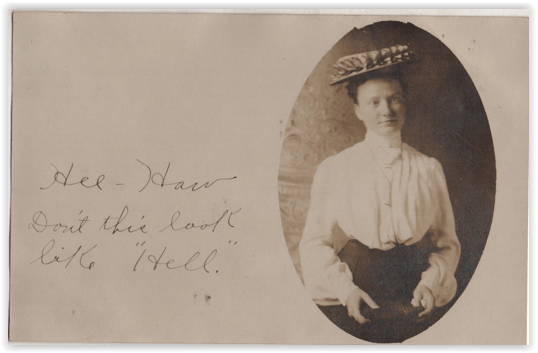
     She wound up in front of a store where the proprietor was explaining, in German with some English mixed in, that it was expensive, but worth it.  Workmen were installing a big glass window at the front of his store (ion installments: glass was rare and delicate, so his window was actually dozens of small panes set into compartments of molding.”  Lena worked her way to the front of the crowd.

     There she noted to the storeowner, “Das ist ja ein’ grosses Fenster.”  (I have bnee withholding my high school German bravely so far.)  “That is one honking big window!”

     “It is,” said the owner, his chest swelling with pride.

     Lena looked him in the eye.  “You’re going to need someone to wash that window.”

     In very little time, lena had become the latest employee at the store, and, in return for room and board, doing the laundry for the storeowner’s family.  Lena was starting to pick up a pattern to American life.

     All went well until the day that Lena, running errands for the storeowner, felt herself flushed with fever, dazed by the sunlight, and intensely tired.  She thought it she sat down for a moment, she might recover, but Galena was not overly supplied with spots for servant girls to stop and rest.  She curled up on a pile of hay at the livery stable, waiting for the fever to pass.  It didn’t pass.  Galena had been gripped by cholera, and Lena realized she had caught it.

     “Hilf mir,” she called to passersby.  “Help me.”  But realizing what the problem was, the passersby passed by.  Two women put handkerchiefs over their faces and moved on.  Three white men crossed the street, and a black man turned and ran the other way.  Lena realized that after all her work to get to America, she was going to die in a pile of hay for rental horses.

     On Wednesday: Lena does not die, and if you looked closely, you saw the reason why in that last paragraph.

He Is Us

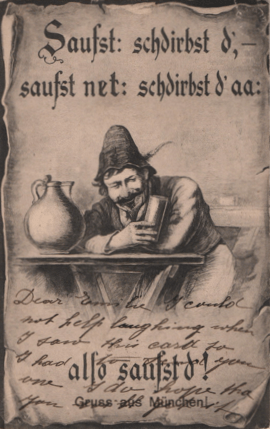
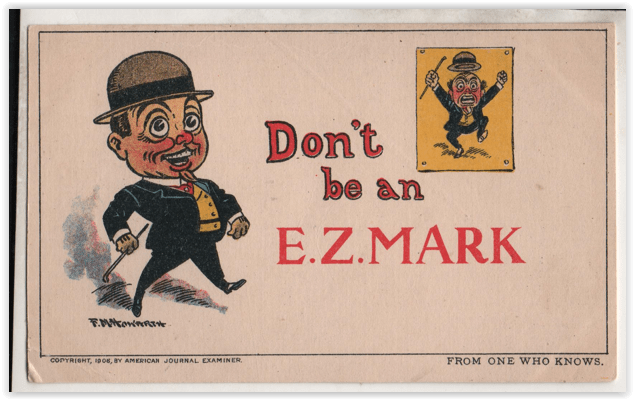
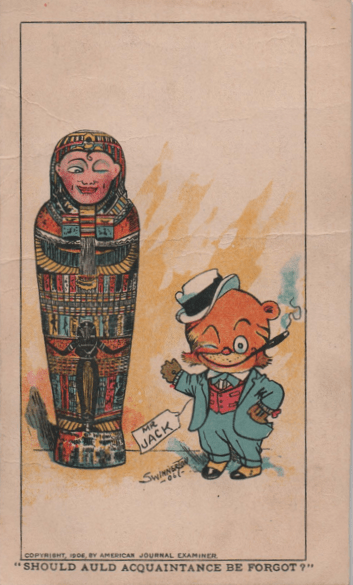
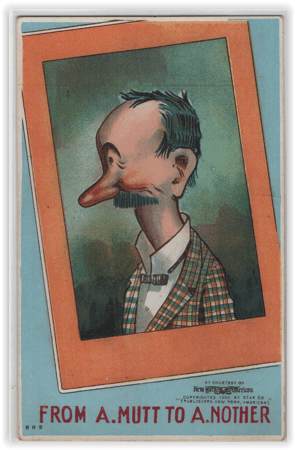
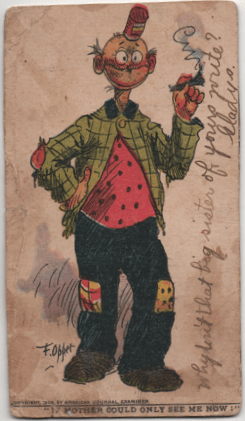
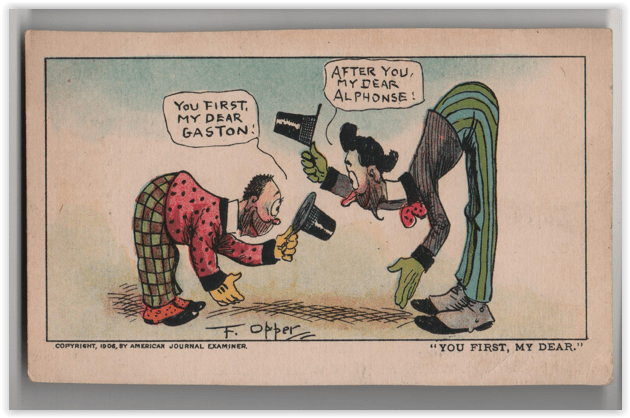
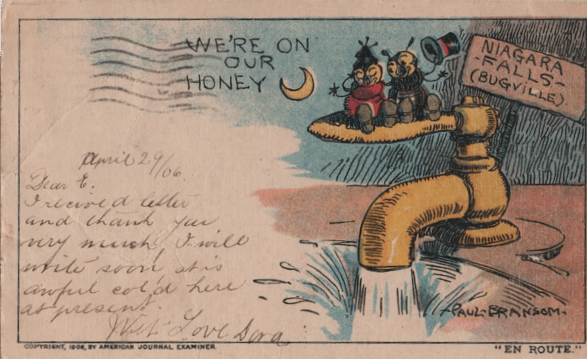
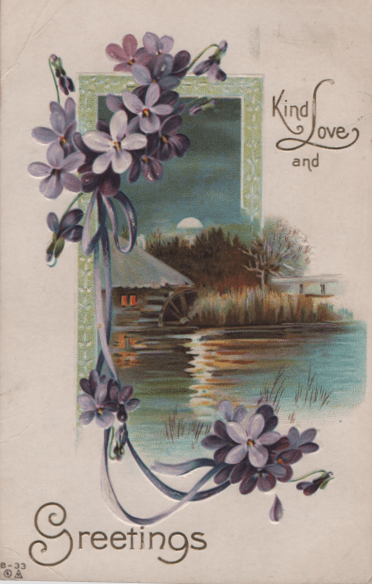
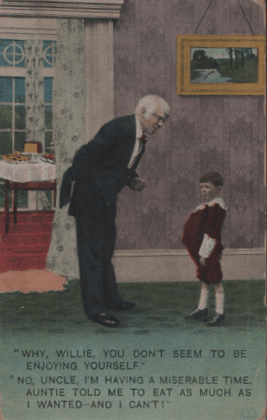
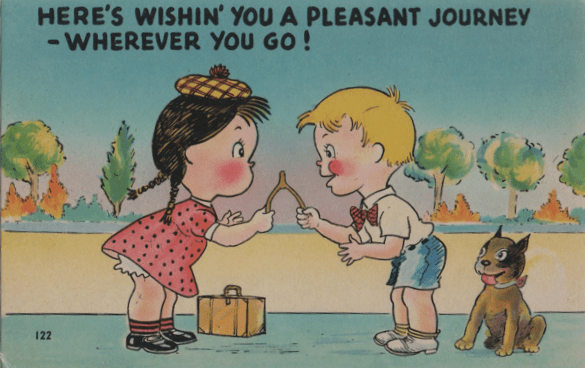
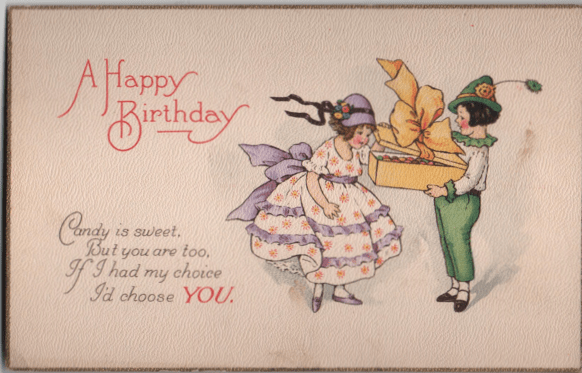
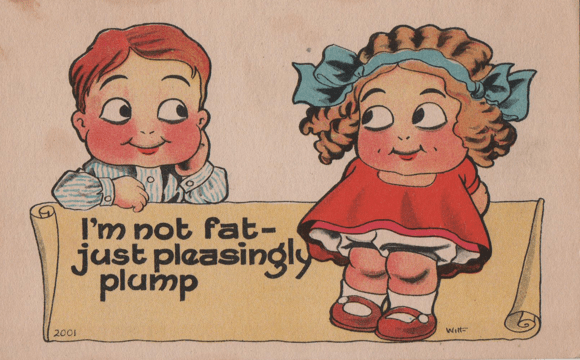
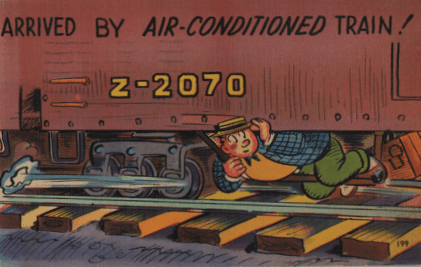
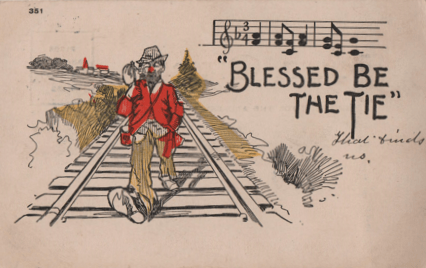
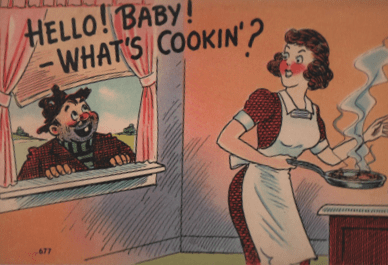
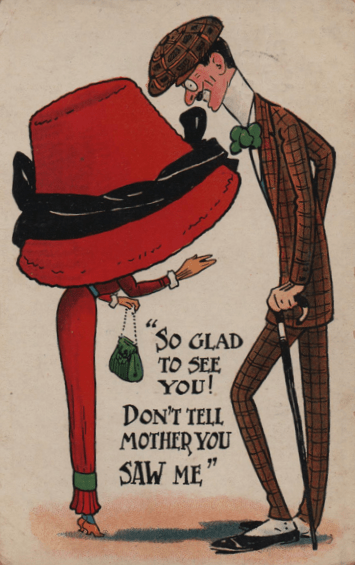
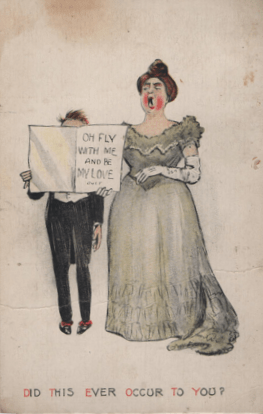
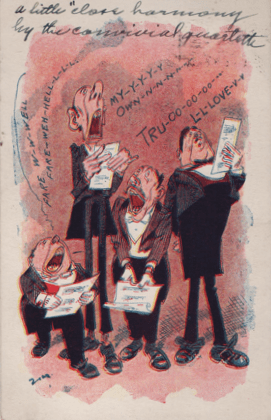
          Eons ago, a lot of jokes in this country dealt with The Other, people who were outside the norm, who had different clothing, different ways, and different language.  This became known as “ethnic humor”, and is now largely considered passe, if not downright evil.  I don’t have much interest in debating the question: some people regarded jokes about their ethnic group as recognition that their group existed at all, while others took the jokes as straight insult.  These postcards from Cavally’s portrait series seem rather genial to me, but I have been told I am incorrect.  I think it is no coincidence that the downfall of the ethnic joke came around the same time as the generation that had been born over here, and didn’t LIKE to be mistaken for those people who were funny, and awkward, and different (their parents and grandparents.)  One of my grandfathers, as a boy, disliked intensely being reminded of his ethnic background, and didn’t like visiting his heavily accented and over emotional grandmother.

     My grandfather grew into a staunchly conservative Republican, and had definite views about The Other, and how people who were different ought to be treated.  He regretted very much that he hadn’t been nicer to his grandmother, and, when fortified with strong coffee, would tell her story.  Sometimes he could take two hours about it, and I wish I had had the nerve to tale a tape recorder with me.  But I will tell the story of this ethnic adventuress in rather less time,. (I hope.)

     Once upon a time in Hesse (I have forgotten whether it was Hesse-Darmstadt or Hess-Casse;, but my grandfather knew) there was a family of farming Hessians comprising Mom and Dad and four children.  Jacob was the oldest of the children, the only boy, AND the tallest of them, coming it at around five foot one.  Not a tall family, the Ruppels.

     Mom and Dad died in an epidemic.  The children mourned, but there was a farm to run, and the cows need to be milked no matter who died.  Jacob and his three sisters worked the farm together until one day the Notice was posted.

     If you have heard of Hessians at all, you know that these were Herman soldiers hired by the British to fight in the American Revolution.  This was how the Hessian governments stayed solvent: they drafted their young men, trained them, and rented them out to other countries.    The Notice stated that all men of a certain age should report for duty: the government needed the money.

     Jacon didn’t especially want to go.  Hesse was filled with the damaged veterans of previous levies, and, anyhow, he didn’t see how he could leave his sisters alone to run the farm.  For one thing, he was the only one tall enough to harness the horse (not wealthy, either, this family).  Those of you from the city might think one of the girls could just stand on a footstool. But a horse is no dummy.  He knows all he has to do is take one step away from you and you have to get down, move the stool, and start over, whereupon he can move one step forward.  He can do this as long as you can: it may be tedious but it’s more fun than hauling a plow.

     Then, too, if news got out that the farm was being run by three small teenaged girls (The shortest and youngest was Magdelena, who at 16 was just four feet tall) this might give ideas to some of those veterans who, unable to find work, gathered into gangs to pillage and loot.  Killing three girls  would have been easy work for someone who had been off fighting in other countries’ wars.  And, after all, killing wasn’t exactly necessary: they could do other things which would make the women happy to marry them and let them loaf on the farm while the young ladies, between producing offspring, could do the work.

     So Jacob and his sisters resolved to get out of Dodge.  They sold the farm quickly got noy much money.  The neighbors were sympathetic about Jacob’s plight, but knew a desperate seller won’t haggle.  The four used that money to get transportation. They turned up at the seaside one jump ahead of the authorities (who had some experience finding draftees who didn’t want to go),  and completely out of funds.

     Next time: How the Kids got to America, though all Lena saw on the ocean trip was suds.

Leisure Pleasure

     So we arrive, once again, at Monday.  If you did not spend your weekend at the Newberry Library Book Fair, well, you missed it.  It was a post-pandemic affair, a bit watered-down from previous concoctions, but there were still books for sale at popular prices.  If you were unable to tear yourself away for it, this Old Joke Quiz is here to console you with tales of other things people do in their free time.  If you have enough time, you can check the ANSWERS below, but I;m sure you won’t actually HAVE to do so.

            J1.Jerry was an awful bore, but people came to his parties because he stocked very good liquor, even though this meant listening to his stories.  “There,” he said, pointing to a mounted bear’s head on the wall.  “Did I ever tell you how I bagged Old Grizzle?  I was down to my last bullet.  It was a case of him or me.”

     “Well,” said Susan, “He (          )”

J2.”What about you?” Jerry asked another guest, later.  “You ever hunt bear?”

     “No,” said Tim, “(          )”

J3.There’s so much game in Africa that the hunting’s great.  One night I shot an elephant in my pajamas.  (           )”

J4.”You’re suire tjios is a safe place to swim?” the tourist asked the guide, as he left his clothes on the bank.  “No alligators out there?”

     “No, sir,” said the guide, “)          _”

J5.”Coming to the big game to see the Red Sox and the Yankees fight for the pennant?”

     “No, thanks.  I know what the score will be before the game even starts.”

     “Really?”

     “Sure.  (          ).”

J6.At halftime, the home team was trailing the Fighting Peacocks by seven touchdowns, so the coach stood up in front of the players in the locker room and said, “The way you guys are playing, we’d better go over some basics.  Lesson one: this here is a football.  Lesson two….”               

     “Coach, Coach, please!” came a voice from the back, “(          )”

J7.Bob and Bambi got stuck in traffic on the way to the big game.  Bob was grumbling to Bambi about the other drivers all the way.  They finally got to their seats in the third quarter.  “What’s the score?” Bob asked the man in the next seat.

     “Nothing to nothing,” the man said.

     “Oh, good,” said Bambi.  “(          )”

J8.Sarah and Thea were wandering through the annual art fair, admiring the cedar windchimes and the photographs of balloon animals.  At a booth hung with dozens of paintings on black velvet, they stopped short.  There, nearly lifesize, was a painting that lseemed to be Sarah, in the nude, in a position which could only be described as indiscreet.

     “Hood grief!” Thea exclaimed.  “You didn’t pose for that, did you?”

     “Certainly not,” snapped Sarah.  “(          )”

J9.Steve dropped in at the studio of his old friend, an artist whose paintings hung in several galleries.  His buddy had just finished work for the day and was washing up.  Steve stepped over to the new painting on the easel and reached out to touch the nose of the figure.

     “Don’t!” said his friend.  “Can’t you see the paint’s still wet?”

     “Oh, it’s okay,” Steeve said.  “(          )”

J10.The party had been going on for some time when the host walked to a closet and brought out a tuba.  “Bought this about a year ago, and I’m getting pretty good.  I can play songs that will make you weep, or I can play lullabies that will put a baby hummingbird to sleep.  I can even tell time with it.”

     “How?” demanded one of his guests.

     The host raised the instrument and performed a few bars of “Beer Barrel Polka”.  Sure enough, (          )

     J11.Bambi was practicing her trombone, playing “Who Threw the Overalls in Mrs. Murphy’s Chowder?”  The phone rang and an angry voice demanded, “Do you know there’s a little old lady here trying to sleep?”

     “No,” she said, “But (          )”

These jokes are just like old songs: you may think you remember all the lyrics, but you want to check the ANSWERS to see if you had the same words as the original.

     A1.He certainly makes a better trophy

     A2.I usually wear a jacket, atr least

     A3.How he got in my pajamas I’ll never know

     A4.The piranhas scare them all way

     A5.Nothing to Nothing

     A6.Not so fast!

     J7.We haven’t missed anything

     J8.He must have painted it from memory

     J9.I have gloves on

     J10.Someone banged on the wall and shouted “Hey, it’s two in the morning!”

     J11.If you hum a few bars, I’ll fake it

Pockets To Let

     I’m not sure I’ve ever even met anybody who was rich.  Oh, I have chatted on a friendly basis with people who might admit they were successful, or well-to-do, or comfortably well-off.  But the ones who were willing to discuss the matter with me could always cite someone richer than they were, someone whose affluence was a distant mark to which they could only aspire.

     Mind you, I can’t say that everyone I ever knew felt this way.  There seem to be a lot of people who remember they have to rush to another appointment when you ask “Are you rich?”

     I think the question here is not one of some subjective term like “rich” but the more immediately understandable (if still subjective) concept of “having enough”.  People who are rich have enough money for anything they choose to buy, and nobody ever really has enough.  Postcard cartoonists have long understood that, and there was no way to raise a sympathetic chuckle like showing some poor bloke who just couldn’t scrape up the necessary.

     Carl Sandburg wrote of the sweet hellos and goodbyes people whispered to their money, and the cartoonist was willing to show that all affluence is fleeting, if not actually an illusion, as in the chap at the top of this column, who invested in a bunch of sure things.

     Having enough money is, of course, all a matter of luck, as some postcards found out to their sorrow.

     And although there were plenty of postcards advising you to get out and get under, to take arms against your troubles, and keep looking up, the cartoonists knew that the FIRST thing you need to do when you’re broke is complain about it.  This is one of a series of European postcards with almost-okay English captions which illustrate what would have been an amazing opera about being completely out of clover.

     I wish I could find the whole series dealing with these gentlemen who sing somehow while devoid of the dough-re-mi.

     These cards were embossed: the surfaces of the star of the picture were raised above the flat background, and liable to friction.  In this case, it helps: the loss of color gives their clothes a more threadbare look, lending a little more authenticity to their arias about their lack of substance.

     There are, of course, resources available to the low-income individual.  I feel this one, from the 1960s (if you couldn’t tell the clothes) is a tad bit harsh.  It probably appealed to those who were broke but not broke enough for government aid.

     But even in the nineteen-aughts, people knew there were ways out of financial difficulties, though these might involve still greater difficulties.  (Is there any truth to the story of one of my favorite authors who, it was said, would find himself broke and take all the first editions of his own books to the pawn shop, use the money to buy enough whiskey to help him write another book, and then go back to the pawnshop with the money from his publisher and buy all his books back?  Or did he make that one up himself?)

     In any case, there are always optimists who are willing to keep looking up even when reserves are down.  Remember this, broccolini waffle, when you have spent all your money at a book fair and can’t afford lunch.

FOOTNOTE BLOG

Just a note to anyone who has a behind and has not yet gotten said behind to the Newberry Library Book Fair at 60 W. Walton Street in Chicago that said behind can be taken there Friday, Saturday, and Sunday to find a nice variety of books, jigsaw puzzles, CDs, :{s. and even a music box or two. Admission is free, checkout is cashless (bring plastic), and it all starts at 10 on Friday July 29. That behind wanted to get out from behind that compyter for a while anyhow.

Funny Business Casual

     Postcard cartoonists in days of yore held strong opinions, or anyway expressed strong opinions, about clothes.  They were cartoonists, after all, and whether clothes make the man or vice versa, they found clothes a very easy way to establish character.  The way a character was clothed told you what the cartoonist wanted you to think about him.  We are, as I think I have hinted in those last few sentences, going to look at how men dressed in postcards, as women’s dress had to carry a variety of messages, from what the cartoonist thought of some new fashion to whether we were expected to take the postcard home and pin it up somewhere the ladies of the house wouldn’t look

     We are excluding, with some regret, golf clothes, which are also an entirely different matter, both on postcards and in life generally.  Froggy,. At the top of this column, will have to wait for some other blog.

     We have discussed, hereintofore, some fashions in men’s clothes, particularly the stiff collar a man could attach to his shirt.  The height of one’s collar had said something about one’s status as a man in polite society, and it was argued from the beginning of the nineteenth century until World War I.  A very high collar signified high fashion and wealth to some people, and stupidity and uselessness to others.  To some cartoonists, the four went together anyhow, as seen in this scene, which, in case you didn’t know you were supposed to laugh at these blokes, monocles and a kind of male bustle have been added to the scene.

     At least their clothing is the right color. Going back in men’s fashion, we find that it is prince Albert who, by his sober example, changed men’s fashion in the direction of dark hues.  A Regency buck in, oh, 1808, would have thought nothing of light blue trousers or a forest green jacket (probably not together.)  But Prince Albert’s dark suits led to five or six funereal generations in men’s clothing.  Men could, and did, wear colors, but the cartoonists recorded what the rest of society thought of them.
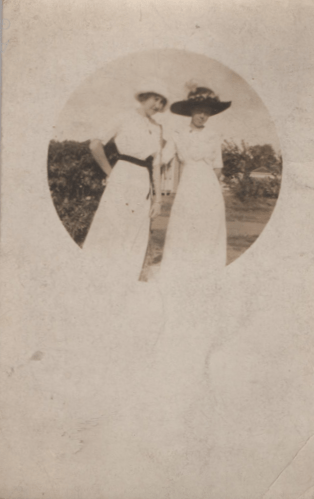
     Such men were suspected of donning flashy dress to make a stir, which the proper gentleman did not.  (This fellow is succeeding in making a stir, but, the cartoonist feels, not a really good one.)

     The artist of the Mollycoddle series could have indulged in worse name-calling than that, but preferred to express opinions through wardrobe.  The central figure here is wearing a gaudy striped sweater with spotless white pants (known universally as “white ducks”), the marks of a weekend athlete, if that.  (Striped sweaters were fabored by muscular members of college football teams—in pre-uniform, pre=helmet days—and he’s not exactly showing off a football physique.)  And any sport you could indulge in while wearing heels that high was not considered much of a sport.

     This mollycoddle goes in for fashion faux pas of another sort.  His watch fob (if he has a watch) is prominent, and adorned with a popular good luck charm.  His tie is broad, his mustache is thin, and his pants are baggy.  Once again, the mollycoddle has dressed to impress, but is not impressing us favorably.  (Quick quiz: list three words the cartoonist may have wanted you to think of instead of “mollycoddle” while looking at these pictures.  Very good.  Now go wash your brain out with Henry Wadsworth Longfellow.)

     Dressing so people notice you is to be avoided.  People may not be thinking of you what you think they should.

     As an antidote to all these encouragements to dress soberly, we shall close with the always reasonable Walter Wellman, who warns us that fashions change, and wishes us to be mindful of that.  After all, it is now the twenty-first century, and if you wish to wear a plaid jacket with a striped sweater and polka dot trousers, you just go ahead and be you.  (As a precaution, though, you might want to add a bag of golf clubs.)

Jest Having Fun

     Now, this is the third time in a row I am going to begin this column by opointing out that it is summer and, as Lewis Carroll decreed, what I tell you three times is true.  It seems appropriate, then, in this time of vacations and warm leisure, to present a collection of old jokes dealing with the things people do when they’re off work.  As always, the answers are hidden at the end, when you feel like going to the trouble of working that far down the page.

     J1.”How was the game, honey?” the woman asked her husband as he set his golf clubs in the closet.”

     “The worst,” he said.  “It was hot, the golf cart wouldn’t work, and after playing four holes in that heat, Ted grabbed his chest and dropped dead.”

     “Wow!  How horrible.”

     “I’;l say.  After that (          )”

J2.The golfer was about to try a putt when, on the highway just beyond the ninth green, a funeral procession passed.  He set the putter against his bag, took off his hat, and waited until the heatrse and the fifty or sixty cars behind it passed in slow procession.  Then he addressed the ball and sank the putt.

     “It was thoughtful of you to show respect like that,” said his partner.

     “It was only right,” he replied.  “After all (          )”

J3.”If you’re so bored,” Steve’s wife said, “Why don’t you play golf?”

     “Ah, everyone’s busy today,” he told her.

     “Why not call up Jim.  He’s retired, too, so he should be available.”

     “Huh!  Would you play with someone who kicks your ball into the rough when you’re not looking, coughs whenever you putt, and refuses to count the swings where he misses the ball when he’s counting up his strokes?”

     “I guess not.”

     “Well, (          ).”

J4.Every Thursday, the foursome met for cards at Casey’s bar and Pizza.  And, every Thursday they could depend on old Buck wandering over to watch, criticizing their play on every hand, expressing contempt for their lack of skill, and just generally making a nuisance of himself.

     “We need to teach him a lesson,” said Bill, one Thursday.  “Let’s start playing, but make up the game as we go along.  Then he can’t criticize.”

     The rest agreed, and when they saw Buck start in their direction, started a game in which each player was dealt eight cards.  “Lemme see,” said Bill, “I’ll take one card and discard two.  I think I have an ultrapong.  I’ll bet ten.”
     “Ha!,” said Jim, tossing down one card.  “I’ll see you ten.  Looks like I have a pippeck.”

     “I can do better,” said Joe, pulling his cards to his chest.  “I have a snozzle.  I make it twenty.”

     Tim tossed four twenties into the pot.  “Well, I’ll raise you.  I’ve got a spludge!”

     Buck couldn’t take any more.  “What are you doing?”

     “Can’t figure it out, eh?” said Jim.

     “No!” snapped Buck, “(          )”

J5.Carl, carrying his rod and his tackle box, stopped at the store on his way home.  He told the man behind the meat counter.  “Wrap up two trout.  And can you throw them over the counter to me?”

     “Sure thing,” said the butcher.  “But why?”

     “Headed home,” said Carl, “And (          )”

J6.The hunters trudged through the forest, becoming more and more convinced that their guide was leading them in circles.  “Admit it,” said Tom, “You’re lost!  And I thought you said you were the best guide in the state of Maine!”

     “I am,” said their guide, “But (          )”

Set that frosty mug of root beer to one side, adjust your bag of chips, and check to see whether I have gotten the same ANSWERS you did.

     A1.It was fourteen holes of Hit the ball, drag Ted, hit the ball, drag Ted….

     A2.We were married for thirty-five years.

     A3/Neither will Steve

     A4.What kind of idiot raises a snozzle with a spludge?

     A5.I want to tell my wife I caught them

     A6.I think we’re in Canada now.

You Give Me Fever

     Well, we are thoroughly into summer now (I saw my first Back-to-School Sale ads) so perhaps you feel this is the wrong time to discuss romance in the long grass.  But hey (this is the last time I’ll make that joke on this outing.  Promise.)  But grass grows more months of the year than in autumn, and romance is seasonless.  What I mean to say is that hay can be gathered from late spring through the earlt frosts, and there is no cut and dried season for gathering rosebuds.  (And we will put an end to the cut and dried jokes now, too.)

     Ecen in the big cities, few people were far from the concept of open fields, and the knowledge that long grass and other crops could provide camouflage for experiments in animal husbandry.  I do think the publishers of this postcard could have shoved down the grass just THERE, as it creates a sightline that gives the impression the young lady’s figure…well, I wasn’t there.  Maybe the growth was abundant that year.)

     This all played into a city-grown concept of farm romance, which was a major factor in popular literature in the nineteenth century.  See, it probably derives from the idea, pushed by Thomas Jefferson and others, that city life was generally unhealthy, and life in the country air was more robust, more real.  This is now seen mainly in cowboy romances, but there used to be a vast movement by city folk to spend some time on a farm during the main growing season, during which the city folk would pay for the privilege of working like, well, like farmers from dawn ‘til dusk, just so they might have a chance at scenes like this.  (In reality, the city folk would be too exhausted by the constant work—so were a lot of the farm folk—to engage in hanky=panky, but we are dealing in romance here.  The caption of this card, by the way, is a reference to an urban pop song, though tall grass plays its part in the story.)

     Of course, if one stayed up late at night, after the chickens had gone to roost, maybe you’d all get your second wind.  Then the camouflage of a handy haystack might prove useful.

     I do not have much data on the mechanics of the proposition, but I do think what you did if underneath a haystack was try to get out again.  Maybe this form of hay is easier to draw so it can be understood than a hayloft, which I should think would be more convenient for this sort of hay fever.  Note that the chickens seem to be shocked.  (We will be making no jokes about shocks of grain, as I feel that is best left to the farm joke professionals.)

     Now, to get to the main target of this blog, we must consider the hayride, that adventure on which, if old stories are to be believed, romance could blossom and young couples got to know each other rather better than they could during the workday.  The hayride, I am told by the unromantic, started as a time when those working on the harvest could get a nap.  The hay had to be transported once cut, and kids and tired, er, hired hands would ride on top of the hay to the spot where it needed to be unloaded.  The hayride was wildly popular in farm romance, and pretty soon the farmers who charged city folk a fee to come and work on the farm realized that other city folk, out to the country on a day trip, would pay a fee to ride on the cargo.  One load of hay could bring in several loads of money, as carloads of tourists could be transported from farm to barn or railroad depot several times before the hay actually had to be unloaded.  (The approach of rain had to be measured against the approach of tourists, and the canny farmer had to time these trips just right for maximum profit.)

     The romantic possibilities of the hayride and the tourists who enjoyed it started somewhere in the late nineteenth century, and the city folk seemed to be having so much fun that hayrides became traditional even if there were no tourists available.  Even country folk were caught up in the romance of the thing, and the hayride, sold to tourists as an old rural tradition, eventuallt SDID become a rural tradition, associated with the autumn harvest and the celebrations that went along with completing the hard labor of the season.  All work and no play, after all….

     This postcard appears to have been published in 1910 by a major agricultural company (THE major agricultural company, as a matter of fact) and to my naughty modern eyes makes no secret about what we’re up in the hay for: good wholesome fresh air and a sense of fun.  The fact that we’ve paired off and are reclining…well, there’s nothing like the scent of new-mown hay.

Summer Seats

     Well, we are well into summer now, so I suppose this would be a good time to discuss hammocks.  Hammocks have a role of their own to play in the postcard world.  Despite the occasional reference to hammocks used by those who go down to the sea in ships, and the occasional vacationer beset my mosquitoes while sitting in a hammock, hammocks were for lovers.  And by that, I do not mean people who wanted to sit next to each other and hold hands.

     Take the couple at the top of this column, secure in silhouette on a modest hammock.  Being told that a grass widow isn’t green lets us know that this is the wife of somebody who is far away, and she knows what she’s getting into when she gets into a hammock

     A fabric swing that was also widely used as a bed carried with it certain possibilities, though this friendly couple would be well-advised to note the one-person dimensions of their hammock and the condition of their trees before moving  to another stage of this relationship.  (Er, is it my imagination, or is she studying his shoe?)

     The romance of the hammock was something which could go on into one’s golden years, even if the local wildlife is watching,

     A cartoonist, of course, could get away with a lot, of course.  This couple have taken up a romantic pose in a hammock of good size held up by reasonably solid trees.  One should not allow questions like how two people small enough to fit into a hammock in this position were able to climb up that far in the first place, and, judging from their expressions, whether they wouldn’t be too exhausted at this point in the date to wave a fan need not get in the way.  (Just as a side note, to distract you from the slanderous suggestion I just made about this pair, fans were, at this point, considered almost inseparable from hammocks: all part of the general association with those lazy, hazy, crazy days of summer.)

     Only rarely did an artist consider such nagging propositions as gravity.  This artist has noticed not only what happens to the hammock when a couple get into it, but what can happen with the couple, but this is generally left to the mind of the reader.

     Postcards which went in for photography over cartooning had to deal with such matters.  Take a look at how much more there is to this hammock than most of the drawn versions, and how this couple is burdening it.

     The reality of physical science as it related to summer romance could not be dismissed with a few brush strokes.  Of course, romance in a hammock was not a mere cartoon frivolity, so obviously there were ways to enjoy oneself even if one WAS three-dimensional.

     Not every hammock in creation could be suspended three feet off the ground.  All you needed was enough clearance to swing, as we can see with this down to earth couple.

     Speaking of which….