Sun ‘n’ Fun

     I am, of course, the first philosopher in the history of mankind to observe this but, man, things used to be easier.  In grade school, I was taught every year that autumn began on September 22.  This was not especially, um, true, as it depends on certain phases of the moon and other useful data, so sometimes it was September 21 and occasionally even September 20, but our teachers were going for information which could be easily assimilated, and I was taught that seasons always began on the 22d.  Even then, we felt that summer really ended on the first day of school, while today, we are told that Meteorological Summer ends August 31, while businesses and society generally in the United States end summer with the Labor Day weekend.  It’s a matter of holiday convenience, since summer “starts” on Memorial Day weekend.  (In my days at the Book Fair, we discouraged donations between these two holidays, thinking that would be easy to remember.  The number of people who somehow worked the Fourth of July into this….)

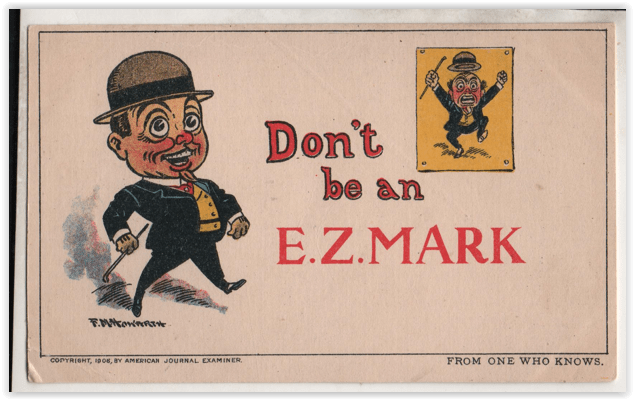
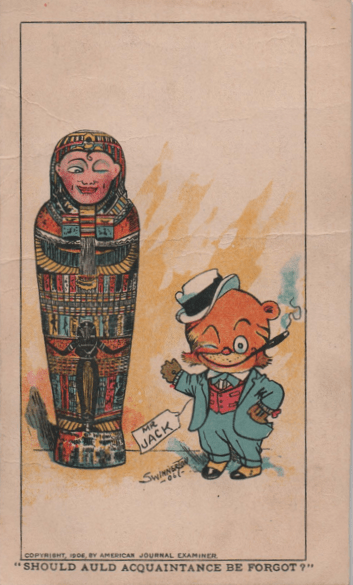
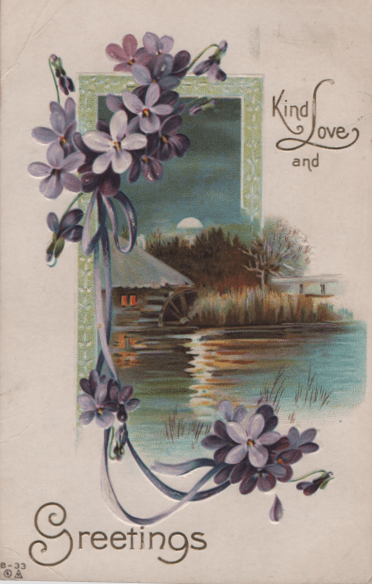
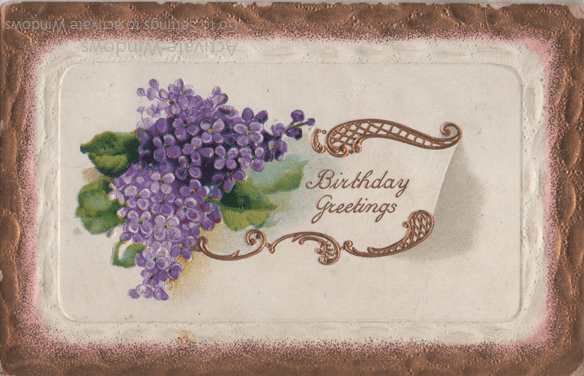
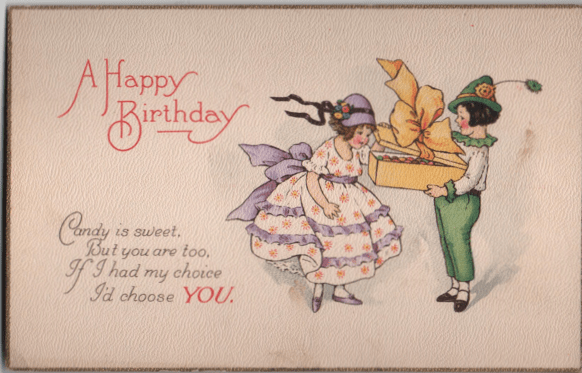
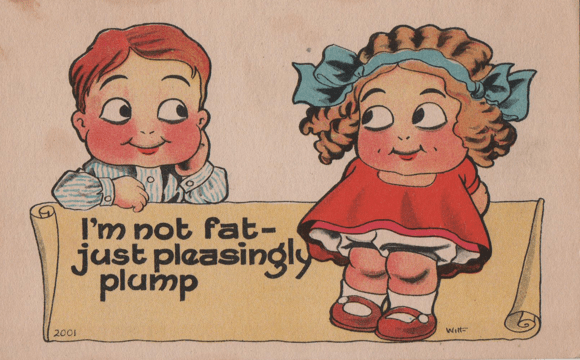
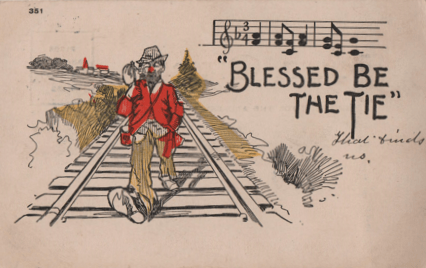
     In any case, I thought we might bid bye-bye to the summer of 2022 with a glance at vacation postcards.  After World War II, most individuals sending postcards did so to show people they were out of town.  The quick communication offered by a postcard were superseded by the telephone and, anyhow, the Post office had pretty much dropped having two mail deliveries a day.  But a postcard was still cheaper than a long-distance call.  (Those of you who are confused by the phrases “long distance call” or “mail delivery” may stay after class.)

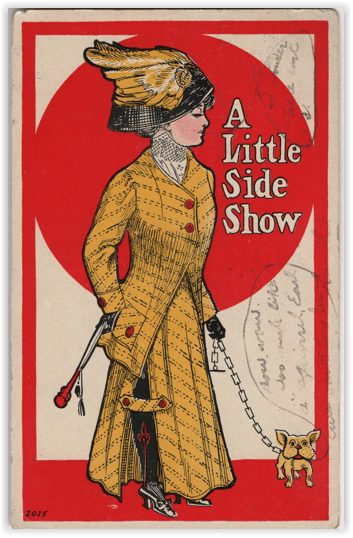
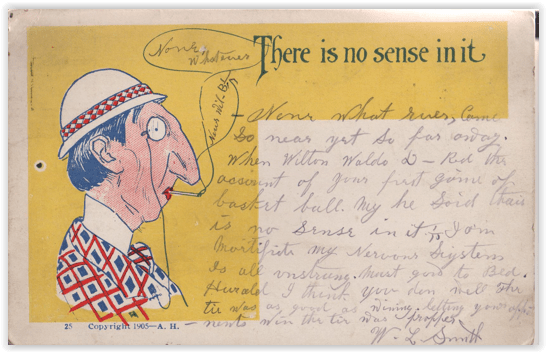
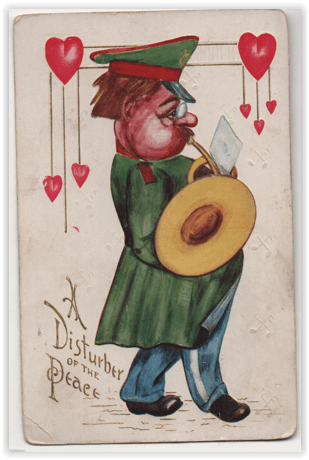
     Many of these postcards involved pictures of the sights you were seeing (this, plus the postmark, verified that you HAD actually been there.)  Others stressed what fun you were having.  But, um, there were others.  Lots of others.
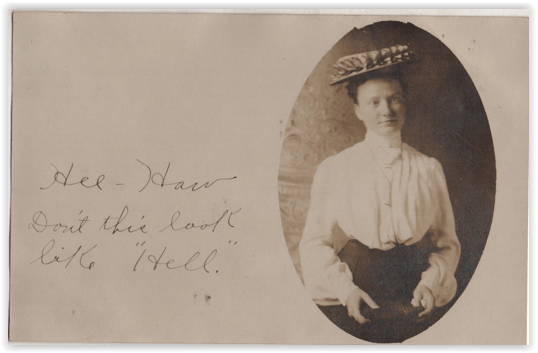
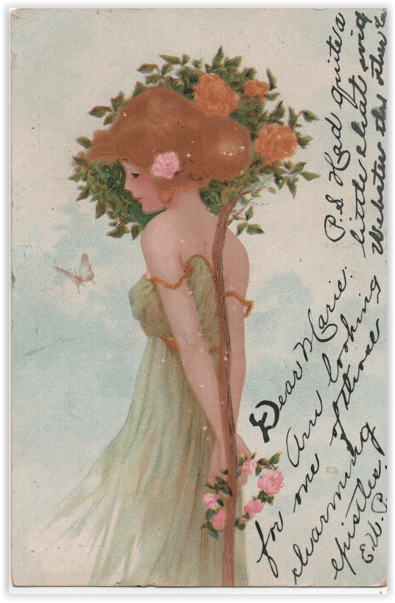
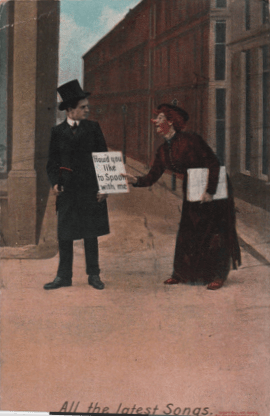
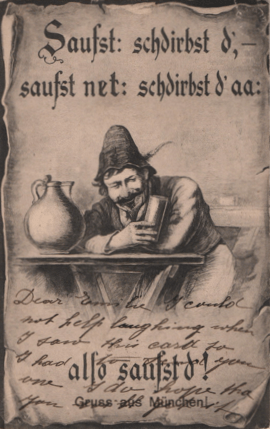
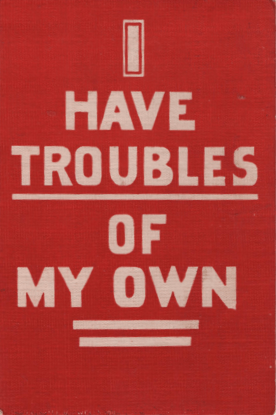
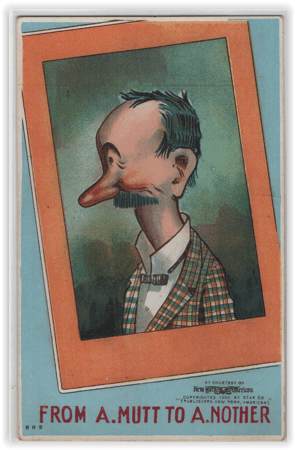
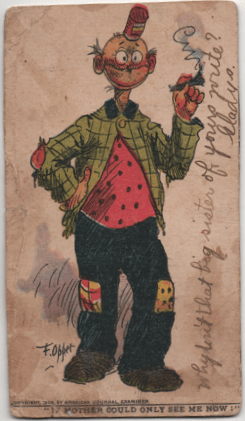
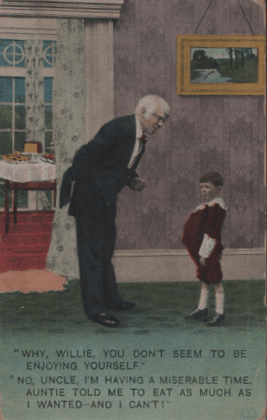
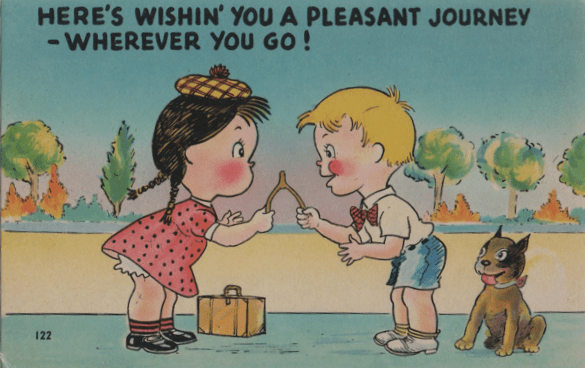
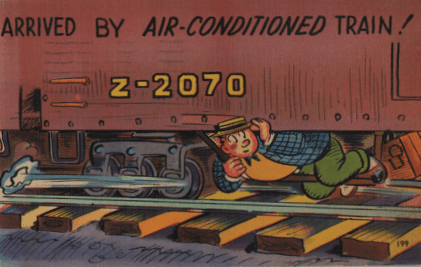
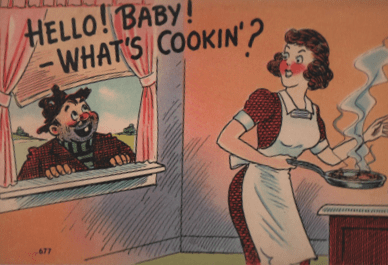
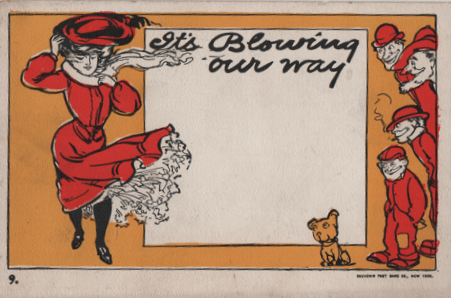
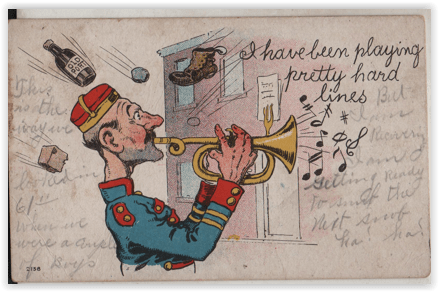
      Some, like the one at the top of this column, and the one below, stressed, and I do mean stress, how hard it was to set out on the fun-filled trip.

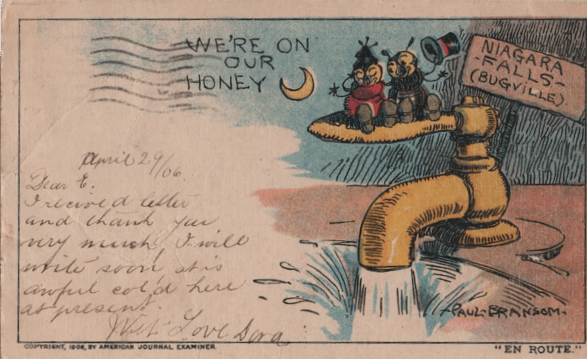
     Others referred to the joys of experiencing nature in whole new places.

     Please refer to previous blog about mosquitoes for much more on this subject.  Not that our ancestors neglected other insect encounters.  (I am NOT going to do a blog on all these hotel bedbug postcards.  I am NOT.)

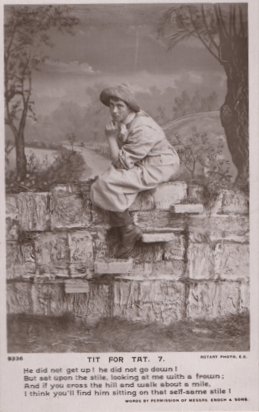
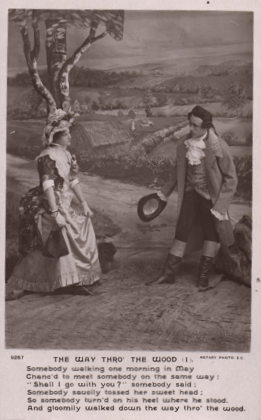
     There were plenty of postcards dealing with other sources of excitement.  A vacationer weas in peril in the forest

     On a stream

     Or even at the beach.

      The whole experience was obviously one of fun and frolic unconfined.

      The end of the vacation was practically a relief, provided you could deal with the exhaustion.

     And it wasn’t just your energy that was exhausted.

     To some people this was an elderly joke, but to others it was stark reality.

     One postcard artist came up with this mathematical equation to calculate the whole experience of a summer vacation.  This was immediately copied by dozens of other artists at other companies, so perfectly does it express the dark side of summer.  Well, anyhow, see you in September.

Old Jokes Go On Forever

  And so we come, butternut squash latte, to the klast of our Old Joke Quizzes.  I know there are a lot of jokes we did not cover: the book I wrote way back in, well, the twentieth century, did not make space for really old joke poems, or really old dirty jokes, or any of the rich supply of ancient ethnic jokes.  But we have now reached the last of the jokes in the original book, leaving nothing but the scoring page (useful in the book but not in a series of columns) and the note about the author (you have probably written your own several times over since we started this trek.)

     I have already selected another book tio serialize on Mondays, a little piece of nonfiction which cost me months and many dollars and is now almost wholly obsolete in an era of Interwebs.  Of course, it was obsolete to begin with—that was the point—but…say, which Monday is this, anyhow?  We have a few old jokes to cover before we get to the obsolete material of the next book.

     As usual, the ANSWERS, if at all necessary, will be found below.

J1.”And therefore, we shall see that science has confidently predicted that the universe as we know it will come to its end in a mere three billion years.”

     “Good heavens, Professor!  HOW many years?”

     “Three billion.”

     “Oh, thank goodness.  I thought uou sad (          )”

J2.The great violinist had performed for virtually every audience in the world and, with his skill and vast repertoire, he had enthralled every audience.  Offers poured in, and he made more money than he could spend in a lifetime.  In Sweden, there was a debate over whether to create a Nobel prize for Music just for him, but in the end, they decided to award him the Peace Prize because of the way his performances made people think, and reflect.

     Exhausted, he decided to take a vacation, and booked a flight to Africa, to as remote a spot as he could find, where there would be no audiences, and no temptation to perform.  He took his trusty violin, of course, since an artist must keep practicing his art.

     Against all the advice of the travel agents and guides, he started to go on long walks into the great open savannah by himself.  He wanted to get as far from people as he possibly could and, besides, he enjoyed walking (though he did notice, after a while, that if he wasn’t walking in time to Flight of the Bumblebee, he was stepping along to the rhythm of Turkey in the Straw.)

     One day, it turned hot early, and he felt fatigue building when he was far from any refreshment.  He finished the last swallow in his canteen about the same time he spotted a distant water hole.  He had been warned about drinking the water, but he felt if he just took off his boots and bathed his feet, he would be able to make the trek back.

     He felt much better after just a few minutes, but he felt worse immediately when he heard a rustle in the long grass.  A full grown lion stepped into view, and spotted him at once.  The lion lowered its head and started forward.  The musician reached for his boots but, on second thought, took up his violin case, which was always with him.  Slowly and carefully, he drew the instrument and the bow into view, tucked the fiddle under his chin, and stroked the strings.

     The lion paused as if confused and then, to the violinist’s delight, settled on its haunches, listening to every note.  As the violinist continued the concert, two more lions joined it, followed, to the musician’s delight, but three antelopes, a giraffe, and a mother elephant and baby.  He noticed their heads were all nodding in time to the music, but ignored this, the same way he did when concertgoers started to hum along.  Once again, the power of music had been proven.  He felt he could now retire; he had played successfully before every kind of audience possible.
     This was a good thing, because his retirement came suddenly.  A panther, leaping over the heads of the other animals, landed on top of him and tore him tyo bits.  The elephants trumpeted with anger, the antelopes loped off, and the lion who had come up first roared, “How could you do that?  That was the most beautiful sound I’;ve ever heard!”

     The panther turned and said, “(          )”

J3.And how else could we finish a book of old jokes ecept with

     “Say good night, , Gracie.”

     “(          )”

And now, what you’ve all been waiting for, the last of the ANSWERS.

     A1.three million.

     A2.Eh?

     A3.Good night, Gracie.

Fries With That?

     There was a time, avocado sherbet, when people avoided eating “out”.  They dined at home or, like my grandmother, packed large lunches when a trip might require being on the road over lunch time.  Fast food did not exist, local inspection of dining establishments did not exist, and people tried to avoid any meal which took place outside the home.  (Picnics didn’t count, as this involved food prepared or at least purchased by those who ran the household, like the cold Spam sandwiches and storebought potato chips my mother remembered so fondly from her childhood road trips.  And even then…cold Spam sandwiches?  Well, SHE liked ‘em.)

     One social historian explains why men’s clubs proliferated in the late nineteenth century by explaining that men who worked in the city, farm from home, eventually had to find a place to eat.  A private club, where one could vote on the sort of menu offered, allowed for an alternative to the bare possibilities of dining in the big city.  A person could pay a hefty price at a restaurant in a fancy hotel.  This involved cigars, different wines with each of usually five courses, and (in Chicago, anyhow) Scotch as the main beverage of choice.  This left one in a very bad state to go back and work in the afternoon.        

     Alternately, if one didn’;t mind eating with the labor force, one could go to a bar, put down a nickle for a pint of beer, and help oneself to the free lunch, plates standing out all day in all weathers, laden with foods that were pickled, boiled, and likely marked with the thumbprints of whoever had been there ahead of you.

     There was also the boarding house, where one could buy a week’s worth of meal tickets for whatever meal one would be there for, sit down family style with whoever else had paid for a ticket, and grab what grub was put on the table, eating as fast as possible so one could grab more, if desired.  As boarding houses were in business to make a profit, the food was notoriously cheap and often just a wee bit past its prime.  This was welcomed by young people with tight budgets and strong digestions.

     When the restaurant owners decided to try appealing to the growingly mobile middle class, therefore, there was a lot of back publicity that had to be counteracted.  Many tried to point out that they were staffed by proud, happy, hard-working chefs.

     Postcard cartoonists took some convincing.  Food in these new drop-in dining establishments could still be unpredictable.  (Anyone who can explain his entrée is welcome to do so.  I DO like the optimism of the dog, waiting for table scraps.)
     In the days when stray dogs roamed the streets of the city at will, by the way, and before the screen door became a must-have for your neighborhood diner, these were a regular feature of the eating experience.  (I don’t know if this dachshund is stealing food, or trying to rescue a fellow sausage.)

     Soup covered a multitude of sins, often including whatever leftovers had already been in the hash twice and were looking for a new job.  (Hey, if you want a soup joke that does NOT employ a fly, here’s one which goes back at least to the days of vaudeville.  “How did you like the soup, sir?”  “To tell you the truth,. I’m kind of sorry I stirred it up.”)

     The quality of the eggs served in a restaurant was another constant source of humor.

     And for more than one generation, at that.

     Meat was tough, fish and butter were likely to be too old to be bought by a boarding house, and if all that was not enough to worry about, the wait staff, as usual, consisted of the veteran and the novice, and fraught with similar perils.

     All in all, it was just safer to eat at home.  (Usually.)

Return of the Ruff Rider

     I may be doing my civic duty, waiting for jury duty, so I am preparing an emergency blog to keep you entertained while I am helping decide the fate of some fellow citizen.  (Unless I use my mother’s suggestion and just say, “Sure, I can serve on a jury.  Anybody who gets accused oughta go to jail, or they wouldn’t be here!”  She never actually tried it herself, so this would answer a long-wondered question.)

     I any case, I have a number of shaggy dogs to corral before we can conclude our collection of old joke quizzes, so here are a few more un[pompadoured puppies.  These jokes even have dogs in them.  No.  Sit.  Stay.

     J1.The two horses were chatting in the stable.  “So this dim human can’t get his car to start and I tell him something’s wrong with his transmission.  What does he do but run and tell the farmer about it!”

     “I heard,” said the other.  “And the old fool tells the driver that you don’t know a thing about cars.  He never does give us any credit.”

     “I’ll say,” the first horse replied.  “And he still drives a Model T because he can’t figure out how to start a car he doesn’t have to crank.”

     A dog who had been curled up in the hay listening piped up.  “Yeah?  Well, I was sitting by the road that day,. and when the mechanic finally showed up, it turned out nothing was wrong with the transmission.  You really don’t know anything about these new Buicks!”

     The first horse looked at the second.  “What do you know!” he said. “(          )”

J2.A man walked into a theatrical agent’s office with a small piano and two cages.  “Scram,” growled the agent, by way of greeting, “No animal acts.”

     “Just listen,” said the man, who was used to this.  He set up the piano and opened the cages.  A dog and a cat strolled out.  “May I introduce yeti and Sammy,. The eighth AND ninth wonders of the world!”

     The cat sat down at the piano and played a magnificent introduction, and then the dog began to sing “Blues My Naughty Sweetie Gives to Me.”  The agent listened, his eyes widening.  Finally he slapped both hands on the desk.

     “Incredible!  Amazing!” he said.  “This should bring in millions!  How did you train them to do all that?”

     “Well,” whispered the man, leaning in.  “There’s a trick to it.  (          ).”

J3.Another man came into the same office later that day, leading a dog.  “:Get out,” the agent invited.

     “This is the greatest talking dog of all time!  Just listen,” the man said, and turned to face the dog.  “What do you call the shingles on top of a house?”

    “Roof!” responded the dog.”

     “Scram,” growled the agent, chompiong on his cigar.

     “We’re just getting warmed up,” the man said.  “Listen!  How would you describe sandpaper?”

     “Rough!” the dog answered.

     The agent stood up.  “I’m warning you, Mister.”

     “Wait for the big finish!” replied the man.  “Who was the greatest baseball player that ever lived?”

     The dog barked, “Ruth!”

     “I warned you,” said the agent.  Mere seconds later, the man and his dog found themselves in the gutter outside the building.  The dog looked over at the man and said, “(          )”

     I hope you came up with more ANSWERS than the poor soul who had ME on his jury.

     A1.A talking dog!

     A2.The cat’s a ventriloquist.

     A3.You think I should have said DiMaggio?

The Shaggy Dog Rides Again

     I see that a great deal of what is left in my Old Joke Quizbook are the shaggy dog stories.  Bennet Cerf once explained, in one of his joke collections, where this phrase came from, but it didn’t make a lot of sense, which is the essence of a shaggy dog story.  I just classified these as the stories which went on a long time, considering the payoff.  But in the interests of completeness, I have decided to bring these to you as well.  It DOES stave off the next bestseller I will be serializing.  So sit back and relax and try to wake up in time to supply the missing punchline.

     !>”Ywes,” Travis was saying, down at the general store in Kakoola, “It had been a pretty good hunting trip.  I didn’t shoot every single bear I saw, because I needed some of them to haul the pelts of the ones I did get.  I picked off so many rabbits that you’d think they were multiplying after I had ‘em in the load with the bearskins.  It got so bad that after a while, I had to load Old Betsy, by trusty shooting iron, with string, so’s I could just lasso the grouse by one leg when I fired.  This way I could just tie ‘;em down to the rest of the load and they could fly most of the way.  This lessened the load on the pack grizzlies who had to do the hauling, of course.”

     “Of course,” said the bored man behind the counter, who had heard these stories before.

     “Of course.  And of course, too, I got to the point where I was just about out of ammunition.  Then I saw this real prize of a bear climbing up to get at a bee’s nest and get all the honey.  I had just the one bullet left, and I was getting a little tired, anyhow, of getting those bearskins tossed up on the big old load of game.  So I took a look, pointed Old Betsy, and shot right through that nest of bees.”

     “That a fact?” yawned the grocer.

     “It is that,” said Travis.  “That nest exploded, and the honey splashed out, blinding olsd Bruin, who tripped and fell right back onto the nearest load.  I tied him down quick while scooping up the honey and putting that in  my hat for later.  Thing is, I didn’t pay a lot of attention to the bees/  They were confused and angry and swam down too close to the brook, where the hungry trout started jumping up to eat ‘em.  I heard the flapping and, quick as I could, I yanked out the old fishing rod I take with me, hooked ‘em, and threw THEM up on the stack.  I counted when I got home, and found I’d hauled in nine hundred and ninety-nine prize trout.”

     “Oh, for the sake of sugar!” exclaimed the grocer, slapping the counter.  “Why don’t you just say it was a thousand?”

     “Well,” said Travis.  “I guess I could.  (          )”

J2.It had been a long struggle, but King Dexter David Donovan III had won the war.  His troops were exhausted, the warhorses had been pushed to their last ounce of equine prowess, and the archers were completely out of arrows.  But they had won.  No one remained of the evil wizard’s mighty army but his little court jester, who had run away and could not be tracked. 

     “Let us now prepare for the victory feast,” King Dexter proclaimed.  “Go to the Queen and tell Her Majesty to join me on the balcony for the proclamation.”  He proceeded up to the balcony.

     Soon a frightened court flunky came onto the balcony and whispered, “Your Majesty, the Queen is gone!  That tricky jester from the evil wizard’s forces tossed her into an enchanted carriage and rode off with her just as the evil wizard was making his death speech on the battlefield!”

     “This is an outrage!” roared the King.  “See if we have a warrior among the army who is fit to pursue him, and bring the fastest horses that can still stand!”

     Sir Horace the Heavyhanded, his arms covered with bandages from the fight and one eye patched, reported for duty.  “Only I can ride out, Your Majesty!” he said.  “All the other men are too weary.  But I can go.  Unfortunately, not a single horse can move from the stables.  This is the only animal we have left for me to ride forth on.”  And a court flunky led in a slow, fat, shaggy St. Bernard.

     The King shook his head.  “Then the Queen is lost to us,” he sighed.  “(          )”

I know you picked out the ANSWERS during the first half hour of each story, but here they are, if you want to check.

     A1.If I wanted to lie.

     A2.I wouldn’t send a knight out on a dog like this.

Drips In Love

     Not long ago, we blogged together in this space about the mishaps of lovers who had to operate under the watchful eyes of a parent or two  True to the belief that the course of true love runs never smooth, postcard cartoonists were cheerfully willing to admit that those who got out into the open air, away from the confines and surveillance of the parlor, did not have it all that easy, either.  And a constant theme of these cartoonists was the danger of damp.

     It is unfair, I suppose, to call the mighty Charles Dana Gibson a postcard cartoonist, since his work had become world-famous in the pages of magazines before postcards were even allowed to have pictures on ‘em.  But his publishers DID bring out a line of postcards as an afterthought, and here we see one of the most popular of his works, the couple in love who simply have no idea (and don’t care) what’s going on around them.

     This couple is similarly inclined.  The tide is coming in and their boat is drifting away, but none of this will matter until rather later

     A trick of the postcard publisher was the story series, in which you could follow an entire comedy by buying half a dozen or so postcards.  This couple is high and dry, if not high-minded.

     They have come out to the riverside to have a nice time together in privacy.  Note that there are no fishermen or boaters handy to sneak a peek at what’s going on.  They have picked just the right dock: it’s kind of small to attract people who are here to enjoy the water.

     Two grown-ups can surely find a time and a place for private contemplation of the intricacies of their relationship.  Perhaps he is thinking about how much money he sets aside from his paycheck each week to be able to afford, one day, a happy home for them to move into as newlyweds.

     Perhaps she is even now running over the contents of her hope chest, and thinking of what else she needs for her trousseau.

     There is, by the way, a YouTube channel (creamofcardstv) where a postcard collector has made short animated films by photographing these sequential series in order.  The films are short, but tell their story, as we have here: another splashy ending for an unsuspecting couple.

     This is not to say that every single couple canoodling in a canoe (yes, several postcard artists used the joke about canoe-dling) was unaware of the danger.

     A sudden moment of passion could, of course, lead to a drenching (and profitable stocking exposure for that sort of postcard buyer.)

     What it comes down to, I guess, is that the postcard artists wanted you to understand the essential incorrectness of the naughty old admonition, “You can’t walk home from a boat ride.”

The Flipside

     Once upon a time at the Book Fair, I would get calls from potential donors asking whether we’d be interested in a donation of old postcards.    And perhaps half the time, I would be told all the postcards were in really great condition because “I threw away all the ones that had messages on the back”.

     If the person had not yet reached the point of actually throwing things away yet, I would try to explain that roughly half the postcard collectors in the world feel a message on the back ENHANCES the value, even if, as I can testify, a lot of the time that message does not rise beyond the level of “How are you?  I am fine.”  (Actually, in the early days, when postcards were as big as texts were, say, in the 2010s the message was more often either “I got your card; here’s one for you” or “I sent you a card and haven’t heard back yet.”)

     For one thing, that postmark tells us when the card was mailed (unless it was lost when some opportunistic stamp collector decided to pull off the stamp.  Have I told you—lately—about the postcard someone slipped off into a corner at the Book fair and just tore off the corner with the stamp on it?  I understand: this was, after all, a card which would have cost a WHOLE DOLLAR.  And to that bungler who tore the inscription out of a book, effectively destroying the value of both the book and the autograph, I have renewed that curse on you, using the usual pumpkin shell filled with…where were we?)  If you’re not sure whether you have a genuine old postmark or a modern reprint, a stamp and postmark from 1907 can be mighty reassuring.  Sometimes the message on the back will comment on the climate or local news of the area shown on the other side: useful local history.  And let’s not sniff at the appeal of just reading someone else’s mail.

     But sometimes the back of the card can amplify the interest or the resale value of a card.  Take that shot at the top of this column.  Very nice, very predictable.  Do you suppose it’s a motel, or a new branch of a local bank?  Funeral home? It might even be a new school building or post office, OR the residence of some new, exciting celebrity.

     This one was never mailed, and you can see why.  The ad for aluminum siding pretty much fills the message space.  It is, in its own way, exciting.  It’s part of that post-war world in which the aluminum siding salesman became a force to be reckoned with in the suburbs and city councils across America.  Until he was replaced, of course, by the vinyl siding salesman.

     Here is another ho-hum type of postcard: the state map surrounded by tourist attractions.  These used to be valued by grader school geography teachers: an inexpensive, graphic way to show a state’s individuality.  Fifty of these—wait, maybe forty-eight for some of us—would make kids remember SOMETHING at least from geography class.  This one has the added attraction of a small hand-drawn X, probably at the spot where the sender bought the card.  What fun!  Let’s flip it over and see if it tells us what these tourist stops in Missouri are.

     Um, no.  it does not.  Somebody at the Curteich postcard factory fed the wrong card into the printer at some point.  (You can check online and find both these cards with their correct flip sides.)  We have instead an ad for the resort in Indiana which boasts Pluto Water.  What I like best about this is that the sender DID buy it in Missouri, and wrote that message and marked that X without particularly caring that the text had nothing to do with the Show-Me State.  WHICH teaches us something about postcard consumers.

     Now this lad carries all sorts of interesting stories behind his back, but let’s enjoy the front for a moment.  This kind of goes with a previous blog in this spot about inebriated gentlemen, especially their use of streetlights.  You will notice that it comes from Italy, and that someone has translated the original caption for a reader of English.

     On the B side, we find out much about the sender and a little about the English reader.  It is franked, marked to be mailed free of charge for a serviceman on active duty in Italy in 1944.  That alone gives it a bit of added interest, although I expect millions of postcards franked for members of the service are still in attics around the world.  Note that he has not bought one of the usual American postcards available at the PX, but has gone for a homegrown specimen.  We may observe also that Italy, after so many years of war, was stilling producing postcards for sale to tourists, a testament to the human spirit (or avarice; take your pick.)

     If you read the message, though, you learn a little about the recipient, who is now singing with a big band.  (At what point in our history did we decide this had to be capitalized?)  This is the sort of thing a dealer in second-hand mail dreams of: something that touched a celebrity.  Can’t QUITE make out that last name, though: Bekale?  Of course, they’d have made her change it if she hit it big, but somewhere on the Interwebs….  Then, too, there were a lot more big bands out there performing than ever achieved any more than local fame.  For every Benny Goodman and His orchestra there were three dozen Kevin LaBaron and His Big Blue Bands.

     But the possibility is still there that someone who fell in love while dancing to the dulcet tones of Betty Bekale would find this card a treasure.  All because somebody did NOT throw it away because somebody wrote on it (and it didn’t even have a stamp.)

And a Bag of Quips

     We honestly do, alas, creep closer and closer to the last jokes in my Old Joke Quizbook.  Yes, I heard some of you sigh with relief, but reflect on this, Turnip Taco.  I have already decided which of my books I will serialize next.  We can hold that sorry fate off only so long as we have elderly japes and jibes to put in this space on a Monday.

     Anyway, I was explaining why this is sort of a Miscellaneous Monday.  These are odds and ends from the last pages of chapters, and do not show the exquisite sorting and classification for which I am legendary.  Yeah, you can go look up “Legendary Sorters” if you like, but the jokes will still be waiting, with the unnecessary answers at the end.

J1.”So, like I was sayin’, them Bears was on the ten yard line and they was gonna….”

“You are hopeless!  Don’t you know the King’s English?”

“Yeah.  (         )”

     J2.”As your doctor, I need to tell you to hive up all that smoking, drinking, nd running around with women.”

     “Will I live to be a hundred?”

     “No.  (          )”

J3.”That curve on the hill just outside your town is mighty dangerous.  I’m surprised you don’t have a warning sign.”

“Well, we DID have a sign up there for a couple of years, (          )”

     J4.It’s the kind of job cub reporters get.  Jeremy was at the local assisted living building interviewing the oldest men there, inquiring after the secrets of long life.

     “Well, now,” said a white-haired man who had walked in leaning on a cane, “I never touched alcohol in any form, not so much as a sip.  That’s how I got to be ninety-five.”

     “Something the same with me,” said another, a bald man who had come to the interview with a walker.  “I avoided tobacco my whole life.  That’s how I figure I made it to ninety-eight.”

     A bald man with scraggly white whiskers piped up from his wheelchair.  “Not me.  I drank enough to float a goat, smoked all kinds of stuff, legal and not, never got to bed before three A.M., and maybe I shouldn’t even mention sex, since the subject didn’t come up, but I kept mighty busy along those lines, too.”

     “Amazing,” said Jeremy. “And how old are you?”

     The man leaned back in his chair to take a deep breath before answering, “(          )’

J5.”Doc, my right leg hurts.”

“Probably just old age.”

“But, Doc, (          )”

      J6.”Doc, my hearing’s getting so bad I can’t hear myself cough.”

     “Take these pills.”

     “Will they improve my hearing?”

     “No, but (          )’

J7.”I finally had to break down and buy a hearing aid.  Not one of those you see on late night TV commercials.  I went through medical channels and got the best model money can buy.”

     “What kind is it?”

     “(          )”

J8.Old Mr. Wrinklerag, who had built a tailor shop into a major fashion industry, was reaching the end, lying in a hospital bed under an oxygen tent as his son stood by.  “I don’t have much time left, son,” said the billionaire.  “I’m leaving everything to you, of course.”

     “Don’t talk that way, Dad,” said his son.  “You’ve made amazing recoveries before.”

     “Not this time, my boy.  I’ve told the lawyers it’s all yours, even my secret Swiss bank account, those three houses I kept hidden for any super models who needed personal attention.  There’s even a map to wear I buried a chest of diamonds, just in case the government collapsed and I needed something besides paper money.  The cryptocurrency is all going to be yours, too, of course.”

     “Dad, Dad, stop!” the young man sobbed, “I know you’re going to make it!  And through all this, and with everything you’ve done for me, there’s absolutely nothing I can do for YOU.”

     “Actually, there is something you can do, Son,” said Mr. Wrinklerag.  “(         )”

I don’t say these will satisfy all those of you who go onto the Interwebs seeking ANSWERS, but here they are.

     A1.So’s the Queen!

     A2.But it’ll feel like it

     A3.But nobody died so we took it down

     A4.Twenty-seven

     A5.My left leg’s just as old and it doesn’t hurt

     A6.They’ll make you cough louder.

     A7.Abbout 9:30      A8.Get your foot off that oxygen tube

Parental Guidance

     Once upon a time, rutabaga meringue, a young man courting a young lady faced complications far more difficult to confront than they are today.  A lot of this had to do with opportunity.  Especially in rural areas, people went out in the evening less than they do now.  Even in the cities, there were simply fewer chances of meeting the (current) love of your life out in public.  (Meeting your snooky ookums in a public place was handy because there were generally private places not far away that you assumed the older folks didn’t know about.)  You might meet a yiung lady at a party or a church supper, but such entertainments were few and far between.

     This meant a lot of your campaign had to be conducted in enemy territory, that is, you had to call on the young lady in her parents’ home. The early stages of the relationship needed to be developed while under scrutiny: the family parlor was where the family gathered of an evening, especially if there was a visitor, and you had to pretend you were really interested in Dad’s jokes, Aunt Lily’s discussion of her doctor visits, and little Booboo’s latest violin piece.  And while you were pretending not to gaze on the object of your affection, all of her relatives were pretending, with differing shades of obviousness, that they weren’t watching YOU.  Some were interested in guaranteeing propriety, others were just placing bets on what your chances were of victory, and one or two were just curious about your general strategy.

     The postcard cartoonists knew, as you did, that even if you and your sweetheart were able to find some privacy, her parents would be alert to your plan.  (Hey, if it was the family home, they were probably trying to get away with the same sort of canoodling in the same places a generation ago.  This was another peril of calling on your dearest darling at her place.)

     You could not elude the watchful eye of chaperonage.  Not noplace.

     Of course, even the parents knew life goes on, and didn’t particularly want to go on paying her room and board forever, so if you were considered a reasonable prospect, a certain amount of privacy would be allowed to you.  But this was a qualified privilege, with the safeguards of propriety never too far away, and perfectly willing to remind you that curfew was approaching.

     With varying degrees of subtlety.

     Wildly varying degrees of subtlety.

      But you were not without resources.  For the price, or at least promise, of ice cream, it might be possible to bribe a few allies in the enemy camp.

     Sometimes sympathy and support can be found even at high levels in the enemy camp.

     Because even the high command of the opposing force knows that time is not on their side.  All they’re really working for, in most cases, is a respectable peace settlement.

     Not that you’re going to be safe from interference even then, of course.

Junior Comedy

     So here it is Monday again and it is time for our Old Joke Quiz.  What?  Wednesday?  Well, yes, I know that, but I didn’t want to break with tradition.  Anyway, the old jokes are two days older now, so you’re getting your money’s worth.

     This week, we return to fine traditional gags featuring children and their various pursuits while outside the school building.  These are just as disreputable as their pursuits IN school, but it’s their parents who have to deal with them, or other innocent bystanders.  (If you consider the parents to be innocent bystanders, of course.  My mother always admitted it was her fault for deciding to have children in the first place.  “I could have had guppies!” she would remind us.)

     J1.Rodney was walking to work when he spotted a rough wooden box which bore the sign “Puppies, One  Million Dollars Each”.  A small boy sat behind the box, while a half dozen fuzzy bundles slept in a wire cage next to him.

     “Are those your puppies?” he asked.

     “Until somebody buys ‘em,’ said the boy.

     “Are the pedigreed?” Rodney inquired.

     The boy pointed at the sign, “They’re puppies!”

     Rodney nodded.  “How many do you expect to sell at a million dollars apiece?”

     “Well,” the boy said, “At that price (          ).”

J2.On his way home that night, Rodney passed the same yard, and found the boy still sitting behind the box.  But now the sign said “Oatmeal Cookies, $100 each.”

     “Gave up on selling puppies, huh?” he said.

     “Nope,” said the boy.  “Sold ‘em all.”

     “I see.  At a million dollars apiece?”

     The boy replied with a sharp nod.  “Yup.  Every single one.”

     Rodney stepped back.  “You mean you sold six puppies for a million dollars each?  In cash, or did they write you a check?”

     “Neither,” the boy told him.  “They (          )”

J3.Tommy was bragging about his family’s many talents.  “My Uncle Tim plays the piano by ear.”

     “That’s nothing,” said Velma.  “My grandpa (          )”

J4.A hundred years ago or thereabouts, a father called his son before him and said, “My boy, I know last night was Halloween, and of course a lot of pranks get played at Halloween.  Did you tip over our outhouse as a part of the general festivities?”

     The boy stood straight and tall, looking Dad in the eye.  “Father,” he said, “I cannot tell a lie.  I did it.”

     His father nodded, snatched up a hairbrush he had been keeping handy, and gave the boy the spanking of his life.  When he was done, the tearful boy said, “But, Pa, I told the truth, just like George Washington did when he chopped down the cherry tree.  And his pa didn’t spank HIM!”

     “No,” said his father, “But (          ).”

J5.”Remember, son, whatever you do in life, you will become a success if you just start at the bottom and keep working your way up.”

     “Is that right, Pa?  What if I (          )?”

J6.”Drive you to the mall, drive you to the swimming pool, drive you to school: you don’t get enough exercise, with your mother and me driving you everywhere.  When I was your age I thought nothing of a nine mile walk.”

     “Well, Pa, (           ).”

J7.”Bah!  With all your modern conveniences, you kids today don’t know what good hard work is!”

     “That’s true, Pa.  (          )”

J8.”Furthermore, it’s shocking that you spend every penny of your allowance on snacks at the store or fast food at the drive-in.  You never give a thought to donating any to charity, to make the world around you a better place.”

     “That’s not fair, Dad.  Just yesterday I gave five dollars to a man who was crying.”

     “Really?  A man who was crying?”

     “Yes, sir.  He was crying (          )”

J9. The kids are being really quiet.  I’d better go see what they’re doing (          ).

      Even if this is Wednesday and not Monday, I’ll bet your wits are as sharp as ever and you don’t need these ANSWERS.  But just to show we observe the same rules in the middle of the week, here they are.

     A1.I only need to sell one.

     A2.swapped me a six million dollar cat.

     A3.fiddles with his whiskers

     A4.George Washington’s father wasn’t sitting in the tree when George chopped it down.

     A5.I get a job digging wells

      A6.I don’t think much of it myself

     A7.I don’t know what good it is

     A8. Ice Cream Five Dollars!

     A9.And make them stop.