I have been getting a lot of advice lately. Fortunately, almost all of it is in the form of old postcards, so there is no need for me to make a personal decision on whether it’s good or not.
Some genius whose name I have forgotten once wrote that all advice is both good and bad: it is useful in some situations but hopelessly harmful in others.
“So how do you know which advice is which in your situation?” he was asked.
He smiled upon his listener. “If you can tell that, you don’t need the advice.”
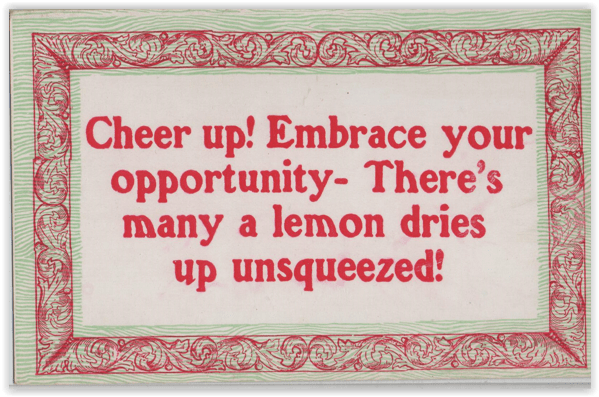
Some of the advice I find on elderly postcards strikes me as dubious, though it may work perfectly well for the right person at the right time. I have been working on the aphorism at the top of this column for quite some time, and I have come out where I went in. I THINK I know what this postcard is getting at, but I can’t quite figure out the analogy. I’m thinking of lemons when I should be thinking of the life lesson I’m being offered.
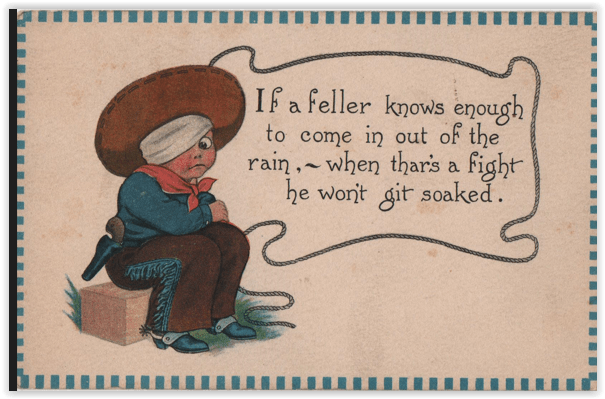
This advice seems a little disjointed, too, but that’s just because it is based on a play on words about “getting soaked”, which ALMOST works.
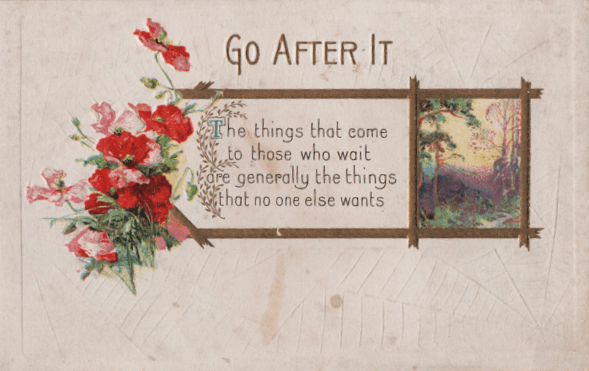
Now, this is fairly obvious, and I value it as a demonstration of the fact that there is no proverb—“All things come to he who waits”—without an equal and opposite proverb.
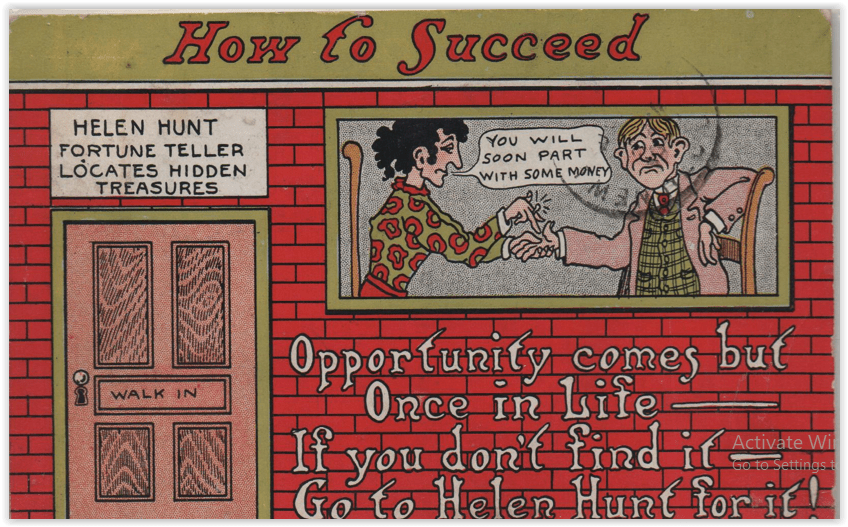
It also demonstrates that our ancestors were no strangers to the idea of the go-getter winning out over all opposition. I am, personally, as ambivalent about this as Helen’s client here. (You DID get the joke about “Go to Helen Hunt for it”, right? Just checking.)
There’s a reason that “Do It Now” is the subject of so many postcards and cartoons through the year. Here’s another admonition to seize the moment…or something.
The attitude will get you into trouble nowadays, of course. To a sales professional, you see, no never means no. (I have seen sales texts criticized ust for saying that you must never ask a potential customer any question that can be answered with Yes or No, because you can’t give anyone the opportunity to say no.)
There was also a great belief in the power of positive thinking. (I am reminded of Thorne Smith’s tale of a businessman whose motto was “Keep smiling and SMILE the Depression away.” The reason his business did not go under during the Depression, Smith notes, is because he had partners who didn’t smile and worked overtime.)
So for a lot of our postcard philosophers, it was all about energy, positivity, and efficiency. This advice beats all the others for sheer efficiency. Squeeze two lemons with one at one go, I say.
No, this is not a joke about bows and yarrows. This plant is also known as Achillea, or Achillea millefolia, or, from that, Common Milfoil. The millefolia is a reference to a plant with many leaves. The other part of the name refers to the hero Achilles, who apparently always carried an ointment made of it. Scottish Highlanders are said to have done the same, and for the same reason: the plant has so many medicinal uses that it is sometimes given the folk-name Nosebleed. Yarrow has been chewed for toothache, and smeared on the skin to handle other aches and pains. Besides its use as a military man’s medicine chest, it has been used to flavor beer, tea, and vinegar. Folkard notes that it is also a favorite for planting in cemeteries. Which wraps it all up rather neatly.
YEW “Sorrow”
Oh, how I wanted this to mean “My Thoughts Are of Yew”. I don’t suppose any of you would have believed it, anyhow.
Yew is a dark, somber tree, another great favorite for graveyard decoration. Grigson claims that to sleep in its shadow was believed by many to be the express lane to the tomb.
*YUCCA “Yours Until Death”
Z
Zephyr Flower: see ANEMONE
ZINNIA “Thoughts of Absent Friends”
You could say this is a way of letting someone know “Hope I’ll Be Zinnia Soon.” You COULD say that.
*ZIPTION SPINOSUM “Be Prudent”
*ZUCCHINI “Surfeit”
And that is more than enough.
HOW TO WRITE A BOUQUET
There are, as floriographers from at least Lucy Hooper onward have pointed out, certain drawbacks to flower language. One’s chats with one’s sweetheart are not limited to spring and summer, and at other times of the year, the plants needed to communicate may be available only at great expense.
An easy way around this is to use the secret code method. In a written bouquet, the flowers need to exist only on paper. Let’s say an average citizen—call him Dilford—has had a fight with his one and only, Daisy Jo Pennies, and wants to make up. But it’s February 15, so he assembles his bouquet on paper, and sends her this message. These books frequently had an index by meaning, so, leafing (sorry) through such a book, Dilford selects words to express himself which can be encoded into a message of contrition, and pleads for mercy.
Oh, my raven-haired ROSE:
The BROKEN STRAW between us will always be one of my ADONIS. But I know you have too much GERANIUM to let you remain angry with me. ZINNIA makes me realize our FIG was a temporary result of foolish ROCKET. Our ROSE is too strong to fall victim to MUSHROOM. Our HAZEL may make people laugh at my COLUMBINE, but I don’t care. I must see you again, PETUNIA.
Sending you SWEET BASIL,
Dilford Dolfus.
See how romantic that is? It takes some thought, since there are not all that many verbs available in flower language. The recipient can decode the message by reversing the process: looking up the meaning for each flower used, to translate the letter as:
Oh, my raven-haired love:
The break-up between us will always be one of my sorrowful memories. But I know you have too much gentility to let you remain angry with me. Thoughts of my absent friend make me realize our argument was a temporary result of foolish rivalry. Our love is too strong to fall victim to suspicion. Our reconciliation may make people laugh at my folly, but I don’t care. I must see you again, your presence soothes me.
Sending you good wishes,
Dilford Dolfus.
Oh, there is just one other thing. The recipient of the bouquet should have a really good flower language book (this one, for example, just to choose something handy), or, at the very least, THE SAME ONE YOU ARE USING. If Daisy Jo Pennies went to the library and checked out the first floriography she finds, perhaps one of the most popular in American libraries today, Dilford’s message would come out like this:
Oh, my raven-haired love:
The break-up between us will always be one of my recollections of life’s pleasures. But I know you have too much folly to let you remain angry with me. Thoughts of absent friends makes me realize our wisdom was a temporary result of foolish lust and vanity. Our love is too strong to fall victim to wisdom and integrity. Our reconciliation may make people laugh at my cuckoldry, but I don’t care. I must see you again; I am furious.
Sending you poverty and hate,
Dilford Dolfus.
Don’t let this happen to you. Buy a copy of THIS flower language book for everyone on your mailing list.
Not too long ago, we discussed the principle that the Scots are one of the few ethnic groups left which allowed, and sometimes encouraged, ethnic jokes about themselves. The Scottish joke may ot have the currency that once it did, but it is still out there, doing its work with a minimum of fuss.
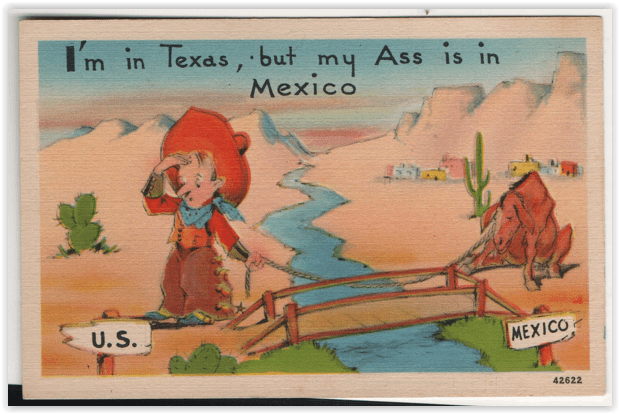
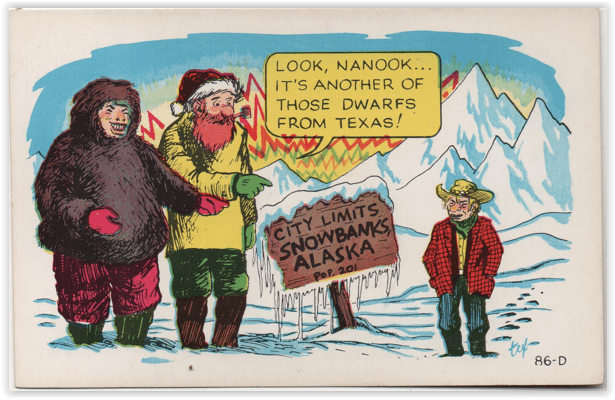
It was brought home to me, as I was leafing through some of the thousands of postcards I have for sale at popular prices (okay, not so popular if I still have the postcards) that I had ignored another ethnic figure which also alternates between pride and exasperation at jokes. This would be the Texan. This transcends mere local rivalries like the jokes Iowans tell about Nebraskans (1. What do you call it when you see twelve tractors parked outside a Nebraska McDonald’s?) or that violinists tell about viola players (2. What’s the difference between a dead violinist by the highway and a dead viola player by the highway?) Books of jokes about Texans were once bestsellers the length and breadth of this nation, because everyone knew ALL about Texans. Texans were cowboys turned oil millionaires who bragged about Texas.
The phenomenon of the Texas joke was always present in American humor, but became a national mania in 1959. The admission of Alaska as the 49th state meant that after more than a century, Alaska was no longer the largest state in the union. This spawned entirely new jokes like the one (3.)about the Texan who denied Alaska should be counted as a large state. “Alaska wouldn’t be bigger than a Texas T-bone steak if you ( )_.”
4. This provoked a response from the Alaskans, who told about the Texan who was so huge that when he died, they couldn’t find a casket to bury him in until the undertaker took a ( ).
5. Even before that, though, people remarked many times about the Texans who bragged about the glories of their state. They told of the Texan who declined to be impressed by a farmer in Iowa who was proud of owning a 26,000 acre farm. “Why, that’s the size of a Texas backyard garden!” said the Texan. “Why, if I got in my Mercedes at the front gate of my farm at dawn, I couldn’t get to the far end of my spread by sundown!”
“I know what you mean,” said the Iowa farmer. “I ( ).”
6. And in my day, we learned in school about the Texas tourist visiting Massachusetts who kept telling the tour guides about the glories of his home state. “We’ve got real heroes down there,” he told anyone within earshot. “There was Sam Houston, who would’ve whipped Santa Ana’s army single-handed if he hadn’t decided to share the glory with some of his army, and Jim Bowie, who cut so many enemies with that knife of his they naturally had to name it for him, and….”
“There were plenty of heroes in Massachusetts, too,” the tour guide broke in. “There was Paul Revere and….”
“Paul Revere?” roared the Texan. “You mean that guy who ( )”
Thank you for a chance to revisit a few jovial ethnic slurs and a chance to revisit as well the joke quizzes of old. Following are, if you needed them, some ANSWERS.
A1. Prom night
A2. The violinist was hit on his way to a job
A3. Left it in the sun and let it melt
A4. Stuck a pin in him and let the hot air out (Points to those of you who know the enema version, and shame on you)
I own books I will never read. Part of this is just depressing statistical certainty. I have plans to get around to some, but as I am always being told I am not allowed to live forever, the moment will never. There are others which I keep around as reference volumes: you don’t read those: you read bits of them.
But there are books I give storage space to though I have no intention of ever opening the covers. These have certain associations with the world that was, and I value them for the memories the sight recalls. This is against the modern rules, of course. More than one tidy-minded individual has told me that if I have to look at a physical object to call up a memory, then the memory is not important. I do not remember the names of these people. I do not keep their books around.
Today’s example is a hardbound volume of magazines from the late nineteenth century. I have nothing at all against Scribner’s Magazine: like any other bound periodicals, it contains any number of rabbit holes down which I might cheerfully wander: travel articles, essays on history (some of which was current events in 1891), and short stories which millions of people read at the time (and never since.) But the pages are discolored and slightly odorous, so the temptation to peruse them is slight.
The person who gave me this book was a warm, spontaneous, impulsive soul who loved black and white movies, British fiction, and Dixieland. She had an intuitive understanding of what was good and true and beautiful, but sabotaged her career and life by ignoring this. Every time she knew she was being really clever, she was taking aim to shoot herself in the foot. Over the years, she brought me books she knew would make her fortune: things she found around the house or bought at unbelievable bargains from people who didn’t know what they had. On this occasion, she handed me a plastic bag containing a volume of Scribner’s she had found at home. I sighed to myself, thinking how I could break it to her that this was not a million-dollar book, and reached into the bag.
“Don’t do that,” she said. “You don’t want to breathe in the mold!”
“Um,” I countered. “And you think this is worth money because…..”
“Look at the bookplate!” she told me.
I thought about explaining I couldn’t do that without opening the bag, but it was a busy Saturday and I didn’t want to spend a lot of extra time on this. I opened the musty volume to find it had once belonged to none other than someone I’d never heard of. But she was eager to explain. The book had belonged to the father of one of her own father’s old tennis partners.
See, her childhood weas spent in one of those worlds where you can’t walk six blocks without running into a celebrity. Her mother played bridge with the mother of a legendary screenwriter, and she herself went to summer camp with a dreamy boy who paid her no notice and grew up to be an internationally-known newspaper columnist. And her father played tennis with one of the most notorious murderers of the twentieth century.
“Someone will pay a bundle for that,” she confided. “They just did another documentary on him.”
She never had a plan which would make her less than a million dollars, and I could not promise her that. But she had at least given me some reason a person MIGHT actually pay money for a moldy volume that was otherwise not in the least bit rare or collectible. I took the plastic bag and its contents home with me.
Once upon a time, I would cheerfully have offered this for sale, just telling her story, but I thought I would just hunt up the gentleman on the bookplate. That’s where things went wrong. My impression of Richard Loeb (murderer of Bobby Franks and the brains of Leopold and Loeb) was that he was the sort of chap who would not go out of his way to accommodate an inferior. And, indeed, he disobligingly refused to have any relatives with the name on the bookplate, much less a father of that name.
I can’t for the life of me remember actually telling my go-getter buddy any of this. At the time, she was busy with plans for a syndicated radio show about jazz which would net her five or six million a year, sending out compact discs of sample shows, which she had safeguarded with written and technological warnings not to release or steal the material on the discs. She knew how the world worked, and was cunning enough to head off miscreants by this means.
This book does not bring back things like dates or times. So I do not know if she handed it to me before or after she discovered that one of the technical tricks she used resulted in dozens of station managers and radio executives sample CDs which were perfectly blank.
(P.S. She made as much on her radio show as on her volume of Scribner’s.)
The floriographers are obviously thinking of grape vines, and, hence, wine. They could have thought of grape jelly, but for some reason, did not think of thinking of it.
*VINE, WILD “Poetry and Imagination”
VIOLET “Modesty”*
The violet is considered a hidden, humble flower. It was also the symbol of Napoleon. If you see the connection, let me know.
One book which attests to this meaning is by the least likely floriographers I ran into. In the 1840s and 1850s, Jane Webb Loudon brought out a five volume set of beautiful (and now ferociously expensive) books, The Ladies’ Flower Garden of Ornamental Flowers, followed by a similar volume called British Wild Flowers. These are largely horticultural, but she did manage to wedge in a modest amount of flower language.
But, see, Jane Webb came into the appropriately feminine world of gardening and flowers by way of science fiction. In her teens, she wrote The Mummy! A Tale of the Twenty-Second Century. The social theories she expounded in and among the sensations made a fan of John Loudon, a crusading horticulturist leading England away from the wildly picturesque gardens which had been in fashion toward a more orderly (and less expensive) style of garden. He sought an introduction to the author of The Mummy, and they hit it off, though when they were married, he was nearly double her age. Jane turned to nature writing and, as far as is known, never strayed into science fiction again.
VIOLET, AFRICAN “Such Worth is Rare”
And so was the African Violet, so far as floriographers were concerned. The rarity of African violets in flower language books results, I am told, from the fact that the African violet was very difficult to grow at home until the advent of the electric light, by which time flower language was on the wane. The multitude of African Violets we see today results from an African Violet craze in the 1920s.
VIOLET, BLUE “Faithfulness”
Violet, Dame’s: see QUEEN’S ROCKET
VIOLET, PARMA “Let Me Love You”
VIOLET, PURPLE “You Occupy My Thoughts”
A close relative of the Pansy, which explains the meaning.
VIOLET, SWEET “Modesty”
But Geoffrey Grigson says this was one of the chief plants of Priapus, because the scent reminded people of sex. For further details, see (and hear) any of the under-the-counter recordings of the song “Sweet Violets”. Even the Dinah Shore version will give you some hints.
VIOLET, WHITE “Candor”*
Because, they tell me, candor comes before innocence, as white violets came before blue ones. Sometimes I think this makes sense, and sometimes I just sit and wonder.
VIOLET, WILD “Love In Idleness”
This is another Pansy relative.
VIOLET, YELLOW “Rural Happiness”
VIRGIN’S BOWER “Filial Love”
See also TRAVELER’S JOY
VISCARIA OCULATA “Will You Dance With Me?”
This is a kind of Catchfly, which may have a lot to do with the meaning.
VOLKAMERICA JAPONICA “May You Be Happy”
This is also spelled Volkamenia japonica in the books. And Volkamenica japonica. And just about anything else which seems halfway reasonable.
W
*WALKING-LEAF “How Came You Here?”
I walked, apparently.
WALLFLOWER “Fidelity in Adversity”*
Yes, there actually is a plant called the Wallflower, so named because it clings to walls. It is especially found growing on the walls of broken-down houses, and is thus a symbol of sticking with something even at the depths of bad luck. The fact is that if someone WERE still living within the walls, they’d probably pull the wallflowers down.
Sheila Pickles has a story about specific walls belonging to a castle with a tower from which a maiden cast herself to her death. There are other romantic stories like this, if you care to look.
Some floriographers refer to this plant as Bloody Warrior, because they see these red flowers as defenders of the walls, and thus make the meaning “Defense”.
WALNUT “Intellect”
The nut happens to look like a brain, that’s all. Some floriographers use the meaning “Stratagem” for much the same reason (Strategy comes from the brain, y’see.) George O’Neill, always on hand to straighten things out, said the American Walnut would mean “Stratagem” and the English Walnut “Intellect”, but the rest of the floriographers failed to pick up on this suggestion.
WALNUT LEAF “Unburden Me”
*WALNUT TREE “Persecuted Innocence”
WATCHER-BY-THE-WAYSIDE “Never Despair”
*WATER-CALTROP “Hidden treason”
*WATER-CALTROP FRUIT “Danger of Costing You Anything”
This is also known as the Water Chestnut. Which is not to be confused with the plant known as Chinese Water Chestnut. HOWEVER, I am further informed, neither of these is even related to the Water Chestnut you get at your local Asian restaurant. I coulda been a full-time dog walker, y’know. I don’t HAVE to do this.
Water Lily: see LILY, WATER
WATERMELON “Bulkiness”
Whatever else COULD it mean?
WATER STAR “Beauty Combined With Piety”
Frances S. Osgood includes this in both of her books, but no other floriographer does.
*WAX BERRY “Confiding Trust”
WAX PLANT “Susceptibility”
This is a type of Hoya, probably as susceptible as the rest of the family to being woven into shapes.
*WEED “I Would Bloom If I Could”
The reason only one floriographer bothered with this is that, frankly, half the plants in this book have been considered weeds at some point or another. And, anyhow, weeds do SO bloom.
WEIGELA “Accept a faithful Heart”
WHEAT “Riches”*
Even Morato’s book agrees with this, and adds that the implication is that these are riches honestly obtained.
Whin: see GORSE
Whortleberry: see BILBERRY
*WILDFLOWER “Fidelity in Misfortune”
This MUST have been a misprint or misreading of WALLFLOWER.
WILLOW “Forsaken”
Folkard says the Willow has been a symbol of grief since Psalm 137 was written. There was also a saying that someone was “wearing the willow” for someone else. This meant there had been a break-up but the person was still in love, and grieving at being forsaken.
*WILLOW, BRANCH “I Want Nothing Of You At All”
We would say “I want nothing FROM you”.
WILLOW, CREEPING “Love Forsaken”
Is this a typo for Weeping Willow, or a reference to a plant known as the Creeping Primrose-Willow?
WILLOW, RENCH “Bravery and Humility”
WILLOW HERB “Pretension”*
I am told that this is sometimes known as Rosebay. There have been weeks when every plant I looked up was “also known as Rosebay”. Spiked Willow Herb, also known as Rosebay, is also given the meaning “Pretension”.
WILLOW HERB, ROSEBAY “Celibacy”
I just don’t want to talk about it.
Willow Herb, Spiked: see WILLOW HERB
Willow, Pussy: see PUSSYWILLOW
WILLOW, WATER “Freedom”
WILLOW, WEEPING “Mourning”
*WILLOW, WHITE “False love”
WISTERIA “I Cling to Thee”
WITCH HAZEL “A Spell”
Some people say the way this plant bloomed in cold weather was spooky, supernatural. Others tell me the name comes from Wych Hazel, which simply means Bendable Hazel. You can see which witch the floriographers favored.
Wolfsbane: see ACONITE
WOODBINE “Fraternal Love”
*WOODPECKER’S TONGUE “You Shall Have What You Desire”
I was worried about this for a long time, but I’ve decided to let it pass.
WORMWOOD “Absence”*
Is this a bit of wordplay, since this is the plant that provides us with absinth? (Indeed, it is sometimes called Absinth.) Or is it simply a matter of the plant being so bitter it is a handy reference for the bitterness of a lover’s absence?
WOODRUFF “Modest Worth”
Joseph E. Meyer calls this “Sweet Woodruff…a favorite little plant…with a pleasant smell, which, like the good deeds of the worthiest persons, delights by its fragrance most after it has been dried.” I would not add one word to that.
X
Xanthium: see CLOTBUR
XERANTHEMUM “Cheerful Under Adversity”
No, as a matter of fact, this is not at all related to the Chrysanthemum, but thanks for asking. It’s more closely related to Everlasting, but that just doesn’t feel right, somehow.
In our last thrilling installment, we were discussing how boys, on postcards but also outside in the world, would pretend to be grown-ups by donning a grown-up hat, most usually a silk topper. Well, girls were liable to the same strategy.
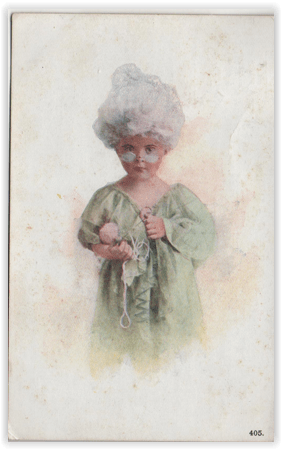
Little girls tended to wear bonnets, like the girl at the top of this…well, maybe not exactly like hers. She’s overdoing it a bit. But you get the general idea. Something close to the head without elaborate brims of decorations, was the norm for lasses with single-digit ages. A big, fancy hat was meant to draw attention, to show off a grown woman’s style and fashion (and availability and, to some degree, general uselessness. Fashion designers understood early the assertion of Oscar Wilde that anything useful could not be a work of art. A really big hat made movement slower and more calculated, particularly on windy days.)
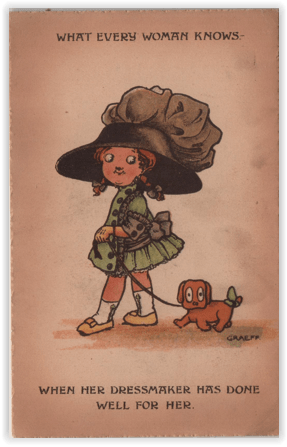
So a little girl in a big hat was cute and funny, as was this young lady who is confident in the work of her dressmaker, though her hatmaker is really more responsible for the effect.
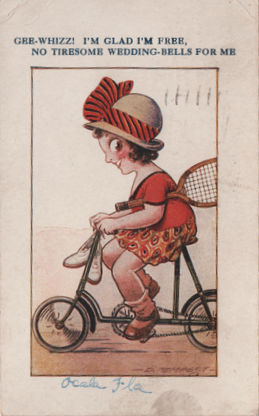
This young lady, now, understands that it’s really all about the accessories. These things worked when her older sister went to a dance, so why shouldn’t that bow and parasol and, especially, that hat, do the same for her?
You simply couldn’t help but impress the opposite sex if you had the right hat.
Though the fashionably set-up young lady, like that supposed older sister, could not be too careful. One had to take at least as good care of one’s reputation as one did of one’s look.
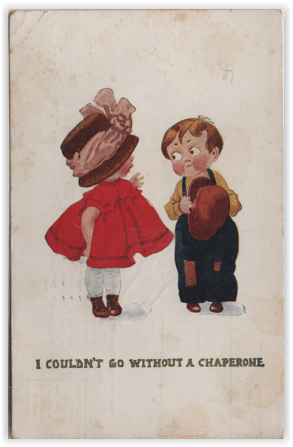
The men would certainly flock around one once that hat was donned. A smart girl kept an eye out for sharpers like this lad, who has also put on a hat worn by his elders. He isn’t pulling the hat over HER eyes.
Of course, as this lady with a 1920s style hat suggests, impressing the opposite sex isn’t the whole point of looking good. A hat can be a serious reflection of one’s self-image and a gauge of one’s self-worth.
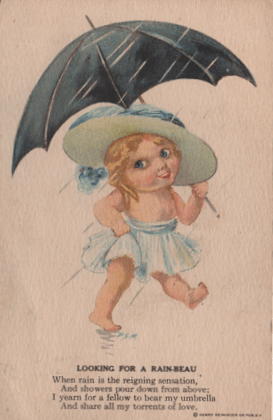
Only once she has those important commodities assured can a lady confidently use her smile…and her big grown-up hat…in the battle between the sexes. This hat-wearer advertises that she’s looking, but her attitude and big umbrella show she’s perfectly comfortable going for a walk with little more than those. Male companionship might be entertaining, but isn’t essential to a lady with the Right Hat.
Our cartoonists, in fact, sometimes worried that the young man would be swept away by a woman with a big hat, someone who would ensnare the poor innocent lad, who would find himself left at home to mind the children while his mate headed back into the world, hat on head, to enjoy a busy life in the world. The lesson was clear: Be the wearer big or small, a grown-up hat could do it all.
If you recall from last week, we were beginning to discuss postcards which show children dressing up like their elders. (Yes, we actually spent that column talking about all the postcards we were NOT going to talk about. But work with me here.) A quick examination of the cards shows that one of the unmistakable signs of a child playing grown-up is a big person’s hat.
Once upon a time, see, clothes made the grown-up. Boys wore short pants until they went through puberty, and girls wore short skirts. Only the adults in the population were allowed to cover their knees. (There must have been some allowances made in parts of the world where snow predominated. But these aren’t things that wind up in family albums, or, for the most part, on postcards.) And as for hats, boys wore caps and girls wore bonnets. Brims and floral arrangements (often with stuffed birds attached) were reserved for those who had made it to marriageable age and were advertising their availability.
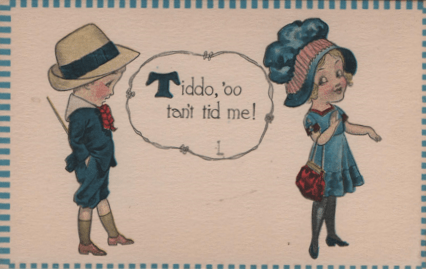
The heroine of the picture at the top of this column, for example, wears only a bow in her hair, quite acceptable for schoolkids. The male specimen she is obviously falling for wears the perfectly acceptable childhood knickerbockers, an odd military blouse, and a slightly battered grown-up hat, which I think is what’s really sending her into swoons. Look at the rest of his clothes, child! Run the other way!
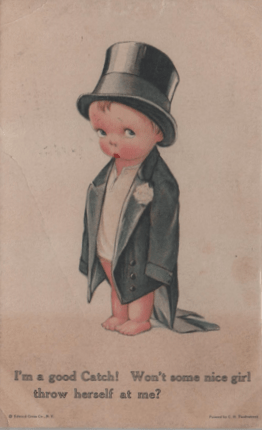
The symbol, though, of a small boy wanting to look grown up is the top hat. The morning coat and boutonniere help, of course, in this vision, but it’s that top hat which really makes us know he is being very adult.
The top hat started to come into fashion in the late eighteenth century, when legend claims its inventor was arrested for wearing headgear intended to frighten timid passersby. It was made of felt, which was made with mercury, and led to the deaths of many beavers whose fur was used in the felt and hatters, who went mad from the mercury poisoning, But after a while, silk was substituted, and it is the silk top hat worn by males in the western world which became an icon. We don’t need to go into the history of its various relatives—the stove-pipe hat, which was a really tall top hat, or the spring-loaded top hat, so beloved of animated cartoons in the 1930s—but it was THE headgear for serious men of business for nearly two generations.
At some point, which the Interwebs are hazy about, it started to take on ironic subtexts. Gradually, it became the headgear only of the wealthy aristocrat and the wild, partying rich playboy. This happened at around the same time that the postcard was becoming the quick communication system of the western world, and here, we really see our kids putting them on.
This chap, headed out on the town, has his topper, his walking stick, and a romper version of evening wear. If we had any doubt what he was planning to do tonight, he makes it clear.
A boys’ night out requires several of these party-mad dandies, and Mabel Lucie Attwell has provided us with a fivesome, giving them full formal attire, with walking sticks and monocles to emphasize the joke.
Yes, a few businessmen still emphasized the serious nature of their jobs by wearing top hats to work, like this young man, the subject of a series of postcards by Kathleen Mathew showing important intervals in a businessman’s day. He is putting on his hat, ready to leave work at precisely five p.m., but I have seen the rest of the series, and know he stops off for a quick one (or two) at the club on his way, so the party boy with the top hat is still present in this picture.
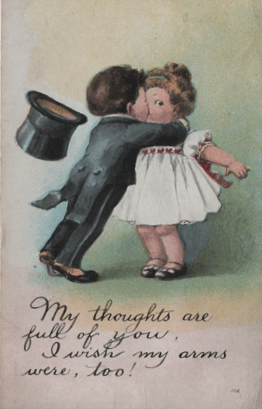
And this chap is simply filled with emotion at the thought of his love. (But to judge by the ferocity of his hug, and her look of surprise, I suspect he’s had a few, too.)
So if you saw a Baby New Year in a top hat welcoming in 2023, you saw that the joke lives on. The small boy pretending to be a grown-up, and entitled to full festivities, is a child in a top hat, and our postcard artists knew that was the only way to….
Okay, there’s always got to be an exception to prove the rule. Nice hat, bro.
Ancient Egyptians believed that the corpse of the murdered god Osiris was tucked into a Tamarisk, to conceal the crime. Further, the Romans put wreaths of tamarisk on their criminals. (Do you think they had a wreath for everybody? A wreath of, oh, cauliflower for great dog breeders?)
TANSY “I Declare Against You”
The Italians, descendants of the Romans mentioned in the previous entry, still, we are told, swap certain flowers to convey certain messages. This is one they hand around when they want to insult somebody. A popular minority meaning for this is “Resistance”, either because in declaring war on a person you intend to resist all efforts to make up your differences, or because it was one of the plants used to resist contagion during epidemics in the Middle Ages.
*TARRAGON “Promptitude, Earliness”
TEASEL “Misanthropy”*
Fuller’s Teasel, or Teasle, or Teazle, or even Fuller’s Thistle, has stickers on it, which gives it its meaning, but it is not a thistle.
TENDRILS OF CLIMBING PLANTS “Ties”
THISTLE “Austerity”*
“Misanthropy” is a close second; both meanings come from it being a prickly plant which grows in wasteland. Robert Tyas hurries to state that this is not a slam at the Scots, whose symbol it is, as you can read below.
THISTLE, SCOTCH “Retaliation”
The Scots motto that goes with this is “Who Dares Meddle With Me?” meaning, of course, that if anyone makes trouble, I will RETALIATE. This and the use of the thistle as a Scottish symbol go back to the days of the Danish invasions, when, and I promise I am not making this up, Scotland was saved from a sneak attack when one of the barefoot Danes stepped on a thistle and yelped, alerting the Scots, who came out and whomped their whole army.
This may seem a lowly thing to credit with saving your country but, after all, the entire Roman Empire was once saved by a flock of geese.
THORNAPPLE “Deceitful Charms”* Some floriographers draw a line between this and a similar plant, Stramonium, giving that the meaning “Disguise”, but it all comes out of the fact that this sort of plant is poisonous.
In fact, Thornapple is one of the Great American Poisonous plants, first encountered by settlers in Jamestown in 1603, hence its nickname Jamestown Weed, shortened to jimsonweed. Scientifically known as Datura stramonium, it is an ugly and foul-smelling plant (as Will Cuppy notes, about the last thing anybody would eat), often found among garbage, for which reason the Natives called it White Man’s Plant. Some people must have thought the flowers pretty, though, hence all the indignation about the poison hidden inside.
The Lady’s Album, however, takes another tack. The June, 1845 issue notes that Thornapple is an evening bloomer, exactly like a languorous society woman, who blooms only at night when the light is not good enough to show her for what she is. The flower also gives off a perfume which can cause lightheadedness or other inebriety, perhaps also like the society woman, though The Lady’s Album doesn’t go that far. The magazine seems to have picked this up from Robert Tyas, who may have found it in Mme. De Latour.
THORN, EVERGREEN “Solace in Adversity”
*THORN, FIERY “Resistance”
THORNS, BRANCH OF “Severity, Rigor”
THRIFT “Sympathy”
Not one floriographer chose “Thrift” as a meaning. Just when you think you’ve got them figured out, they pull something like this.
THROATWORT “Neglected Beauty”
Henry Phillips chose this meaning for the Throatwort, which he felt had been neglected by painters, poets, and sculptors.
I have myself neglected a few Greek and Roman flower myths, by the way, but only because most of the floriographers seem to have done so as well. In case you thought the floriographers noticed every single orgy in the books, they ignored the legend of the Daisy, once an innocent nymph named Bellis until she was changed into a flower to escape Vertumnus, perhaps the same satyr who married Pomona. The Orchid was once a lad named Orchis, who got drunk and disorderly and was ripped to pieces by followers of Bacchus, only to have certain parts of him brought back to life as a flower.
One wonders if the Greeks thought there were any plants at all on Earth before the satyrs and nymphs started chasing each other around the mulberry bush (if there was even a mulberry bush.)
THYME “Activity”*
The Greeks ate this to revive their appetite and give them more energy. Someday anthropologists will be studying us and oat bran, so I guess there’s nothing to say.
THYME, WILD “Thoughtless”
When having a wild time, one could get thoughtless.
TIGER FLOWER “For Once May pride Befriend Me”
Tiger Lily: see LILY, TIGER
TOOTHWORT “Secret Love”
This plant is known for blooming in out-of-the-way places, often under moss or leaves.
Touch-Me-Not: see BALSAM
TRAVELLER’S JOY “Gaiety”
They tell me that this clematis, sometimes known as Virgin’s Bower, is shaped like a sheltering bower, a sort of little booth into which a traveler could retreat to get in out of the sun, or rain. )Symbolic, of course, since you could not squeeze in here if you were more than about half an inch tall.)
TREFOIL “Revenge”
Bird’s Foot Trefoil has the same meaning.
TREMELLA NESTOC “Resistance”*
This is a kind of algae also known as Star Jelly. It was apparently scraped up and used as a medicine (to RESIST disease) because some people thought it fell from stars. Some still do.
TRILLIUM PICTUM “Modest Beauty”
TRIPTILION SPINOSUM “Be Prudent”
TRUFFLE “Surprise”*
These are those fungoid morsels you dig up from underground. It’s a Surprise to find one.
Robert Benchley tells the tale of how he pretended to be a gourmet expert when it came to truffles, confident in the assumption that he would never be called on to eat one. He reports that when he was served his first truffle by someone who expected him to be an expert, the experience was surprising.
TRUMPET FLOWER “Fame”
Whether you are blowing your own trumpet or someone is blowing it for you.
TRUMPET-FLOWER, ASH-LEAVED “Separation”
Caroline Waterman says the leaves fall ff very easily, thus suffering separation.
TUBEROSE “Dangerous Pleasures”
The tuberose has a thick, almost sickeningly sweet perfume. The Victorians seem to have liked their perfumes thick and heady, and believed this scent to be the most intoxicating of all. And since anything that intoxicated was dangerous, they made the flower a symbol of dangerous pleasures. Nowadays, of course, we believe any pleasure is dangerous. If you’re enjoying anything which doesn’t make you richer or healthier, you’re supposed to stop it right now and get with the program.
TULIP “Declaration of Love”*
Tulips generally, and red tulips especially, carry this meaning. A number of floriographers declare that the black base of the blossom symbolizes the cinder to which your heart has been burnt by the fiery passion of your love, symbolized by the red petals. Claire Powell says the original meaning in the orient was “Violent Love”, which obviously goes along with the same symbolism. But Laura Peroni claims the best known meaning around the world is “Inconstancy”. Laura Peroni is, for some reason, the only floriographer who knows about the best known meaning in the world.
*TULIP, UPSIDE-DOWN “Blatant Rejection”
Tulip, Red: see TULIP
TULIP, VARIEGATED “Beautiful Eyes”
TULIP, YELLOW “Hopeless Love”
TULIP TREE “Rural Happiness”
TURNIP “Charity”
Henry Phillips says the turnip was used in coats of arms to denote someone with a good disposition, and is thus a good symbol for charity. I, personally, believe it’s because turnips are some of the easiest things to give away.
Tussilage: see COLTSFOOT
U
*UMBRELLA PLANT “Have No Fear; Have Covered Everything”
Umbrella? Covered Everything? That George O’Neill can be such a card.
V
VALERIAN “Accommodating Disposition”
The floriographers liked Valerian because it had a nice scent and bloomed anywhere, year round. Very accommodating of it.
VALERIAN, GREEN or BLUE-FOLOWERED GREEK “Rupture”*
Claire Powell explains that a number of Greek kings argued about which one of them had discovered this nifty plant, and it led to a rupture in international relations (a war.)
VENUS’S CAR “Fly With Me”
Everyone who lists this plant agrees on this meaning. But they can’t agree on which flower they’re talking about. Some say it’s Betony, which is sometimes called Venus-In-Her-Car. Others say it’s a kind of Aconite known as Venus’s Chariot, or, if one has the time, Venus’s-Chariot-Drawn-By-Two-Doves. And a lot of people have tried to convince me it was all merely a misprint for Venus’s Ear. You can’t fly with someone in an ear. You can have a fly IN your ear.
VENUS’S FLYTRAP “Deceit”
All the flycatching plants are given sinister meanings, as if a plant was just supposed to accept the flies and not fight back. No one has told me what Venus has to do with flytraps, though a certain number of people have informed me that this is a kind of plant which grows on the planet Venus. A bunch of these people also believe Elvis is on the planet Venus, watering the flowers.
VENUS’S LOOKING GLASS “Flattery”
Venus owned a mirror which flattered anybody who looked into it. Venus was ascendantly beautiful, and needed no such flattering looking-glass, but sometimes she thought she did. (I have days like that.) Cupid, her son, once caught a peasant looking into the mirror. What happened next depends on which story you read. Some say the peasant decided he was so good-looking he didn’t need to work any more. Cupid then smashed the mirror to keep mankind from giving in to vanity and sloth. Other versions claim Cupid was just disgusted at seeing a rustic, homely face gazing into his mother’s mirror, and smashed the mirror so no other yokels could look into it. Either way, these flowers grew from the smashed pieces of the looking-glass. None of them say much about what Mom did when she found out about the broken mirror (but maybe that’s where the whole Seven Years’ Bad Luck idea comes from. And what became of the peasant? Shouldn’t he have been turned into a…why don’t we just move on?
Veronica: see SPEEDWELL
VERVAIN “Enchantment”*
This is also known as Verbena; it can get listed under both names in the same book sometimes. When it is called Wormwood, it always gets a separate entry, so see also that.
Vervain was traditionally used in numbers of potions and spells, and also sometimes called Holy Herb. Sax Rohmer, the author who gave us Fu Manchu, also wrote about a detective, Moris Klaw, who carried a perfume atomizer and spritzed the crime scene with Verbena before working on the case, so he would pick up the right psychic vibrations. I do not believe this caught on with law enforcement generally.
VERVAIN, PINK “Family Union”
VERVAIN, SCARLET “Church Union”
There is an implication for both of these meanings of people uniting against a common foe.
WHAT is so cute as a small child dressing up in grown-up clothes? Once cameras were accessible to the everyday consumer, few collections of family pictures did not include at least one photo of Boopsy putting on Dad’s hat or Mom’s shoes. Swiping one’s parents attire was a great way to play grown-up, or, if the child was of a more prosaic disposition, just getting an immediate laugh from the big people in the house. It was sometimes good training for one’s teen years, if your parents were your size and wore something cool enough to borrow on a night out.
Postcard cartoonists were certainly aware that cute was a constant seller, hence all the puppies and kitties we have discussed hereintofore. So I thought I would show off a few postcards dealing with young people dressed in attire obviously designed for older wearers.
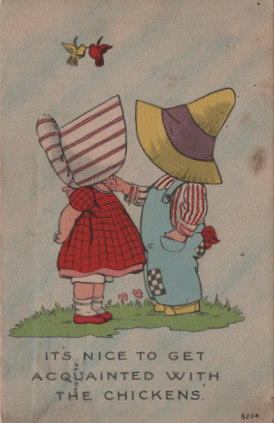
First, however, I need to set up a few rules. There is an endless array of postcards like the one at the top of the column. We have discussed before how our ancestors regarded nudity as thoroughly cute, at least in small children. So adding a few adult accessories made it all that much cuter. So I wasn’t going to cover THAT entire genre.
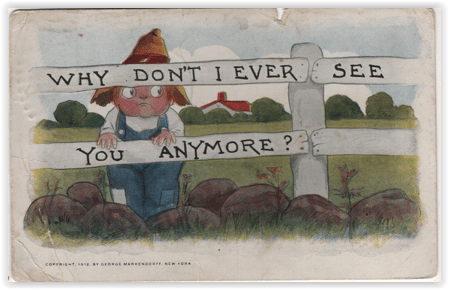
Overalls were considered a farmer’s workday clothes throughout much of the land, so kids in overalls turn up frequently, as they pretend to be grownups
The problem with this is that overalls being such a functional garment, lots of children wear those anyhow. The gag here is not so much what they’re wearing as what they’re doing.
So children in overalls don’t really count toward this topic.
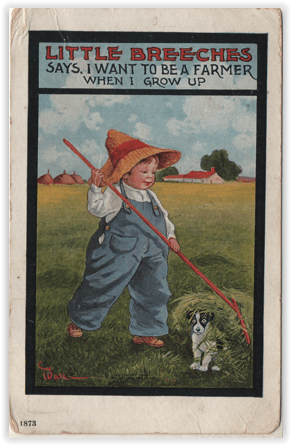
Even though this rules out a long and heartwarming series of postcards about Little Breeches, who appears in overalls in postcards showing what he would like to be when he grows up. The puppy and hat and overalls stay pretty much the same, whether he is imagining being a circus performer, a fireman, or what have you. It all ends with a postcard of him in his jammies, kneeling at his bedside, praying to be a good man when he grows up. We will not discuss him (and the poem that inspired them, possibly THE most famous poem ever written by a U.S. Secretary of State) in this column.
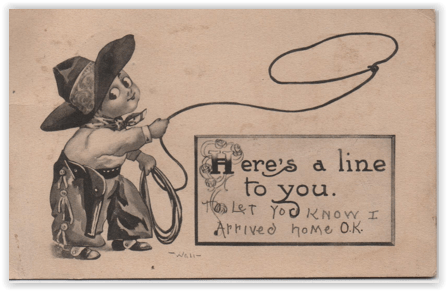
The same thing goes for all the postcards which show small boys dressed as cowboys. The cowboy was a hero of popular culture before the postcard was even invented, so naturally, kids were dressing up as cowboys long ago. Once again, as with the overalls, the clothes just set the scene.
Children in cowboy hats were not, by that fact alone, supposed to be awfully cute or funny. Sometimes, as here, the attention to detail made things more chortleworthy, but, again, we’re not affected by the thought “Hey, this kid’s way younger than his clothes!’
Now, having covered that, we can go on to…oh. Out of room for today. Well, maybe next week.
I was discussing some icons of American kitchens the other day, and going over the fact that there WAS a Duncan Hines and a Chef Boyardee, while Betty Crocker was a marketing construct. As this is not a food blog, as mentioned hereintofore, I don’t think there’s any need to cover that. Besides, I am not going to get into a fight with doubters over whether there really is a Pillsbury Doughboy and whether he is taller than Lucky, the leprechaun who works the cereal trade.
But as someone who has strolled along the streets of Chicago, popping in when possible at Powell’s or Kroch’s and Brentano’s, I thought I might explore the lesser-known question of bookstore names while a few still exist. Most bookstores were named for people, with the exception, say, of Crown, named for headgear, Waldenbooks, named for a pond, or Amazon, named for a river or a warrior or something. (Anyway, who remembers nowadays that Amazon started as a bookselling business?)
Border’s was started by college kids Tom and Louis Borders in 1971. It was a small, local chain in Michigan until it was bought out by Kmart, which had recently bought Waldenbooks as well. Kmart, with much effort, was able to prove that running a bookstore and running a department store are different occupations. After much national expansion, followed by international expansion, the chain shrank and dwindled until it was absorbed into Barnes & Noble.
Barnes & Noble is an old-fashioned American business story, though there is a kind of regional divide in accounts of its history, some stories beginning with Arthur L. Hinds & Co. in New York in 1886 and some with Charles M. Barnes in Wheaton, Illinois in 1873. Wikipedia says there was a Hinds & Noble period, but the official Barnes & Noble history leaves out Mr. Hinds and instead sees Barnes’s son moving to New York to team up with Gilbert Clifford Noble. At that point, things become clearer, and it is obvious that these two chaps went a long way toward pioneering the modern bookstore. All accounts agree they were the first store to pipe in Muzak, and a modern pioneer in encouraging people to loiter and read a while before buying.
Rizzoli’s was started by Angelo Rizzoli in 1964, and operated in New York for a good decade or more until it thought about branching out. The Chicago store, where I encountered it and its Rizzoli Gallery (and its unbelievably eccentric background music) opened in 1976. The chain did not grow large, and was pulled back into the main New York location in this latest century. They became more widely famous for their publishing business, which also continues today.
I see we are running out of space, so some important Chicago bookstores will have to wait for a later installment. Besides, although I THINK I now know the difference between Kroch’s and Brentano’s and the New York based Brentano’s, but I have yet to decipher the relationship between Oregon’s Powell’s and Chicago’s Powell’s. Anyway, we now know there were….
What’s that, Kafka Knish? Oh, yes, B. Dalton! Well, see, once upon a time there was a Dayton family which ran a department store chain called Dayton’s (later Dayton-Hudson and, by the way, the founders of a side business they called Target) and one of the five brothers in charge of the family firm thought a separate chain of bookstores would succeed. His name was Bruce, but instead of calling the chain B. Dayton, he liked the sound of B. Dalton. The chain became the largest purveyor of hardcover books in the United States, but the decline of the shopping mall led to it being sold to Barnes & Noble. (But maybe you’ve heard of another little side business now known as GameStop.) So yeah, there WAS a B. Dalton, but his name was…you get it.

















 Blogsy Babbles