I try, Heaven knows, to run a lighthearted blog, which tries to avoid current issues and the dark side of life. (Okay, we just had a blog where the hero considers a corpse. Yes, we did discuss profanity a few columns ago. If you’re not going to work with me on this, you’ll get nothing but turkey sandwiches for the rest of this week, too.)
But the time has come to address a pressing problem: is there too much violent crime on postcards? What is it teaching our young people? (Whom we must protect from every possible influence we disagree with, even if that influence is over a century old and would not have even been noticed by them unless we told them not to look, and…sorry. Got stuck in the twenty-first century there for a moment.)
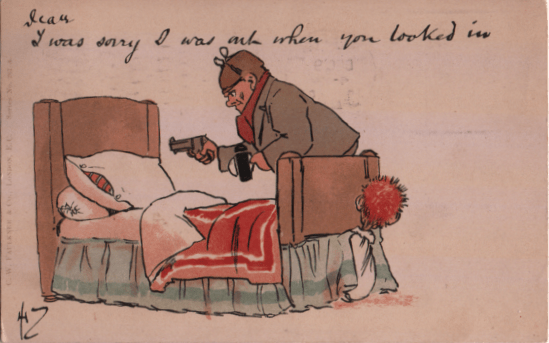
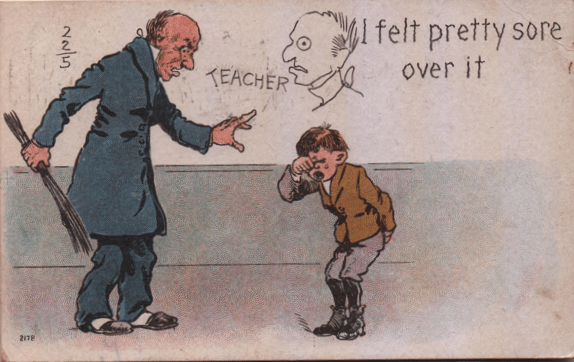
Aside from public drunkenness, and the occasional pickpocket, as seen at the top of this column, crime generally involved a thug with a gun. Sometimes it was an urban thug and sometimes a bandit from the Old West tradition. This one is also unusual in that it involves a more practical plan than most: one man to hold the mark steady with the guns while another goes through those pockets.
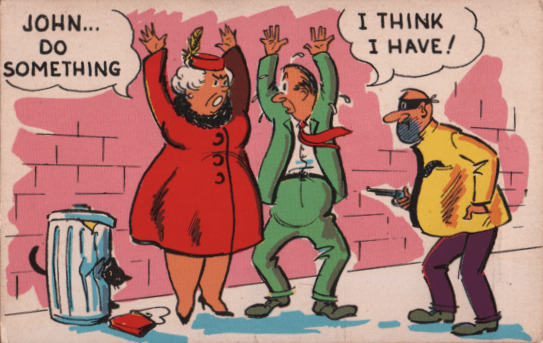
This masked malefactor, for example, could be in trouble if that rather robust victim decides to take a swing at the weapon involved (admittedly a fifty-fifty proposition, and he IS a bigger target. Still, he looks as if he could do it and is just waiting for the right moment.)
Another practical consideration which you see being practiced more often on postcards is choice of victim. The victim is almost always better dressed than the crook (A man who was dressed for the city was guaranteed to be a weakling, lacking the strength and moxie of the rough-dressed denizen of the underworld. AND he was unlikely to be packing a gun himself. There is the faintest hint in a lot of these postcards that our sympathy is supposed to be with the daring bandit, and not the wimpy victim. This may be why you almost always see a MALE victim. Robbing a woman–unless she was the crook’s wife, of course–would have roused a chivalric impulse and spoiled the joke.)
In postcards of the nineteen-oh-somethings, you almost never see the cartoonist letting the victim catch a break. Some of this continues in later postcards.
This gag, for example, exists in numerous cards by numerous artists.
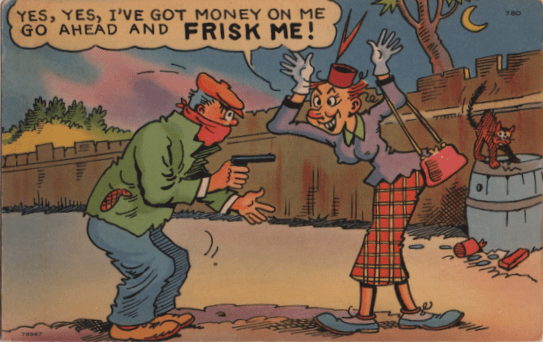
But as the world moved toward the era of the daring bank robber and powerful gangster, the Dillinger and/or Capone years, we begin to see more postcards where the joke is on the bandit. Maybe this was more acceptable if the victim was female, because this turning of the tables often features a woman.
Approaching a point at which we have to wonder just who the victim is. (Note, also, that the gun and the punchline are almost always on the same side. I suppose humor depends on who gets the last shot.)
He recoiled in terror, for the scene had changed, and now he almost touched a bed: a bare, uncurtained bed; on which, beneath a ragged sheet, there lay a something covered up, which, though it was dumb, announced itself in awful language.
The room was very dark, too dark to be observed with any accuracy, though Scrooge glanced round it in obedience to a secret impulse, anxious to know what kind of room it was. A pale light, rising in the outer air, fell straight upon the bed; and on it, plundered and bereft, unwatched, unwept, uncared for, was the body of this man.
Scrooge glanced toward the Phantom. Its steady hand was pointed to the head. The cover was so carelessly adjusted that the slightest raising of it, the motion of a finger on Scrooge’s part, would have disclosed the face. He thought of it, felt how easy it would be to do, and longed to do it; but had no more power to withdraw the veil than to dismiss the spectre ay his side.
Oh, cold, cold, rigid, dreadful Death, set up thine altar here, and dress it with such terrors as thou hast at thy command: for this is thy dominion! But of the loved, revered, and honored dead, thou canst not turn one hair to thy dread purposes, or make one feature odious. It is not that the hand is heavy and will fall down when released; it is not that the heart and pulse are still; but that the hand WAS open, generous, and true; the heart brave, warm, and tender; and the pulse a man’s. Strike, Shadow, strike! And see his good deeds springing from the wound, to sow the world with life immortal!
No voice pronounced these words in Scrooge’s ears, and yet he heard them when he looked upon the bed. Ge thought if this man could be raised up now, what would be his foremost thoughts? Avarice, hard dealing, griping cares? They have brought him to a rich end, truly!
He lay, in the dark empty house, with not a man, a woman, or a child, to say he was kind to me in this or that, and for the memory of one kind word I will be kind to him. A cat was tearing at the door, and there was a sound of gnawing rats beneath the hearth-stone. What THEY wanted in this room of death, and why they were so restless and disturbed, Scrooge did not dare to think.
“Spirit!” he said, “this is a fearful place. In leaving it, I shall not leave its lesson, trust me. Let us go!:
Still the Ghost pointed with an unmoved finger to the head.
“I understand you,” Scrooge returned, “and I would do it, if I could. But I have not the power, Spirit. I have not the power.”
This corpse scene is frequently left out: not, I suspect, because it is nasty (though even those filmmakers who use it leave out the rats and the cat) but because it is one of the most difficult scenes for screenwriters dealing with a delicate problem. It is getting harder and harder to have scrooge see all these scenes and still not suspect that they are (spoiler alert) dealing directly with his own future. He is still convinced this all deals with a dead stranger, or at most a business acquaintance, and to show him now standing, without realizing it, in his own bedroom runs the risk of making him seem a complete chucklehead.
It’s all very well for Dickens to say it is dark, or for me to point out that when confronted with a corpse few of us are going to observe much about the furniture. A screenwriter cannot distract us with that marvelous paragraph on Death and the unloved, and only a few even make the attempt at all.
Hicks just looks at the body and demands, tragically, “Is this the man they spoke of? Neglected? Robbed? Hated? Can you not show me some tenderness connected with death?”
Owen stands by the bed. He tries to reach out, but gives up, stepping back. He seems more discouraged than frightened, and looks a plea to the Ghost. “Is death always like this? Is it never followed by sorrow and weeping?”
Haddrick reaches toward the sheet, but pulls away. “I can’t look, Spirit. I can’t.”
Sim II finds himself in a very dark room, looking at a body feetfirst. The Ghost points. We get both of Scrooge’s speeches, and then, “Let me see some tenderness connected with a death.”
Curry, as the Spirit raises an arm, finds himself in a large, empty room, where WE, at least, immediately recognize the tiled fireplace. He puts out one shaking hand, but before things can go further, the thieves arrive and we move into the scavenger section described in the last section.
Scott passes a quick shot of his doorknocker and then sees the body on the bed. He asks to leave here; thunder cracks. When the Ghost points, Scrooge reaches for the bed and then pulls back. “No, I will not. This you cannot make me do. I say I understand you: that is sufficient to the moment. Furthermore, there must be someone in this city that feels emotion at this man’s death. I demand to see that person.” A streak of lightning passes, and he also is taken to the ragpicker scene of the last section.
Stewart is in a very dark room. He delivers only the second speech, splitting it in two. He tries to reach out to the body, and finds he can’t.
I admit that, despite my omnipresence on the Interwebs, that I am not in the mainstream of pop culture. I am kept so busy producing brilliant work that I have o time to attend to the alerts on radio, TV, and social media. So I do not know yet what this year’s big controversy is in the world of Christmas music.
If you are among the multitudes who are in a store, realize suddenly that the seasonal Muzak is playing, lower your head, and soldier on, you may be unaware that at least one song each year is targeted by the uncommonly sensitive who have appointed themselves unofficial advisers to the rest of us. These stories do sometimes make the evening news, but unless you are a subscriber to some service which alerts you to things which are unclean, unworthy, and otherwise evil (and even then, you will probably get only one side of the protests, as these come from many directions) you may have missed the last few decades, from the move to erase “Grandma Got Run Over By a Reindeer” from radio playlists through the more recent effort to ban “Baby, It’s Cold Outside.”
Well, as noted, I am not up to date on this sort of thing, but I CAN let you know about a few of the controversies about what will be playing in the background everywhere you go (to quote on of the controversial songs.)
JINGLE BELLS: You have to be a thorough purist to object to this number, which in the United States is THE musical cue to let audiences know it’s winter, or that Yuletide is approaching. But there are those who refuse to sing it at Christmas on the grounds that it was WRITTEN as a Thanksgiving song. Just like “Over the River and Through the Woods”, this was meant to tell of a trip during November, primarily in regions where there is more snow that month. The whole problem bothered one writer so much that somewhere toward the beginning of the twentieth century, someone wrote a new verse, specifically mentioning Christmas, so it would be okay. This does not fool the Truly Traditional.
GOD REST YE MERRY, GENETLEMEN: Yes, I know, but I was taught that’s where the comma was meant to be. This song has been banned and rewritten in several markets for several reasons. One church group had it removed from the hymnal on the grounds that the Gentlemen were so Merry because they were drunk, and this had no place in a sacred service. Other groups have pointed out that women are not included in the title, and the lyrics are thus not inclusive enough. This resulted in a new version called “God Rest Ye Merry Gentle Friends.” The same controversy has plagued “Good Christian Men Rejoice”, which is now frequently sung with the first line in the original Latin, “In Dulci Jubilo . Some versions make the second line rhyme with Jubilo, and some keep the second line as it was, even if it doesn’t rhyme.
IT’S BEGINNING TO LOOK A LOT LIKE CHRISTMAS: It’s that jaunty little bit in the middle, where we learn BOYS want a pair of Hopalong boots and a pistol that shoots, thus not only forcing violent toys and male children but also endorsing the theft of the West from the native inhabitants) while GIRLS want dolls, which reinforce typical stereotyped sex roles in a patriarchal society. Some rewriters have simply switched two names, making the guns the choice of Barney and Jen, while the dolls are for Janice and Ben (spoils the alliteration of the original, but it’s in a good cause.) And that bit about Mom and Dad wanting school to start again suggests that adults don’t want to spend quality time with their families.
HAVE YOURSELF A MERRY LITTLE CHRISTMAS: The FIRST rewrite of this song came at the very beginning, when Judy Garland complained to the songwriter that the song was WAY too depressing, whereupon it was rewritten as we know it. However, in later years, the songwriter went through a religious conversion, and was troubled by the line “if the Fates allow”, since this referred to a non-Christian mythical entity, and rewrote it himself as “if the Lord allows”. It was his song, and his conscience, so I GUESS it passes muster, but gee whiz.
We do not have room here to continue through the entire controversy of “Winter Wonderland” (I heard a neighbor of mine rebuke the organizer of a Christmas singalong in 1997 or thereabouts for including such a scandalous song in the program), or Poor Little Jesus Boy, or The Little Drummer Boy, or…. But the overly sensitive are always on the lookout—that’s what Social Media is FOR—and there will be more exclamations of dismay this year. Away in a Manger may be up for attack again, or even Rudolph, the Red-Nosed Reindeer. Keep your ears open. In the meantime, I’m going for a walk. Sleigh bells ring—are you listening? In the lane….
One of the saddest, funniest book donations I received, and due to the nature of the donor, I received it more than once, as she donated things in small, easy installments, was a collection of books on the subject of, um, how to win friends and influence people. Nah, let’s put it right out there. She was donating her collection of books on how to catch a man.
There’s a large literature on this and, naturally, plenty of books on how to catch a woman. And there is no shame in buying these, especially, either on the part of someone who is just figuring out that meeting people you want to become involved with romantically can be awkward, OR for experienced rovers who want to know if there’s any gambit they’ve missed. I would not have observed anything amiss about her owning one, two, or a half dozen such books. It was never my job to criticize anybody’s reading choices, and I hope things stay that way.
BUT I had noticed in other books her habit of dog-earing pages she wanted to return to. She also highlighted pages. A LOT. Sometimes a whole page would be highlighted, and she’d go back and underline things as well. That this renders a book almost impossible to resell was not her concern, and she was not alone in this among my donors.
But these books on how to meet a man exceeded even her books on how to get a job. See, you can dog-ear a page by folding down a corner. You can double dog-ear a page by taking that folded corner and folding part of it back up. In these books, she had highlighted, underlined, dog-eared, double dog-eared, triple dog-eared, and even quadruple-dogeared pages. Some of these books were three times as thick at the top as they were at the bottom. They had been rendered unsaleable except as art objects. She had really STUDIED these books (and apparently had no qualms about passing them along to people who might mention how thoroughly she had studied them. I did hint at this once, and received the answer I expected: she thought EVERYBODY did that.)
What she would have done with a man if she’d gotten one is unclear, as she told me about a number of her broken relationships over the years. They frequently ended when…but we are taking a long detour to get to what I wanted to talk about, which was the pick-up line. (We do not have the space, nor I the degree in psychology, to discuss her romantic life, real or imagined.)
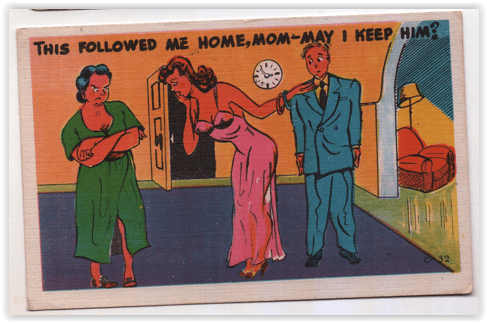
Postcards of the past have plenty of suggestions, some for first encounters, some meant more for use on people you knew somewhat, but wanted to tell that you were interested in knowing them better. I have my doubts about how well some of them would work, but there are passive ones, aggressive ones, and passive-aggressive ones, so take your pick.
I do know someone else who studied the question at length, and was much impressed by a book which suggested a general approach was best. Everyone, it noted, was willing to talk about food, so that was a non-threatening way to get someone to talk to you. Start with something noncontroversial, it suggested, like “Some of my friends don’t eat breakfast” or “Do you like cheese?”
She reported that “Do you like cheese?”, in actual practice, never got QUITE the response she was going for. In fact, rather than attracting men, it had the opposite response.
Another acquaintance of mine, on meeting a young lady who sparked his interest (so to speak), who try a simple opening line of “Will you marry me?” This had pretty much the same immediate response as “Do you like cheese?” The lady would back away a bit and whisper to someone nearby “How much has he had to drink?” But her interest (and eyes) would grow on learning that the man in question didn’t drink at all. So this line, at least, won some response.
So choose what you like from those approaches, or the possibilities offered by the postcards of our ancestors. Let me know what happens, but remember the first rule of dating: bloggers assume no responsibility if you wind up in court.
They left the busy scene, and went into an obscure part of the town, where Scrooge had never penetrated before although he recognized the situation, and its bad repute. The ways were foul and narrow, the shops and houses wretched; the people half-naked, drunken, slip-shod, ugly. Alleys and archways, like so many cesspools, disgorged their offences of smell, and dirt, and life, upon the straggling streets, and the whole quarter reeked with crime, with filth, and misery.
Far in this den of infamous resort, there was a low-browed, beetling shop, below a pent-house roof, where iron, old rags, bottles, bones, and greasy offal, were brought. Upon the floor within, were piled up heaps of rusty keys, nails, chains, hinges, files, scales, weights, and refuse iron of all kinds. Secrets that few would like to scrutinize were bred and hidden in mountains of unseemly rags, masses of corrupted fat, and sepulchres of bones. Sitting in among the wares he dealt in, by a charcoal-stove, made of old bricks, was a fray-haired rascal, nearly seventy years of age; who had screened himself from the cold air without, by a frousy curtaining of miscellaneous tatters, hung upon a line; and smoked his pipe in all the luxury of calm retirement.
Scrooge and the Phantom came into the presence of this man, just as a woman with a heavy bundle slunk into the shop. But she had scarcely entered, when another woman, similarly laden, came in too: and she was closely followed by a man in faded black, who was no less startled by the sight of them, than they had been upon the recognition of each other. After a short period of blank astonishment, in which the old man with the pipe had joined them, they all three burst into a laugh.
“Let the charwoman alone to be the first!” cried she who had entered first. “Let the laundress alone to be the second; and let the undertaker’s man alone to be the third. Look here,, old Joe, here’s a chance! If we haven’t all three met here without meaning it!”
“You couldn’t have met in a better place,” said old Joe, removing his pipe from his mouth. “Come into the parlour. You were made free of it long ago, you know, and the other two an’t strangers. Stop till I shut the door of the shop. Ah! How it skreeks! There an’t such a rusty bit of metal in the place as its own hinges, I believe; and I’m sure there’s no such old bones here, as mine. Ha, ha! We’re all suitable to our calling, we’re well matched. Some not the parlour. Come into the parlour.”
The parlour was the space behind the screen of rags. The old man raked the fire together with an old stair-rod, and having trimmed his smoky lamp (for it was night), with the stem of his pipe, put it in his mouth again.
While he did this, the woman who had already spoken threw er bundle on the floor and sat down in a flaunting manner on a stool; crossing her elbows on her knees, and looking down with a bold defiance at the other two.
“What odds then! What odds, Mrs. Dilber?” said the woman. “Every person has a right to take care of themselves. HE always did!”
“That’s true, indeed!” said the laundress. “No man more so.”
“Why then, don’t stand staring as if you was afraid woman; who’s the wiser? We’re not going to pick holes in each other’s coats, I suppose?”
“No, indeed!: said Mrs. Dilber and the man together. “We should hope not!”
“Very well, then!” cried the woman. “That’s enough. Who’s the worse for the loos of a few things like these? Not a dead man, I suppose.”
“No, indeed,” said Mrs. Dilver, laughing.
“If he wanted to keep ‘em after he was dead, a wicked old screw,” pursued the woman, “why wasn’t he natural in his lifetime? If he had been, he’d have had somebody to look after him when he was struck with death, instead of lying gasping out his last there, alone by himself.”
“It’s the truest word that ever was spoke,” said Mrs. Dilber. “It’s a judgement on him.”
“I wish it was a little heavier one,” replied the woman; “and it would have been, you may depend upon it, if I could have laid my hands on anything else. Open the bundle, old Joe, and let me know the value of it. Speak out plain. I’m not afraid to be the first, nor afraid for them to see it. We knew pretty well that we were helping ourselves, before we met here, I believe. It’s no sin. Open the bundle, Joe.”
Vut the gallantry of her friends would not allow of this; and the man in faded black, mounting the breach first, produced his plunder. It was not extensive. A deal or two, a pencil-case, a pair of sleeve-buttons, and a brooch of no great value, were all. They were severally examined and appraised by Old Joe, who chalked the sums he disposed to give for each, upon the wall,, and added them up not a total when he found there was nothing more to come.
“That’s your account,” said Joe, “and I wouldn’t give another sixpence, if I was to be boiled for not doing it. Who’s next?”
Mrs. Dilber was next. Sheets and towels, a little wearing apparel, two big old-fashioned silver teaspoons, a pair of sugar-tongs, and a few boots. Her account was stated on the wall in the same manner.
“I always give too much to ladies. It’s a weakness of mine, and that’s the way I ruin myself,” said old Joe. “That’s your account. If you aske for another penny, and made I an ope question, I’d repent of being so liberal and knock off half-a-crown.”
“And now undo MY bundle, Joe,” said the first woman.
Jow went down on his knees for the greater convenience of opening it, and having unfastened a great many knots, dragged out a large and heavy roll of some dark stuff.”
“What do you call this?” said Joe. “Bed-curtains?”
“Ah!” said the woman, laughing and leaning forward on her crossed arms. “Bed-curtains!”
“You don’t mean to say you took ‘em down, rings and all, with him lying there?” said Joe.
“Yes I do,” replied the woman. “Why not?”
“You were born to make your fortune,” said Joe, “and you’ll certainly do it.”
“I certainly shan’t hold my hand, when I get anything in it by reaching it out, for the sake of such a man as he was, I promise you, Joe,” returned the woman coolly. “Don’t drop that oil upon the blankets now.”
“His blankets?” asked Joe.
“Whose else’s do you think?” replied the woman. “He isn’t likely to take cold without ‘em, I dare say.”
“I hope he didn’t die of anything catching? Eh?” said old Joe, stopping in his work, and looking up.
“Don’t you be afraid of that,” returned the woman. “I an’t so fond of his company that I’d loiter about him for such things, if eh did. Ah! You may look through that shirt till your eyes ache; but you won’t find a hole in it, nor a threadbare place. It’s the best he had, and a fine one, too. They’d have wasted it, if it hadn’t been for me.”
“What do you call wasting of it?” asked old Joe.
“Putting it on him to be buried in, to be sure,” replied the woman with a laugh. “Somebody was fool enough to do it, but I took it off again. If calico isn’t good enough for such a purpose, it isn’t good enough for anything. It’s quite as becoming to the body. He can’t look uglier than he was in that one.”
Scrooge listened to this dialogue in horror. As they sat grouped around their spoil, in the scanty light afforded by the old man’s lamp, he viewed them with detestation and disgust, which could hardly have been greater, had they been obscene demons, marketing the corpse itself.
“Ha, ha!” laughed the same woman, when old Joe, producing a flannel bag with money in it, told out their several gains upon the ground. “This is the end of it, you see! He frightened every one away from him when he was alive, to profit us when he was dead! Ha, ha, ha!”
“Spirit!” said Scrooge, shuddering from head to foot. “I see, I see. The case of this unhappy man might be my own. My life tends that way, now. Merciful Heaven, what is this?”
Well, now. Just about everybody loves these rascals: they provide a quick dash of nastiness in a tale of good will. The company will vary, with the den of garbage not QUITE so nasty as Dickens wrote it up (filmmakers making do with darkness and clutter) but it is hard to resist the delight and horror of those bed curtains, torn down, rings and all. And it is delicious, too, to see the death of some old miser being an occasion for buying and selling.
Several versions give us the corpse scene first, as a natural answer to Scrooge’s concern with who is dead. And some lighter, quicker versions—Owen, March, Finney, and McDuck—skip this business establishment.
Hicks gives us a smoky store, cluttered and dark and inspired by German expressionist film. Joe is a smallish fellow with a clay pipe; we watch the three conspirators arrive separately. They peer at each other, suspicious, and then laugh as they realize the coincidence. They deliver just the high points of Dickens’s dialogue. We see some of the totals old Joe chalks on the wall: the undertaker’s man gets eight shillings for his lot. Joe laughs with admiration at the idea of that shirt being removed from the dead body. Soon everyone is laughing, turning into cackling, gap-toothed demons in shadow and flickering light. At the woman’s laugh about “This is the end of it, you see!” we get a close-up of grasping hands reaching for payment. Scrooge delivers the closing speech in a dead tone.
Sim I reverses the three visions of the future, so this comes after the visit to the Cratchits’. Coughing children sort the wares in this establishment. Joe is a fat, sagging man who is losing his teeth. The two ladies arrive first, followed shortly by the undertaker we saw much earlier, at Marley’s deathbed. They laugh at the coincidence, and joe invites them into the parlour, noting jovially “We’re all suited to our calling.” The conversation slithers along as written until the bundles open. The undertaker announces he will go first, “Just to show we all got trust in one another.” The loot is displayed and accounts settled; whenever Joe announces a total, everyone’s eyes roll skyward. (The undertaker gets eight shillings again, the first woman 17/6. The two women are obviously rivals, each a bit jealous on seeing what the other got away with.) The rest of the party are suitably stunned when they hear about the shirt being taken from the dead man. Then they have a good laugh at the justice of it all; in fact, the undertaker calls it poetic justice, and gets the line about “This is the end of it, you see!” Scrooge will now, in this version, move that overhearing the gentlemen at the Exchange.
Rathbone puts this third, after the Cratchits and the Exchange. Scrooge is led by the Ghost to a door suspended in the fog. A sign with three balls on it hangs somewhat farther up, the indication of a pawnshop. One woman waits inside; the pawnbroker is asking her, “You don’t mean to say you took his bed-curtains down, rings and all, with him lying there?” She notes what the dead man should have done if he’d wanted to keep ‘em after he was dead, and how he might’ve had someone with him to look after him when he was struck with death. The pawnbroker offers her three shillings. Scrooge is appalled and reflects that the case of this unhappy man might be his own.
Magoo is led by the Spirit, one bony hand upon his shoulder. Three shadowy figures enter “Ye Olde Junk Shoppe”. It s shabby and cluttered, but clean. A rat spots the spectral Scrooge, and flees. Old Joe inquires “What poor stiff have ye robbed now?” They quickly show their booty—the undertaker shows off cufflinks with the monogram “ES”—but te only new dialogue is about the bed-curtains. Scrooge shudders. The villains then break into a major musical number, “We’re Despicable”, which is there just for the fun of it. Scrooge delivers the speech at the end of this sequence, and bridges the gap to the next one with “Oh, please, kind Spirit! Let me see some tenderness connected with a death!”
Haddrick, offended by the men at the Exchange, demands, “Is there no reverence for the dead in this time of yours?” He is taken to the rag and bone shop in the middle of the two women’s announcement about “a judgement on him”. The undertaker’s man does not appear, and the dialogue is abbreviated. The group, who look just a bit like gnomes, declare this is “Justice: he made hardship for our tribe while he was alive and now we profit from his death.” Scrooge thinks he has understood, and delivers the speech at the end; he is breathless, and a bit cowed.
Sim II sweeps quickly through a sequence f shadows and alleys; a baby cries, a rat scampers by. Children sort among the rags. Thre whole shop is a more venomous version of that in Sim I. The group is moving into the parlour, declaring that this is a judgement. Joe says “Come into the parlour” three times. He is amazed by the blankets, and then by the bed curtains. They agree that the wicked old screw should have been more natural in his lifetime, and laugh about it. Scrooge says, “Spirit, I see, I do. I do see.”
Matthau is brought her directly from his bedroom. The shopowner asks a woman, “Where’d you steal these, Love?” and is told “from a dead man’s home.” Scrooge asks who has been robbed, and is whisked to the graveyard.
Scott has the corpse scene first and is then taken to a foul, foggy part of town. Scrooge declares this must be a mistake: the Spirit has taken a wrong turn. This slum is unpleasant and Gothic. When the Spirit points to a low, doorless hovel from which firelight emerges, Scrooge protests, “I have no business to transact in there.” Mrs. Dilber is alone with Joe. “You’ll not ask me how I came by these?” The proprietor looks to be in his forties; he replies that every person has the right to take care of themselves. “He always did.” She asks who’s the worse for the loss of a few things like these: not a dead man. “No, indeed,” says Joe. She goes on about what he should have done if he wanted to keep ‘em when he was dead, and produces spoons. Scrooge recognizes these. “These are my things. She’s stolen my things. I’ll have her before a magistrate.” We see the chiming watch that stood by his bed; Scrooge, realizing that this loot was taken from a dead man, convinces himself that they aren’t his at all, merely similar. The conversation continues, voices fading a little when money comes into question: the bed-curtains are omitted. Joe finally offers one pound, five, and threepence, “and I wouldn’t give another sixpence, if I was to be boiled for it.” “You’ve hardened, Joe, and no mistake.” “I’m always kind to the ladies. That’s how I ruin myself.” They laugh. Scrooge is indignant. “Spirit, what perversity is this? I ask to see emotion associated with this man’s death and you show me only greed and avarice! Let me see some tenderness, some depth of feeling!”
Caine enters fearfully into a shadow indicated by the Spirit. Joe is a huge spider, inquiring of his visitors, “Back from the house of sadness?” One woman snaps, “It’s only sad that he didn’t die sooner, the old skinflint.” “What’ve you got for old Joe? What’ve you got for me…to remember him by?” Collar-buttons and bed-curtains get less attention than the blankets. “They’re still warm! I don’t pay extra for the warmth, y’know.” “You should!” says Mrs. Dilber. “They’re the only warmth he ever had.” They laugh. Scrooge turns away. Saying “I understand, Spirit.” He delivers the closing speech as written, as far as “Merciful Heavens’, which becomes a general comment on the whole scene, rather than a lead-in to the next.
Curry has the corpse scene first, in answer to his “Who has died?” as he hesitates by the dead body, a man enters, and a woman rises from where she has been stealing teaspoons hidden under the bed. “His tea-stirring days are over.” “If he wanted someone to look after hs belongings after he was dead, he should’ve made friends while he was still breathin’.” “Aye, Love. Truer words was never spoken.” She takes the slippers from the dead man’s feet; the man is carrying the bed-curtains. They agree that the man is not likely to catch cold without ‘em. “Spirit, this is a fearful place, but I see the lesson. The case of this unhappy man might happen to me some day.”
Stewart is led up a narrow alley where a small stream meanders up the pavement. Aimless drunks and the usual crying baby ornament the scene; Scrooge moves on to a battered little shop. A man in an old dressing gown is surprised to see guests. “What’s this? An undertaker, a laundress, and a charlady?” They explain it’s a coincidence and not conspiracy. “I can’t be too careful. As it is, you’re welcome.” “Howe goes the day, Joe?” He replies with bits of the speech about old bones and rusty hinges, and notes that we are suited to our calling, matched in Heaven. He is a rag and bone man by trade and a rag and bone man by nature. But trade is not what it was. Now Mrs. Riggs demands, “Why you looking, Mrs. Dilver? Everybody’s a right to take care of theirselves: HE always did!” “No man more so, Mrs. Riggs,” says Mrs. Dilber (who is played, by the way, by Liz Smith, who was Mrs. Dilber in the Scott version as well.) The dialogue about what the wicked old screw should have done while living is split between Mrs. Riggs and the lugubrious undertaker. Mrs. Riggs tells Joe to open the bundles; she’s not afraid to go first. “It’s no sin.” “Only if we get caught.” “No chance of that. No one cared what happened to him, then or now.” The undertaker, one Mr. Crump, insists on going first; he gets seven shillings for his swag. Mrs. Dilver produces teaspoons, sugar tongs, sheets, and towels, and some boots in need of repair; she is offered one pound, one, and ha’pence. When she cries out in protest, old Joe replies, “I always give too much to ladies. It’s a weakness of mine. If you asked for one more penny, I’ll repent and knock off five shillings.” (Obviously an effect of decimalization.) Scrooge has grown confused, and demands, “What are we doing in this place, Spirit?” Mrs. Riggs now produces the bed-curtains; Joe exclaims, “God in Heaven! The rings are still on ‘em!” Blankets come next; Mrs. Dilber is the one who asks if they’re HIS blankets. Scrooge cringes on hearing the shirt came off the dead man’s body; even Joe is stunned. Scrooge, gritting his teeth, backs away. When he backs into a bedpost, he turns and finds himself in the next segment.
Oh, never mind why our conversation turned lightly to Gadzookie, the nephew, cousin, or son of Godzilla in cartoons of my younger days. (And no, we will not be considering what this means to the world that Godzilla must, therefore. have had siblings, uncles, or a wife. Other people have already discussed these things. OUR question was how the little fellow got his name.
Well, neighbor, “Gadzooks!”, it turns out, is a bygone bit of profanity in which someone was swearing “God’s hooks!”, a reference to the nails used in the Crucifixion. It is thus akin to the equally picturesque “Zounds!” which was a means of expressing surprise with a reference to “God’s wounds!” (Logically, thus, it should be pronounced to rhyme with wounds, and not with sounds, which is the way anyone with sense says the word.)
The whole question of profanity has been largely ignored over the last few decades, as we in the English-speaking world have become more addicted to obscenity. THAT deals with words referring to body processes, which are far more popular than those which were taken as a mockery, or at least a failure to revere, religious references.
Yes, when Tweety Pie’s Granny (or Dwanny) exclaimed “Heavens to Betsy!”, she was, technically, swearing, and would once have had her mouth washed out, the same as those British gentlemen in the movies who would cry “Gad!” or “By Jove!” (God, and a reference to Jupiter, one of the few popular references to stray from Christianity in its sacrilegious naughtiness.)
Even by the 1940s, such expressions were becoming quaint, with “Gol durn it” being something your old Uncle Zeke in the country said in place of “God damn it”. People DO still use some related phrases, though it, like any cussing, is a matter of habit. Those of us who do not use the phrases can only stand back and wonder at why some folks cry “Gosh damn it” and others shout “God darn it!”
Even Walt Disney made fun of such antique cussing, though it was not TOO obvious, since his movies were going out to the broad spectrum of viewers. But in 1940, there WAS some pushback when Pinocchio gave us Jiminy Cricket, whose name was a popular shout of surprise or exasperation used in place of “Jesus Christ!” The wonderfully subversive folk song The Blue-Tail Fly used a similar euphemism in the chorus “Jimmy Crack Corn, and I don’t care.” Yes, your grandfather, when he cries of “Criminentlies!” or “Jiminy Christmas!”, is also dealing in such veiled profanity.
It worked the other way as well: one did not refer lightly to the infernal regions and their work, so we indulged in many a “Dash It All” or “Dang It” id Mom or Aunt Booney were listening. “Hot Diggety” was used for “Hot Damn” the same way. (I have not investigated whether a hot damn is stronger than a mere damn; wouldn’t ANY damned thing get pretty hot?) And you know, I am sure, why some folks exclaim “Heckfire!” It is because the bad guys remained censorable long after even radio and TV censors started allowing the word “God” to be used. This is why those of us who played with pocket calculators once upon a time, like to type in 7734.0 and then flip the screen over. And some were reprimanded for it, even as their parents listened to songs about “Jumping Jack Flash” on the radio.
Which is going a long way to explain why those chaps in “A Christmas Carol” noted that Old Scratch had got his own at last: the Devil, whose name was not mentioned in polite conversation, had claimed a miserable soul.
Thank you for not guessing that’s where we were going with this. To the Dickens.
I realize that my serialized publication of my unpublished coffee table boo on performances of Charles Dickens’s A Christmas Carol has a way to go, but as the season for actually watching these movies approaches, I thought I would add a few notes on which versions you should seek out.
By the way, one of the main reasons this book never got much of a nibble from any of the publishers who had their chance was expressed in a memo I got by mistake with one of my rejection slips. In so many words, the publisher’s reader asked why anyone would publish a book no one would read, and would only be BOUGHT during that three day period every year between the realization that Christmas was coming and the hundredth time they heard “The Little Drummer Boy”. I still disagree, but I must admit they had a point. Even those versions of A Christmas Carol which are given a four star rating in “Best Movies” guides never wind up on anyone’s list of Best Movies. A Christmas Carol is to be viewed at Christmas, with the family, apparently while eating popcorn and possibly playing Trivial Pursuit. Holiday movies never get their due.
But it was not the four star versions I wanted to talk about. I wanted to warn you about the half-star Christmas Carols. This will not be a comprehensive list. After all, I wrote my book in 1999, and have felt no responsibility to see every single version produced since then. And even then, I excluded all versions NOT set in nineteenth century London. So, continuing that theme, I cannot get into the All Dogs Christmas Carol (an extension of the All Dogs Go To Heaven series) or any of the pornographic versions (one of which, by the way, DOES include a surprising amount of the original text, even though set in the twentieth century and, um, interested in other things than Christmas merriment.)
Only one version which approaches this list made it into my original book. BOTH versions made starring Ron Haddrick as Ebenezer Scrooge were quickie made-for-TV animated cartoons, and show it. The one discussed in my text s the more interesting of the two, being downright weird, with its sudden inclusion of a musical number in a version which has no other songs. It has a large percentage of the original dialogue, and its occasional interpolations of new material are sometimes thoughtful, even when wedged in without much warning. (The Ghost, warning Scrooge that always rubbing his lucky coin will wear it away and destroy its value despite his love of money, is interesting, but it would be better if we had noticed this coin being rubbed at any point before this.)
I feel perfectly awful about mentioning Vincent Price in the context of bad movies, but we might as well admit that this constantly-working star was in a LOT of pictures where he was the most (or only) interesting part of the show. One of these is certainly “A Christmas Carol”, produced way on the cheap for television in 1949. Taylor Holmes plays Ebenezer Scrooge with gusto and a rich aroma of ham. To make the story fit into a half hour time slot, the key scenes are linked by scenes of Vincent Price in a library, reading us text to connect the scenes, except for the scene with young Scrooge’s fiancee, which is simply summarized by the Ghost so Scrooge can refuse to watch it. The script also decides to give Vincent that last “God bless us, every one.” He does all his lines with his usual polish and air, and he seems quite out of place with the rest of the show.(There IS one other point of interest, which I have just read about: one of the Cratchit children in this version is a VERY young Jill St. John.)
I disrecollect exactly why the animated version produced by Saban (the Japanese animation firm which gave us VR Troopers, among other classics) but this 1991 version is my absolute favorite among bad Carols. The Ghosts are suddenly all little fairy creatures with magic wands, and this version can NOT make up its mind whether it is a parody or not. From the moment Scrooge informs Bob Cratchit that he is going to buy a jet ski with the money an investor has asked be applied to health food restaurants we know where we are. (When Bob complains, he is told that it is, after all, 1843, and no one will be eating bran muffins for a century.) Scrooge’s tears as he realizes he has contributed to Tiny Tim’s upcoming demise are genuine, as the narrator informs us that “It was now that Ebenezer Scrooge realized he was the villain in this story.”. And, as I think I have mentioned, it is the only version which explains what happened to cause that death. (Tim is being trained as a jockey, being so tiny, but his parents can’t afford a horse with FOUR legs, thanks to Scrooge’s cheapness, so one day, as the fairy…Ghost explains, the horse will tip over on Tim and–this is the actual dialogue–SQUISH.)
But if you want to absolutely waste half an hour with the all-time worst version of A Christmas Carol which it has been my misfortune to watch, you’ll need to hook up your old VCR and find a copy of…but there, we’re out of time again And why should I offer the lawyers more business, even at Christmas?
“Lead on!” said Scrooge. “Lead on! The night is waning fast, and it is precious time to me, I know. Lead on, Spirit!”
The Spirit moved away as it had come towards him. Scrooge followed in the shadow of its dress, which bore him up, he thought, and carried him along.
They scarcely seemed to enter the city, for the city rather seemed to spring up about them, and encompass them of its own act. But there they were, in the heart of it, on ‘Change, amongst the merchants, who hurried up and down, and chinked the money in their pockets, and conversed in groups, and looked at their watches, and trifled thoughtfully with their great gold seals, and so forth, as Scrooge had seen them often.
The Spirit stopped beside one little knot of business men. Observing that the hand was pointed to them, Scrooge advanced to listen to their talk.
“No,” said a great fat man with a monstrous chin, “:I don’t know much=h about it either way. I only know he’s dead.”
“When did he die?” inquired another.
“Last night, I believe.”
“why, what was the matter with him?” asked a third, taking a vast quantity of snuff out of a very large snuff-box. “I thought he’d never die.”
“God knows,” said the first, with a yawn.
“What has he done with his money?” asked a red-faced gentleman with a pendulous excrescence on the end of his nose, that shook like the gills of a turkey-cock.
“I haven’t heard,” said the man with the large chin, yawning again. “Left it to his Company, perhaps. He hasn’t ;left it to me. That’s all I know.”
\ This pleasantry was received with a general laugh.
“It’s likely to be a very cheap funeral,” said the same speaker, “for upon my life I don’t know of anybody to go to it. Suppose we make up a party and volunteer?”
“I don’t mind going if a lunch is provided,” observed the gentleman with the excrescence on his nose. :But I must be fed, if I make one.”
Another laugh.
“Well, I am the most disinterested among you, after all,” said the first speaker, “for I never wear black gloves, and I never eat lunch. But I’ll offer to go, is anybody else will. When I come to think about it, I’m not at all sure that I wasn’t his particular friend; for we used to stop and speak whenever we met. Bye, bye!”
Speakers and listeners strolled away, and mixed with other groups. Scrooge knew the men, and looked towards the Spirit for an explanation.
The Phantom glided on into a street. Its finger pointed to two persons meeting. Scrooge listened again, thinking that the explanation might lie here.
He knew these men, also, perfectly. They were men of business: very wealthy, and of great importance. He had made a point always of standing well in their esteem: in a business point of view, that is; strictly in business point of view.
“How are you?” said one.
“How are you?” returned the other.
“Well!” said the first. “Old Scratch has got his own at last, hey?”
“So I am told,” returned the second. “Cold, isn’t it?”
“Seasonable for Christmas time. You’re not a skater, I suppose.”
“No. No. Something else to think of. Good Morning!”
Not another word. That was their meeting, their conversation, and their parting.
Scrooge was at first inclined to be surprised that the Spirit should attach importance to conversation apparently so trivial, but feeling assured that they must have some hidden purpose, he set himself to consider what it was likely to be. They could scarcely be supposed to have any bearing on the death of Jacob, his old partner, for that was Past, and this Ghost’s province was the Future. Nor could he think of any one immediately connected with himself, to whom he could apply them. But nothing doubting that to whomsoever they applied that had some latent moral for his own improvement, he resolved to treasure up every word he heard, and everything he saw; and especially to observe the shadow of himself when it appeared. For he had an expectation that the conduct of his future self would give him some clue he missed, and would render the solution of these riddles easy.
He looked about in that very place for his own image; but another man stood in his accustomed corner, and though the clock pointed to his usual time of day for being there, he saw no likeness of himself among the multitudes that poured in through the Porch. It gave him little surprise, however; for he had been revolving in his mind a change of life, and thought and hoped he saw his new-born resolution carried out in this.
Quiet and dark, beside him stood the Phantom, with its outstretched hand. When he roused himself from his thoughtful quest, he fancied from the turn of the head, and the situation in reference to himself, that the Unseen Eyes were looking at him keenly. It made him shudder, and feel very cold.
There is obvious temptation to the filmmakers to combine the two overheard conversations, the second one being just as trivial as Scrooge thought it. Dickens is making a mild distinction, however: the first speakers would appear to be businessmen at Scrooge’s ;level, while the second conversation is between men who have made so much money that the old Scrooge was always at paints to stay on their good side. (The Basil Rathbone recorded version, put on 78 rpm discs in 1942, makes all the men Cockneys.)
Several versions, though, do skip the men and their chat entirely: March, McDuck, and Matthau have no time for them.
Hicks appears in these scenes as a face inside the dark shadow of his own head. He watches as three well-dressed men hold the first conversation up to the gag about “He hasn’t left it to ME.” The finger then points another direction, and a man says “So Old Nick has hot his own,” and the other conversation follows. Scrooge looks around and complains, “I do not see myself in my accustomed place. Where am I? Why am I not here?”
Owen says “Lead on. I shall follow, gladly.” They move to the Exchange through a great deal of snow. The first conversation goes much as written, save that one man, when asked what was the matter with the deceased replies, “Who knows? Who cares?” When the Spirit moves toward the second conversation, Scrooge exclaims, “I know them! I know them both! Business associates!” When this conversation ends with “No time for it. Business on my mind”, Scrooge looks confused.
Sim I says “Lead on, then.” The camera at last pulls back to show the Spirit: a deeply dark, hooded figure. It moves off and Scrooge follows, not eagerly. There is smoke, and we go first to the Cratchits’. The ragpicker scene follows that, and only after that do we arrive upon ‘Change. The men who discussed the ant and the grasshopper with Scrooge at the beginning of this picture hold the first conversation, with a few flourishes. When one man notes, “I thought he’d never die”, another replies, “So did he, I dare say.” The conversation ends with one man noting , “I don’t mind going if there’s a luncheon provided, but I must be fed, or else I stay at home.” Scrooge muses, “I know those men. They’re men of business: very wealthy, very important. Whose funeral are they talking about? Strange. My usual place is over there: under the clock. I ought to be there at this time of day, but I’m not.” His fear is evident. “I’m not!”
Rathbone also puts this scene after the visit to the Cratchits’./ The Ghost points through the fog, and we watch as two men wheel a coffin past us. We move on to a streetlight beneath which two well-dressed neb, one rather rotund, converse. “When did the old wretch die?” “Last night, I’m told.” “What was the matter with him?” “Heaven knows.” They discuss the weather being seasonal, and not being a skater. The thinner man then takes himself off while the round man takes snuff. Scrooge eases up to ask this man, “Who was that you were talking about so callously?” The man cannot, of course hear him, and the Ghost points on.
Magoo is led down a street; when he sees the three men, he greets them by name, obviously expecting a friendly response. The first conversation is performed through the line about a lunch being provided. Scrooge complains, “Spirit, what connection can these people have with my future? Of whom were they talking? Jacob Marley’s death was in the past, and…where am I? I am always here at this time of day: always!”
Haddrick says, “Lead on. Lead on, Spirit.” He is taken to a dark street, where he observes fairly young men holding that first conversation through “What was the matter with him?” Another suggests, “Maybe he tried to eat some of his money.” “Why would he do that?” “To get closer to it!”
After “Lead on. Lead on, Spirit,” Sim II witnesses a quick conversation. These men are getting on in years; one of them has the nose Dickens describes. “Well, Old Scratch has got his own, I hear.” “Why, what was the matter with him?” “What did he die of?” “God knows.” “I don’t mind going if a lunch is provided, but I must be fed.” They laugh.
“Very well,” says Scott, “Lead on. The night is waning fast, and time is precious to me.” He seems to force himself to follow the Ghost. Night has fallen on the Exchange; the square is lit with torches. Scrooge enters. The first conversation follows, much as written, though the man who says “Left it to his Company, perhaps” adds “Who else did he have?” After the rack about lunch being provided (“I must be fed for the time I’ll waste.”) Scrooge demands, “Have these men no respect for the dead?” The scene blacks out, leaving him in a spotlight; he can, however, still hear the echoing voices of the men. “I suppose I must go. We did considerable business together.” “Well, I must go and find the price of corn.” Scrooge is less uneasy than irritated. “Why was I privy to that conversation? What purpose could it have for me?”
Caine is unnerved by the Ghost’s silence after the jovial Christmas present. “Oh, yes. Yes. The night is waning fast. Lead on, Spirit.” They move through a sort of wormhole effect into a rainy London day where four jovial pigs we saw earlier in the city crowd now stand chatting under umbrellas. “No, I don’t know much about it either way. I only know he’s DEAD.” “When?” “Last night, I believe.” “Wonder what he died of; I thought he’d never GO.” “Well, I don’t know or care why he’s gone; I’d just like to know what he’s done with his money.” “Wouldn’t we all?” “Well, he didn’t gib it to me.” “No no no.” “It’s likely to be a very cheap funeral; I don’t know a single soul who’d go to it.” “I wouldn’t mind going.” Everyone grunts surprise at this speaker, who adds, “If a lunch is provided!” They all laugh and decide to go now to lunch themselves. “I know some of those gentlemen,” Scrooge observes. “Spriit, of what poor wretch do they speak?”
Curry says, “Lead on.” The Spirit raises its arm and Scrooge finds himself in “The Business Exchange! I come here often. But where am I today?” Some men nearby are chatting. “No, I don’t know much about it either way. I only know he died last night.” “Well, the devil has got his own at lat, hey?” They laugh. “What’s he done with his money?” “Well, e hasn’t left it to me. That’s all I know.” Scrooge steps over to ask them “Which of our colleagues has died?” “It’ll probably be a cheap funeral, because nobody’ll go to it.” “I don’t mind going, if a lunch is provided.” “Well, good day.” Scrooge is honestly puzzled. “I don’t understand the meaning of this. Who has died?”
Stewart’s version begins just as written; Scrooge seems to try to smile. He is obviously relieved to find himself in the Exchange. “I know these men.” He is confident, sure of his ground. “Here profit is worshipped. Profit is everything.” A more varied group than usual chats. “Find out the truth about Old Scratch?” and the conversation from there goes much as Dickens had it, with minor abridgements. This is the only version to include the man who never wears black gloves and never eats lunch. To the proposal that they make up a party, another man replies, “Let’s just say…we’ll think about it”, disappointing the man who suggested it. Scrooge glances at the Spirit in some confusion, but is simply led on.
Finney substitutes a major musical production with similar intent, addressing directly the question of who has died, and explaining why Scrooge doesn’t catch on. Scrooge speaks to the Ghost about the night waning fast, and there is a flash of fire. Ton Jenkins, the hot soup man, is found polishing the brass plate which reads “Scrooge and Marley”. It is daylight, and a large crowd has assembled, apparently just to watch him do this. Tom turns and addresses them, announcing that they have all of course assembled to express their common gratitude to Ebenezer Scrooge. Scrooge is much impressed by this Future; he recognizes the whole crowd as people who owed him money. “They love me and I never knew it!” Tom calls for three cheers. Scrooge, anxious to thank everyone, mounts his front steps to address the group. Thus he has his back to the door when it opens so his coffin can be carried from the counting house. He misinterprets the reaction of the crowd, the rest of Tom’s speech, and the musical number “Thank You Very Much.” He comes to believe that the impromptu funeral procession is a parade in his honor and capers along with it, completely failing to notice the men dancing atop the coffin. Ony the sudden reappearance of the Spirit shuts off his glee. He freezes at the sight, and the procession rollicks on without him.
Sigmund Spaeth, best known for what people regard as a misguided attempt to teach children instrumental classics by setting lyrics to them, wrote a LOT about music. One of his wisest observations was about how audiences react to performance of a medley. It is true, as he states, that whenever a new song starts in the medley, the audience applauds. They are not, he said, applauding the song, or the performer. They’re applauding themselves for recognizing the song.
There is a similar phenomenon in comedy, in which we see only the lead-up to the payoff, and get our joy not only out of the plight of the character headed for disaster (it’s usually disaster) but also from our anticipation of what comes next. (I’m not sure, but I think about HALF the postcard depictions of people in canoes show the canoe about to go over a waterfall. Canoes apparently do not come with instruction manuals.)
This works especially well in a static medium, like the cartoon. In a movie, we MIGHT feel cheated if we don’t get to see the payoff.
In fact, if enough work is spent drawing the setup, the joke gets a little better. Here we can glory in the man whose maneuver with his mustache automatically makes us want to see him come to grief. But the impact we imagine is much more satisfying than anything the cartoonist could have drawn.
We enjoy the suspense, as Alfred Hitchcock pointed out, of knowing what the hero does not: that danger lies in wait.
As when we recognize that song coming in the medley, we are uplifted by our own sense of superiority to the clueless protagonist.
Another ploy used in comedy is to cut from the set-up of the catastrophe directly to the aftermath, leaving the event in our imagination as we look at the consequences. Once again, we are allowed to feel a glow of intelligence because we know what happened without actually being shown the event itself.
Some cartoonists provided postcards with just the aftermath shot, taking advantage of just this human tendency.
It may just be the postcards in MY inventory, but it does seem to me that an awfully lot of this kind of comedy involves the sitting section of the human body.
Perhaps this added a layer of sympathy to the gag. Or maybe, as some comedians have pointed out, that’s just the funniest end of the body.
But (and I use the word with some trepidation) perhaps this involves another issue. The cartoonist COULD not show the actual calamity, or knew that this would never go through the mails, anyhow. (It would also be less funny, but that’s the opinion of a twentieth century brain.)
If you want to apply your own intellect to a joke, I will leave you with this one, and you can decide for yourself whether this depicts something which is ABOUT to happen, or which HAS happened. Which is funnier, really? Or have you already shuddered and moved on to listen to a YouTube medley of golden oldies from the 2010s?)
A man named Charles Williams, Jr. had the honor of having the first phone number in the United States. (It was 1, of course. Mr. Williams produced telephone equipment for Alexander Graham Bell, so he played guinea pig. (He also, by the way, had the second phone number—2–for his shop.) You can read the whole history around the Interwebs: how numbers were promoted over just asking the operator for the name of your party during a measles epidemic, which would make it easier for trainees if operators went home sick.
Direct dialing began in the 1920s, but calling the operator, at “Central”, lingered as ifferent parts of the country caught up with the latest in phones. (I missed it in my college dorm by only seven years…yeah, yeah, right after the Spanish-American War. Looked up that joke on your phone, did you?) For a while, calling “Central” was so well-known that it appeared in any number of pop songs: “Hello Central, Give Me Heaven” or “Hello, Central, Give Me No Man’s Land”.
Speaking of pop songs, if you recall “Pennsylvania 6-5000”, that represents a brief detour in many telephoned countries. As more and more phones were sold, numbers got longer and longer: three digits became four and then five. When they reached seven digits, executives rebelled. No one, they claimed, should be expected to remember a seven-digit number, so a word was substituted, and the caller was expected to use just the first two letters of the word.
This is why your landline phones still have numbers next to the digits, creating trivia and mystery clues, since Q and X did not appear on the dial. (They do now, again creating problems for people watching old movies.) Other countries used other systems, by the way: in England, logic took charge over math when the Zero was assigned the letter O.
This eventually became cumbersome and, anyhow numbers went on getting longer. Area codes in the 1950s, with the biggest cities getting the numbers people considered easiest to dial. People seemed to find ways to remember these numbers without trouble. (Although, lemme tell you about calling 911, which started in the 1960s, suffered a slight pause for reconsideration because this was originally pronounced “Nine-Eleven”, and people were wasting their time looking for an eleven on the dial. Everyone started saying “Nine-one-one” instead, and children were taught this in school, often with a special pushbutton classroom aid which, as far as I can tell, is numbered backward, so I always see these kids proudly punching what will be, on a real phone, 7-3-3.)
Now, of course, no one HAS to remember phone numbers. You simply type them into your phone once and then you just look up the name. The phonebook, thus, is dwindling away (how do little kids sit up to the table at Thanksgiving now?) and phone numbers ae losing the hyphens and parentheses I remember so well. We do still use a 1-3-3-4 arrangement of our numbers.
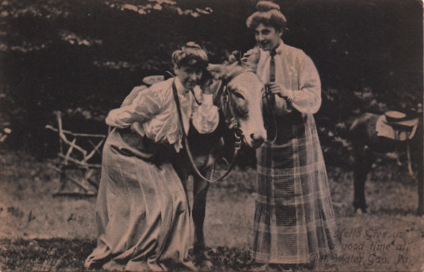
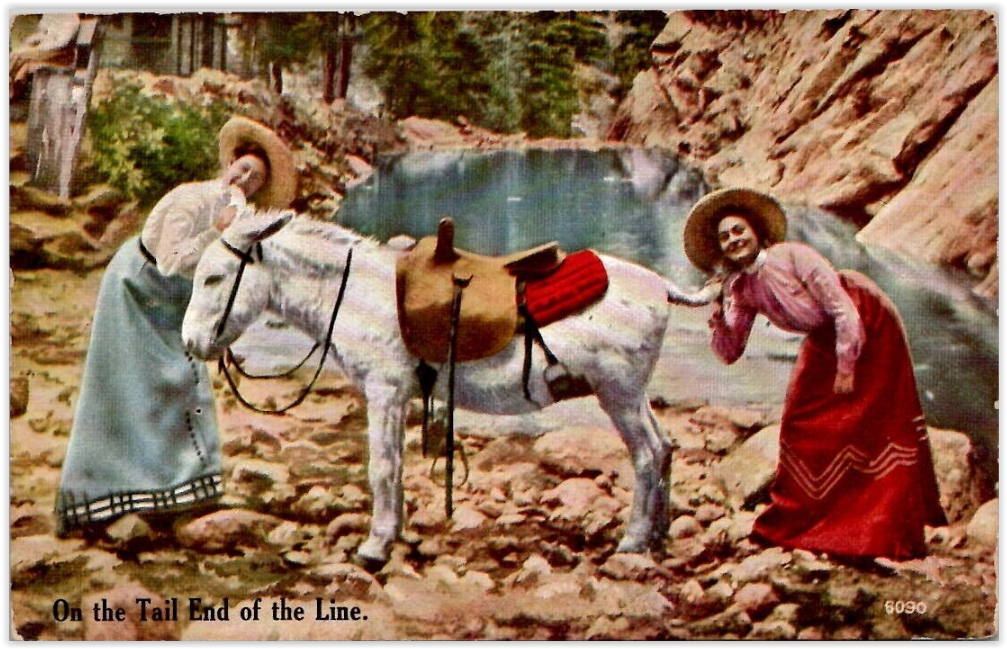
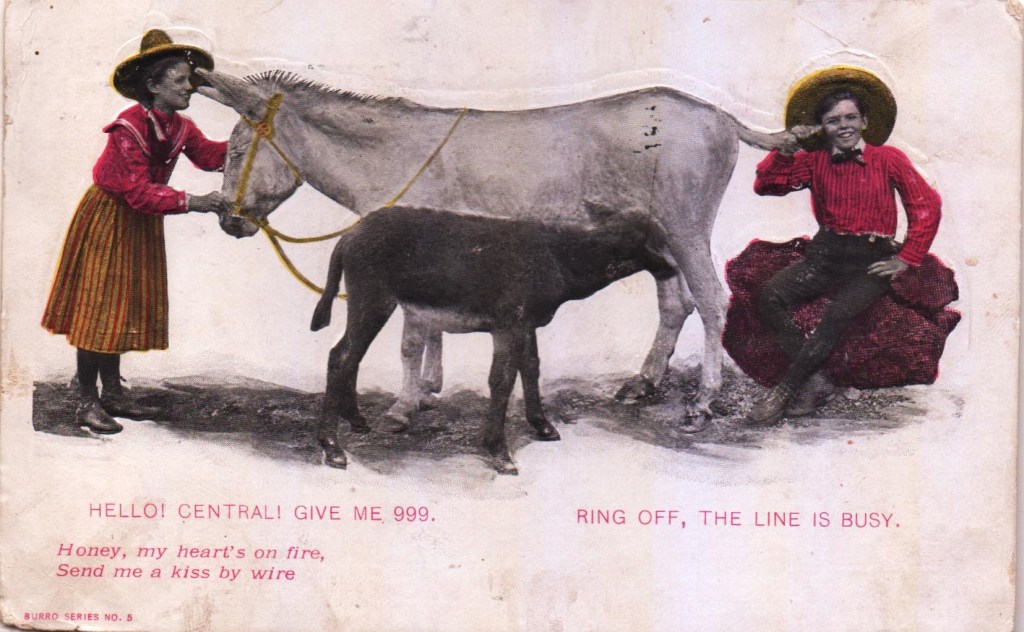
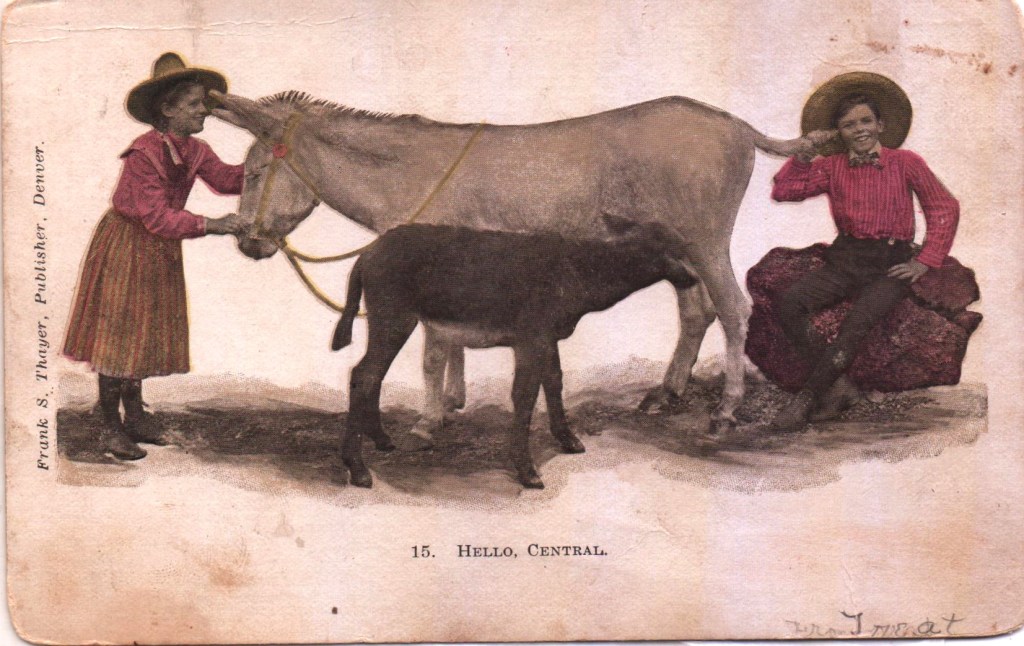
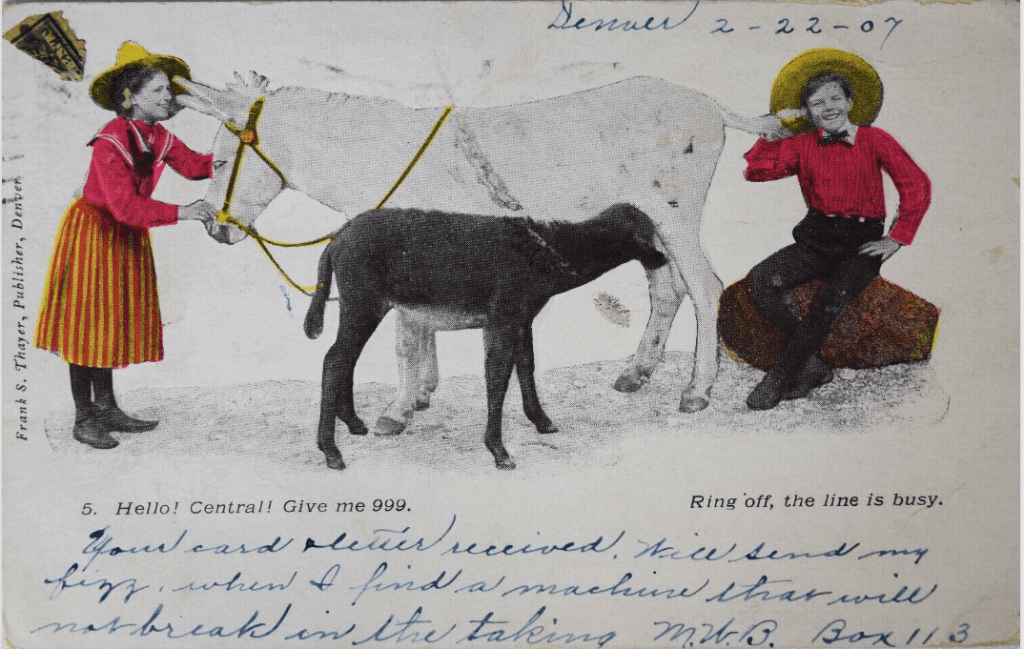
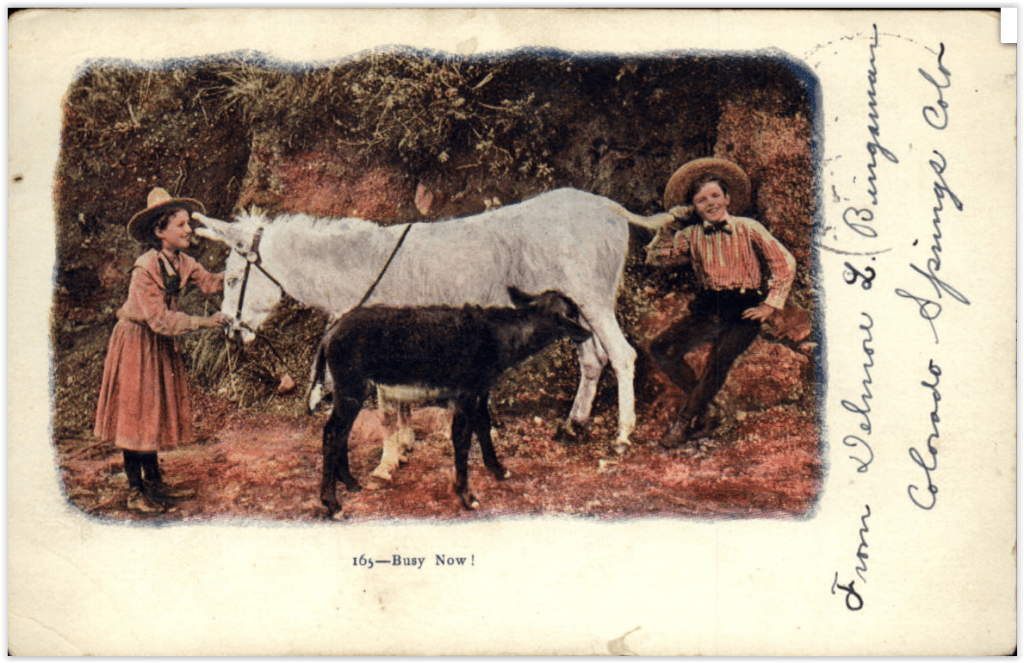
Other countries do a different division of their numbers, by the way: They also vary in whether they prefer hyphens or spaces or periods between the…my, we’re taking a long time to get to the question of why phone calls were associated with donkeys. I couldn’t find out anything st all about that: the Interwebs have their limits, somehow. Maybe we just had more donkeys around the house in those days, or maybe the joke sold best in western areas, where there were more donkeys than telephones.
Nor can I do much more than illustrate how one simple photograph could bounce from postcard to postcard, with slightly different jokes. Other cards in my inventory play a similar trick: an identical picture above several different jokes, and nearly every one involves a donkey. A lot are from Frank S. Thayer, of Denver, who, as you can see from just these examples, must have sold pictures of his donkey to every tourist who passed through Colorado.
That’s probably the answer. Maybe when the boys in Thayer’s shop were short a card for the next season’s assortment, they would simply burro a picture.





















 Blogsy Babbles