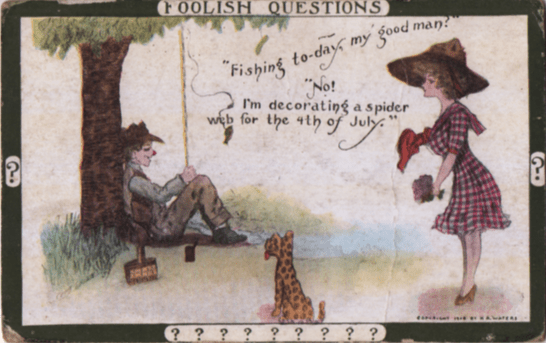
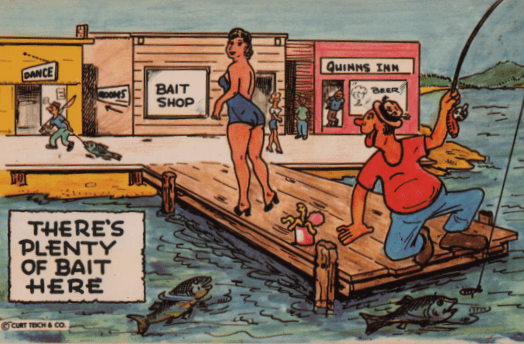
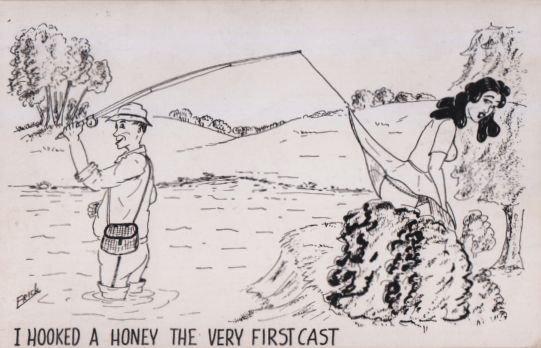
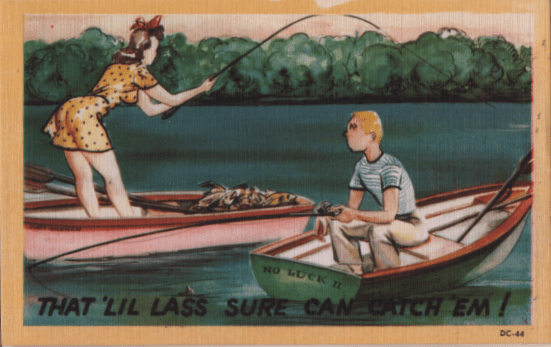
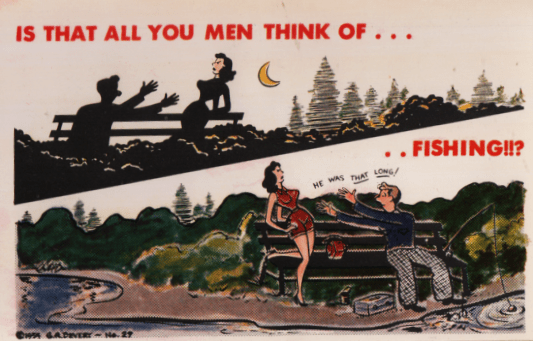
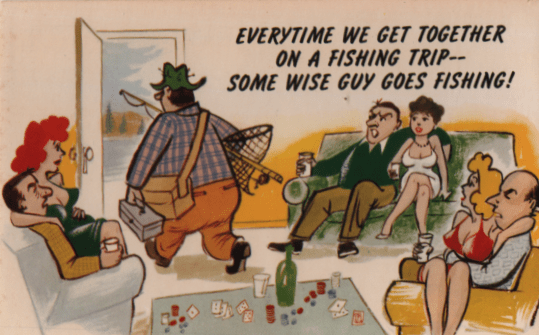
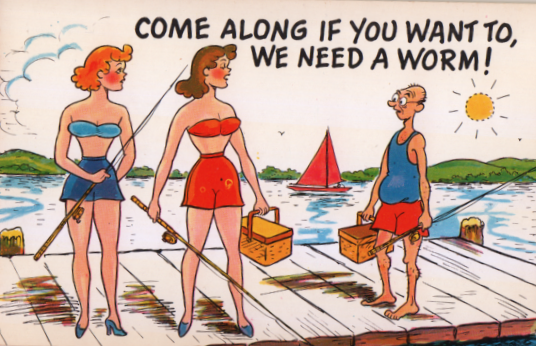
Three years ago or thereabouts, we considered in this space the nightmare possibility of an alien civilization coming to earth years hence and finding little that remains of our culture but boxes and boxes of someone’s stock of old postcards. The nightmare, of course, would be that the columns found in this space would no longer exist to EXPLAIN these postcards. Thus, the successors to our command (such as it was) of the Earth would have to conclude that men fished, and women wondered why.
We have also discussed the fact that women DID fish, but to go by the evidence presented by the cards, the vast majority of women on Twentieth Century Earth were, at best, just a distraction to the poor, persecuted fisherman.
The fisherman, we see from the cards, was a man with a purpose, a noble quest, always discouraged and sometimes even foiled, in one way by the presence of women.
Success in his chosen art was hardly guaranteed, and even when he did achieve some major goal, he could count on women somehow getting in the way of his triumph.
The most skilled of fishermen could hardly set out to work at his craft without some woman providing both distraction and obstruction.
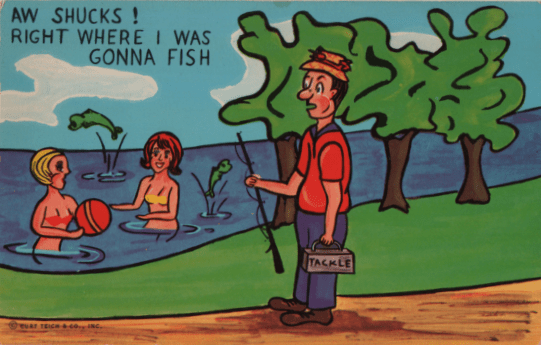
This was never the fault of the fisherman, of course, but of huge masses of women who chose to swim in the traditional sacred fishing sites (to judge by how many more times than two this particular gag was used.)
Even those women who did become skilled at the manly art of fishing turned out to be impediments to the men concentrating on their own piscatorial pursuits.
Some men did apparently attempt to explain their passion, with little success.
Attempts to include the ladies on fishing retreats generally ended in disappointment.
And those women who DID fish expressed undeserved scorn for the men who had attempted to show them the way. But there was one threat even worse than the prideful female who thought herself worthy of the fishing rituals.
But he was early at the office next morning. Oh, he was early there. If he could only be there first, and catch Bob Cratchit coming late! That was the thing he had set his heart upon.
And he did it: yes, he did! The clock struck nine. No Bob. A quarter past. No Bob. He was dull eighteen minutes and a half, behind his time. Scrooge sat with his door wide open, that he might see him come into the Tank.
His hat was off, before he opened the door; his comforter, too. He was on his stool in a jiffy, driving away with his pen, as if he were trying to overtake nine o’clock.
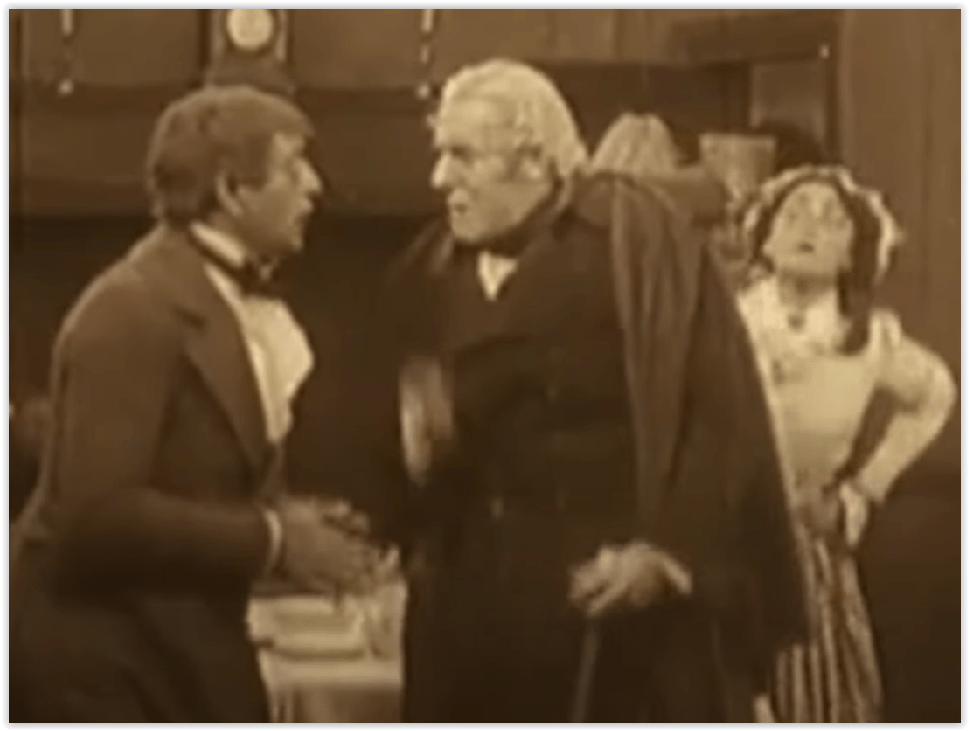
“Hallo,” growled Scrooge, is his accustomed voice as near as he could feign it. “What do you mean by coming here at this time of day?”
“I’m very sorry, sir,” said Bob. “I AM behind my time.”
“You are?” repeated Scrooge. “Yes, I think you are. Step this way, if you please.”
“It’s only once a year, sir,” pleaded Bob, appearing from the Tank. “It shall not be repeated. I was making rather merry yesterday, sir.”
“Now, I’ll tell you what, my friend,” said Scrooge, “I am not going to stand this sort of ting any longer. And therefore,” he continued, leaping from his stool, and giving Bob such a jab in his waistcoat that he staggered back into the Tank again: “and therefore I am about to raise your salary.”
Bob trembled, and got a little nearer t the ruler. He had a momentary idea of knocking Scrooge down with it, holding him; and calling to the people in the court for help and a strait-jacket.
“A merry Christmas, Bob!” said Scrooge, with an earnestness that could not be mistaken, as he clapped him on the back. “A merrier Christmas, Bob, my good fellow, than I have given you, for many a year! I’ll raise your salary, and endeavor to assist your struggling family, and we’ll discuss your affairs this very afternoon, over a Christas bowl of smoking bishop, Bob! Make up the fires, and buy another coal-scuttle before you dot another I, Bob Cratchit!”
It’s a great scene, sometimes suspenseful in the possibility that Bob in a panic, will knock Scrooge down before the old man gets his point across. Screenwriters just love Scrooge’s “therefore” doubled, and so do the actors.
In Hicks, we dissolve from the food at Fred’s on Friday night to the food on the Cratchit table next morning. Mrs. Cratchit reminds Bob that he promised Mr. Scrooge to be all the earlier this morning. Choking down the last of his coffee, he rushes out, pausing only to let Tim put his hat on for him. The Cratchits watch from the window as he hurries out, minding the ivy pavement; Scrooge, meanwhile, peers through a grimy window to see him approach. Spying the clerk, Scrooge jumps to his accustomed position at the desk, his back to the door, trying not to successfully to stop grinning. Fortunately for his scheme, when Bob enters, the clerk, like us, can see only Scrooge’s back, just as at the beginning of the movie. Bob believes he can still slip in unobserved and, of course, is incorrect about this. “Mr. Cratchit! What do you mean by coming here at this time of day?” “I am very sorry, sir. I AM behind my time.” “I think you are, sir. I think you are!” Bob starts to explain, but Scrooge breaks in to say he is not going to take this. He thumps his desk, trying not to giggle at the effect of this. During the “therefores”, he gives Bob a playful push. Bob seizes the ruler in self-defense. When he realizes his employer has just spoken of raising his salary, he cries, “Sir! You’re joking!” “Never more serious in my life, Bob,” says Scrooge. Once Bob is convinced, he is ordered from the office to go be with his family; Scrooge even hands him his hat. “They’ll be wanting you today!” As Bob rushes out, Scrooge calls, “Merry Christmas! “Happy New Year to everyone!” “God bless us all! God bless us, every one!” We hear “Hark! The Herald Angels Sing” and then see Scrooge in church, in the same pew as Bob.
Sim I comes rushing into his office, very happy to see Bob is not present. He assumes his pose. Bob hustles faster and faster along the street, still hoping he can make it in time. Scrooge can’t help looking up. “Cratchit! You’re late!” “Sir!” “What do you mean by coming here at this time of day? Hmmmm?” The dialogue proceeds as written, through “I was making rather merry myself.” “Well, we won’t beat about the bush,” Scrooge informs him, his manner firm, businesslike. But he delivers the line about raising Bob’s salary laughing, and nodding to assure Bob he means this. Bob is not convinced, so Scrooge goes on, “I haven’t taken leave of my senses, Bob: I’ve come to them. From now on I want to try to help you raise that family of yours, id you’ll let me.” He makes a remark about a bowl of hot punch, then orders Bob to buy another coal scuttle before he dots another I, thumping the desk to emphasize this stern command. Finally believing the old man is in earnest, Bob rushes to build up the fire. Scrooge goes on laughing. “Ah,” he finally snarls to himself, “I don’t deserve to be so happy.” He tries to get back to business and gives up, throwing his pen over one shoulder. “But I can’t help it. I just can’t help it.”
In Rathbone, we watch Bob rush in and start to work, only to be called on the carpet by the boss. Scrooge is back to his finest Franz Liszt manner, and Bob is very frightened, blaming his lateness on the previous night’s merriment. You see, someone mysteriously sent them an enormous turkey, and…. Scrooge snaps that he is not going to take this any longer and then laughs, giving Bob a jab with one elbow. Bob has no idea what’s going on, his eyes widening as Scrooge lifts a cloth from the desk to reveal a punchbowl. Only when Scrooge fills a glass with punch and hands it to him does Bob begin to catch on. The two men raise their glasses in a toast and fade from view.
Sim II finds us in the office: the clock shows 9:18. The dialogue is abbreviated, with most of Bob’s mashed into one speech; he is shrinking and staring through most of this scene, looking as pitiable as at any point in the movie. He continues to back away as Scrooge turns friendly, apparently more frightened by the new Scrooge than the old one. Scrooge breaks into a booming and slightly sinister laugh; he does not mention a new coal scuttle.
In Matthau, Cratchit is rushing up the street and into the office, where he is met by his employer. “You’re late!” “Just a minute and a half: it will never happen again, sir.” Scrooge rushes into the “I’m not going to stand for this” and proceeds through THREE therefores, way over the op on every one of them, dropping next to a very mild “I’m going to raise your salary.” Stunned, Bob drops the overshoes he’s been clutching. Scrooge wishes him a merry Christas, “merrier than any I have given you. Make up the fires! And use lots of coal!” Bob is still taking this all in, asking, “But sir…is such an extravagance good for business?” Scrooge is shocked by such a mercenary thought, using it as a cue to launch into “Mankind Should Be My Business”. During this song, he ventures outside to make amends with everyone he offended earlier during the song “The Stingiest Man In Town”: the match girl, the chestnut vendor, the newsboy, the charity solicitors (not previously seen), and even the cats and dogs who sang along with the earlier song.
Scott, humming, unlocks his office and glances at the clock. “Nine o’clock. Late again, eh, Cratchit? We’ll see about that.” Cratchit runs up to the counting-house. As he takes out his key, one elbow bumps the door and it opens, dashing his hopes of being the first one there. Bracing himself, he enters quietly, apparently still hoping he can get in unobserved. A call of “Mr. Cratchit!” makes him wince. “Yes, sir.” “Do you know what time it is?” “Yes, sir.” “What time is it?” “Eighteen minutes oast the hour, sir.” “Eighteen and a half minutes past the hour. What do you mean by coming here at this time of day?” The dialogue proceeds as written through “therefore I am about to double your salary.” Scrooge tosses a small bag of coins to Bob, who looks unsure about which of them is going mad. “Double my salary, sir?” Scrooge laughs and embraces him. “I’ll double your salary for a start, and endeavor to assist your family in any way I can. And Tim will walk again, upon my life he will. But we’ll talk about it over a Christmas bowl.” He pauses, studying Bob’s face, and asks, “What’s wrong with you?” “Nothing, sir. It’s just that….” A look at Scrooge’s smile, which is broad and genuine, makes him start over: “Nothing. Thank you, sir.” Scrooge returns to business. “Make up the fire before we freeze to death. And buy some more coal before you dot another I, Bob Cratchit!”
Stewart is grave; his clock shows 9:18. Bob is in great apprehension; hurrying in, he begins to write furiously. Scrooge waits a moment and then calls “Mr. Cratchit: a word with you.” The cold, sadistic schoolmaster is back; Bob comes out of the Tank, clutching his own elbows for warmth and moral support. “What do you mean by coming here at this time of day?” “I’m very sorry, sir. I am behind my time.” “Oh, yes, you are. Indeed you are.” “It’s only once a year, sir. I was making rather merry yesterday, sir.” Bob nods along as Scrooge begins his scold. Come the line about raising the clerk’s salary, a gleeful Scrooge thumps his desk with a triumphant “Ha!” and adds “Merry Christmas, Bob!” Bob lunges for the fire irons to defend himself against the madman. Scrooge, observing this, delivers the next lines in self-defense. Bob takes a while to understand it all, but once the threat of violence subsides, Scrooge orders him to make up the fire, hands rubbing together as if the old man has noticed the cold for the first tie. Bob sets to it with a right good will.
Nostalgia Time: In 1991, I was able to sell an article on what I deemed, watching Saturday morning cartoons (nostalgia for some other time) were the dumbest new toys being slung at us for the holiday buying season. This was fun (it was headlined by Baby Magic Potty, after all) and I produced one of these articles every year for the next half dozen years. These did NOT sell.
This week I turned up a copy of the 1995 edition. Realizing that some of the hapless children who experienced these toys may be old enough to read on their own, I have reproduced that minor opus, so that you can re-experience the joy or tedium of your childhood discoveries. I have resisted the temptation to change the phraseology, so you can see what sort of blogger I was in The Time Before Blogs.
Heckuva life, working in product development. You’ve got to redesign last year’s cupholder so next year’s Chevillac Gottago can be touted as the newest and most improved car on the market. You have to add a wire or a function to your keyboard every ten days or your computer falls behind the competition. And every fall, you need to come out with new toys that do more than last year’s, or do it better, or faster, or meaner, or cuter.
Bur hey, this is America. Yanke ingenuity gave us the first commercially viable phonograph, the first marketable electric light, the first balloons-and-bluegrass festival.
Of course, it also gave us the Edsel.
So here is this fall’s crop of new toys, all decked out in cute commercials with snappy jingles, hoping to induce Santa to pack them into the sleigh. It is inevitable that one or two come at us that looked good in development conference rooms but which Santa wouldn’t be caught in a chimney with. Those are the toys on my personal Wish List (as in “I wish I knew what was in the minds of the geniuses who came up with these.”
I.BIG JOHN
Any toy featuring a toilet leaps to the top of this list. In this competition, you dump your “green scuzzies” into Big John and pull the handle. Unfortunately, the plumbing is a bit clogged. Your aim is to dump all of your scuzzies and keep the toilet from flushing them all over you. I see this as the educational toy of the year: Dozens of children will be inspired to become plumbers because of this Christmas surprise.
II.SURPRISE HAT SUSIE
Take off Susie’s hat, and you find out what color her hair has been streaked! Jewels drop out of the hat: gee, they’re color-coordinated with that stripe of hair! Ans the hat can turn into a purse!
Any interest taken in this doll after the first five minutes is up to the owner.
III.SUZIE STRETCH
It is NOT a good year for little girls named Susie. This particular Susie is a doll you bind to yourself at the wrists, ankles, and waist, so she can dance with you, run with you, exercise with you, and so forth. But wait! There’s more! At night, you twist her head around so that her second face, the one with closed eyes, is uppermost, so she can sleep with you, too. It’s another educational toy, I think: something to do with teaching us the dangers of co-dependency.
IV.BUBBLE PUP
The 1995 version of “Let the kids run around and knock over furniture” game, unlike previous versions like Grabbin’ Grasshoppers, has a dish full of soapy water that can be spilled on the rug. A fat, benign puppy squats in the center of the game board and blows bubbles, which the players catch in little cups. Since the bubbles break immediately in the cup, arguments about the score can add gaiety to the spills and broken lamps.
V.PRINCESS WISHING STAR
Ask a question, wave your magic wand, and touch the princess. Stars on her head blink “YES”, “NO”, and “?”. The star that remains lit at the end answers your question. This connection of asking questions with waving a wand, disturbs me. Isn’t it another question of how our society is turning away from traditional values into New Age gimmickry? Why can’t the kids use a Magic Eight Ball, like their ancestors?
VI.KARATE FIGHTERS
The problem, I guess, with the classic Rock-‘Em-Sock’Em Robots was that the plastic fighters were fastened down at the feet, and thus unable to kick each other in the crotch. This has now been remedied, thanks to modern technology.
VII.LIBERTY BASE
I guess this is deep I the future, when the Statue of Liberty has tipped a little, and is buried bust-deep in the dust of civilization or something. Anyhow, you use her as a secret military base. Her fce even pops open so your fighters can fly out shooting. This is also an educationall toy: national monuments CAN be functional.
VIII.POWER SPARK WELDER
This machine tool pumps out molten plastic, so you can put toys together after you’ve smashed them. In fact, the commercial tells us we can now smash toys as much as we want. Good. Can we start with Big John?
IX.STAR CASTLE TEA PARTY SET
If you haven’t been paying attention over the last few years, you may not know that the major theme for the nineties is miniature playsets: teeny figures that come with teeny houses or teeny haunted houses, and an endless line of accessories. It is not surprising that someone should have come out with this miniature castle, complete with princess, secret passages, furniture, and so forth. Ah, but not only can you play adventures with this castle, you can also close it all up, dill it with water, and use it at your tea party. The tops of the towers are the cups, and the whole castle is the pot. No word on what the miniature princess thinks of all this. She may be thrilled to have a castle with indoor plumbing.
X.CHICKEN LIMBO
This is similar to the bar you use for dancing the limbo, but in this version a lastic chicken stands over you as you bend yourself under her. If you fail to clear her tail, she emits a wicked, cackling laugh. This is so dumb it is obviously destined to become a bestseller on every college campus from coast to coast.
These are just the top ten. Honorable Mention awards must go to Mimi and the Gor-gons, simply for having the dumbest name of any new product this season, and Barbie’s Mustang, a two-seater that stretches into a four-seater when needed, simply because a list of this nature is not official if barbie isn’t mentioned somewhere.
This 1995 crop shows promise. Whether Big John becomes as much of a classic as Baby Magic Potty, or if Surprise Hat Susie can ever mean as much to us as that pair of boots Barbie had a few years back with rubber stamps in the heels remains to be seen. But the toys of this new holiday season are definitely one more example of the practice of good old Yankee ingenuity.
Pigs are apparently nearly inextricable from Human society. One author says you can find them in more settlements than you find dogs, which confirmed his suspicions about humanity. One conspiracy theorist connected all the dots a few decades ago, and endorsed a ban on eating pork: he declared this a form of cannibalism. (See, the clues are that story about Circe turning Odysseus’s crew into pigs, and in the dietary laws of…never mind. The Interwebs will tell you all about it, along with notes about which current politicians are to blame for it.)
We have covered pigs before in this space, but largely in conjunction with the bygone habit of sending postcards with pigs on them as a New Year’s wish for prosperity. (This is ripe for study in thesis or dissertation: a geographic determination of which countries sent cards with pigs for that, which sent cards with fish—also discussed hereintofore—and which sent both, just to be sure.)
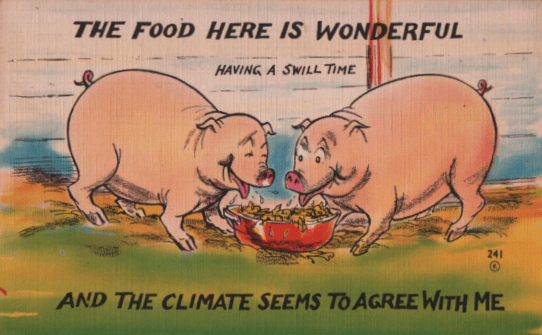
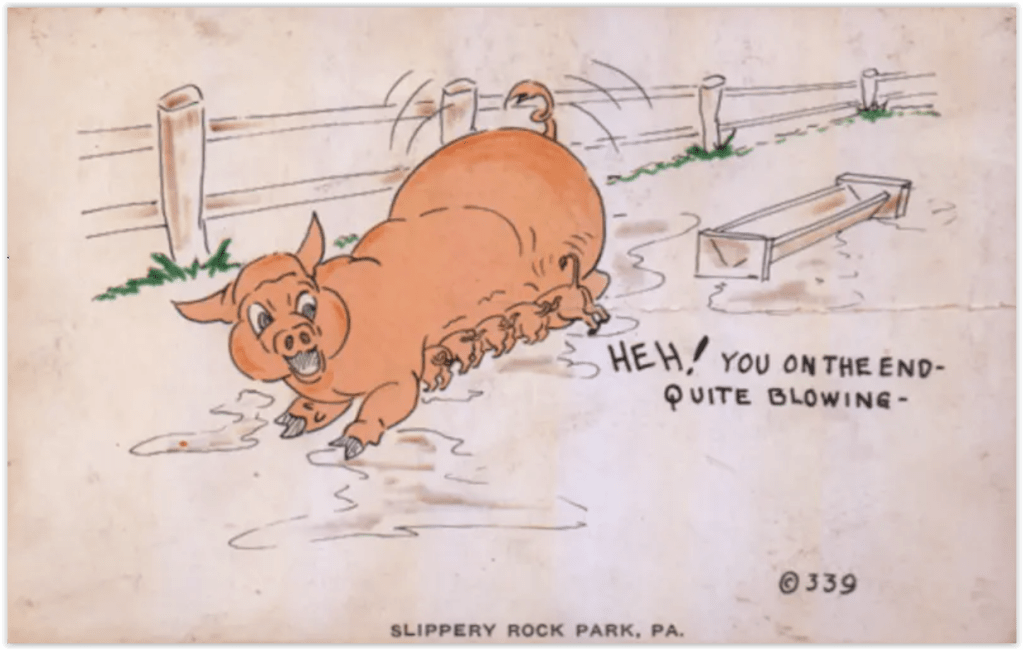
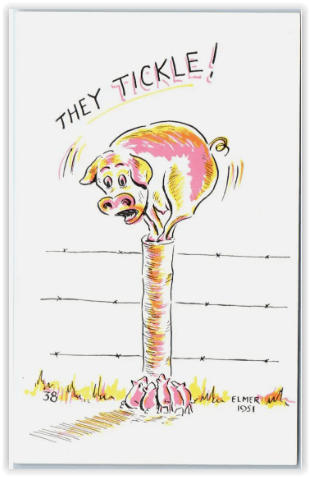
As with other animals in the postcard universe, pigs have their lives reduced to only a couple of traits useful to cartoonists. And for a majority of cartoonists, pigs had two basic habits: they ate a lot and they fed a lot.
There were outliers, of course—a few postcard pigs made loud nises, and some were simply there to be fat without considering their dining habits—but by and large, pigs were what the educational community once called “eager eaters” (as opposed to picky eaters.) Eager eating was encouraged among small children, despite all the postcards which warned them not to be a pig.
But for those (of us, admit it) who go on vacations simply to seek out the best all-you-can-eat buffets, this was a Good Thing (or a SWILL thing, if you HAVE to.)
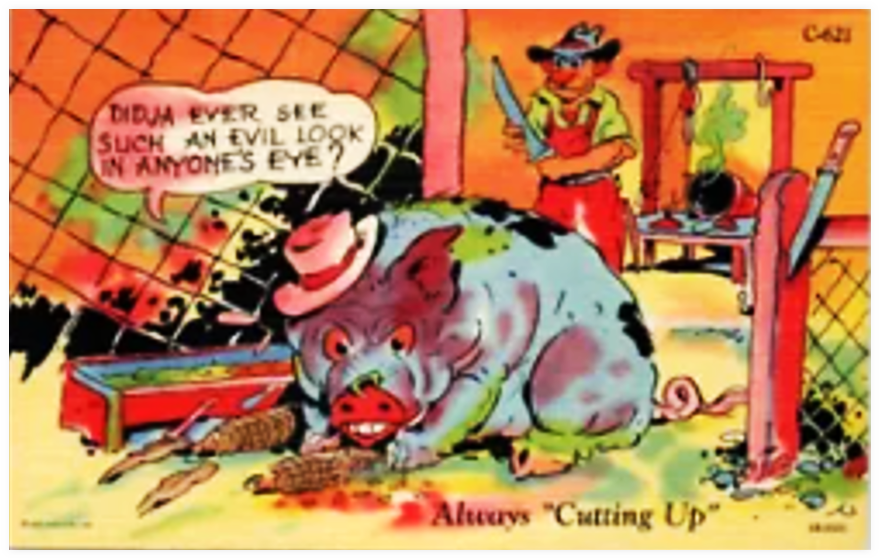
There are a few postcards dealing with butchers and such realities of a pig’s life, this was NOT the sort of feeding that tickled the cartoonists’ pens.
But the observation of a pig’s dining style (see the pop song “Would You Like To Swing On a Star”), what really amused the postcard artists was the way pigs fed others, especially their children.)
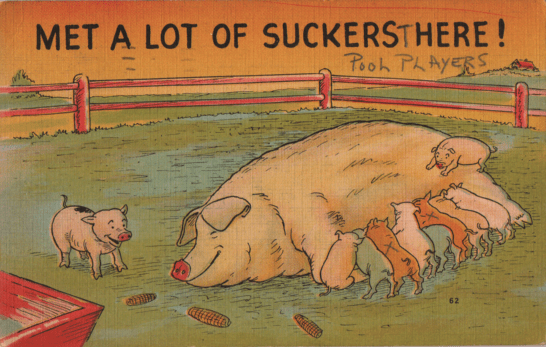
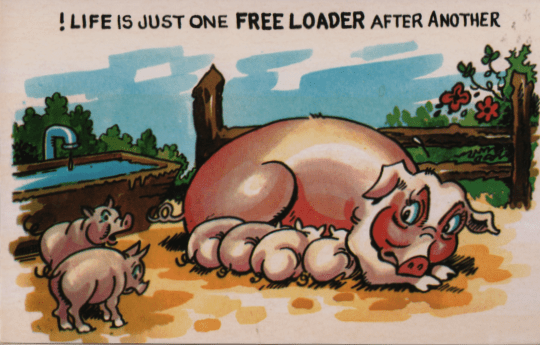
It’s not as if the pig is the only animal that nurses its young lying down, nor even that it refuses to do this any other way. It’s just the sheer resemblance the classic nursing pig has to tourists like me at that all you can eat buffet.
The sow (or Mama Pig) has six nipples, see, so she can efficiently handle half a dozen offspring at once. And we humans find this fabulously funny, providing us with dozens of punchlines.
We COULD have had a blog dealing just with the hungry piglets and demands made on Mom. But my inventory is low on these since, for some reason, they proliferated in the second half of the twentieth century, not the first. (Was the first half of the century more squeamish, or the second half more removed from the realities of livestock? There: another dissertation topic. I keep pitchin’ ‘em and you keep whackin’ ‘em over the backstop.)
The tickling gag and this one seem to be the most popular, with four or five cartoonists each trying a hand at them. For reasons not known to me, the gag about “Mom, can Eustace stay for lunch?” is covered only on cow postcards. Similarly, the joke about other animals, including pigs, coming over for a drink applies mainly to Mama Cow. Perhaps Mama Pig lying down takes away some opportunities for free mil delivery.
Maybe it’s just a matter of pigs being easy to draw (One big fat oval, a circle, and a snout) or that little piggies are so cute, that make for so many mama-and-piglets postcards. Or perhaps, like the conspiracy theorists, we just see our own plight in the life of the pig. (Note on vocabulary: I did grow up in pork producing territory, where the word ‘hog’ was everywhere and ‘pig’ was used only when referring to Porky, on TV. Postcard artists, as well as other comic creators, just seem to think ‘pig’ is the funnier word, so I have followed suit. I need all the help I can get.)
He went to church, and walked about the streets, and watched the people hurrying to and fro, and patted children on the head, and questioned beggars, and looked down into the kitchens of houses. And up to the windows; and found that everything could yield hi pleasure. He had never dreamed that any walk—that anything—could give him so much happiness. In the afternoon, he turned his steps toward his nephew’s house.
He passed the door a dozen times, before he had the courage to go up and knock. But he made a dash, and did it.
“Is your master at home, my dear?” said Scrooge to the girl. Nice girl: very.
“Yes, sir.”
“Where is he, my love?” said Scrooge.
“He is in the dining-room, sir, along with mistress. I’ll show you upstairs, if you please.”
“Thank’ee. He knows me,” said Scrooge, with his hand already on the dining-room lock. “I’ll go in here, my dear.”
He turned it gently, and sidled his face in, round the door. They were looking at the table (which was spread out in great array); doe ese young housekeepers are always nervous o such points, and like to see that everything is right.
“Fred!” said Scrooge.
Dear heart alive, how his niece by marriage started! Scrooge had forgotten, for a moment, about her sitting in the corner. With the footstool, or he wouldn’t have done it, on any account.
“Why, bless my soul!” cried Fred, “Who’s this?”
“It’s I. Your Uncle Scrooge. I have come to dinner. Will you let me in, Fred?”
Let him in! It is a wonder that he didn’t shake his arm off. He was at home in five minutes. Nothing could be heartier. His niece looked just the same. So did Topper when he came. So did the plump sister, when SHE came. So did every one when THEY came. Wonderful party, wonderful games, wonderful unanimity, wonderful happiness!
And so Scrooge is reconciled with what there is of his family. Dickens allows a lot of room for interpretation in this passage, and those filmmakers who include Fred make the most of it. For one thing, this becomes another space for Scrooge to set out whatever moral this particular version is going for. Note, by the way, how often Scrooge is the last to arrive, whereas in the text he shows up while Fred and wife are still getting things ready. Note also that we are again ignoring the hint that Scrooge’s family is about to be increased (the business about Scrooge regretting having startled his niece-in-law.
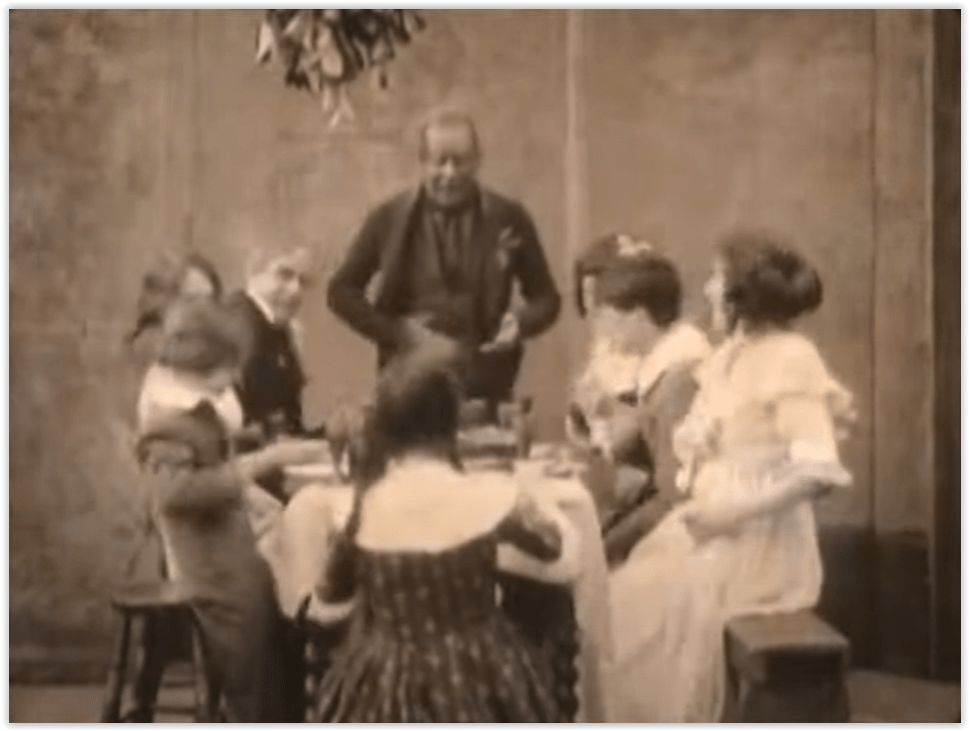
In Hicks, we see Fred’s party already begun, with Fred delivering the business about how Uncle Scrooge won’t come and dine with us, and don’t miss much of a dinner. Scrooge is moving slowly toward the door, passes it, comes back, goes up and raises a hand to the knocker and stops. He thinks this over, and reaches up again, knocking just twice before starting away from the door. He is well onto the sidewalk when the door opens and, seeing a non-threatening maid, he steps back up to go through that dialogue as written, with a very earnest and almost desperately jolly “He knows me! He knows me!” In the dining room, the guests sit down to the table, Fred still standing to see if they are all comfortable when the door slowly opens and a shy but smiling Scrooge peeps in. The dialogue proceeds as written from here; we look from face to face among the stunned guests; Mrs. Fred rises, as hostess, curtsying a little as she welcomes him. Fred gives up his seat at the head of the table to his uncle, who wishes everyone a Merry Christmas. His attention wanders, and he himself wanders to a snow-trimmed window, where he hears “Tiny Tim, at a dreamy distance, singing “Hark! The Herald Angels Sing”. Fred draws him back to the table as the turkey is brought it. Bread is sliced, allowing us to cut to a scene of Mrs. Cratchit slicing bread at HER table on December 16th.
Owen is in a hurry, very jolly. To the maid answering the door, he says, “Hello, my love! Will you tell Mr. Fred I want to see him?” He pinches her chin, too, which she not only accepts, but rather likes, giving him a calculating once-over. “Fred!” “Well, who’s this?” “Your uncle! Your Uncle Scrooge!” “I didn’t know you.” “The smile changes me, doesn’t it?” Fred ushers hi inside, where the guests refuse to believe this CAN be Uncle Scrooge. It’s the smile, they complain, and besides, he said…. “That Christmas was a humbug?” Scrooge demands, “That people who celebrate it are fools? It was stupid of him! He won’t say it again, mark you: he won’t say it again, ever!” He whispers a secret to Bess, the prospective Mrs. Fred; she then whispers the secret to Fred, in great excitement. He also is thrilled, and we shift now to the Cheat Ending seen in the last installment.
Sim I taps hesitantly at Fred’s door. When the door opens, he enters with reluctance. No words pass between him and the maid, who watches with growing interest as he all but tiptoes inside. After removing his topcoat to reveal a very dapper suit, he approaches the double doors of the dining room and stops, obviously considering a speedy retreat. Doubting his welcome, he looks back to find the maid nodding at him, encouraging him to go on. Nodding in reply, he does so. The music we have been hearing from the room (“Barbara Allen”) stops. Everyone is surprised; Mrs. Fred emits a faint cry. Fred, calling “Uncle Scrooge!”, strides to meet him. Scrooge inquires “Is it too late to accept your invitation to diner?” “Too late? I’m delighted! Delighted!” Scrooge steps past him to Mrs. Fred, asking forgiveness so humbly that she is won over in a second, and kisses him, saying that he has made Fred so happy. Topper gives a wink to the pianist, who strikes up a polka. Scrooge dances very well with Mrs. Fred, for someone who can’t have had much practice lately.
In Rathbone, only four people are sitting down to dinner at Fred’s. Everyone is similarly thrilled to see Uncle Scrooge arrive. He, in his turn, is impressed by the size of the turkey, which is easily three times the size of the goose we saw on the Cratchit table.
Sim II confronts a plump, cheerful maid. After an abbreviated version of that exchange, he goes inside. Mr. and Mrs. Fred are alone together, looking sat the table: turning, both exclaimed, “Come in, Uncle!”
Matthau and Caine stop off at Fred’s to hand over some presents, but that’s all.
Scott strolls down a very snowy avenue, twirling his cane. Fred, inside his house, is giving his wife a gold bracelet. Hearing a knock, Fred goes to the window to look: he and his wife (Janet) are astounded by what they see. Scrooge, entering, is perfectly self-assured, entirely at home. Fred decides he is glad to see his uncle, and conducts him to the dining room. Mrs. Fred is reserved, but says all the right things expected of a hostess. Scrooge sees through this, and announces that he is more of a surprise than a pleasure. Fred, not offended by this, reminds him of his previous sentiments. Scrooge recalls these too, at greater length, in fact, than he delivered them in the first place. HE recalls saying that Christas was “a false and commercial festival devoutly to be ignored”, which bears little resemblance to what he actually did say. Well, says he, he has come here for three reasons: the first is to take back what he said about Christmas. “That was a humbug.” “Was it?” “I didn’t know it then, but I know it now.” The second is to meet Fred’s wife. “Well, here she is.” “Yes, and a beautiful woman she is, too.” He confides that he was once in love (which Mrs. Fred believes) but had neither the courage, nor, perhaps, the depth of feeling that his nephew and niece=-law have. The third reason for coming is to accept the invitation to dinner, if that is still I force. Fred says he was sure that one day his uncle would accept. Mrs. Fred has thawed as well, and accepts him into the family. He asks whether she likes to play party games, and indulges in a private little joke, telling her that the proper simile for “tight as” is “a drum” (and not the answer given in his vision.) He then makes further apologies, saying that perhaps he chose to forget how much he loved his sister. “God forgive me for the time I’ve wasted.”
Stewart visits a church, feeling a bit out of place (he has to be prompted to remove his hat) but finding his voice on “God Rest Ye, Merry Gentlemen”. He goes from there to Fred’s but paces for a while on the sidewalk while, inside, Topper sings a comical song “I’m So Terribly Shy”. Scrooge makes a dash for the door at last and knocks, just twice. A pudgy maid is surprised to see a late arrival. They converse as in the text. The others have sat down to dine by the time Scrooge peers around the door. Clearing his throat to attract attention, he calls, with timidity, “It’s I. It’s your Uncle Scrooge. I’ve, uh, come to dinner. Will you have me, Fred?” Fred cries, “Bless my soul!” The rest of the company, silenced by shock, sit and watch. Scrooge moves to Mrs. Fred. “Can you forgive a stupid old man who doesn’t want to be left out in the cold any more? Will you take me in?” This strikes to her heart and, saying, “Merry Christmas, Uncle!” she kisses him. The guests applaud. After dinner, we see the pair of them polka.
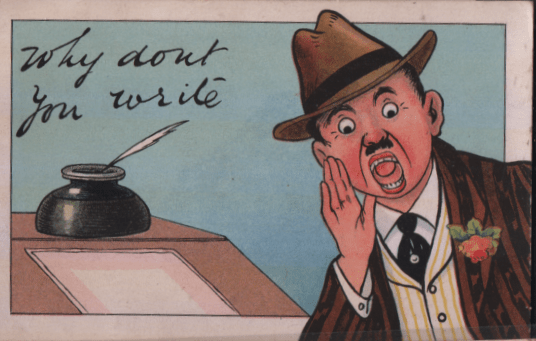
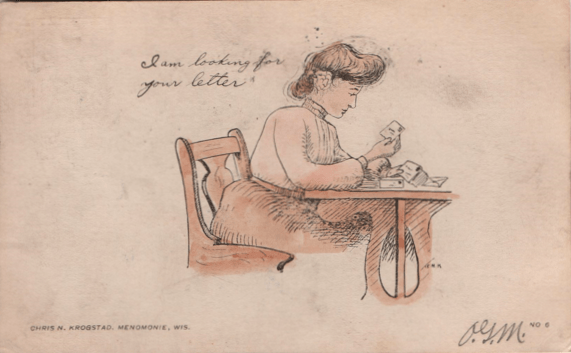
We have addressed this question before, but addressing things gets to be a habit when you’re dealing with postcards. (Please, please: so much applause frightens the neighbors.) Although “Having wonderful time”, “Wish you were here” and “I am fine; how are you?” are all popular postcard messages, back around the turn of the last century, one of the most persistent was “Why haven’t you written?”
You’ll understand this if you throw your imagination into the thrilling days of yesteryear. We go back to a day when phones were rare and expensive, not a pocket accessory. There was certainly no chances to use email, or social media posts. Unless you were within walking distance of your friends and relatives—and in times of heavy snow and omnipresent ice, even that might not be good enough—the Postal Service was your only way to keep in touch.
The etiquette of the system is intuitional, but even in those days was frequently shuffled aside. The basic rue was “I write you a letter, you write ME a letter.” Sending someone two letters in a row was going above and beyond (this was in a day when a four or five page letter was not unusual, so a lot of work was involved.) Another rule, pertinent to the era of our concern, was “A letter demands a LETTER in return.” The receipt of a mere postcard did not count, which is why the jumble of designs and cartoons on postcards past includes so many “Here’s a card, I’ll REALLY write later” designs. This amounts to an apology for not taking the time to get out paper and an envelope (and it’s fascinating that the postcard industry was right there to supply this need. What other corporations produce products which apologize for their existence?)
That explains the aggrieved nature of so many of these postcards. They point out “You OWE me” or “I cared enough to write; what about you?”
We Do still have a little of that in the current century. Surely you had exchanges, back in the earlier days of the Interwebs, where you or your contact demanded, “Didn’t you get my email?” But there are alternatives now: texts and actual telephone calls. In the days when a trip to the mailbox involved rising hopes which would be dashed on arrival the anger was more fierce.
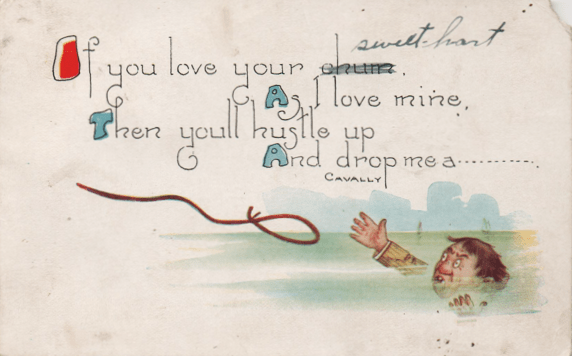
You COULD, of course, make a joke or a game of it. A mere hint (well, a blatant hint) might get a response where out and out scolding would not.
Oh, even just a pun would do the job.
To judge by how many years this particular pun was called into service. (Such a Fine Old Joke was a boon to cartoonists who needed to do a nagging postcard so as to get back to writing all those letters THEY owed people. I haven’t checked on how much fan mail postcard cartoonists received, but that’s a whole nother blog.)
Pretending to be concerned about the possible reasons for a lack of response was just as jolly, but a little more pointed. Your friend knew that YOU know they hadn’t run out of stamps, or paper, or ink. But at least you were going for the chuckle.
Other people simply prefer straightforward statement of their case. These are the postcard equivalent of rapping your foot when and where your friend can’t fail to notice: a short sharp reminder. Come to think of it….we’ll close now. I think I need to finish that stack of Christmas cards.
This is January, and this is NOT a food blog. Nonetheless, we are going to discuss a Christmas-related food experience. Those who are bothered by this may run out and buy Valentines.
Nuts in the shell were always included in Christmas stockings at our hose, resulting in the appearance of the family nutcracker and nutpicks in its little red box. I do not recall any of us getting into mischief with these nutpicks, which is unusual for our clan. I had no interest in nutpcisk: having gotten a small toolkit in my stocking one year, I learned with glee how well the screwdrivers opened walnuts. Pecans and almonds were more of a challenge, and hazelnuts resisted my efforts. But the Brazil nut was the hardest nut to crack.
It is sad, then, that shortly after I learned an easy way to open them, Brazil nuts seem to have slipped from our Christmas tradition. (You leave the Brazil nut in the freezer for a day and then throw it as hard as you can on the floor. This method MAY have something to do with Santa leaving them out of the stocking mix.)
In 2023, during another Brazil-free holiday, I started to wonder. I DO recall Carmen Miranda being “from Brazil, where the NUTS come from” but wondered if, like Russian dressing or French toast….
Nope, it’s for real. Even in Brazil, they call ‘em “chestnuts from Brazil”. The nuts grow in rainforests, and only in undisturbed ones, since lumbering operations and other clearances chase away the bees needed to pollinate the plants. If, like a younger me, you ever wondered why the Brazil nut in its shell looks like a fossil orange segment, this is because Brazils grow together in an orange-lake cluster, inside a coconut-shaped fruit. These are nibbled in the wild by the agouti, which is a warning to us all to avoid angering an agouti. If those teeth can nibble through a Brazil nut shell…dibs on making the horror movie Night of the Agouti. The debate online is, like most online agreements, pretty fierce over whether Brazil nuts are good for us. They are rich in selenium, whatever that does for you, but the shell contains a carcinogen (so don’t eat the shell.) These shells are often ground up to make a polishing agent for jewelry, and Brazil nut oil, I am informed, is used to lubricate clocks.
Besides appearing in big displays of mixed nuts in the shell (this existed back in MY day. Things may be different since Andrew Jackson was elected) there are plenty of fruitcake recipes which require slivers of the coconut-like delicacy. But for my money, if you aren’t freezing them and throwing them on the kitchen floor, you need your Brazil nuts covered in chocolate.
The nut is a staple in “bridge mix”, an assortment of nuts, creams, and other goodies robed in milk and dark chocolate. It has been around since the 1930s, when America was going through a bridge-playing craze, and there is a possibility that the stuff became popular as a snack at tournaments (easy to grab without getting up from the card table, see.) That’s too easy for many people, who prefer a story that the original bridge mix was made of candy which fell off the conveyor belts (bridges) at Hershey, and were tossed into a barrel so workers could have a free snack. According to this tale, a new manager decided having workers eat candy which had been on the floor FOR FREE was disgusting, and decided to package it and sell it to the public. A rather more believable story says the “bridge” was a quality control conveyor belt: imperfect chocolates were taken from that and put into a barrel for free consumption and THEN a new manager, etc. etc. “Bridge Mix”, “Bridge Mixture”, and other variations are all kind of trademarked by individual companies, each of which uses its own mix of fillings. (If you have eaten, and I hope you have, the Brach’s version, those jelly centers are officially “orange marmalade jellies” and “cherry marmalade jellies”.) Brazil nuts appear in virtually every assortment, and are immediately recognizable (avoided by most children) as the biggest lumps in the mix.
Another place Brazil nuts could be found in a chocolate coating was the old “Seven-Up”, discontinued after some forty years or so of the candy company and the beverage company arguing about the name. This was a candy bar which tried to be a box of chocolates in bar form, comprising seven chocolate shells (“pillows”), each with a different filling. In my day, that middle pillow was always a Brazil nut, but the confection was unpredictable: apparently over the years, there were fifteen different possible centers, some of which varied in flavor because of the unreliability of flavor suppliers. There was even a dark chocolate version of the bar which survived for only a few months before the whole line was given up in 1979.
Necco, your friends who invented those wafers, as well as conversation hearts (tell the people who left the room) does make a similar item called the SkyBar, but as no Brazil nuts are involved, it falls outside the scope of this discussion, along with all the other multi-flavor candy bars that once existed, which might be stretched to include the ORIGINAL Three Musketeers bar, and…..
Even the movies which do not cheat the ending like to toss in a scene showing the arrival of a prize turkey at the home of the Cratchits. They NEED to see that turkey done all the way through.
None I have seen quite discuss the effect of the arrival of a new entrée on the doorstep on Mrs. Cratchit’s dinner plans. Even if it arrived first thing in the morning, can you COOK a turkey twice the size of Tiny Tim by dinnertime? (One or two critics suggest this is a plot on the part of Ebenezer Scrooge, who wants to make Bob late for work on December 26th.)
Sim I shows us the Cratchits confused. They can’t imagine where the bird might have come from. Tiny Tim DOES wonder whether Mr. Scrooge sent it. This confuses his parents still further: what, they ask him, would make Mr. Scrooge so take leave of his senses? Grinning, Tim answers “Christmas!”
Matthau goes shopping. Later, we see the Cratchits marveling at the mysterious arrival of a turkey and gifts. They sing again that there IS a Santa Claus.
In Scott, the ppoulterer’s man kicks at the door in Camdentown to make the delivery, first having to convince Bob that there is no mistake about the address. On being told that “a gentleman” has sent the turkey, Bob demands, “What gentleman? What’s his name?” The deliveryman cries, “Anonymous! He wishes to remain anonymous!” The children are agog. Mrs. Cratchit suggests that the thing to do is to eat the turkey; Bob feels she has had the right idea. Tim calls, “And God bless us all, every one!” The family approve this idea as well.
THE CHEAT ENDING
Some movies cannot wait for the ending Dickens wrote. We must rush to the Cratchit household, where the textual Scrooge is never seen, in the flesh, and have Scrooge present the family with its new prosperity. Those versions which omitted Fred have no choice in the matter, of course: Scrooge really has noplace else to go.
You see how this happens. For some people, this is the center of the story: Tiny Tim, the Cratchits, and how Scrooge learns to be nice to such people. Showing this by having the reformed miser visit them upon Christmas Day is the only logical outcome. You may prefer Dickens’s ending with its joke on poor Bob (showing the old man DOES have a waggish sense of humor, no matter what Dickens says about him) but the cheat ending gives a better excuse for a big closing musical number, as well as bringing Tiny Tim on stage in person to bless us, every one.
In Owen, the cheat comes later than this, after a scene at Fred’s. Scrooge, with Fred and Bess (who is not yet Mrs. Fred) ride together to Camde Town. Scrooge goes into the Cratchit house first, leaving the young couple in the carriage. Bob is stunned at the appearance of his former employer bearing gifts; Martha, the only other witness to this (besides being the only other person who knows her father was fired last night) is also amazed. Bob is dispatched to the kitchen with the turkey, and Martha is sent to bring in all the other little Cratchits. Bob informs his wife, in the kitchen, that Mr. Scrooge has gone quite mad; she does not believe this until she gets a good look at the turkey the old miser has given them. They hear the children shriek; Mrs. Cratchit pushes Bob to go rescue the little Cratchits from this maniac. The children are, in fact, shrieking with glee at the mechanical carousel Mr. Scrooge has brought. Bob doesn’t know what to make of this; when he spots Fred and Bess, he assumes they have come to pack the poor old man off to the hospital. Instead, Fred reveals that Scrooge has made him a partner in the firm, and now he can marry Bess. Bob runs to fetch his own wife, who is hiding in the pantry, and brings her out to confront the whole event. Scrooge now becomes exceedingly stern. “Bob Cratchit!” he snaps. “Yes, sir?” “Pass out the punch!” Bob’s salary, he goes on, is about to be doubled, and once Peter is old enough, a job will be found for the lad as well. “Everything for everybody, eh, Fred?” Mrs. Cratchit is still unconvinced. Scrooge admits he is rusty at this, never having done it before, but proposes a toast. “Merry Christmas to us all, my dears!” Tiny Tim adds, “God bless us, every one!” We move to “Silent Night” and the closing credits.
March goes first to Fred’s, singing, “A Very Merry Christmas”. Fred, smoking a little clay pipe, os wode-eyed throughout his uncle’s visit, and never does find voice to reply. “I’m rejoining the human race, Fred! I’ll be back in an hour or so. Save me some mince pie!” He runs to his office, and is distressed to realize it is the only one on the street with no display of seasonal greenery. Breaking a sprig of holly from a neighbor’s sign, he tucks this behind his own. When he arrives at the Cratchits’, a daughter opens the door. Scrooge is saying he has no wish to intrude when Bob comes to see who it is. Bob is struck with anxiety, but Scrooge wishes him “A Merry Christmas, Bob! A merrier Christmas, my good fellow” and the rest of the speech we will find in the canonical ending. Only after saying the bit about the best of care for Tim and the smoking bowl of hot bishop does he ask if he can come in. Bob, still stunned, lets him enter; Mrs. Cratchit, who has heard all, positively glows. Nonetheless, the family are a bit uneasy when Scrooge sits down to dine with them. Bob notices Peter is wearing one of his collars, and starts to berate him until Scrooge interrupts with “You don’t mind, do you, Bob?” “I don’t now.” Scrooge is introduced to the children; Tim is the only one who accepts the old man at once. He says he’s glad Mr. Scrooge is there, and offers to sing his Christmas song. A chorus joins in in the background; we watch emotions play over Scrooge’s face as the song continues (for QUITE a long time. My guess is that the song was written to be extended or cut short, depending on how the live performance was doing for time, and the director realized they were way short of the required time slot.) At the end, Tim rises to call “God bless us, every one!” and the invisible chorus sings “Amen” . When Magoo arrives, the Cratchits are just sitting down to table. The toast to “The Founder of the Feast” appears here, somewhat abbreviated. The children, as in the text, show no enthusiasm for the toast, and their father reproves them: they must be jolly I order to do justice to this glorious bird. He unveils the enigmatic turkey, and immediately there is a knock at the door. Tim guesses it is Father Christmas; a scowling Peter says it is more likely some beggar who has smelled the turkey. Bob declares that if it is, then the beggar shall have some. A stern and savage Scrooge storms into the house. The Cratchits huddle together, terrified, as he delivers the line about “I am not going to stand for this any longer!” following it with the canonical dialogue right through “A merrier Christmas than I have given you in many a year.” They reprise “Ringle Ringle”, during which Scrooge presents gold coins to the children. A Christmas tree is delivered, and Scrooge gives Tiny Tim a horsey ride on his back. Bob declares, “You’re a child again, sir!” Scrooge proposes a toast. “A merry Christmas, and God bless all of you.” Tim replies, “God bless us, every one!” They now reprise “The Lord’s Bright Blessing (Razzleberry Dressing)” amd rimg down the curtain. Mr. Magoo leads the curtain calls, during which all the characters EXCEPT The Ghost of Christmas yet To Come appear.
Haddrick goes shopping and then knocks on the Cratchit door. Bob is dismayed to see his employer, and wonders what he has done wrong. Scrooge wishes him a merry Christmas. “Are you feeling well, sir?” “Better than you’ll ever know, Bob, my boy.” Scrooge then informs Mrs. Cratchit that he is here at his most ill-mannered, for he is inviting himself to dinner. As he moves in, the adult Cratchits retreat to the kitchen for a whispered conference. “What’s gotten into him, I wonder.” “The Christmas Spirit, I’d say.” “Look at the turkey! From the looks of it, it was more than one spirit.” Out front, sitting in Bob’s chair, Scrooge finally manages to sneeze, resolving THAT unnecessary subplot and providing an excuse for the Cratchits to say “Bless you.” “Ah yes, I truly have been.” They sing “We Wish You a Merry Christmas, Our Dear Nr. Scrooge”, followed by closing credits over a darkened London.
Finney sets off on a shopping spree, terrifying the toyshop owner by ordering plenty of everything, paying for it all with a handful of gold coins, and announcing that he will require the services of several small boys to deliver all this. Each boy will be given half a crown. “Mr. Scrooge, what has happened?” “What’s happened is perfectly simple, Pringle! I’ve discovered that I like life.” This is, of course, the cue to reprise “I Like Life”. Scrooge spends more money at the wine shop, handing out bottles to people on the street. After a quick slide on the ice, aided by the carolers he tangled with earlier, he spots Henry (this version’s Fred substitute) and Mrs. Henry, who are amazed. He hands them wine and gifts “from an old fool who deeply regrets the Christmases gone by that he might have shared.” Mrs. Henry invites him to Christmas lunch at three; he cries just a little and accepts. Shortly thereafter, he spots a Father Christmas suit in a window and buys that, giving him a disguise AND an excuse to reprise “Father Christmas”. His procession grows as he enters Camden Town, adding dancers and bell ringers. The Cratchit children watch this parade approach their house. Scrooge continues right into the house, surprising Mrs. Cratchit so much that she drops the Christmas goose. Father Christmas suggests she uses this little bird as stuffing for the prize turkey, and starts handing out toys to the children. The girl who coveted it earlier gets the “dolly in the corner”. Father Christmas now pretends to leave without giving anything to Tiny Tim, and then “suddenly remembers” a mechanical carousel. Tim is agog, but, being a man of the world, inquires “You didn’t steal it, did you?” Scrooge assures him he has not, and then asks if Bob has recognized him yet. Totally at sea, Bob guesses “Father Christmas?” Scrooge jerks his beard down for a moment; Mrs. Cratchit recognizes him and screams that the man has gone mad. Bob assures her there is nothing to fear, but on being told his salary is about to be doubled, agrees that Scrooge has gone completely insane. Once he has convinced the Cratchits he is sane and sober, Scrooge dances back out into the street to confront Tom Jenkins about that loan. Tom is pleading for more time when Scrooge tells him the debt is cancelled: in fact, he is forgiving everyone’s debt. THIS is an excuse to reprise “Thank You Very Much”; all his debtors now join the merry parade. Spotting the Chairty Solicitors, he calls to them to come to his office tomorrow for a hundred guineas, and the same every Christmas. They don’t seem particularly surprised at this. The parade now passes a church, where the choir is reprising “Sing a Christmas Carol”. Scrooge’s energy flags at last; he slips away from the parade. Humming his way home, he greets his doorknocker and calls out to Jacob Marley that, between them, they made a merry Christmas at last. Now he must excuse himself. He is going to have Christmas Dinner WITH HIS FAMILY. We move to the closing credits.
McDuck, out on the street, frightens Fred’s horse, and Fred, too: Fred is understandably concerned to see his uncle abroad in hat, coat, nightshirt, and slippers. Scrooge says he’s coming to Christmas dinner, and is so merry about it he convinces even the horse. Shopping, he fills a huge bag, which he carries himself to the Cratchits’. Struggling to keep his face stern, he storms in, pretending he has another bag of laundry. Tim sees a Teddy bear bounce loose. Scrooge hides this; scowling, he turns to Bob and growls “You leave me no alternative but to give you….” “Toys!” shouts Tiny Tim, who is not fooled. Scrooge now explains that Bob will be getting a raise, and become Scrooge’s partner. Bob thanks him, Scrooge wishes him a merry Christmas, Tiny Tim says “God bless us, every ine”, and to the tune of “Oh, What a Merry Christmas Day”, we focus on the happy group and the closing credits.
Caine orders “Follow me!” Singing “With a Thankful Heart”, a little musical sermon on what he has learned, he does his shopping, leaving plentiful coal for his bookkeeping staff. Hugs and gifts are distributed at Fred’s; Mrs. Fred is left glowing while Fred himself can only blink in amazement. The next stop is an old folk’s home, where he leaves gifts for Fozziewig and his old schoolmaster. The mice and other poor families seen earlier are not forgotten. Je finally moves on to the home of the Cratchits. He has his gift-bearing procession hide, and makes his face very stiff. “Bob Cratchit! Ah! Here you are!” “M…Mr. Scrooge, sir!” “You were not at work this morning, as we had discussed.” “But Mr. Scrooge, sir, we did discuss it. It’s Christmas Day. You gave me the day off!” “I? I, Ebenezer Scrooge? Would I do a thing like that?” “No. Er, yes. But you did.” “Bob Cratchit, I’ve had my fill of this.” Scrooge goes through with the rest of his mock scolding of his clerk, with interjections from a pugnacious Mrs. Cratchit, who in fact orders him out of the house and threatens him with physical violence before she realizes he has just raised Bob’s salary. He then adds that he intends to pay Bob’s mortgage on this house, smiling a genuine smile. He is invited in, and in turn invites the Cratchits to join him in a little Christmas feast of his own. Now his procession of gifts can be brought in.
In Curry, there is a knock at the door just as the Cratchits are admiring the mystery bird which has been delivered. Fred and Mrs. Fred enter, and are invited to stay for dinner. Fred explains he has had an order from his uncle to meet Mr. Scrooge here. Bob wonders what he’s done wrong now. Outside, Scrooge and Debit force their faces into familiar scowls. Marching in, Scrooge demands to know what Bob is doing at home at this time of day. “It’s only once a year, sir.” Fred protests on Bob’s behalf, but is silenced by Debit’s growl. “I’m not going to stand for this sort of thing any longer. Therefore, I am about to….” “Oh no, sir.” “Double your salary!” Mrs. Cratchit embraces him. Bob can say only “I give you Mr. Scrooge, the Founder of the Feast!” Everyone joins the toast. An old fiddler, possibly the very one from Fezziwig’s party, enters, and a small caroler drags in a bagful of presents. Scrooge vows to teach them all “Santa’s Sooty Suit” and asks for Fred’s forgiveness. He also promises to get Tim healthy again. Fred cries out “God bless us!”. Scrooge and Tim reply, “God bless us, every one!”
I don’t go LOOKING for trouble, Heaven knows. I was just curious about a food item—though I certainly do not write a food blog—and went into the Interwebs to answer my question. Someday I shall sum up my research into the history of the BLT, but I was sidetracked into a completely unrelated issue which is one of those polarizing questions which divides our country.
I never meant to walk into such a bulletstorm, but there it is. You do or you don’t. It is such a deep issue that the haters got started over seventy years ago, at a time when people tell me the spread of the problem was only beginning. The number of lovers grew, and the whole debate expanded to a point where it seems inevitable that the lovers marry the haters, or two lovers marry and rise up a whole family of haters. The lovers seem to me to slightly outnumber the haters, but there are haters out there disguised as lovers, if you read their posts closely enough. The problem comes down to three simple words.
Tuna. And. Noodles.
Most everyone traces this recipe back to the Pacific Northwest in 1930, thanks to research from an outfit called TASTE. You can check their website for the primitive origins of the dish, but several other experts chime in on the importance of the year 1934, when Campbell’s introduced canned Cream of Mushroom Soup. But perhaps even THEY were unprepared for the pressures of the Depression and World War II, which made even such a culinary expert as M.F.K. Fisher state that C of M was a ready comfort in times of trouble. Cooks found it an excellent substitute for white sauce in recipes (the original Tuna and Noodles was made with white sauce).
The experts have also stated that casseroles became a craze of the 1950s, without saying why. I’m guessing it was some combination of television (T& could be prepared ahead of time and refrigerated to be cooked whenever everyone had time) and suburban expansion (casseroles were really convenient for taking to get-acquainted potluck suppers.) In 1952, according to TASTE, one cookbook author was defiantly refusing to have the recipe in her book, and culinary critics were sneering at T&N as the supreme “dump and bake” recipe, not REAL cooking at all.
But this was the FIFTIES, caramel-covered carrot stick, and between the food companies and the women’s magazine editors, improving (gimmicking up) recipes was in full swing. The classic T&N, which apparently involved a cheese and corn flake topping and the addition of canned peas to the blend, was being gussied up with fancier cheeses, and any vegetables or spices you happened to have around: I saw (logical, since the carrots and peas frozen mix was spreading like an epidemic around the same time), spinach, pearl onions, dill, parsley, pimiento, green peppers, red peppers, jalapenos (as we move into a new century). The noodles can be replaced with any sort of pasta you choose, the corn flakes with bread crumbs (perhaps the original topping) or croutons or garlic bread of a chicken-and-dumpling sort of hybrid, while the tuna can be replaced with chicken, hamburger, salmon, lobster…the possibilities of course are endless. AND, this being the twenty-first century, some apparently conscience-less souls substitute low-fat yogurt for the cream of mushroom soup. Is nothing sacred?
Truth be told, some recipes go the other way. I know one cook who was bewildered to learn you do anything to this dish but boil up some noodles, drain them, and then dump in one can of tuna and one can of C of M, and then eat it right out of the pot. “Baking?” he demanded, “Topping? Why complicate your life?”
I yearn to see some educational institution announce a T&N Extravaganza, with professional chefs producing everything from the original 1930 recipe (or the 1932 recipe suggested for hospital kitchens) through James Beard’s variation through the wildest of Fifties extravaganza to a modern version with homemade fettucine, low-fat yogurt, salmon, Gruyere, and garlic croutons. There will, of course, be a protest march by the Tuna and Noodle haters, demanding pizza, but if we can get the deep dish and the thin crust radicals to go at each other, everyone inside can devour their uncovered dishes without fear.
Last week in this space we discussed those informational postcards which informed you about candidates who knew you were the right kind of citizen and would vote for them. These are considered by most of America to be part of a larger subclass of educational material known as “junk mail”.
The custom of sending this sort of useful information to prospective buyers goes back to the invention of the post office, basically. Postmasters were allowed to send mail for free as part of their job; companies eagerly sent bulk mailings to these overworked souls and told them to pass these along (all for free) to any customer who might like it. As advertising became bigger and bigger business, the postmasters were cut out, since postage rates were low enough to make it possible to send out millions of postcards duplicating your magazine ads. (I suspect it was the magazines, and not the postcards, which were responsible for the dozen or so copies of each of these books donated to the Book Fair.)
Companies with lower budgets might skip the magazine ads and go straight to “targeted mail”, as some advertisers prefer to call it. Some of these were extremely specialized.
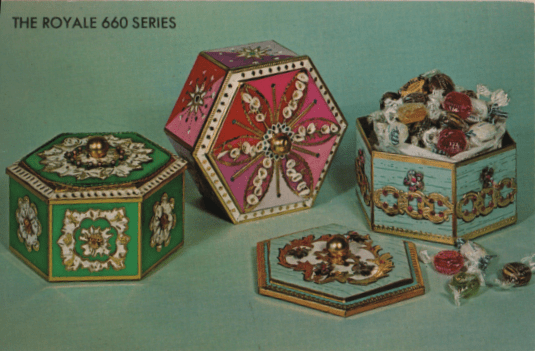
While others became a trifle obscure. This may LOOK like an ad for fancy boxes of holiday candy, and so it is. But it was not meant for the customer looking for a present to give on Valentine’s Day. No, this postcard was for department store managers looking for something pretty to display in the candy section during the critical months of sale.
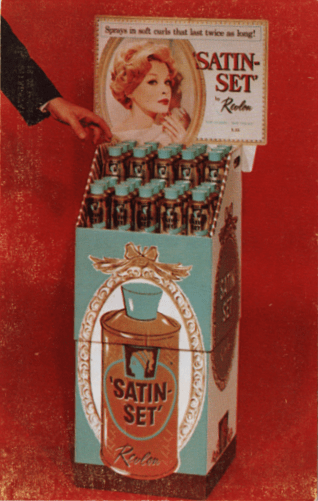
Similarly, this is NOT an ad for Revlon’s Satin-Set. It calls to you on behalf of Interstate Boocheyer, a major company for producing store displays. Interstate Boocheyer was not worried about whether anyone would buy Revlon. Of course customers would buy it, because Revlon had had the sense to ask Interstate Boocheyer to design the displays.
The whole principle of showing something besides the product is favored by some advertising experts. This postcard which appears to show some oddly-dressed tourists on their vacations, probably an ad for some travel service, is, as it says here, is a picture to demonstrate how Olive Garden chefs visit Italy for instruction.
From the turn of the current century, we have this postcard which is NOT telling you to buy a new CD, but is instead warn you to steer clear of pre-marital sex. By suggesting there’s a band they’ve never heard of, the card was expected to hit musiclovers of just that dangerous age, and convince them to “just Say No”. (Sorry, wrong ad campaign.)
Similarly, this is not an ad for the Volkswagen Bus, but, as you can see from the license plate, for elevator music. The connection between elevators and Volkswagens may not at first be obvious, but you’re not an advertising executive.
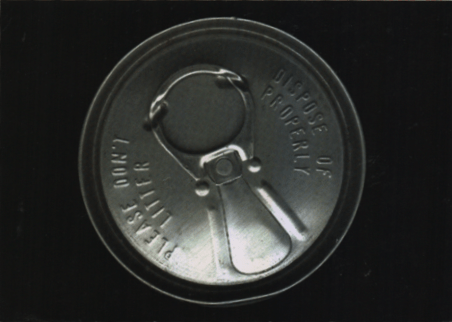
This postcard, as you can plainly see from the picture, is an ad for a book. A trivia quiz book published a quarter of a century ago, asked if people could remember things like the removable tabs on cans of Tab or Kick. I wonder how this worked: if you NOTICED “Hey, that’s an old-fashioned can!”, you were probably too young for the book.
I also wonder about this ad campaign, which is for a new cigar from an honored old purveyor of tobacco. Maybe it’s my reliance on translation services found on the Interwebs, but as far as I can tell, the slogan expressed by this cigar smoke genie (completely unnoticed by those below) is “BE the Pelvis of the Panther!” Whether it went over or not it surely deserves SOME kind of award.


















 Blogsy Babbles