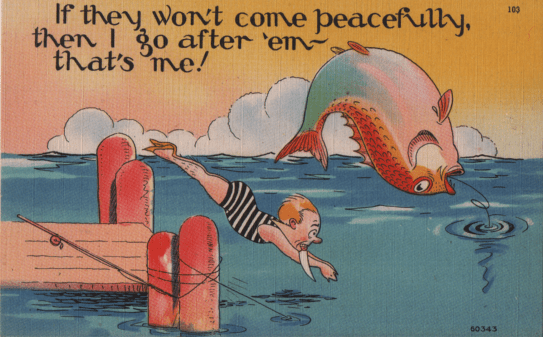
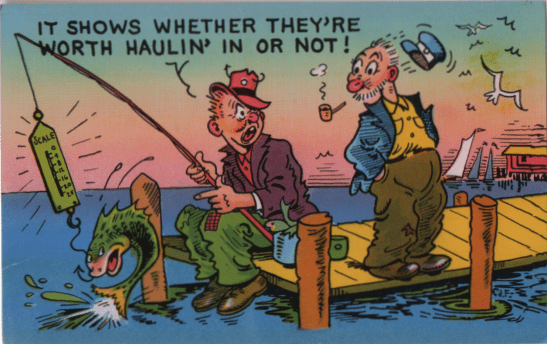
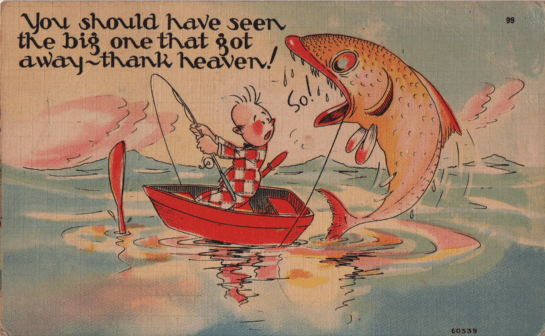
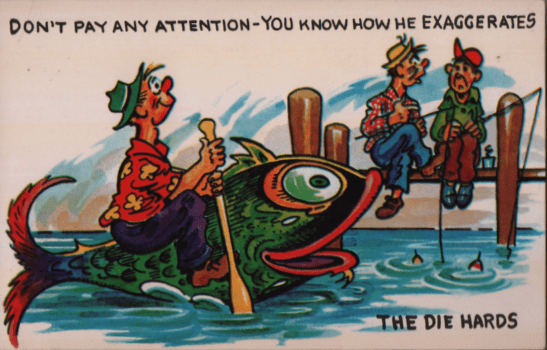
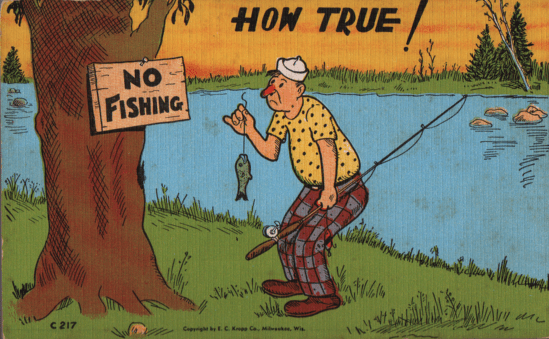
They say a person can learn a lot about life from fishing. This is, as our ancestors said, as may be. I can’t speak to it. I gave up fishing at the ripe old age of eight or so when my excitement at actually catching a fish was dashed when I was told I had to throw it back (it was ALMOST as long as my thumb.) But I WILL say there are life lessons to be learned from looking at POSTCARDS about fishing.
BE PROACTIVE. Our postcard cartoonists were nearly unanimous in rejecting the old saying that “All things come to those who wait.” Postcards flourished in the age which honored the go-getter, the person who went out and took the good things in life without waiting in line.
UNDERSTAND YOUR PRIORITIES. Before you can go out and get what you want, of course, you need to decide what that is. Once you’ve made that decision your course becomes clearer. As the fine old motto has it: Plan your work and then work your plan.
REMEMBER YOUR GOALS: Don’t let yourself be distracted from your main aim by other possibilities. You need to stick to your plan once you’ve planned your stick. (Wait, that’s not quite…..)
NEVER SETTLE. The go-getting ideal does not accept substitutes, or “almost good enough”. Keep aiming for the stars. (note: you need to be fairly definite about that. I can find almost no postcards which involve going after starfish.)
ON THE OTHER HAND, LET’S BE REASONABLE. Hey, Captain Ahab went after what he wanted, knew what it was, and wouldn’t settle. And look what it got him: star billing in a classic tragedy. You should sometimes reassess your priorities and goals. Beats drowning.
FOLLOW THROUGH: Yes, getting there is half the fun. But if you want ALL the fun, be prepared to deal with what you wanted once you get it.
THINK TWICE, SPEAK ONCE. Many postcards remind us of the main work hazard of being a fish. If a fish would just keep his mouth shut….
WHENEVER POSSIBE, JUST TELL THE TRUTH. One of the downfalls of those who talk too much is that when they have something actually significant to say, no one is listening any more, especially if they are known for giving in to that common fishing fib habit.
PAY ATTENTION TO THOSE WHO HAVE GONE BEFORE. You will often find they know what they’re talking about. (This doesn’t mean you HAVE to believe that story about the three hundred pound catfish, or always put your hat on backward until you get in the boat. But you can’t sort out the good advice from the so-so unless you listen to all of it. Speaking of which, never forget this blogger’s main watchword: Everything In the World is Off By a Quarter of an Inch. If that fish back in nineteen-aught-whatever had been a quarter of an inch shorter, I wouldn’t even have been able to see it, and might not have become so disillusioned so young.)
Meanwhile, having been surrounded by a sack, Dimity found herself being dragged down stairs which would have been much too high for her to have walked down. They felt like tree roots as she bounced across them, but the smell alone would have helped her guess she had been taken underground.
“You are mine now!” roared whoever was dragging the bag. “Mine!”
“What do you want with me?” Dimity demanded.
“Oh, every ogre has to have a princess around the place,” the voice roared. “For weeping, sweeping, mopping, moping, crying, begging for mercy: things like that.”
A door slammed. Now Dimity was being dragged along a bumpy floor. Another door went bang, and the bag was tossed down to roll along a floor that was even bumpier. After a mere second of rest, the sack was jerked away, sending her facefirst onto the floor again.
The floor was dirt, as well as dirty. Dimity tried to push herself up, but was shoved back down again. The hand that pushed her was dirty, too. She looked over her shoulder along the dirty arm attached to the hand to see who this hand belonged to.
He was big, much taller than any of the three knights, or the purple dragon. Round red eyes burned in his face, above a nose that went in instead of out. Dripping fangs went right through his lower lip. Hair draggled from the back of his head, down a body that was pale and soggy. All he wore was a kind of raggy brown kilt.
He was even uglier than Sir Ceee, though it was close.
“Who are you?” Dimity inquired, while pulling herself a little farther along the floor, away from him.
“Gelvander,” said the ogre, thumping his chest with one fist. “And your name is ‘Mine”. You’re nobody else’s damsel now, with ball gowns and a feather bed. Do you good to sleep on cold rocks.”
The rocks sounded like a good idea. Dimity snatched up a couple and, rolling, flung them at the ogre, just to see how he felt about this. Gelvander dodged them, and snatched the princess up by one wrist.
“I shall dress you in greasy garments and feed you bits of bats,” he said. His breath smelled of unwashed socks.
“No, thank you,” said the princess, kicking in the direction of his third chin.
Gelvander had expected that, too, and the kick missed. With one deft flick of the wrist, he tossed the princess into a cage that was standing open, and slammed the door, just missing her fingers.
“Wait there.”
Dimity thought that was a silly thing to say, as she had heard a lock click when the door banged shut. “I’ll be back to explain your damsel duties after I see if those princes have defeated my dragon. I expect they have. He’s always been worthless. I’ll be back to see if you’re any better in a bit, damsel Mine.” He slammed the door on his way out of the room. A clump of dripping mold landed on the top of the cage with a sploooorp.
Dimity wasted no time. She rose to her feet and gave the cage door a quick kick, just to see how difficult this was going to be. The door didn’t budge.
“Nice joke on the ogre, giving him a damsel who’s going to fall apart if she doesn’t meet a prince soon,” she said, hands on hips. “But he probably wouldn’t laugh and I don’t think it’s that funny myself. I’d better just escape.”
Anyway, the cage did not appeal to her. The ogre appeared to have been using it as a trash bin. And such trash! Bones, rotting turnips, spoiling peaches: what Dimity liked least of all were the rusty bits of armor and tarnished hair ribbons.
Putting her hands through the bars of the door, she felt around until she had hold of the lock. It was the turning kind, which needed a combination to open, but Dimity didn’t believe this particular ogre could remember very many numbers.
“This would be tons easier if you took better care of your things,” she scolded him. The lock was rusty, and hard to turn. Bits of rust kept scratching her hands. Maybe the ogre, who was bigger and perhaps got regular naps, was unbothered by such things.
She heard a click, which cheered her up. But then she heard the boom of a slamming door.
Gelvander smashed into the room and gave the door a good kick behind him. “Give a dragon a comfy cage for a hundred years and what happens? He turns on you! Helping a prince! I hope he gets his brains boiled!”
Spotting the cage, he gave this a kick which sent it sailing along the floor. Dimity rolled back into the trash inside the car, and hit her head on one of the bars of the back wall.
“Keep thinking,” she told herself. “Ah!” She shoved one hand into a pocket.
Gelvander kicked the cage again, so hard Dimity thought it might roll right over. She wondered if that would help.
“Oh, please, please, please, don’t hurt me!” she cried. She hoped that sounded convincing: she’d never pleaded for mercy before.
“Hurt you?” roared the ogre. “Hurt you? Twit! What do you think I dragged you all this way for? Of course I’m going to hurt you!”
Dimity was crouching in the garbage, ready to run if he kicked the cage hard enough to break it apart. But Gelvander reached down to open the door. She bounced forward the second that was open, throwing her anti-monster charms right into the ogre’s face. She used the other hand, and both feet, to scramble along the floor to the exit.
She got halfway there. Then a large hand caught one ankle and lifted her into the air.
Her little silver hammer charm was stuck to Gelvander’s forehead, which was growing a red spot around it, and her golden arrow was caught among some scraggly hairs. He didn’t look especially impressed. He didn’t look especially happy, either.
“I thought I told you you were Mine,” he snarled, and shook her until her pencils fell out of her pockets. “Don’t you know I’m Gelvander the Grand, monarch of this haunted forest and terror to all who know me?”
“No, you didn’t introduce yourself thoroughly,” said the princes, who was able to brush the floor with one hand and grab a couple of pencils back.
The ogre shook her again. “I have powers that scare bears in their lairs! Wolves howl like owls! I’ll teach you a couple of things, you damsel, you!”
Gelvander carried Dimity out into a dim hallway; she was glad she’d tied her hair back before starting this adventure, since he probably would have stepped on it every chance he got. She was hauled into a damp, foggy room filled with orange light.
He dropped her onto the floor so he could slam this door, too. “Didn’t your mother teach you how to enter a room properly?” the princess demanded. She had had kind of a headache to start with, and all this banging of doors wasn’t helping, especially as he had dropped her on her head.
“Silence, damsel!” roared the ogre. “Do you know where you are?”
“How would I know that?” Looking around the room, Dimity found it was filled with row upon row of rough wooden tables. On each of these in turn were rows upon rows of pots and vases and jars. Out of each container grew a number of plants, some beautiful, some horrible.
“This is where I grow special flowers and trees for my forest,” Gelvander informed her. “My forest grows and grows, and one day will cover the earth! Every prince and princess, every damsel and grandam, will have to live in it and do my bidding. And here are flowers for you, oh damsel Mine!”
With one hand, he snatched up a pot of flowers. With the other, he caught up the same ankle he’d clutched before, and dragged the princess behind him into a small room just off his plant laboratory. Of course, he slammed this door shut before dropping the pot of flowers and the princess onto a high, hard table.
“Don’t move,” he warned Dimity. He reached up to a shelf on the wall and brought down two bottles. One held liquid. The other held cotton, which he took out and jammed into his long dirty ears.
“These flowers,” he said, shouting because he could no longer hear himself, “Are my Poppies of Horrible Nightmares. Sleeping Poppies just send people to sleep. These poppies will make you sleep and bring up every worst nightmare you have ever dreamed, and make them worse. The last damsel couldn’t say anything but ‘don’t” for two months after she woke up.”
Dimity looked at the thick green leaves with new interest. Gelvander opened the second bottle and shook a few drops onto the plant. “Sing, my poppies!”
Tiny red flowers appeared among the leaves. Perfume, sickeningly sweet, filled the air. A song whispered from among the new blossoms.
“Louder!” said Gelvander, letting a few more drops of plant food fall from the bottle.
The flowers expanded to the size of Dimity’s fists. The sweet scent grew thicker, and the song was louder. Some petals seemed to be moving like lips.
“That’s it, my poppies,” said the ogre. “Put the princess to sleep. Make her dream dreams that scream.”
He turned to Dimity, who was crushing her fists against her ears. The song was doing nothing at all to soothe her headache.
“Still awake?” he demanded. He poured plant food from the bottle onto the blossoms. “Louder, you wicked weeds! Sing louder!”
The flowers grew now to the size of Dimity’s head. She could definitely see several mouths singing on each flower, each with a pair of squinched-up eyes above these. The song continued the increase the size of her headache, no matter how hard she mashed her hands against her ears.
“You should be twitching in troubled sleep by now!” Gelvander roared, “Terrified by vast vicious visions! What’s wrong? Are these wicked things singing at all?”
He ripped the cotton from his ears. Wide red eyes opened wider, and then shut tight. Gelvander sat down hard on the bumpy floor.
“But wh….” He started to say, and he stretched out, eyes closed, lips trembling.
Dimity watched the ogre for a while, to make sure this wasn’t a trick. Then she reached to the bottle sitting near her and upended it, pouring every lost drop inside onto the poppies.
“Keep singing,” she whispered. The flowers, doubling in size art once and showing an inclination to double again, seemed to nod. She saw teeth in the mouths of the blossoms.
Sliding forward, the princess dropped from the table and started to tiptoe toward the big door. She heard the ogre roar again.
She looked behind her. “Stay away!” the sleeping ogre cried out to whatever he was dreaming. “Stay away!”
“Fine with me,” said Dimity, and hurried out of the room.
One of my numerous former employers has for years tantalized us with the possibility of a massive exhibition of items from its collection related to dogs and/or cats. I never had anything to do with that branch of the place, but I would bet anything that one of the reasons this has never happened is because the cat people want a cats-only display and the dog people…remind me to tell you some day about the staff barbecue which included a Cutest Pet contest, in which the two halves of staff immediately chose up sides and staked out their territories. (This never reached the level of food fight, because on our salaries we were not going to waste a single hot dog bun.) They COULD mount an exhibition of dogs AND cats, but that would require careful counting, since neither side would allow the other to have an advantage and there would need to be exactly the same number of kitties and puppies in the exhibit.
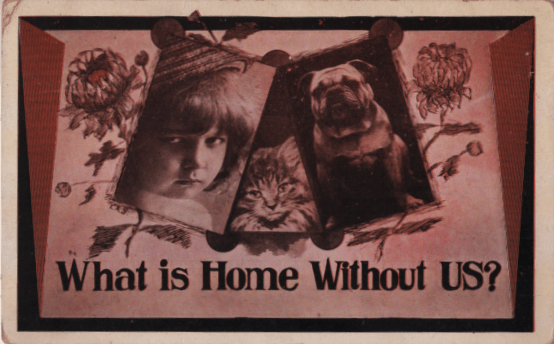
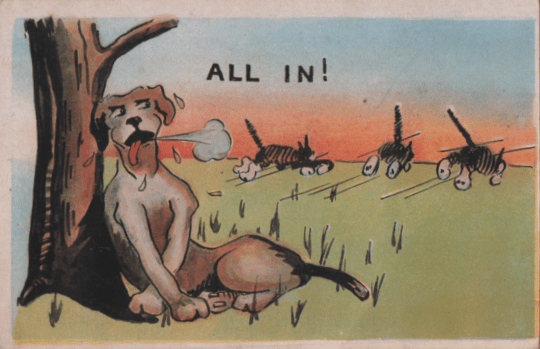
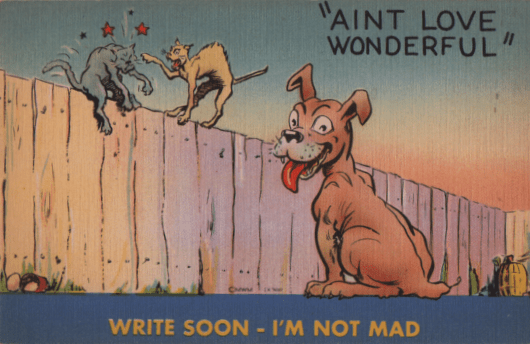
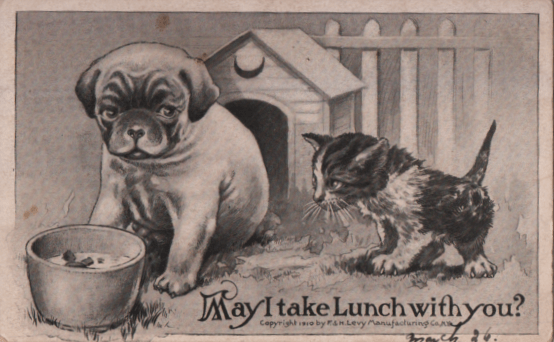
It occurred to me, while cogitating on that ancient feud, that although I have treated of dogs in this space, AND cats, I have never considered the postcards which show both. Those of us who grew up with classic animated cartoons, particularly Tom and Jerry but also the works of Disney, Warner Brothers, and similar artists’ studios, MIGHT assume the majority of dog and cat postcards involve the eternal chase: Dog after Cat (after Mouse.)
But this doesn’t seem to be the case. My inventory, as well as a look at the offerings of other postcard mavens online, suggests that the two cartoon animals are more often involved with romance.
It’s another one of those dissertation topics I keep tossing out to my readers that society observes certain conventions in the portrayal of the sexes. Paintings from ancient Egypt and other cultures, for example, show women as being lighter skinned than men, though presumably both had to work out in the sun. It has also long been a convention in art and cinema that the hero is always taller than the heroine (really tall actresses were generally relegated to comic relief.) And in these romantic dramas featuring cats and dogs, the dog is almost always the boyfriend, while the cat is the girlfriend. (Cats are always grooming their hair and dogs pee in public: I get it.)
The pairing was ideal for postcard cartoonists of course. Not only did it offer comic possibilities, but there was a Romeo and Juliet touch of forbidden affection underlying your story. (Of course, Romeo and Juliet itself is centimeters away from turning into a comedy, with those preposterous parents, the messages that go astray, the “we’ll pretend you’re dead” plot…I think Shakespeare made the right choice, but what if…where were we?)
In effect, of course, in the “boy chases girl” teen romance fashion, we DO have dogs chasing cats in these postcards.
Although we are pretty close here to a dog chasing a dog gag (or dog AND cat chasing a dog. THAT would have been a new twist on…excuse me, I have to go send a note to a movie studio. Hallmark, here we come.)
It’s all about accidents and chance. Did you ever run across some rediscovered artist online: some songwriter ignored in her own day whose friends preserved her manuscripts and recordings or author whose stories and poems were published in cheap, quickly discarded magazines? Years later, someone comes along and says “Hey, look at this!” and brings out the results to bring the originator some posthumous fame? That’s a wonderful thing, but what about those artists whose manuscripts went into recycling, whose paintings were burned to make room in a warehouse, and whose tapes were erased so they could be reused? Those make the survivals all the more amazing.
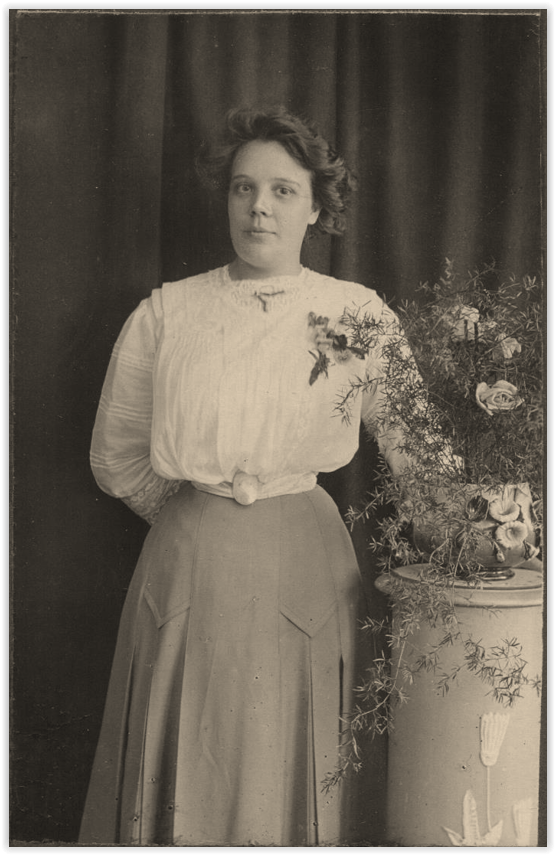
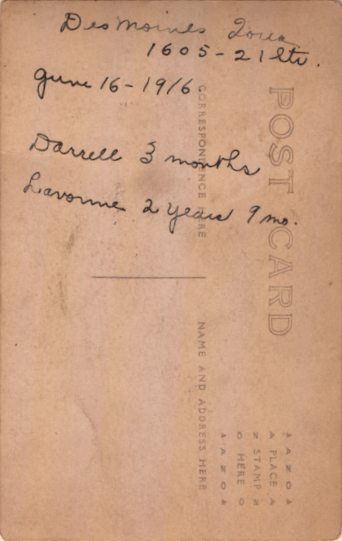
Anyhow, the face smiling at you at the top of this column is Lavonne (Lenins? Levins? Levine?) at the age of 2 years and 1 month, in Des Moines, Iowa in December of 1915. We know this because someone wrote it on the back of the RPPC (Real Photo Postcard) which was printed for sending out to the family. If you are one of those highly specialized blogreaders, used to scanning everything you find on the Interwebs for inconsistencies and things that don’t sound right, you may be objecting, “Yeah, I see her name and age, but where do you get 1915 and Des Moines out of that?”
I don’t. Instead I marvel at the accident which saw related postcards survive together to be bought by me. For HERE is Lavonne with her little brother Darrell eight months later. And, once again, useful information has been added at the back.
We even get the address of that house in Des Moines, which MIGHT, if I wanted to exhaust myself in research, add useful details on that last name. But there’s no hint whether they owned the house or rented, and records of a family that lived there for only a short time…what? How do I know THAT?
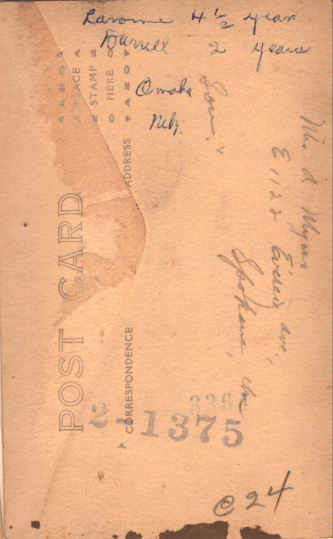
Well, again by mere chance, here are Lavonne and Darrell roughly two years later. Lavonne has maintained her smile and either Darrell dislikes having hs picture taken, or knows he is starting on a life as straight man. Now, id I had been paying attention to online auctions, there might be more of this story (these three came in two different auctions from the same seller) but I am perfectly happy to leave Lavonne and Darrell in 1918, without necessarily pursuing the next hundred and six years.
For example, here is Hazel Ann, also photographed in 1918. That’s all anybody wrote on this RPPC, but here I can cheat. I knew the original owner of these cards, who was Hazel Ann’s little sister, born in 1924. So, with a last name, I was able to find out what became of Hazel Ann.
Hazel Ann, shown again in 1918 with a protective older brother, never married, and worked her way up through a number of clerical jobs to become chief recordkeeper and motivational power behind a big city not-for-profit, and marketing director for a for-profit, all of which earned her a laudatory obituary. Worth remembering. And so, I suppose, is the brother who was buried with what remained of the rest of his crew when his bomber was shot down in France during World War II.
Remember, all ye would-be rediscovered artists: the key to a happy ending is knowing when to stop the story.
Affretz sat up and rubbed his eyes. Was something wrong? He couldn’t hear Deedee talking.
There was nothing much to see but the wagon, the sinister forest, and the horses. He was about to call out when he heard Archels’s voice.
“How could we let him get away? I wanted to find out what dragon steak tastes like?”
“Well, to judge by this dragon,” Alain answered, “It probably tastes a lot like chicken.”
His brothers stepped out onto the path, sliding swords back into their scabbards. “What’s new?” asked Affretz. “Did you all go off and leave me sleeping while something exciting was going on?”
“You looked as if you needed your sleep,” Alain said. “It wasn’t all that exciting. Just a little purple dragon. Deedee wasn’t afraid of it for a second.”
“Where is she?” asked Archels.
“Didn’t she go with you?” Affretz demanded.
After Alain and Archels explained the situation, they all called for their companion. When there was no answer, the brothers drew their swords again.
“I knew there had to be some kind of fiend behind all this,” said Alain. “You can tell it’s that kind of forest, just by looking at it.”
“We didn’t pass any fiends on our way from the south,” said Archels. “Maybe if we keep going north, we’ll find the fiend.”
“Let’s hurry,” said Affretz. Even if Deedee was able to talk for hours on end without getting tired, she was still not the sort of person you liked to think of in the clutches of a fiend.
The princes rode north, but before they got very far, they found the path broke into three narrower paths. “Which way do you suppose the fiend is on?” asked Archels.
“Well, there are three paths and three of us,” Alain replied. “Shout if you see Deedee or any fiends.”
Alain took the path to the right. Not very far along it, he heard a whimper. He didn’t think it sounded like Deedee, but since he’d never heard her whimper, he couldn’t be sure. He hurried toward the sound.
In a small clearing, the whimper came out again, not from Deedee but from a huge red and blue flower. The color of each petal shifted and they were ruffled by the breeze.
The flower was surrounded, as if imprisoned, by tall black trees, their long sharp branches reaching in at the flower. The trees seemed to lean in and the flower trembled.
“No, you don’t!” shouted the prince, jumping into the circle.
A wind in the trees seemed to be whispering “Ssssstay back! Thissss was hard work.”
Alain knew how hard it was for trees to move: they must really hate the flower. He swung his sword, lopping off half a dozen branches.
“Ha! There, fiend! Now try to….”
“Fallallop,” said the flower, as it swallowed him.
“We tried to sssstop you,” said the trees, waving their shortened limbs.
Archels took the path to the center. Not fr north of the path, it broke into two other paths. On the branch to the left, he saw a giant striped spider, twice as tall as the prince, completely still. One leg was raised as if to strike Archels down, but it waited and watched.
Archels did not charge right in. He glanced up the other path, and saw a smaller creature, half woman and half wolf. It too did not move, waiting and watching the prince.
“Ah,,” said the prince to himself. “Anyone would think a hero smart enough and strong enough to get this fae would naturally attack the big monster first, to get it out of the way. So this is a trick, and that wolfwoman is the real dangerous fiend.”
No one moved. “But maybe,” he thought, “They expected a smart prince would figure out the trick. In that case, the spider is the REAL fiend.”
Archels looked from one creature to the other. They stood waiting.
Archels nodded. “But no one could have predicted that the strongest prince in the world would come up this path. I can pull down one of these tall trees and knock both monsters down before I go on.”
Dozens of light brown trees, much prettier than any he’d seen so far, grew between the two paths. Archels picked out a good tall one, and threw his arms around it to lift it free.
“Oh!” His hands sank into the bark. No matter how hard he pulled, his fingers would not come free. A sound of crying, as if from far away, came to his ears.
Archels looked up among the leaves. Of course! These were the Wailing Trees he’d read about. This brown stuff was not their bark at all. Wailing trees produced a thick sap, the color of amber, which hardened so fast that some authors called it amber grease. A thick heavy dollop landed on his head.
What made matters worse was that, from this angle, he could see that neither the spider nor the wolf-woman would ever move again. They had been alive once, but now the sun highlighted a thin, solid coat of amber grease on each, showing they were now nothing but fierce statues. The prince twisted and pulled, but his arms sank deeper into the soft brown ooze.
Affretz, having taken the wagon and all three horses with him, was not moving as fast as his brothers. His path did not take long to bring him to something strange.
A very tall and extremely ugly man was trying to fight with a fat purple dragon which kept hissing steam. The man had only a wooden club, and wore no armor. Looking up at the sounds from the path, the man bellowed, “Awake, are you? How about lending me a hand here?”
Affretz started forward, but stopped after three steps. “You have to be careful in a haunted forest,” he thought. “Just because this man looks like me doesn’t mean he’s right.”
As he thought this, the big man jumped to the side, striking the dragon on the head and kicking the pale purple belly at the same time. “Talk back to me, will you?” The man jumped away from another cloud of steam and struck the dragon again. “You’ll be getting no supper tonight!”
The dragon was far too slow and entirely too small to fight back in any useful way. Affretz frowned. The man didn’t NEED any help fighting. “You just think it would be fun for me to beat up on that dragon!”
The thought angered him so much, he drew his sword. “Hey, that’s pretty,” said the man. “Did you steal that from a prince?”
“I AM a prince!” Affretz replied, running forward.
“No fair!” shouted the big man. “Princes are supposed to be good-looking!”
“I’ll teach you what princes are supposed to be,” snarled Affretz.
His foe swung that club up to knock away Affretz’s sword. This took the big man’s attention away from the dragon. Hot steam billowed along the backs of the huge legs.
“No fair!” the big man roared again. He stuck out one long bare foot so he could kick the dragon with the other, and Affretz jumped up to land on the long white, ogreish toes.
“Yeow!” The ogre-like man dropped his club and ran off up the path. Affretz started after him, but something jerked him back.
The purple dragon’s mouth was clamped around the prince’s right boot.
While I was refiling some of the postcards we examined in our meditations upon romance, the idea leaped out at me that we have been passing by a fairly common romantic association on postcards of the past. That is the connection between romance and food, the association of the stomach and the heart. The two requirements are basic and eternal, and our postcard people understood how natural was their association.
Think of how we express these things: our romantic target is often called “sweet” or “yummy”. We become “passionate” about a great restaurant, and I have seen more than one chef described as “creating dishes which call to your heart.” (Better than calling to your epiglottis, I suppose.)
Sometimes, of course, the two are seen in conflict, and a young man learns the lesson of taking his sweetness out to dinner, only to find out how much it costs to feed a relationship. (There are plenty of these postcards, but most deal with the price of champagne and other beverages. The link between romance and booze is a more complex topic, to be treated when we have more time on our hands.)
And on occasion, the postcard artists admit that two hearts can be set on fire so thoroughly that they don’t see their food through the resulting smokescreen. (Dorothy L. Sayers covers this in a scene where the hero’s mother, meeting her son’s fiancée, finds her so befuddled by the unexpected proposal that she can’t remember whether she’s eaten anything over the preceding twenty-four hours.) Just because the heart and stomach are close friends, they DO sometimes work at cross purposes.
Many times, though, the food directly brings on the romance. There are dozens of postcards which show grateful diners yearning for their waitresses. And how much milk must have been consumed by those men who pursue milkmaids! I’m surprised the dairy industry survived at all, between the delays in getting her back to the dairy, and the amount those suitors must have drunk (at least to suggest that was all they were really after.)
Some cartoonists were not afraid to become even more intimate in their connection of food and romance, moving on to topics where some artists would have given way to nausea. These are the postcards which show us lovers feeding each other. This is probably a game which goes back centuries, and the only reason we have no paintings of Cleopatra feeding Marc Antony grapes is that the painters just gave in to weak stomachs.
Playing this goes on well into the honeymoon period, and even reaches the kitchen of the couple.
See, our artists saved their closest associations of food and love to the couple which had set up housekeeping together. We have the couple warm and cozy in a meal just for the two of them,
And the newlyweds working together in the kitchen as they go through figuring out how this whole complex process really works (baking, I mean.)
A folksinger once came forward with a song about this, called “The Hugs In the Kitchen Are the Best.” Although the postcard folks were willing to point out they DID sometimes make the meal go wrong. BUT folks don’t live on broth alone.
More postcards have joined my inventory, and some of them prove to be (so far) beyond my intense scholarly research on the Interwebs. So I thought I might share some of the things I am clueless about. No, wait! Come back! I said SOME of the things. My space on this website is not infinite, so I will try to observe a reasonable limit.
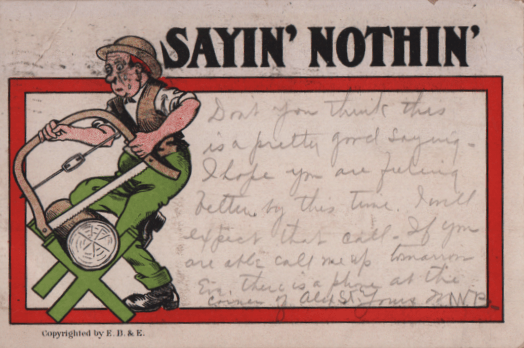
We have discussed the man at the top of this column before, but more examples of his work continue to appear. These cards involve a man sawing wood and “saying nothing” or a variation on that sentiment. I am steadfast in my belief that this is a bygone catchphrase (“meme” to those of you born after the Battle of Gettysburg) that I can’t trace back to the comedian or cartoonist who started it. These cards should not be confused with those captioned “Just Tell Them That You SAW Me”. There is still enough left above my eyebrows to figure that one out. But no one has come forth and explained “Sayin’ Nothin’”. Ten to one it’s another song by Bert Williams YouTube hasn’t uploaded yet.
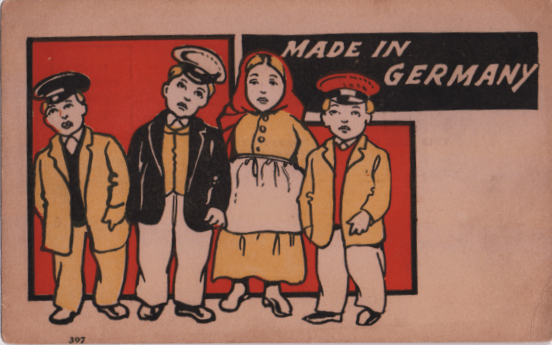
AND I have been forced to review again THESE kids, and similar postcards showing a group of children with the caption “Made In Germany”. Despite a sort of doll-like deadpan expression, there’s nothing especially unpleasant about our protagonists, which means the cards aren’t meant as an outright ethnic slur (our cartoonists were never subtle about this sort of thing.) But if it’s a celebration of the diversity offered by immigrants why have I seen no “Made In Italy” or “Made In Norway” kids? Is it a subtle threat: a warning that all these immigrants are bringing over kids with accents? Again: surely the cartoonists of 1907 or thereabouts would have been more blatant, more unpleasant. I’m still missing something somewhere.
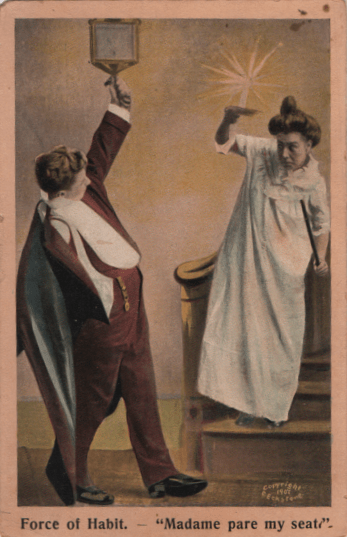
Now with this card, I am on firmer ground. This is another “Husband Comes Home late and Drunk” postcard. The setting is simple: two people, a staircase, and a few props. I can’t quite figure out what he’s grabbed for support. A clock? A birdcage? It could be easier if I just knew what the caption means. A quick glance made me think he was hallucinating a subway car, and was offering his seat to a lady by grabbing a strap hanging from the ceiling (all things which existed by the time the card was published.) But no: the caption is clearly, “Pare My Seat”. Prepare his seat? This is something he’s in the habit of saying, hence the rest of the caption. Repair his seat? Whatever it is is out of place, and that’s as far as I’ve gotten on this line.
The oldest and most widespread meaning of a “full hand” deals with cards. (Sorry.) It is another term for a full house: a five card hand with three of one card and two of another. What I am not sure about is what’s going on in the picture. I’m pretty sure she’s holding a “growler”, the tin pail one took to the bar to get a family’s daily supply of beer. If she has just drunk up the entire supply, though, which would explain her expression, the growler is no longer full, so how can she have a full hand? Am I overthinking a mediocre joke, or would the joke be much better if I understood some detail that’s eluding me so far?
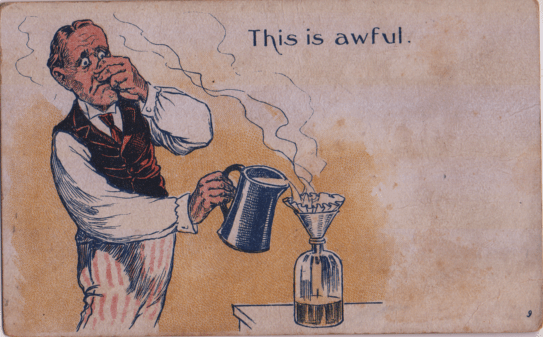
Similarly, the basics of this gag are obvious. Somebody is making an infusion of some basic ingredient, and the aroma is intensely unpleasant. I am at least ahead of the person who listed a card like this as “Man Making Coffee”. This is NOT the expression of someone smelling fresh coffee, nor do we make coffee by letting it drip into a clear glass jug. (That’s the wrong color for coffee, too.) But I’m not doing any better. I assumed at first this was some home remedy involving asafetida, a cold and flu preventative which I had read about for years, the children forced to wear it complaining of its vile odor. Unfortunately, one does NOT distill asafetida; one just wraps it in a bag and ties it around the neck of children too small to defend themselves. And, anyway, the odor of asafetida (which is generally agreed upon: the word “fetid” is not in the name by accident) dissipates when it is cooked. So what IS he making? Is it medicine or is it something like floor polish or rodent repellent?
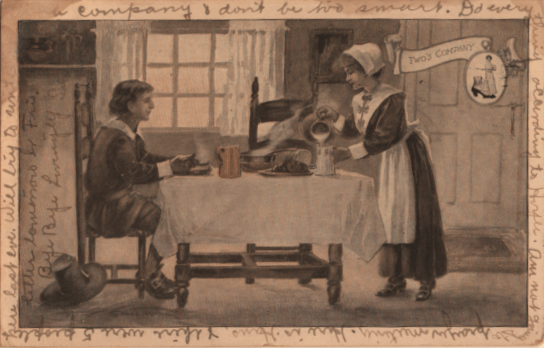
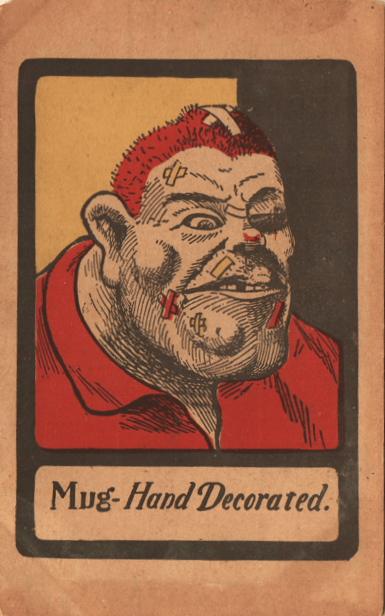
Maybe I could use these to illustrate a story: the man cooked something “Made In Germany” that the lady drank from her “Full Hand”, as did the man who was so spifflicated he told his wife to get a paring knife and then fell into a deep slumber, so his snoring was like sawing wood, and…..
What they were moving toward was, in fact, another castle. It was quite as large as the castle Dimity had grown up in, and even the larger one where her uncle had been kind. It could not be seen above the trees of the grisly grove, however because unlike the majority of castles, which lift towers high enough to cast shadows across whole countries, this was built to extend down into the ground. It had been dug more than built, and it was the home and castle of Gelvander.
Gelvander was a large and ancient ogre who entertained himself by kidnapping fairies, stealing babies, locking princes in deep dungeons, and so forth. He slept on a bed of rotting moss which stretched across a layer of sharp stones. It was his belief that if you got up in the morning feeling bad and smelling bad, this made it all the easier for you to BE bad.
Today when he woke up, his back hurt, his stomach hurt, and he had an earache. He marched across a floor strewn with broken dishes to fetch his breakfast: stale pond water from a cracked jug. It was terrible. With a smack of his lips, he said, “What a perfect day to do horrible things!”
A sound like all the thunder of a thousand storms rolled through the room, making his slap his hands over his ears and squinch his eyes shut. Growling, he stomped back across the room to his bed and knelt to pull a heavy iron chest from under a broken chair with no seat. This chest was making the noise.
Bringing one hand in front of his face, he used to other to unlatch the rusty hasp which held the chest shut. The lid popped up at once. Burning white light shot out and filled the room.
“Oooooh,” said Gelvander, pressing both hands against his eyes now. Then, leaning forward, he spread the fingers of one hand the tiniest bit and looked down into the light.
This came from a glowing ball which had the power to show the ogre everything that happened in his forest, when he cared to look. The light hurt his eyes so much that he did not do this often. But that thunderous alarm had warned him the someone or something was approaching the doors of his castle.
The globe showed him a woman driving a wagon. A fine-looking man rode on either side of him, while a ferociously ugly creature was lying unconscious in the wagon.
Gelvander considered the intruders. “A princess, without a doubt,” he growled. “And two princes! No doubt they rescued her from one of my brother ogres, and tossed his dead body in the cart. Hmmmm. And the princess has…long hair. She can help me floss.”
Grimacing to show long and untidy teeth, he marched back across the littered floor, hurting his feet some more, and kicked a covered metal cage. “Wake up in there!” he roared.
A pale purple head came up to the bars of the cage, only to have Gelvander swat it back. “Wait until I get the door open!” the ogre roared. “There now!”
The purple head eased forward as the door creaked open. Gelvander reached down, grabbed the bulbous purple nose, and pulled the purple body out onto the floor. Steamy tears rolled down the creature’s face.
“There are princes in my forest!” Gelvander bellowed at the balloonish purple dragon. “I wan them led astray. Get to it, you worthless firepig!”
One heavy ogre foot came up hard against the soft purple stomach. The dragon grunted and, uttering “meep meep mumble”, shuffled from the room.
Meanwhile, Dimity was listening to Sir Bee tell a story he had read in an old book at his college. The princess was listening politely: she liked old stories, but at this point she had been listening to the story for nearly five hours.
The way the three knights travelled, with one sleeping and two riding, struck her as perfectly ingenious, especially as they stopped now and again to let the horses rest. For one thing, there was someone for her to talk to all the time. She had talked with Ae and Ceee while Bee slept, and with Bee and Ceee while Ae slept. Now she was talking with Ae and Bee while Ceee slept.
Each knight seemed happy to have an audience, and never once mentioned the fact tht “Deedee” never seemed to need to sleep herself. Dimity didn’t refer to it herself. She was feeling a little better, now that she got to ride at the front of the wagon instead of walking all the way. And each knight had different things to talk to her about, all of which were new and interesting.
Sir Ae told her about the people in the castle where he lived, what they looked like, and how they talked. It did not surprise her or bore her to learn that they generally talked most about how handsome and how brave Sir Ae was.
Sir Bee liked to talk about the things he’d read about. He did seem to have a rather low opinion of people who had n’t read as many books as HE had. Dimity had of course read quite a lot of books herself, but nowhere near as many as Sir Bee.
She could not look for long at Sir Ceee, but she found she could talk to him. He knew nearly as many stories as the other two, and he liked to discuss them with her. He and Dimity had discussed such burning topics as why Mother Hubbard kept bones in her cupboard and how Miss Muffet could have run anywhere with a spider in her whey. They did have to keep assuring each other they were listening, though, as both kept yawning all the time they talked.
Sir Ceee was sleeping now, of course, and Sir Bee was explaining, “Of course, this is completely contradicted by St. Gregory of Tours in his sixth book, where he claims….”
“Hold, brother.” Sir Ae raised a hand. “What was that?”
Sir Bee fell silent and, after a look at his brother, frowned at the forest. Dimity tried to listen, too, but the brothers must have had the best hearing in the world, for each was already drawing long steel blades before the princess heard the first footstep.
“A dragon!” whispered Sir Ae as a purple body the size of a horse appeared between two trees. The dragon saw them at the same time, and released a stream of steam from a potato-shaped snout.
“I’ve always wanted to find a dragon!” Sir Bee whispered back.
“Ne too!” said Dimity.
The purple dragon hissed again and then backed away, its head bobbing as if to say “You go your way and I’ll go mine and maybe nobody will get broken.”
“Since none of us is really going anywhere,” said Sir Ae, jumping down from his horse, “It doesn’t matter what time we get there. So I think we should take some time to go look this dragon over.”
“Wait here,” Sir Bee told Dimity.
“Wait here?” the princess demanded. She had been getting ready to jump down and go study the dragon herself.
“Somebody has to watch the horses and stuff,” Sir Bee told her. “And Aff…Sir Ceee needs his sleep. He missed his nap yesterday.”
“We’ll tell you all about it when we get back,” Sir Ae promised. “And if the dragon is agreeable—or dead—we’ll bring it back with us.” The dragon was almost invisible now among the trees, so he hurried after Sir Bee to follow.
Dimity thought about waiting a few minutes and then slipping quietly after them, but, looking around, she thought this would be a terrible place to leave the horses unguarded. And she was the last person in the world to be waking someone like Sir Ceee up. People needed, she knew very well, their sleep.
So she took out her map and drew the dragon n on it. Then, flipping the map over, she started to sketch Sir Ceee’s face, stopping only once or twice to shudder. When she simply couldn’t take any more, she flipped the map over again and looked at the dragon she had drawn.
”I don’t know for sure that it WAS a dragon,” she said, starting a note under the picture. “It could be a prince under a spell.”
“He is,” growled something behind her, just before the bag came down over her head.
With the onset of spring (inch of snow last Friday) we have been discussing postcard representations of romance. It is important to remember, however, that the course of true love runs never smooth. This is, in fact, the basis of a LOT of postcards, not to mention books, poems, plays, movies, soap operas, and comic books.
A long line of postcards, for example, show us the interruption of a romantic interlude by the arrival of a rival. It doesn’t need to be a serious suitor: the point is the interruption of the cozy chat.
Or the outright prevention of that cozy chat.
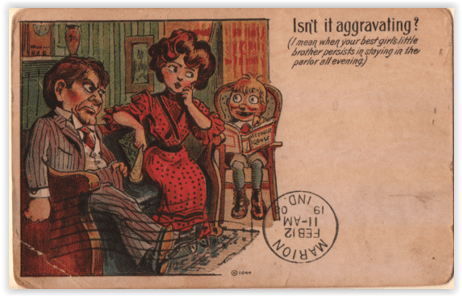
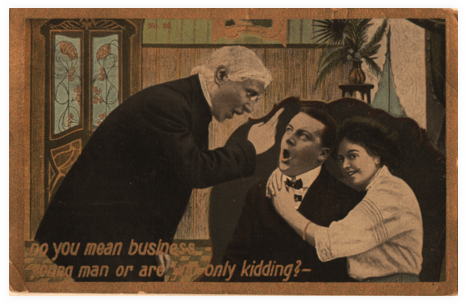
Relatives are a frequent source of this interruption. Little brothers and sisters are important comic foils, but no one can beat the sudden intrusion of one or more of her parents. (Is the young lady hanging onto him so he can’t take flight?)
Although the sudden appearance of a spouse can accomplish equally aggravating results.
Sometimes the interruption is not caused by a third party at all.
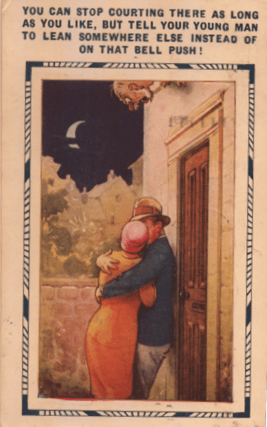
At other times, the interruption is caused by non-human forces. Two lovers may be in a condition where they do not regard the outside world as important, or even existing at all. But this is not the way the world sees it.
Intruders do not see the joke, or even understand that they are intruding. Your presence may have been interrupting THEIR day.
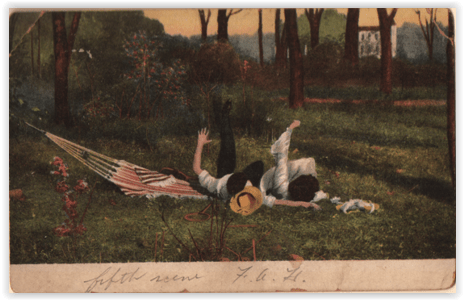
Or they may just be doing their jobs. Gravity was at this long before you realized you could use that improvised platform to steal a kiss.
Or hung up that hammock.
Or strolled out on the dock.
The only thing poor lovers can do in the face of an uncaring world is carry on the best they can. And isn’t spring made for couples carrying on?
A fantasy artist once submitted an amazing illustration showing a skull-headed demon glaring hungrily at the viewer from in front of a complex and twisted grove of obviously cursed trees. The editor loved the drawing, but said “You’re not fooling me, you know. You just wanted to draw those interesting trees and added the demon so somebody would actually buy the picture.”
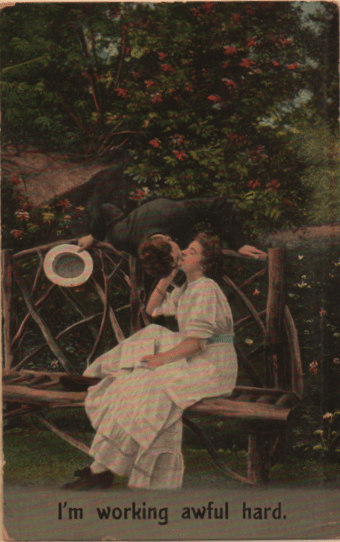
The world works that way, and it was no less true in the world of postcard illustration. In romance postcards particularly, where pretty much the same loving glances and warm embraces were repeated endlessly, being timeless, it is obvious that the photographer was really interested in something else. I don’t mean those cards where the joke is so big it needs to take up space from the lovers just for emphasis.
This one, say, where we’re spending a lot of space on that picturesque stone wall but we HAVE to, to make the joke about his “stile” more obvious.
And sometimes it’s apparent that the scenery was the inspiration for the whole picture, and you HAVE to emphasize the natural scenery.
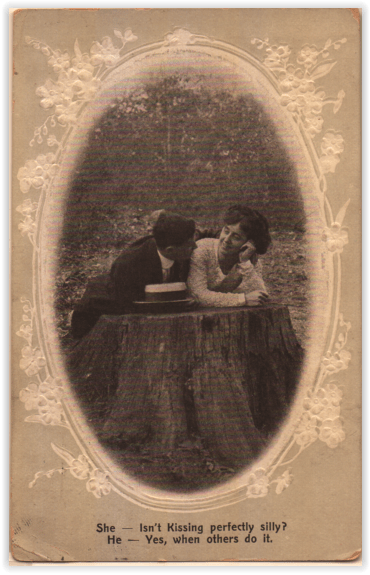
Here, though, we have a joke which could have been told in a ballroom, on a boat, or even in a broken tree. But we have it being told while our protagonists lean on a stump because the photographer realized that stump was probably the only thing new about a pair of lovers or the gag.
Other postcards, like the illustration mentioned above, look as if the forest was what the photographer wanted to record, and the lovers and their dialogue were an afterthought. People sell better than trees, you see. There were more lovers than nature lovers in the postcard audience.
There’s the question of definition, too, a matter of making something more obvious (always a good thing when dealing with the buying public.) You can call a scene romantic, but why not emphasize it by showing someone conducting a romance in one corner of the scene (where they won’t block the view)?
It’s a simple compromise: some customers will want to buy a card for the lovers and others for the tree. (Though this can backfire: some will pass the card up because they wanted a closer look at the kiss, and others will spurn it since you have those ruddy people in front of that interesting tree.)
It doesn’t have to be trees, of course. Any really interesting scene, fun to photograph, can have a couple of hand-holders added. (Yes, I see the bridge joke. But they thought of it BECAUSE they wanted to take a picture of the bridge and needed the excuse.)
The result is interesting for all kinds of viewer to this day. Some of us will be interested in the fashions worn by the lovers, or the design of that umbrella, while others will say, “Wow! Where would I need to go nowadays to lie down in a field of giant flowers?” (This blog not responsible for heartache or hay fever if you try this at home.)




























 Blogsy Babbles