In olden days I was acquainted with a young lady I refer to as the Dumpster Cinderella. This is not the place to go into ALL of her qualities and quiddities, but one of her goals in life was spreading the word about Real Jazz. This was a musical form which she felt ceased to exist around 1932, when jazz went all new-fangled. She wrote articles (or, more often, article-long letters to editors) and took her recordings and her message to any audience which would listen. She succeeded beyond her hopes with high school music classes. She found the kids genuinely interested in music new to them: they asked intelligent questions, and inquired where they could find more Real Jazz.
So she frequently did follow-up lectures, with recordings the kids hadn’t heard the first time. And she came to me once with a problem. Not to ask my advice, since, as usual, she had made up her mind, but simply to add strength to her own arguments.
“Some of these songs are really raw,” she told me. “The performers were way too frank about race and sex, especially sex, for me to play these for high school students.”
“I don’t know how much rap and hip-hop you listen to,” I said, “But I have a feeling they won’t learn any new words.”
“Oh, these are instrumentals,” she assured me. “But I don’t dare play them because the kids could look up the lyrics online.”
It is easy to make fun of the Dumpster Cinderella (believe me) and her caution, but I have, in my hunt through archaeological comedy, run into similar warnings and cautions. Leafing through a college newspaper of the later nineteenth century, I found a note that although they welcome articles and stories written by students, they would not tolerate the use of terms like “Shucks”. I was taken aback by this, as the term in my own day was used by comical backwoods types. Gradually, the reason dawned on me.
“Shucks”, like “Shoot”, which I found banned in other periodicals, is a euphemism for a biological product found frequently by the roadside in that distant century of horse-drawn vehicles, but never never mentioned in polite society. And on the principal that everybody who saw “Shucks” would know what word was meant, the euphemism was banned too.
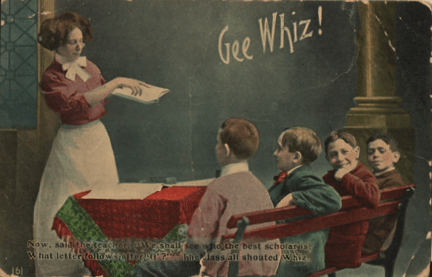
In my own time, I had teachers who reacted with horror to children who exclaimed, “Jeez!” In their ears, this was profanity, as it was short for a longer sacred name. The same was true in some postcards I have received, which are a little cagey about using the exclamation “Gee!: a similar abbreviation, or simply short for “God” (a word that couldn’t, like “Devil”, be used on many radio networks through the middle of the twentieth century.)
Banning these cover-ups was slow in leaving us. Walt Disney’s Pinocchio received token resistance when it referred to the nameless cricket character by a similar euphemism. By my time, in spite of teachers who banned “Jeez”, we sang “Blue Tail Fly” in music classes without a hint that the phrase “Jimmy Crack Corn” was anything but a nonce phrase like those Fa La Las in “Deck the Halls”. Of course, with our steam-driven cell phones and no Internet, we had no place to look this up.
Nowadays, as we move further into the age of dysphemism, in which we not only avoid using euphemisms but try to come up with an even more offensive phrase, I wonder what will happen to the poets of euphemism, those folks who preferred to bellow “Fudgesicles! Drippy, sloppy fudgesicles!” and “Well, goshdang the goldarn thing!” Or will some musical combo decide to write bold brave songs using once-banned terms like “Gee whillikers” and “Shucks”, and start a whole new trend in rock, rap, or even Real Jazz? (Dibs on the Fudgesicle Blues.)
“Yes indeed, Madame. Welcome to the shop. How may I assist you?”
“Well, I’ve inherited my sister’s house. She made it out of gingerbread to bring in livestock for her larder but there was a little accident with some supper that got the drop on her.”
“I’m sorry to hear that, Madame. What….”
“It wasn’t so bad. They managed to cremate her before they left, so I didn’t have to waste time on the funeral.”
“Congratulations, Madame. And how….”
“Just tossed her across the garden.”
“Yes, Madame. May I ask….”
“Really good for the asparagus.”
“I will keep it in mind, Madame. How may I help you?”
“What I really need is a good mystic appetite suppressant: a ring or amulet I can wear. Hate taking pills.”
“Living in your sister’s cottage….”
“She must not have had my sweet tooth. I can’t help taking a bite out of the shutters when I go out to poison the birdbath, and at midnight, when I need a little something….anyway, I’m eating myself out of house and home.”
“I see, Madame.”
“I’m the first witch in the family to eat her own back door.”
“It is not….”
“Twice. I…”.
“I can see where that might be awkward for you, Madame.”
“The deer wander in and out and the rabbits always seem disgusted that I’m not some sweet little lost princess.”
“I think I know….”
“I’d start singing to let ‘em know they’ve got the wrong cottage, but the only song I know is Ninety-Nine Bottles of Brew on the Porch.”
“This book of spells and potions….”
“And I keep losing my place and starting over.”
“This volume contains a number of magical recipes for repairing such cottages.”
“That’s all very well, but what I’ll look like after weeks of chewing on my balconies….”
“Here, for example, are spells and recipes which would gradually replace the gingerbread with pretzels, salted nuts, and corn chips.”
“Aha! I can eat the house and replace it with something that doesn’t tempt me so much!”
“It might tempt certain visitors, though, especially if they can smell that you’re cooking chili or making salsa.”
“So the cottage would still bring me main courses. And if the little brats are loaded with salted stuff, they’re less likely to have the stamina to run away. Maybe I’ll make jerky out of those dratted bunnies and bucks, too.”
“Perhaps, Madame. I’m charging four gold pieces for the book, and you should probably be warned that such a cottage is likely to attract every huntsman and woodcutter for miles around.”
“I hadn’t thought of that.”
“The author included a couple pf recipes for beer in the back. Apparently, SHE found running a bar a more reliable way of making a living than luring in lost children.”
“I like it. And anyone who falls behind on their bar tab winds up on the menu!”
“That would discourage….”
“I can see the sign: ‘Special today: Roast Bum’. Ha! Or I could call it ’Fell Behind’.”
“Four gold pieces, Madame.”
“Or the Weak End Special.”
“Thank you, Madame. I wish you the very best with your….”
“Or Best Seat In the House.”
“It was a pleasure doing business with you, Madame. I can see you want to get right to work.”
No matter what Bott pushed or pulled or thumped, the ship was going down, down. He had defeated his old ship, filled with librarians, and that was all the amusement the Emperor intended for this particular prop.
“Everthin’s dead, Cap’n,” Louba told him. This was unnecessary: the smiling flowers on the console were wilting as he watched.
The BBB-44 bounced to a wobbly seat atop a white cube. “Okay,” said Bott, rising from the seat and hitching up his pants a bit, “Let’s go see what else we can do for fun.”
Bassada was closest to the door. She jerked her hand back as this shut with a bang. “Don’t s’pose ‘ere’s much point in knockin’.”
“Not a bit,” Chlorda agreed, falling with her blue counterpart. Louba tried to hang onto her sonsole as the floor slid the rest of the way back. A creak and a crack sent her after the rest of the company.
“Waddya know?” cried Bassada, splashing as she sat up. “Private swimmin’ pool! ‘at empra’s gittin’ cushy in his ol’ age!”
Bott stood up. The pink water sloshed around his shins. Pink mist swirled up from the surface but was refused as the ceiling slid shut. He saw no walls, but assumed he was inside the cube the BBB-44 had set down on.
“Where to next, Cap’n?” Louba inquired.
He hadn’t noticed any doors on the outside of the cube as they descended, but four prisoners starving to death in a pool of pink wouldn’t draw many bets. He reached into the grenade satchel for Nubry’s book, and checked a random page. “Straight ahead until we find something.”
Chlorda was nearest to the direction he pointed. She put out a hand. “Very well. I’ve found a wall.”
The others stepped to her side to verify that it was, in fact, a wall. Bott wondered if the water was warming up, or if that was just embarrassment.
“Well, grab me by the ear an’ use me fer a plunger!” Squatting, Louba jabbed a finger at a thin dark line. “It ain’t jes’ a wall, Cap’m!”
“She’s starvin’ agin,” sighed Bassada, dealing the seat of the broad overalls a swat. “Nuthin’ vut a stummick on big round legs.”
“Hey, it was a thirsty fight!” Louba drew her hands across the food computer slot. “Blues don’t drink nuthin’ but ol’ bathwater, but I could use a shloorp.”
Bott drew out his card. “This will probably get us anything in inventory. What’ll it be? Cup of tea?”
“Spose we gotsta laugh when Cap’n Bottsy makes a joke,” said Louba, arching one hand at him, little finger down. “Ha ha ha. Computer, gimme some Qonors Red Limpid Lager.”
“Ballul.” Bassada wrapped both arms around her own stomach. “Stuff tastes like grass outa yer county dump.”
“At’s whatcha drink, ha?” Louba patted the card in the slot. “Gimme a glass.”
“Yer a waste o’ space, greengridle.” Bassads spotted the door opening. Four glasses with green and gold rims and absolutely nothing inside were revealed.
Louba snatched one up and glared down into it. “If you can find the wide end, Luv, that’s the one you want,” said Chlorda, reaching past her for another empty tumbler.
“All I learned about follerin’ you around is little bitty ends. Right now I’m lookin’ fer ‘at booze.” Louva leaned down to peer inside the little foods delivery chamber.
She plopped backward into the pink pool as a red fountain of the requested beverage came shooting from the little cube. Bott’s shoulders rose as little doors around the room popped open and further fountains of lager shot into the room.
“Good job.” Bassada patted the green head. “Got yerself more booze’n yez kin swaller, even wit’ yer big mout’.”
Louba rolled mournful eyes up to her commander. “Want me ta try, Cap’n?”
“Say no, Cap’m.” Bassada shook her hand at the green Klamathan. “She’d git it all drunk up an’ ‘en flood all over us.”
Bott was not paying much attention, frowning at the red fountains filling the chamber. “There’s another way out. The Emperor hasn’t won nearly enough money yet.”
The mist was thickening around them. “Anything could be swimming in here,” Chlorda noted, lifting first one foot and then the other.
“Don’ get bit by a watersnake, yellacheeks,” said Bassada, kicking at the rising red lager.
“Better that they should watch for you,” the gold replied, with a little curtsy. “If you sat on them, they’d be flatworms.”
The level of the beer continued to rise. “Do hates ta see good booze gittin’ watered down,” said Louba, opening her mouth and leaning into the fountain.
Bott watched her fill her mouth, marveling at her capacity. At the same time, he was considering those ast three grenades in his satchel. There was plenty of maze yet. If he just waited, he was sure to find the method the imperial game scientists had built into this latest peril.
But all that back and forth dogfighting with the other ship had inclined him to action and, anyhow, patience wasn’t one of his best skills. Picking the middle specimen from the tumble of ancient grenades, he flipped away the key and flung it at the highest point he could see on the wall. The four prisoners crouched in the beer, Bassada stealing a few sips as her eyes followed the grenade.
Entirely without fuss, the grenade flattened itself against the far wall, stuck out little gray legs, and started to climb.
“Paint half muh teeth black an’ call me a piana! Bugs got inta ‘at one, Cap’n!”
The prisoners rose to follow the grenade’s progress. It was leaving little black footprints as it scuttled toward the ceiling. “Get back down!” Bott whispered. He wasn’t sure in this atmosphere, but smoke seemed to rise from each little footprint.
With a spark and a flash, the grenade vanished. The footprints smoked for another second, and then flashed like their begetter.
“Whoopsadaisy!” cried Bassada, ducking away from not only fragments of wall which had been neatly curt away but also a cascade of multi-colored boxes. Bott nodded. It would have been too simple to blast a hole into the big room. They had instead opened up some kind of storage closet.
“Mus’be sumpm here we kin use.” Louba popped lids around her, revealing a high black hat with an orange plume, a stuffed firgan, and a broken ficdual. “Huh. Like ‘at time I walked inta a blue shower room: seein’ lotsa trash.”
Chlotda stepped toward a particularly nice gold and purple case and stumbled, landing facefirst in the pink pool. She came up shaking lager from her hair, and pointing at a shadow in the beer. “A door down there, Cap’n…er, Captain. Maybe we’re expected to try an underwater maze. Or underbeer.”
“Ha!” Bassada checked the particularly large box between her knees. “Divin’ stuff!”
She pulled out an oval helmet attached to a gold tank. She pulled out three more helmets of assorted colors and sizes, and handed these to her companions. Bott studied his, his face coming together in a scowl.
“A pirate,” Captain Bish told him once, “Owns the ground he walks on.” Bott checked the oxygen tank, and then tossed the whole thing over one shoulder.
The Klamathans stared. “Not yer size, Cap’m?” Louba inquired.
“He’s going to keep doing this.” His eyes followed a brown flowerpot floating past. “Finding ways to nearly kill us and then slipping us a way out so he can nearly kill us in the next room. The grenade didn’t spoil his game; he’d have shown us another way to get to these masks. Maybe it’s better to drown than keep giving him things to laugh at.”
“Cap’n Honey,” said Bassada, coming over to catch up his discarded helmet and deal him an encouraging swat on the back. “I betcha he has a really good laugh fer ‘em as drowns wit’ defiance.”
“The longer we last, the bigger parade he’ll throw when we die.” Bott kicked at the flowerpot and missed. “Seen the processions? The high blue banners with his picture on them? Didn’t he congratulate himself when he captured you? He sure did when he burned the High Priest of Hutch, and every time this big new slave ship of his made port. He and his big blue ship and his pigs and his bann….”
He shoved a hand in his pocket. The Imperial processions marched through his brain, bands in blue uniforms fanfaring cages filled with shivering prisoners, and the bodyguard decked out with bright blue accoutrements and….
“Ship,” he said, raising his communications card to his lips.
“Sorry, lummox. I don’t believe there’ll be time enough to teach you to swim.”
“Ship, didn’t you tell me I had one of three Imperial override cards?”
“He listens! The lummox listens! I am quietly agog.”
The Klamathans had moved in, all obviously wondering what he was up to. He hoped they wouldn’t figure it out before he did. “Ship, would it do any good if I shoved that override card inro a foods computer slot?”
“If that’s the most entertaining place you can think of to shove it.”
“It’ll be a gold and ivory card,” said Chlorda, stepping forward. “Those are his family colors.”
“But his favorite seems to be light blue.” Bott slid that card from his deck. “At least I should get a pretty good dinner before I drown.”
“WE drown,” said Bassada, dropping her helmet into the lager.
“Cap’m.” A green hand rested gently on his wrist. “Is ‘at a food slot? Computer didn’t make any wisecracks. It wasn’t but a trap, ta water us and see if we grew. Why’nt we jus’ swim fer it?”
Bott looked from her to the light blue card, nodded, and raised the communications card again. “Ship, he must know I have this. He could have reprogrammed you to recognize it, and just electrocute me if I use it.”
That blog about the sitcoms some people call “Commercials” generated some interest, and a couple of complaints. Some people expect quizzes about TV commercials to involve slogans or jingles, while other people complained I said next to nothing about the products involved. Well, we CAN do something about that.
Of course, every product was the invention mankind had been waiting for, bnever mind the wheel, and naturally each was better than those Brand X competing types. But can you remember what else they were. True, most were “enriched”, and, inevitably, “new and improved”, while almost every cereal was “part of a balanced breakfast”. But can you recall these other features enough to identify the product?
I was old enough when I found out about it that I was more surprised than shocked. The distance between what we are shown and what really is was known to me from an early age, at least to that time in second grade when I picked up the little cup of cherry Kool-Aid and found out it was tomato juice. As always, part of the blame for that is mine: why on earth would our lunch ladies be giving us cherry Kool-Aid anyhow? What we WANT to see takes precedence over what’s really there.
So today we are going to talk about scenic landscape postcards which have been somewhat amended to show the world as postcard publishers think we want to see. We will NOT be discussing pure works of art, like the collage “Water Tank” by Michael Langenstein at the top of this column, nor the massive Brooks Catsup bottle in Collinsville, Illinois, which is really there and has not been touched up at all in this postcard.
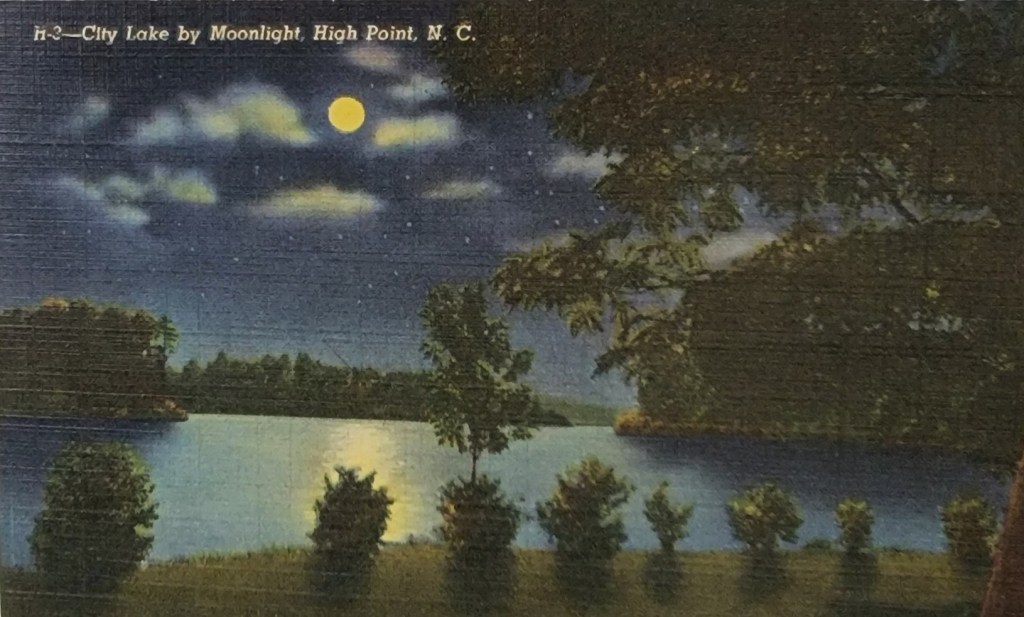
What tipped me off was a series of Our City at Night postcards like this one. If you have ever tried to get a glowing and romantic a picture like this on your own camera, digital or otherwise, you know it takes patience and care. But postcard companies put these things out by the dozens. Were their photographers that good, or did each company have one picture-taker who specialized in night scenes? Even more complex are the night-time street scene postcards, where a busy district in town has been photographed during the evening theatre hours. How was this even possible, given the unpredictability of tragic and weather?
Well, you can go into the archive of some of these companies and find out. (Curt Teich did a lot of this work, beautifully.) They DID have great photographers. These photographers would take a picture by daylight and then have the artists in the design department paint the sky a nice midnight blue and draw in a brilliant moon. Or take that photo of the theatre district and paint lights in the windows and a beautiful evening sky.
Our ancestor discovered the process for portrait paintings in the nineteenth century. It takes a long time for a person to sit still and be painted, so why not take a photo, blow it up to a size suitable for hanging on the wall, and have an artist paint OVER it. Properly done, no one can tell how much of the picture comes from the original, and how much from the mind of the artist. More authentic than leaving the whole picture up to the painter and more flattering than the version from the camera. (I’m not sure I’m seeing ANY of the original photo in this beautiful sunset.)
Of course, once one has discovered the process, anything is possible. A company in New England produced dozens of small town city views presented as photographs of what the town would look like in a hundred years, with subway entrances added to quiet corners on Main Street, airships and aeroplanes above. Similar enjoyment of the joke goes on to this day, with some improvement in technology.
None of these postcard companies are trying to lie to us. Especially with those night photographs, the goal is to show us reality while omitting the details of actuality that get in the way. I am not at all certain this view of San Francisco is an honest to goodness photo. But as Vincent Starrett wrote, after all, “Only those things the heart believes are true.”
The ship that might be the Dragonshelf dropped almost straight down on the nasty-looking orange and black one. Nubry had known Bott could fly, but watching it from here made that really obvious. If only he hadn’t been a pirate as well! Her eyes moved to where the captioned dialogue was rolling up the screen.
DEAR ME, CAPTAIN DARLING. COULD WE NOT RECRUIT THEM AS CREW?
NO, SWEET NBASSADA. EVEN COPIES OF THAT INSANE LIBRARIAN MIGHT RUIN OUR TRIUMPH.
THEY’D INSIST ON KEEPING THE BOOKS. AND TJEY OUTNUMBER US.
This sort of thing had upset her at first. But there was no sense in getting angry. She wasn’t likely to live long enough for it to make a difference.
All that she asked was to be completely dead before she saw them destroy the books she had sworn to protect and defend. It couldn’t be long now. The cuffs were surely all that was holding her up. One foot stretched out in front of her as if she were climbing a very shallow staircase. Her hands were clasped behind her head, pressing forward just enough to hurt.
I THINK WE SHOULD JETTISON THE BOIOOKS AS WE LEAVE, TO CONFUSE THE SENSORS WHEN THEY TRACK US.
I SAY SET THEM ALIGHT AS WE DROP THEM, TO CAUSE A DIVERSION.
I DO HOPE YU LADIOES AREN’TGOING TO ARGUE. WE HAVE A LOT OF WORK TO DO AND YOUR CONTINUED FRIENDSHIP IS KEY TO OUR SUCCESS.
“Bilstim controls!”
Nubry frowned. That had been Bott’s voice; she hadn’t run across that particular expletive anywhere else. Were they fighting right under this room? Would she have heard it, even so? And why didn’t it show up on the monitor?
She rolled her eyes to the Emperor, who was using a long blue swizzle stick to stir small ichikans who struggled in a solvent which destroyed their bodies without killing them. He reached for a straw.
OH, WE COULD NEVER ALLOW PETTY QUARRELS TO INTERRUPT OUR DEVOTION TO YOU,DEAR CAPTAIN.
THERE, CAPTAIN. GIVE HER A SHOT UP THE TAILPIPE, THE WAY YOU DID
Nubry’s head jerked to one side. She’d heard him say “flowers”. She knew she’d heard him. Ignoring what felt like a million red hot needles in every muscle of her body, she turned her head, looking for some alternate source of communication.
Catching the movement, His Imperial Worship glanced at his captive and then back at the battle. “Pity your captain doesn’t realize one of his ladies is feeding us secrets.”
“Is she really?” That black spot on his earlobe: it wasn’t the only spot on his face but it was the only Kydczak earphone. She strained to hear: Bott was saying something about circles.
WE SHOULD POUR ACID ON THE BOOKS AND MAKE THEM REALLY DANGEROUS WHEN WE DROP THEM.
“Only a tiny fraction of what she tells us is any use.” The Emperor took a long drag on the straw. “But the odds were so goof I thought I should bet on one of them making it out alive.”
“Why are you wearing….”
A hand slid from his beaker to the controls. Nubry’s face was lowered to the level of her waist. Her ankles came sharply together and then spread left and right.
She felt herself moan as her feet were jerked above her head. But her brain was busy with that tiny earphone. If he was listening to the prisoners with that, all the words on the computer could be lies. Bott probably wasn’t planning to destroy the books at all. Why would he? No pirate would destroy something he could sell.
Her nose itched; ti would run if she wasn’t so dehydrated. It could simply be something else, someone else’s voice. Or the words on the monitor could be delayed, while the Emperor was listening to them in real time. And she wasn’t going to live to find out. As that long hand reached for the nastiest button on the console Nubry recited to herself the Schlatter Seed Carakog Inventory. Maybe if she realty concentrated, she could ignore the pain.
The thumb held its position just above the vital control. Imperial eyes had turned to the screen. Nubry was about to cheer at the sight of the perhaps-Dragonshelf moving around behind the wicked-looking other ship, but remembered in the nick of time that she was possibly very angry at the pirate.
The tiniest vibration in the big eggshell told her the Imperial thumb had not forgotten its duty. A second later, her face was on fire, and the familiar flaming claws were tearing flesh from her back.
The Emperor took another drink.
Hot coals forcing themselves up through her throat told her the new copy was about to arrive. She forced herself to think of something else, to concentrate as she had during long days on the Dragonshelf. Having read a number of books on mental powers, she had tried to force characters from other books to materialize, and talk to her. She wanted to ask Lilu Lemonleaves why she had never, in the course of fifteen novels from Decledy, trust her husband. She intended to discuss weather with rain deity Kilaui Dumm-Dumm, and introduce Susan Sedan to Justin Alastair. Right now, if she worked hard enough, perhaps she could materialize the reading room around herself, and be aboard the Dragonshelf, ordering a conversation between people who never got to meet.
A figure was hovering just on the edge of reality. The copy, of course: Nubry’s powers of concentration had never materialized anything even this ephemeral. She had always felt a little guilty about forcing dialogue into the mouths of other people’s characters. As her spine seemed to roll into a little ball, cracking and splintering in phantom stabs of red agony, she decided to stop feeling gulty about it.
“Move back,” she thought, staring at the spot where the copy was growing but not allowing her eyes to focus. It was the same method she used when trying to materialize Lily Lemonleaves. “Move back.”
Suddenly the copy was solid, and suddenly the trap door opened. But between the suddenlies, the copy rolled one leg over the other and moved away from the opening in the floor.
Nubry glanced at the emperor. At first she thought he was enrapt by the way the big ship of black and orange (hereditary colors of the hawk people of Wilnead) was desperately trying to elude the maybe-Dragonshelf. But no: his eyes were fixed on a smaller monitor showing the current odds, his hands flexing to change the conditions in the big white room in any way that might enhance his profit.
Looking down, she saw the poor girl trying to get up. She did not look at all well. His Imperial Worship must have twiddled his controls to make her look even worse. Surely she, herself did not look so raw, so flimsy.
The Nubry on the floor tried to get her legs under her. She had very thin legs. She opened her mouth as if she had to cough.
“Don’t cough,” the original Nubry thought. The copy swallowed.
On the big screen, the library ship rose swiftly against the bottom of the larger one, trying to smash it against the ceiling. Nubry nodded; she might have tried that.
“Catch your breath,” she thought, as the other Nubry struggled to rise. She wondered why the copy didn’t look back. It was really quite interesting. One to thing watch oneself moving on a screen; the brain could explain that away. Seeing Nubry in the flesh, leaving bloody streaks as she dragged herself along the floor, was an entirely other thing.
Yet here she was, dangling in mid-air high above the light blue tile. The copy ought to take a look, Nubry’s whole career was based on sharing interesting things.
Now look: the copy’s mouth was open and her tongue was hanging out. Where did that come from ? She never did such a thing. Did she? Well, hardly ever.
QUIT PLAYING WITH THEM, CAPTAIN SWEETNESS. JUST FINISH THEM OFF.
YOU JUST WANT ME TO PLAY WITH YOU SOME MORE.
Nubry frowned. Interesting as this was, there ought to be something useful she could do with it. That she could give instructions to the copy was an achievement, perhaps the last of her life. But what did she want it to do?
The emperor nodded as the possible Dragonshelf swooped. The other ship was way too low as it came across those tall cones.
“Go up and take those controls away from him,” Nubry thought. “Take them away.”
The copy’s head turned toward the Imperial chair, her tongue still hanging out, her torn chest heaving with deep breaths. The Emperor did not look back. The large ship pulled up too late.
“Hurry,” thought Nubry.
The copy’s shoulders bounced. Muscles tensed in her legs. The bottom of the orange and black ship was torn open.
“Boy hey!” cried the Emperor, as the copy leapt.
Both Nubrys shrieked as the copy hit the forcefield around the Imperial chair, One stopped sooner than the other. The surviving Nubry watched the copy fall to the floor, emitting smoke in a dozen places.
“My compliments,” said His Imperial Worship, as the copy fell into ash. “I’ve never had a duplicate try to take my life.”
“I never….” Nubry found her head being pulled up and back. Her hands were still behind her, but her elbows drew in.
“It must frustrate you more, but I need to inform you this shield has neither a battery to steal nor a cord to cut.”
Nubry tried to explain again that killing him was not her plan, but found herself unable to speak through a neck bent this way. Her lips rose in a smile she didn’t intend as an Imperial hand swept across a spherical control.
“You must not hurt enough.” He spun another sphere on the console. “Let’s augment the power and see if that doesn’t occupy your mind.”
Last week, we touched on some of the problems for me in assessing comedy of the middle of the twentieth century, as I have occasionally threatened to do in a series called “Is That Even Still Funny?” One problem was that there was so MUCH of it. Except when the news was on, and I ignored it, our television was almost always tuned to either a sitcom or a variety show, where what I found most interesting was the comedians. If we watched a movie, it was a comedy. True, there was the occasional National Geographic animal special but even THAT was heavy with baby bears bumping into porcupines, otters sliding downhill, and albatrosses coming in for bouncy, bumpy landings. I can’t go back and watch EVERYTHING.
And, at that, I forgot about some of my very favorite sitcoms, which are very seldom discussed when comedy of the 1960s and 1970s are concerned. These were those little one minute sitcoms crammed between segments of longer shows. Oh, the uninitiated might call them “commercials” or “ads”. But we knew the characters, and reveled in the situations they found themselves in in each installment. These really entered into our consciousness because, unlike longer sitcoms, which in those dark days were broadcast once, seen a second time in reruns, and then disappeared until someone sold the show for syndication, these could be enjoyed several times a night for up to a year.
So to redress my own neglect, as well as that of scholars, let us consider those thirty to ninety second shows we all watched and quoted for years thereafter.
QUESTIONS
Q1.Smokers of what cigarette were always having part of it torn off by passing darts, an elevator door, or a butcher knife because they were “A silly millimeter longer?
Q2.As with the Three Stooges, we KNEW the violence was coming. What “fruit juicy” soft drink always resulted in the hero knocking the same innocent bystander for a loop?
Q3.what long-running series hero yearned to steal a breakfast cereal that was colored “raspberry red, lemon yellow, and orange orange”?
Q4.What hero was trying to keep his marshmallow and cereal combination (which included “green shamrocks”) from being stolen by others?
Q5.what product spokesman, instead of trying to steal his product or protect it from being stolen, was obsessed with proving he had enough good taste to get a job with the company?
Q6.Sunny, another series hero, had to be prevented by his friends from even SEEING what product because he would “go cuckoo”?
Q7.Silent movie slapstick was the main feature for whose commercials which featured a bear in the land of sky blue waters, a brief commercial for the product, and then the bear again?
Q8.What was the name of the authority figure who spent his time in the grocery store trying to prevent a crime, only to be (always) caught committing that crime himself?
Q9.What product offered a domestic sitcom dealing with the protagonist’s varied menu, resulting catchphrases like “I can’t believe I ate the whole thing” and “Try it, you’ll like it”?
was the catch phrase of the domestic sitcom which centered on the efforts of the protagonist’s wife to provide exciting new, if undigestible dishes?
Q10.What product used silent movies as the inspiration for commercials which, among other things, reminded people women achieved the right to vote in 1920 AND featured one of the most hated jingles of its day?
ANSWERS
A1.Benson & Hedges 100s
A2.Hawaiian Punch
A3.The Trix Rabbit
A4.Lucky, the Lucky Charms leprechaun
A5.Charlie the Tuna, for Starkist
A6.Cocoa Puffs cereal
A7.Hamm’s (the beer refreshing)
A8.Mr. Whipple, who wanted people to stop squeezing the Charmin
A9.Alka-Selrzer
A10.Virginia Slims Cigarettes (Sing it with me, “You’ve come a long way, baby, to get where…what, out of time? Gee whiz.)
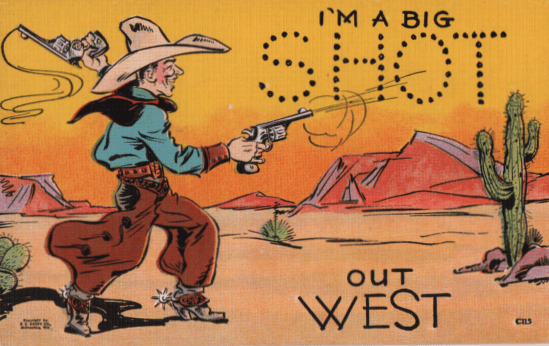
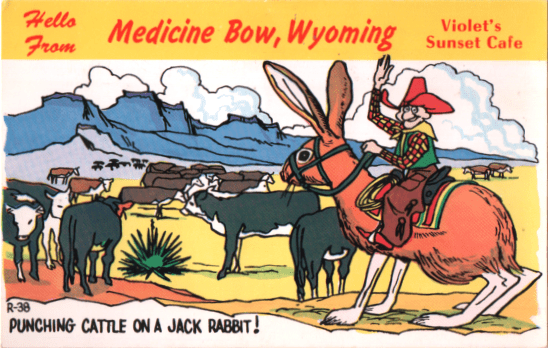
The Western’s popularity rises and falls, but has not gone away for at least a century and a half. The last big era for postcards coincided with an era that valued Westerns highly: they were still popular in cheap, kid-friendly movies (“oaters”), proliferated across radio (“Return with us now to the thrilling days of yesteryear”), and were about to explode all over television (thanks to William “Hopalong Cassidy” Boyd’s perceptive investment in his own movies.)
During this decade, as in others, there were actual cowboys paying attention to all these phenomena. And one or two voices were always ready to rise and complain “That ain’t the way it was, by Ned!” The makers of mass-market westerns would respond that they were making mass entertainment, not trying to bring out the most historically accurate views of the Old West.
But postcards go back a couple of generations prior to the mid-century adoration of Roy Rogers, Gene Autry, Tex Ritter, the Lone Ranger, Red Ryder, Lash LaRue, etc. So perhaps we can get a more accurate look at what the cowboy looked like. The hat, especially, was an important part of the mythos.
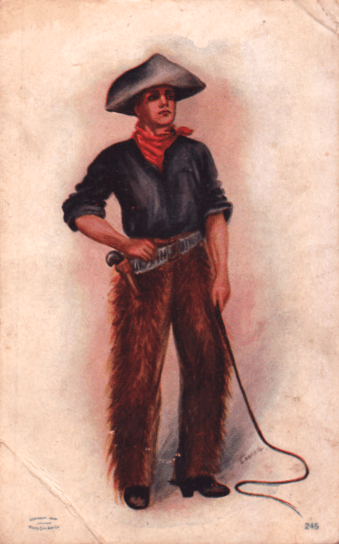
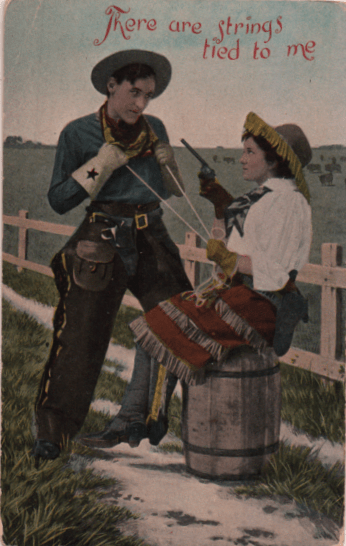
The problem is that the general myths go back even farther than that. In the late nineteenth century, writers like Bill Nye were complaining that cheap magazines had given the folks back East a picture of the cowboy that was romantic, adventurous, and hopelessly inaccurate. (Bill Nye claimed that the average cowboy, given a handgun, was more likely to shoot his own foot than anything else.) This postcard is a hundred and twenty years old, and looks…like a cowboy from the cover of a paperback romance. MAYBE some outfits expected their cowboys to shave every day, but how did he get to be a cowboy without any sign of a tan? (Some sage Native shaman selling an ancient potion called SPF-66?)
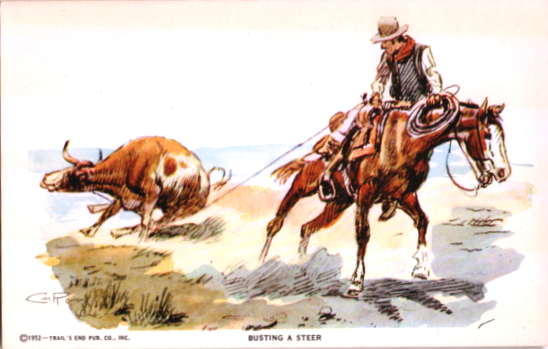
There ARE some postcards in inventory which show off drawings by Charles Russell, the great cowboy-turned-painter, so we can see what the nineteenth century cowboy looked like (perhaps modified by memory or the market? This chap also looks rather clean-shaven and pale-faced. Or am I just recycling someone else’s mythical construct of the stubbled cowboy with leathery hide?)
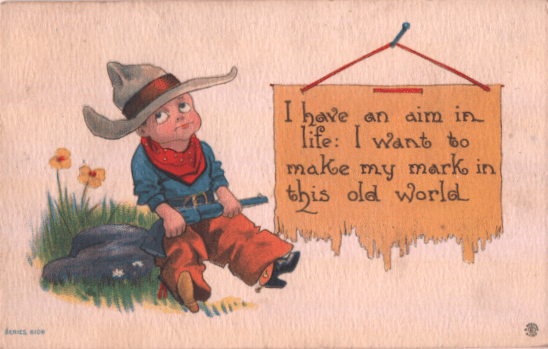
But however far away from reality, we can at least get some truth-adjacent observations on the cowboy’s hat. This cowpuncher’s hat seems a little small, but perhaps in a situation like…I forget what I was going to say.
The brim seems to be the most important part of the hat anyhow, to keep the sun off…yes, I know what I said about tans, but only a very few cowboys, mostly on television, wore hats broad enough to shade their arms.
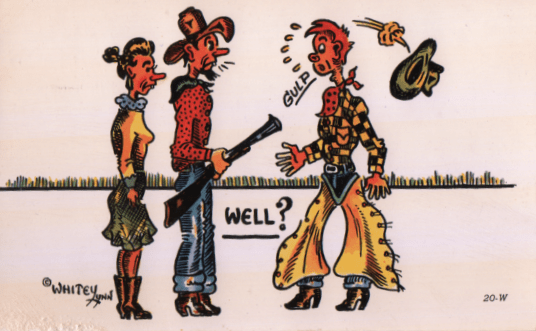
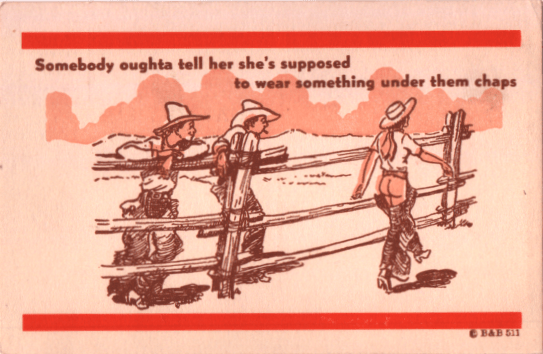
Another part of the cowboy wardrobe that can be observed in both early and late postcards of the Wild West are chaps, those protective leggings you may have observed various cowpokes wearing in earlier parts of this column.
Their popularity on postcards, though, is due to another sort of joke which also goes well back before the mid-nineteenth century. She does have the right hat, though, and that’s what counts. (It doesn’t seem big enough to prevent a third degree suntan. Zorro never had to deal with these things.)
At the height of the high white flight of stairs was a small landing and a tall wooden door. Bott and his crew studied it for a moment without detecting spikes, poisoned nails, or opening for projectiles. It lacked even a knocker with a nasty expression. One hand on a grenade, Bott turned the knb and walked through.
“Well, when UI milk the president into his own hat!” cried Louba.
Light blue walls were hung with gold draperies. Under each set of curtains sat a handsome golden chair with a blue cushion. Between each display f chair and drapes was another plain white wooden door.
“Leastways, we gets ta rest our foots,” noted Louba, heading for a throne.
Chlorda raised one gold hand. “Don’t, dear. If either of you deposits your poundage on one of those, we’ll have shiny kindling.”
“Neato squeato,” said Bassada, thrusting one hand down the collar of the aristocrat’s gown. “Jes’ right fer toastin’ shiny tiny toes.”
Bott was studying the doors. Bolted to each doorframe, above the actual entryway, was a row of brass letters, different on each. Bott could read none of these: “NOT THIS WAY”, “THIS DOOR AND TWO LEFT TURNS AND YOU’RE FREE”, or “VERY HUNGRY WEIRNETS BACK HERE.”
“Ow!”
He turned to find the gold sitting on the floor next to one of the chairs. “I don’t mind going plop if it entertains little brains.” She said, rubbing one hip as she rose. “But you might’ve smashed my lunch.”
“I was over here, Teeny Top,” said Louba, giving the hangings around another chair a yank, and stepping back to see if anything happened.
“Don’t care where ya sits,” said Bassada, easing herself gingerly onto the seat of another chair. “Long’s it ain’t me face.”
“You’d have to wash your face,” snapped Chlorda.
“Flallop!” Louba spun to face them, looking from one to another. “Still got that rope on ya, do ya, Cap’n?” She rubbed both hips vigorously.
Bott set his back against a door labeled ‘GRENADE STORAGE”. “We’re not alone. Did it feel like an insect bite?”
“Whoops!”Bassada jumped out of the chair. “If it’s a bug, it’s got mighty educated fingers!”
”Let’s leave, shall we?” Chlorda reached for a door marked ‘THIS IS A SHOWER WITH BOILING WATER.”
“No!” Bott shouted. “We’re a crew, remember? Over here! All of you!”
He shoved a hand in one pocket as the Klamathans grouped around him. “We’ve got one or more invisible characters in here with us.” His fingers ground together; he lowered his voice. “They’re here to force us through one of these….”
The gold’s hair floated forward a little on the left side. Bott pushed her away and reached out with his handful of crushed berries. The temptation to go for the face was resisted; farther down, there might be cloth which would hold a stain.
A dark blue smudge hung in the air for a moment. When Chlorda and Louba lunged, it disappeared.
“He’s runnin’ for it!”
“Watch what door it opens!”
The smudge showed again for a moment as its wearer looked back. This second second was the one too many. Three bodies collided at that point.
“Don’t kill it!” Bott had a grenade out in case there was evidence of a larger group. “It may be useful.”
“It’s got hair,” said Bassada, groping the invisible prisoner. “Useta have two ears!”
“I think I’ve found a swotf!” Chlorda drew something from below the smudge.
“Think I know what I found, too.” Louba pulled out a dagger she had never drawn in self-defense. “Mebbe I’ll keep it, as a souvenir.”
The Klamathans moved closer as the body struggled. Louba thumped the top of its presumed head. “Nah, more fun if I leaves it on. Cap’n’s right; he might be useful.”
“Don’t grab,” snarled the blue. “Yez’ll get yer turn.”
“I was going to check its pockets,” said Chlorda, with some dignity. “I…what’s that?”
“That” was a bump in the previously flat carpet. As they watched, it rose into a hill. “Bet back!” Bott ordered, rather unnecessarily as they began to slide. “Take him with you!”
“Hooptydoo!” Louba fell backward. “Who yanked the rug frum under me toes?”
Something hissed. Bott yanked open the satchel and dropped the grenade back in. “Where’s the rope? Did we bring it?”
“Here ‘tis,” said Louba, reaching into a pocket. “Want us ta truss him up?”
“No.” Bott took the rope; he hoped it was long enough. :Just stand right there. Bassada, you go to that corner. Chlorda, that one. Come in as the rug comes in. Pass the rope along.”
The hill continued to rise until the sides were nearly vertical. It did not fill the room. “Don’t let it tip.” He finished his loop of rope. “Keep moving.”
The lump, still hissing, continued to rie. Louba’s face shone with hope as she turned it toward the ceiling. The end of the rope came back around to Bott, and he slid it through the loop.
“Okay. Keep moving. Pull it tight and make sure to keep it above the edges of the carpet.
His heels lifted from the floor. There wasn’t much left of it but a large hole, which had stopped hissing. “Hop to it, Cap’n!” Bassada roared.
“Hoopta!” Louba agreed.
Gold hands gripped the rope just below his. Bott hoped it was long enough to accommodate all four passengers. He also hoped whatever gas was filling this cloth bubble was light enough to lift three Klamathans at once. He frowned. And an invisible saboteur as well?
His hope held, as did the rope. All his crew swung in the air. Louba was kicking at the far end. “Sorry, feller! Crew only.”
“Let him get his own balloon,” Bott called down.
“Lala!” Chlorda noted, as the ceiling opened above them. Bott leaned back to see where they were going. Knowing when to let go was going to be crucial. If they were given a chance for that at all, of course.
He forgot to let go. “Fazzlepig!” snarled Bassafa, as her eyes cleared the opening. Chlorda sighed.
It was a vast, beautiful, white room sprinkled with light grey cubes, cones, and cylinders. Bott also felt a mite discouraged at seeing this chamber again, but called down, “If we hang on, we might pass through this ceiling, too.”
“Gonna make a heckuva target,” Bassada told him.
“Captain?” Chlorda’s voice sounded congested. “Was that here before?”
She was pointing up. “Flallop!” Louba shouted.
Bott was too close to the bulge of the balloon to look straight up, and hate to wait until they had risen above the cylinders and cones, at which point the ship was too big for him to miss.
It was a BBB-44; whether it was THE BBB-44 was another question. The cargo ramp was down. “Don’t jump,” he ordered. “It may be a hologram.”
The loud hiss did not come from his crew. “Somethin’ up there’s real enough ta pop our balloon,” Louba pointed out.
“Okay, change the plan a bit,” Bott called down. “Jump!”
He obeyed himself on the word of command, considering the possibility that the ship was real but the cargo ramp was a hologram. The theory was abandoned as he landed hard on the platform. He clawed himself up before his crew could drop on him, and looked for signs that this might actually be the Dragonshelf.
“Don’t let her come along,” gasped Bassada, landing next to Chlorda. “She’ll tip it over.”
“Everyone in this crew has a role to play,” Chlorda informed her, hauling her up toward the body of the ship. “We might need an anchor.”
Bott left them to it, and raced to the cockpit. Experience in dozens of spacecraft had given him the ability to recognize any vehicle he’d flown in before. The contours of a seat, the feel of the controls, a combination of things on the periphery of vision that he could not have listed if asked—a light here, a reflection there—all combined to tell him this was NOT Nubry’s ship.
Looking up and finding the console before him was bright red with knobs shaped like flowers helped, too.
“Quite the decorator, yer sweetie,” noted Bassada, joining the captain.
“This isn’t the Dragonshelf.” Bott rose from the seat. “It’s another trick. We….”
He fell back into the seat as the ship jerked. “’At a trick too?” Louba demanded, “Or is we movin’?”
“One way to find out,” he said, leaning toward the control console.
“Do you think you can play with these toys?” Chlorda pushed past her larger companions to plop into the co-pilot seat.
“If they’re functional. I can fly anything when I’m sober and I haven’t had a drink in three days.”
He shifted a blue blossom; the shipped turned right and dipped. A grinning face appeared in the center of the flower, but he decided to ignore this. He pressed a long yellow bloom forward. The ship picked up speed.
“They….” The ship bounced, in response to no command of his.
“We ain’t alone!” Bassada dropped into another seat and pointed at a screen.
Asecond ship, guns still firing, zipped around the BBB-44. Bott sucked in his breath, then nodded. It was a replica of his own pirate ship: just the thing to amuse an Emperor. Put him under attack by a ship he might hesitate to destroy.
Bott did not feel like amusing His Imperial Worship. Judging by the other blossoms, the ones that controlled the guns should be down her, just to the right.
“Hey! ‘Ey’re callin’ us!” Bassada peered at a monitor. “Wanna see?”
It was part of the show, of course. There would be replicas of his old crew, and perhaps him as well, to plead their case. He could take it. “We’ll listen.”
She tried a couple of flowers before finding the right one. A small screen lit up, showing the cockpit of his old ship crewed with a number of nude Nubrys, looking as if they’d been liberally sprinkled with red pepper. “In the name of Thomas, Lord Fairfax,” they ordered, I unison, “Stop following us. We are taking the library ship to a safe place. Once we find it.”
Bott’s first impulse was to fire. Then he called, “Can we reply?”
“Could ‘n’ should,” Bassada replied, twisting another flower.
“Hailing the librarians,” Bott called. “Let’s look for the Dragonshelf together. Our two ships together ought to e able to blow holes in this little shooting gallery.”
The ship bounced underneath him again. “That was our last warning shot, Bott!” the Nubrys intoned. “Beware. We are armed with peteseeging missiles. Are we? Yes, we are!”
“Duno if bluetush pushed the wrong petal,” said Louba, leaning over the screen, “But it looks to me like ‘ey don’t has any ears switched on, Bottsy Cap’n.”
“They wouldn’t, of course.” Bott pulled the ship to dodge a direct shot, and reached for what he assumed were the firing flowers.
Every now and then, when I feel like living dangerously, I consider writing a series called “Is That Still Funny?”, in which I would examine the comedy that made me laugh when I was growing up. I have it all figured out: how I will guard myself against laughing simply from nostalgia, how we will skirt the issue of whether something can be offensive AND funny (and how many comedians have banked on getting the balance just right), and so on.
One of the problems with this is that I grew up watching almost exclusively comedy, from sitcoms to stand-up, from Saturday morning cartoons to Saturday afternoon showings of Abbot and Costello movies and, of course, the omnipresent Three Stooges shorts (which, for those of you watching them on television today, were actually run in their entirety ad commercials were stuck in BETWEEN them.)
The sheer variety of the offerings, which necessitates taking into consideration the comedy writers as well as costumes and sets, makes the whole thing impractical. Then you work in the question of catchphrases (as we used to label memes). These are a comedy staple going back decades, and almost certainly centuries, and each generation is mystified by the catchphrases of those before and those after. As “Vas You Dere, Sharlie” gave way to “Tain’t funny, McGee” to “And awaaaay we go” to “Verrry interesting” to “Can we talk?”, youngsters have looked on puzzled as their elders dissolved into helpless laughter.
So you will probably not be seeing me review Captain Nice or TomTerrific or Donald Kaul here. Unless I lose all sense of responsibility and start in on the research again. (I have tried. Erma Bombeck and Alan King, by the way, held up pretty well, while Space Kidettes did not.)
HOWEVER, just to hint at the difficulties, here is a quiz based on some comic mainstays of my formative years. If you know these from your own research into comic archaeology, good for you. If you REMEMBER all these, welcome to what I prefer to call Late Middle Age.
QUESTIONS
Q1.What were the names of the two seagulls Red Skelton used to impersonate?
Q2.What member of the animal kingdom was Dick Martin, of Rowan & Martin, justifiably proud he could imitate?
Q3.What creature spent Saturday mornings foiling Dick Dastardly and Muttley (in their Flying Machines?)
Q5.Who perpetrated knock knock jokes with Captain Kangaroo as his straight man?
Q6.What animal starred in another joke fad, often involving Tarzan or toenail polish or root beer?
Q7.Popular Italian comedian Topo Gigio made many an appearance on the Ed Sullivan show. What was especially notable about this very short media darling?
Q8.What singing group turned a popular comedy show into a recording career, in the eyes of some fans eclipsing the Beatles?
Q9.What singing group turned a hit Christmas song into a never-ending series of animated cartoons and movies?








 Blogsy Babbles