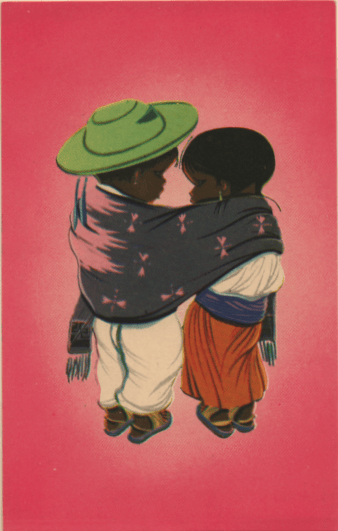
We can read about the allure of postcards, and how they and their messages can lead us to faraway places with strange-sounding names. The ones I deal with do take me on certain journeys, which most people call rabbit holes. Take these kids, reminiscent of a certain school of popular art in the 1950s and 1960s. Any of you old enough to get that reference to faraway places will recall it advertised in the back pages of magazines. This boy and girl aren’t quite so obnoxiously cute as a lot of that wall art. They are here to demonstrate traditional garb worn on special occasions in parts of Mexico.
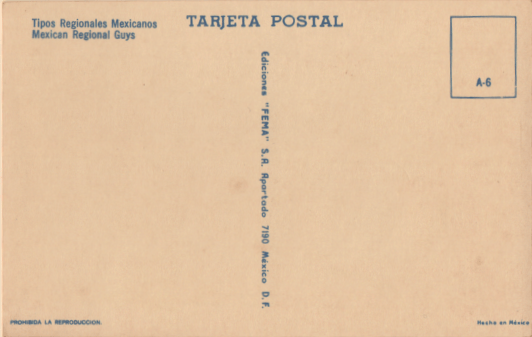
What sent me bunny hunting was the English title. I consulted several AI (and one actual human) translators, all of whom told me “tipos” is best rendered as “types”. Were they going for “Mexican Regional GUISE”? Once again, I was left alone in the rabbit hole, wondering where my carrots had gone.
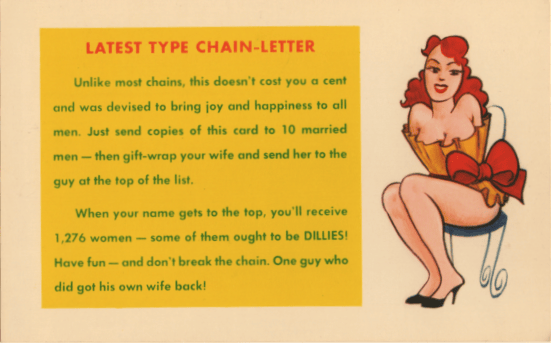
This card lured me into the history of chain letters and wondering if they still even existed in the days of email. This is a solidly constructed rabbit hole. Different sources take the custom back into the sixth century, while one or two go back farther (THEY could be joking.) And as you no doubt already know, the chain letter blossomed and flourished when email came along, whether you call it cyberbullying, crowdsourcing, or something in between.
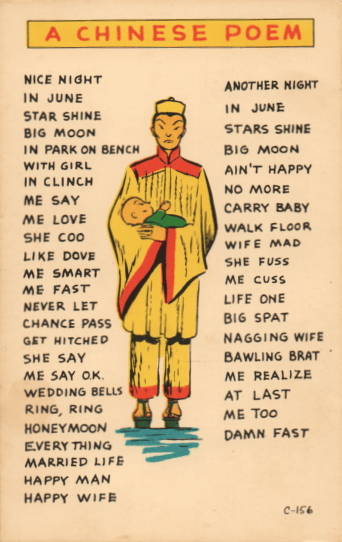
Ever since I found that one popular postcard poem was the work of Milton Berle, I have been curious about these folk lyrics. So I braced myself for protests about anti-Asian stereotyping, which I did not find. But I didn’t find a lot of help on where this came from, either. The card is from the 1950s or thereabouts, so sources who traced it to authors in the 1980s and 1990s are off a bit. At some point a Dr. Richard Dobbins started using it as an aid to Christian marriage counselling, and a number of performers have used it that way since. But whether Dr. Dobbins wrote it, or found it and applied it, is not perfectly clear. SOME people insist it is the work of Langston Hughes. I’ll, er, look that up when my social calendar isn’t quite so full.
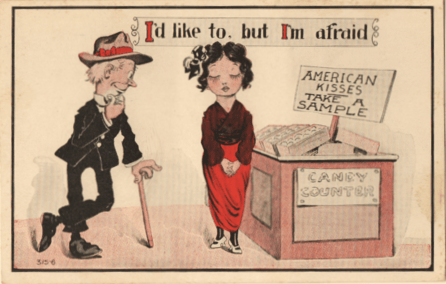
This one found me a little ahead of the crowd. Plenty of people pointed me to Hershey, and the invention of their famous Kiss in 1907. And yet I knew that neither Hershey’s nor chocolate have a lock on the word: those of us who went trick-or-treating during the War of 1812 remember peanut butter kisses, and there are also molasses kisses. The best anyone can do with all of this is that “kiss” for a small wrapped candy started somewhere around the turn of the last century, and is unique to North America, being either a Canadian invention or a development south of the Great Lakes.
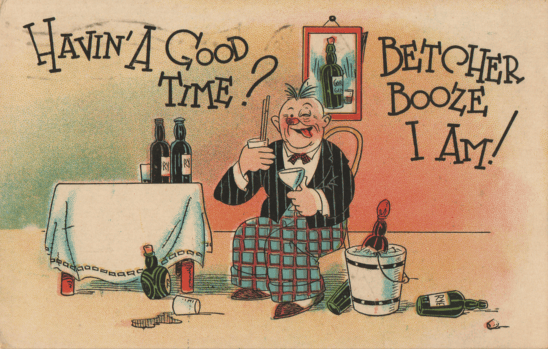
At least the kiss people offered concrete data. All I found when I got curious about “you bet your boots” comes down to “Boots are expensive.” This card, from right after the Repeal of Prohibition, puts the phrase before 1933, and I came up with THAT date all by myself (helped by the postmark on the card.) Half the websites say, “Well, we figger during World War I, soldiers would wager valuable things” and the other half say “Wall now, we reckon it was cowboys who would wager their boots that….” Moral: don’t bet your boots on research done through the Interwebs.
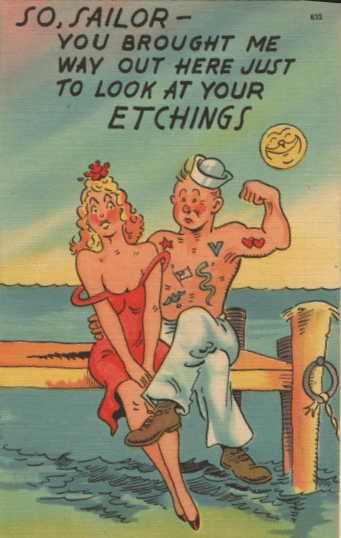
This took me down a very similar rabbit hole, with more branching tunnels. Nobody knows where the “come up and see my etchings” invitation from a rakish male to a potential female partner comes from. In chronological order: some websites which say it comes from sitcoms of the 1950s (again, the card is from before that.) Others feel it was inspired by Mar West’s “Come up and see me some time,” though a few claim Alfred Hitchcock used it first in 1929. One or two sources award it to rascal architect Stanford White around 1907, but others toss it into the 1890s with impoverished artists luring possible customers into their studios (which is NOT the same thing at all, at all.) A LOT of people mention that, of all people, Horatio Alger used an invitation from a woman to a young hero to look at some etchings in “The Erie Train Boy”, but this comes by mail, and is not meant lasciviously. One website suggests that in the 1880s or thereabouts, wealthy art collectors in France discovered erotic Japanese prints and would invite young ladies to come and look at Japanese art without divulging the nature of the imported prints. This writer did express some doubt, not being able to find a French equivalent of the invitation. Another expert remarks that the history of erotic etchings goes back as far as the history of printmaking, and suggests that eighteenth century English gentlemen….
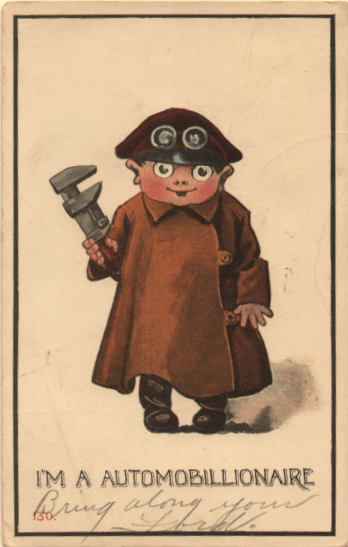
Here I just wanted to find out whether anyone picked up on this word for someone who is really obsessed with cars. And, having learned that no one has, I’d like to know why.

