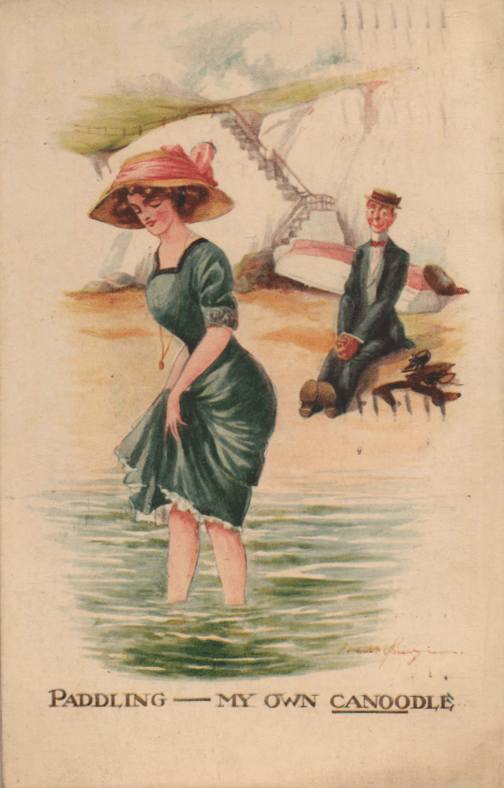
There are numerous roadblocks to my intended series: “Is This Still Funny?” wherein I would look over the work of the stand-up comics of my boy days and figure out whether their work stands up. One is that a certain amount of comedy carries an expiration date. Jokes about Warren G. Harding, for example, may have been hilarious in their day, but to someone now who lacks an everyday familiarity with culture and politics a hundred years old, they have evaporated.
Similarly, the language of a joke can take it out of contention. The postcard at the top of this column, for example, is doomed by using references to three different bits of language which are now obsolete or nearly so. We are playing on the phrase “Paddle Your Own Canoe”, which still gets SOME use, but we are also making reference to “paddling”, once used, especially in England, for just splashing about on the edges of a body of water, and canoodle, a term for dating, flirting, etc. (And am I missing something in the word “canoodle” if it encompassed a lady taking off her shoes and stockings right there at the beach?)

Similarly, “Get Out and Get Under” was a catch phrase for getting down to work, not always used literally, as in this postcard or in the song which MAY have been its source of being (the hero had to get out and get under his broken-down car.) You see how “is this funny?” can be hard to apply. Now that I’ve explained the joke, you understand why other people thought it was funny once upon a time, but, without the cultural background, the likelihood of any of us actually laughing lands somewhere Zilch and Nil. (Makes me recall a gag in Iowa about the new state lottery which just featured photos and Mother Theresa and Slim Whitman…to show your chances of winning anything were between Slim and Nun. See what I mean? It was funny at the time.)
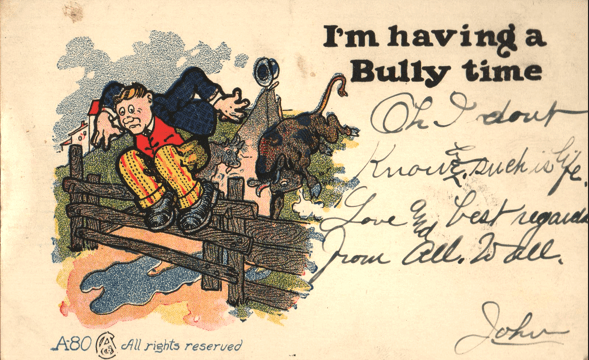
Similarly, only historians and students of cartoons recall that “bully” once meant “excellent”, popularized by Theodore Roosevelt (who also popularized the use of “Excellent”. TR really went for an optimistic public image.)
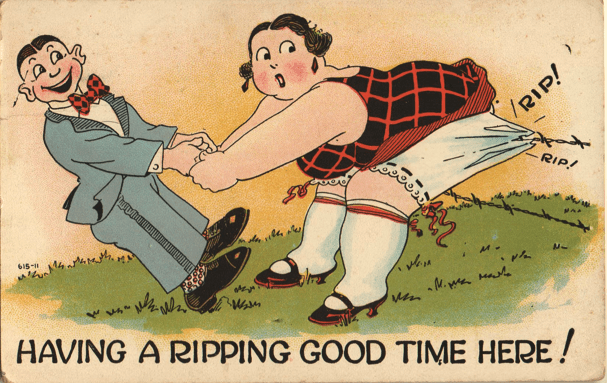
A later generation used “Ripping” in much the same way. We don’t, especially.

A synonym for “canoodling”, to go back further in this sermon, was “Petting”, and that generation, instead of paddling their canoodles, minded their pets. If you don’t have that in your vocabulary nowadays, this is just a postcard sent by an animal lover.

Knowing your audience’s vocabulary is important to those of us who occasionally try to be funny. Not long ago, I mentioned that I could not tell the joke about 288 because it was too gross. This joke skipped past half my audience, and someone who still used “Gross” to refer to 144 had to explain about “two gross.” The same malady affects this joke, since although a few people still use “laying for” to mean “waiting to pounce”, the phrase is fading from usage. (And, admittedly, this joke wasn’t all THAT funny to start with. Unless I’m missing something else.)
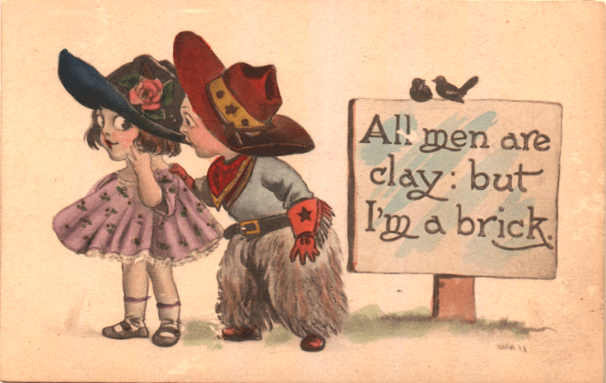
Here we’re lurching under another double reference. A man being made of clay is still used (although “having feet of clay” is more popular) but almost nobody still refers to a trustworthy, reliable friend as “a brick”.

We will close with this joke, which was used by several different cartoonists at different postcard companies. It relies first of all on the bygone expression calling a person’s face a “map”, and connecting that with the double meaning of “to go astray”, suggesting that…oh, you got that one. Was it funny?
 Blogsy Babbles