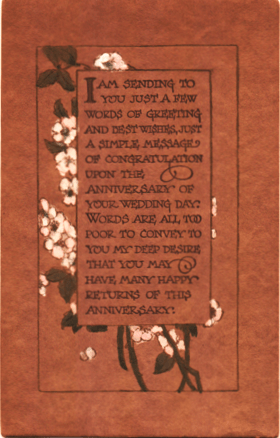
It has been a while since we have discussed the postcard which is all, or nearly all, words. Our ancestors were great fans of an art form which some prefer to call poetry, though sometimes the same sentiments were written in a paragraph that didn’t pretend to be anything but prose. I don’t know if today’s generation would understand a sentiment written out not to be part of a huge essay but just to exist on its own as…what? A text? A tweet? A meme? Okay, you’re going to relate to these postcards more than I thought.
Anyhow, I recently acquired a large collection of postcards described as “romance and marriage, which included a half dozen of these wordy cards. Be warned that they do deal with the fantasy and reality of both. Oh, and as seen by the one at the top of this column, some of them are examples of just Too Many Words. This leaves the sender nothing to say (which may have been the point.)
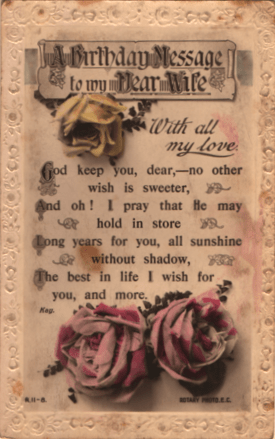
This is a little more flowery (so to speak), and really a little easier to read because of that. This is the only postcard in this article which was actually messaged: a man wrote a two-line message endorsing the front of the card, and handed it to his wife (whom he addresses in the message as “Wife”.)
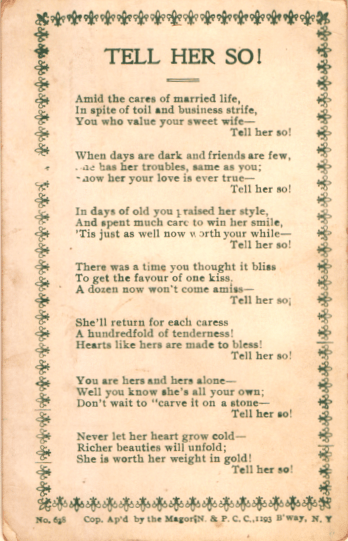
We have discussed hereintofore the habit of a generation or two around the turn of the last century for what I call “refrain” poems, where a sentiment is hammered in by putting it at the end of every stanza. (I’ll look into whether or not these were all inspired by the best-selling poem “Excelsior”, but that’s a whole nother blog.) Telling other people how to treat their spouses, however, has no specific age in history, and I am not sure this doesn’t do the job better than some 300-page how to books on the same subject. (On the other hand, the song “Little Things Mean a Lot” covers the same territory, and has a melody.)

This, however, tosses the whole question into the cold, harsh light of day, what some might call “real life”. I feared the worst on seeing the title, but steel your nerves, good reader. The moral of the story is also better done here than in many a trade paperback self-help volume.
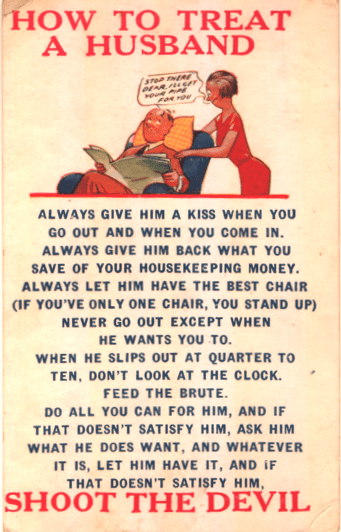
It should be understood that there were plenty of postcards as well about how to treat your husband. This is a British contribution to the literature of interpersonal relations.
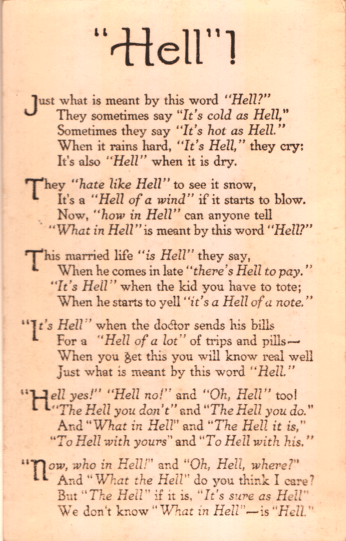
How this got into the collection I hesitate to ponder. But I like its attitude and I admire its courage, since it bears all the marks of a card published somewhere around 1912, when, I was always taught, Americans minded their language in public. (I have also read that we simply became more mealy-mouthed somewhere around 1929.) I started rewriting this text in my head, substituting other words. But the result would be merely derivative, larcenous, and unpublishable. Consider your own version…AFTER you decide why this was part of the matrimonial postcard collection.
 Blogsy Babbles