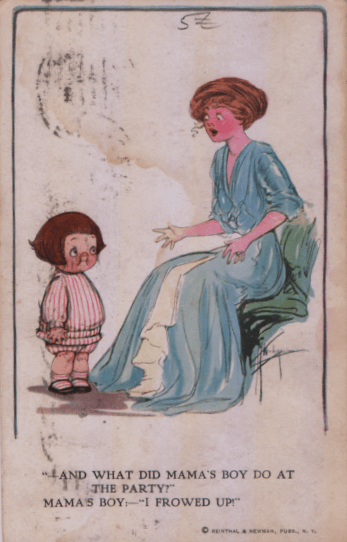
If you hate baby talk, you have a lot of company. One of Irving Berlin’s lesser hit songs dealt with how it set his teeth on edge, and I have been running through the bookshelves in my brain to come up with authors who made the attempt successfully. I had no problem with a couple of novels by Mazo de la Roche (NOT her famous Jalna books) and a long but forgotten book by Lewis Carroll which I enjoyed. But I read those all a long time ago, and will not go out on a limb for them.
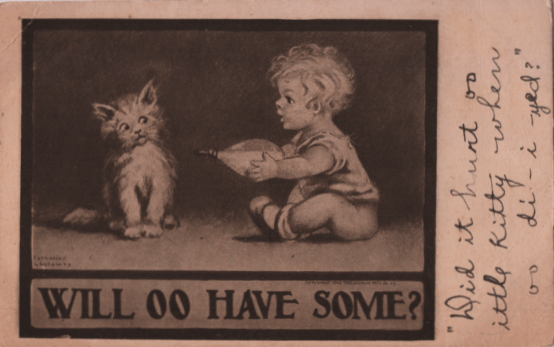
None of which, of course, kept postcard artists from attempting this unloved dialect. Here, as elsewhere, certain rules do apply. Babies themselves almost never speak in baby talk. Baby talk is more commonly something that otherwise apparently normal human beings use for speaking TO babies. As every cartoonist knows, it is more entertaining when actual babies speak in full sentences and discuss complex moral and philosophical problems.
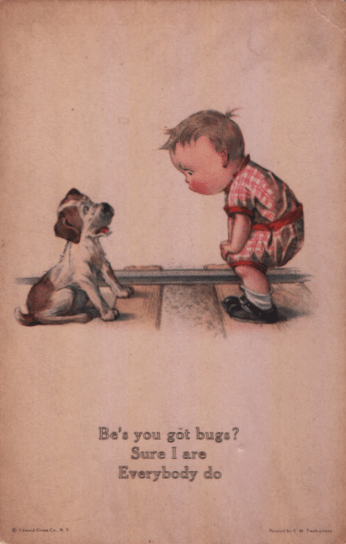
It is also, as seen here, often used for speaking to small, fuzzy animals. This is true of the world outside of postcards as well.

But baby talk, as Irving Berlin observed in his song “Snooky Ookums”, is at its most nauseating when used between two adults whose romance is going through a sickeningly sweet stage. It reflects a principle we have discussed hereintofore: some concepts just seem easier to approach when spoken of with an accent.

The postcard artists used this to great effect in the 1910s or thereabouts with the mammoth phenomenon of Dutch accents on postcards. And having a CHILD voice those sentiments removed the danger by one more degree. This is one of the reasons for the millions of postcards featuring Dutch kids in the 1910s.

But we have walked under those windmills many times. Today we are sticking to children speaking of romance, and in baby talk, so if some grownup (mostly) lover was frowing kisses by mail at the wrong person, one could always pretend it was all a joke.

This does not seem to have been nearly as popular as the Dutch kid postcards, perhaps because there were plenty of people in the United States at that time who still spoke with foreign accents to make fun of (and who enjoyed having their accents recognized.) But even then, people just got shudders hearing grown-ups address each other with THIS accent in public. A number of potential customers may have turned away from these cute kids due to a memory of using this lingo. Belated embarrassment may explain why we make that face when we hear it or see it later.

It might be useful if we went through our memories and postcards and books now to compile a glossary of baby talk, explaining the various usages (they are not uniform, so this is probably good dissertation material). This will be helpful to future readers, in an age when humanity has outgrown the practice.

Thus that brave new world will be able not only to read the ancient texts in which grade schoolers address each other as “booful” so adults don’t have to, but also understand the names of such classic toys as the Booful Beans doll (from early in the beanbag doll craze of the most recent century.) Much cultural data may be lost to them if we don’t move now to….
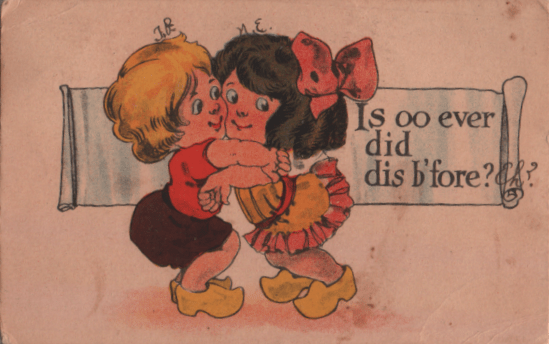
What’s that? You don’t think we will ever, as a species, outgrow the urge to say “Oose wittow tweeheart is oo?” You have a point there. One should never deny the contrariness of the human race. Even if it does lead you to go find comfort in the bottle. (Test the temperature on your wrist first.)
 Blogsy Babbles