As noted heretofore, this is another one of them new years, a time when this column generally looks back to the world of books marking significant anniversaries. I thought I might start with things which are celebrating their fiftieth anniversary, and now I wish I hadn’t. The last thing I really need, when considering a new year full of hope and promise, is to remember that I was looking forward to the same sorts of things fifty years ago, and was old enough then to generate thoughts which are still present in my memory. This suggests I was more than two or three in 1973, which they tell me was fifty years ago. But I will deal with that elsewhere. You want to know about the books.
I noticed right away two books on the list which at least half my classmates picked up and read during 1973. Each was a pioneer in its own way, though the authors, honored in their fields, have seen their reputations continue in odd ways. One was Tim O’Brien’s memoir of the Vietnam War (a.k.a. the War in Viet Nam) If I Die in a Combat Zone, Box Me Up and Ship Me Home, which was banned from a number of school libraries as the decade went on, and won its author mighty praise. The Other was Lois Duncan’s I Know What You Did Last Summer, which set off a new wave of teen thriller novels and movies, few of which really earned a lot of stars from critics. So that’s what folks in my age group wanted: books their elders would disapprove of.
Not quite so popular but still gobbled up by certain of my classmates was the 16-personality heroine Sybil, whose story was told by Flora Schreiber in 1873, while others were fascinated by the grit of a well-thumbed copy of Serpico by Peter Mass. A small number of my adventurous colleagues found their way into Nancy Friday’s My Secret Garden. They must have picked that up at a bookstore, since it would not have been available at the school library. Nor would Jacquelinne Susann’s record-breaking Once is Not Enough (which made her the first author to have three consecutive novels hit #1 on the bestseller list) though this MIGHT have been in the Adults Only cupboard at our public library.
As far as I can recall, my classmates and I had no notion of other disreputable classics of the year 1973: Equus by Peter Shaffer or Gravity’s Rainbow by Thomas Pynchon). Later in life, I knew someone who never traveled anywhere without his copy of Gravity’s Rainbow. He didn’t especially relish flying, but after working his way into the first chapter of that classic he knew he’d be fast asleep. This is not what brought it its fame, but each reader reads a book for themself.
More vital to me personally at the time were the deaths of two authors who did a lot to make me what I am today (whatever that was), Walt Kelly and J.R.R. Tolkien. I had been familiar with Walt Kelly’s Pogo since shortly before birth, but I had only recently finished The Lord of the Rings, which set me off on a quest for more fantasy literature, which was exceedingly rare in those days, as publishers everywhere knew such junk didn’t sell.
This would lead me eventually to a book first published in 1973, William Goldman’s The Princess Bride. Not only is this an amazing and inimitable novel (though people have tried), but I treasure the paperback I picked up in 1974 or thereabouts, which bears along the top of the cover the words “Soon to Be a Major Motion Picture”. The movie, which became a classic as well, appeared in 1987, and I have always wondered what the record is for “Soon” to be a major motion picture.
Other classics appeared in 1973, but these are the works which jumped at my memory. When next we cover this topic, we will move to a year comfortably in the past. (Though 1923 is actually headlined by another disreputable book I read when I was…never mind how old I was in 1973. Far too young to be reading so subversive a tome, I’m sure.)
Now, your old Uncle Blogsy has never been a great one for New Year’s resolutions. I like the concept, and I applaud those who make them. But as making resolutions to do better in the New Year implies that I am not perfect to begin with, I prefer not to participate.
(As for those uncommonly enlightened souls who cry out that they hate New Year’s resolutions because there is no reason to wait for a special day to resolve to change things, I wish you the very best success with your resolutions of October 27 or May 14, but don’t quite see what the fuss is about. Making New Year’s resolutions doesn’t mean you CAN’T make resolutions any other day, like, say, March 18th, when you swear never to chug that much Guinness right after all that corned beef and cabbage or July 7th, when you resolve to make sure your bathing suit is secure before jumping off the high dive, or maybe on February 15th, when you swear you will check the first name of your beloved before mailing that…where were we?)
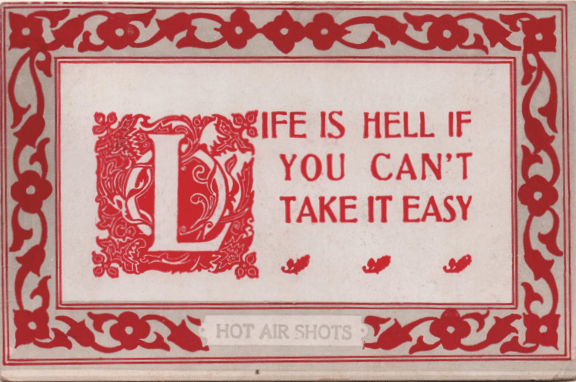
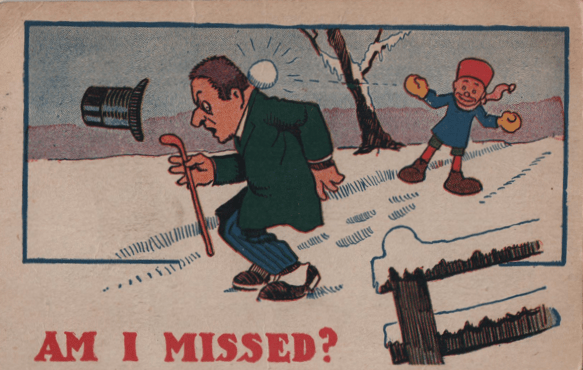
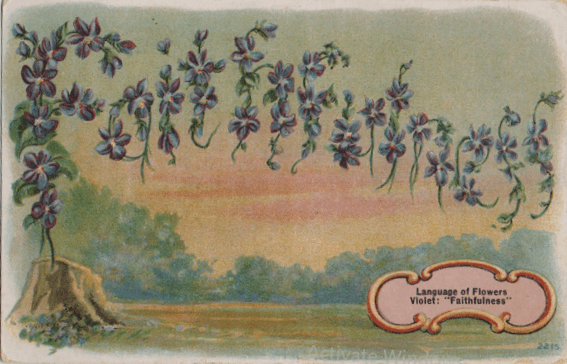
Anyway, New Year’s or not, postcards have always been willing to urge you on to self-improvement, whether they were dead serious, like the one at the top of the column or done for the sake of the joke, like the following.
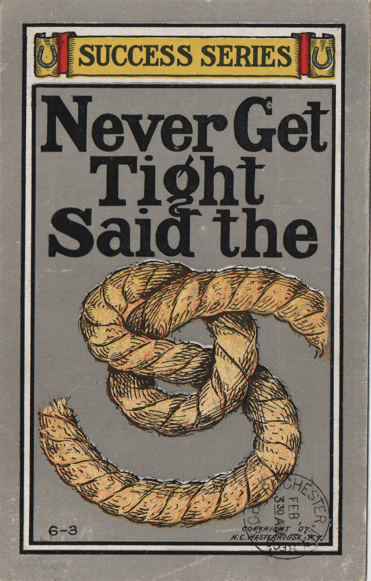
(By the way, was our language able to support the reading :Never get tight, said the NOT”? Or is that a twenty-first century idiom?). Other admonitions came from the writings of experts (defined, then as now, as “anyone whose remark I like”) It was an era that believed in the power of positive thinking, even before that phrase was invented.
In fact, it may surprise you to find so many life counsellors, in an age when urgent effort and keeping your nose constantly to the grindstone were considered the only ways to success, went around suggesting that you could go too far that way.
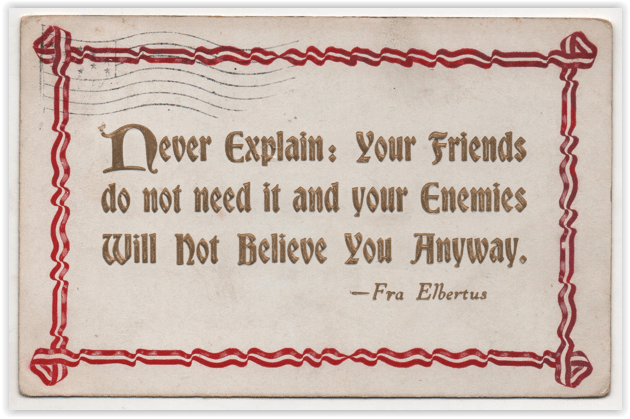
Resolutions frequently involve swearing off bad habits. Some of our ancestors’ heroes picked out bad habits you might not expect. (Fra Elbertus was a nickname of Elbert Hubbard, one of the busiest life counsellors of his day.)
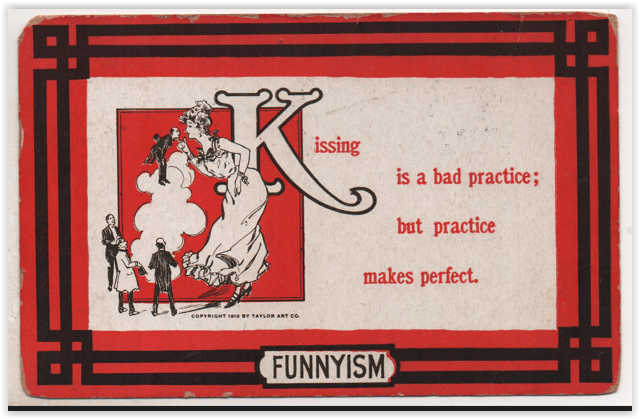
Another common sort of resolution is the one where you vow to get better at something. This kind was just as common in 1910, when this reflection was available on a postcard.
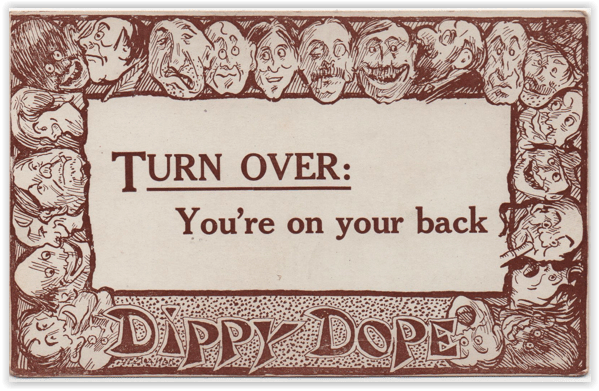
This is not to say that every single bit of advice provided by the benevolent postcard companies is especially useful.
Or even all that explicable. Still, I will say this is the easiest resolution I’ve seen so far this year.
A lot of our early history was concentrated around the Mediterranean, where palm trees are often handy. It became the custom to spread the road with palm fronds if a conqueror was to come that way. To this day, we speak of winners as “taking the palm”, though it has fallen into the category of semi-archaic quaint expressions like “That takes the cake” or “Don’t that beat all!”
PANSY “Thoughts”
As anyone with high school French can tell you, this is simply the Englishification of “Pensée” or “Thought”. It is essentially a violet gone uptown; further refinements on the flower are known as Heart’s Ease and Love-In-Idleness. This has inspired a number of cautionary poems about how Heart’s Ease became Love-In-Idleness. Let’s skip ‘em.
The pansy is also sometimes known as Johnny-Jump-Up, Three-Faces-Under-a-Hood, Cuddle-Me, and Kiss-Me-In-the-Pantry. You can see how these Thoughts were trending.
PANSY, BOUQUET OF SEVERAL “Love”
Particularly, says George O’Neill, on May Day.
*PANSY, WITH A BROKEN FLOWER “Adieu, But Remember Me”
PARSLEY “Feasting”*
The Greeks would wear a bit of parsley when attending a banquet or have a sprig of it placed on their plate before they dined, in the belief that this promoted appetite and inhibited drunkenness. There are still restaurants which place this at the side of your dish, but nowadays that’s just because it’s pretty. The habit really started to die off when the mineral content of parsley started to be played up, and parsley was bought for consumption rather than decoration. Another sign of the fading of the twentieth century.
*PARSLEY WRAPPED AROUND A CARROT “Fecundity”
Josephine Addison came up with this. I haven’t decided yet whether I approve.
PARSLEY, FOOL’S “Silliness”
*PARSNIP “Poison”
Several of my friends feel that way about it.
PASQUE FLOWER “You Are Without Pretension”*
This may SOUND like a compliment, but what it meant originally was “You Have No Claims” or “You can’t even pretend you have any claim on me or my heart”. Pretension became a derogatory term, from people who pretended to be superior.
This meaning occasionally turns up attached to Rose Campion, because the word Mme. De Latour used for Pasque Flower can be translated that way if you aren’t paying attention.
PASSION FLOWER “Religious Superstition”
Several books say this means “Faith” if presented upside-up and “Religious Superstition” only if presented wrong way around. For the most part, however, floriographers used this in a reaction against a romantic tendency to trace all the paraphernalia of the Crucifixion in the flower: this part represented the nails, this the crown of thorns, and so on. Nowadays writers blame this symbolism on the Victorians, but it was already going out of fashion when the floriographers came to sneer at it. Dorothea Dix, writing in 1829, attributed the whole thing to missionaries who preached well before her time.
Patience: see DOCK
PEA “An Appointed Meeting”
*PEA LEAVES “Liberality and Good Living”
PEAPOD “Akin”
“As alike as two peas in a pod”, you see.
PEA, EVERLASTING “Lasting Pleasure”
*PEA, SCARLET “Must Thou Depart?”
PEA, SWEET “Departure”
Malcolm Hillier says this comes from the way the Sweet Pea last such a very short time after being cut. (The Everlasting Pea lasts longer, hence its name and meaning.) But our authority in this question is Dorothea Dix, who takes an image from the poet Keats, of Sweet Peas looking as if they were on tiptoe to hurry away.
I hate to keep whining about this, but four books listed one meaning for “Pea, Sweet” and a completely different one for “Sweet Pea”.
PEACH “Your Qualities, Like Your Charms, Are Unequalled”
PEACH BLOSSOM “I Am Your Captive”
PEAR “Affection”
PEAR, PRICKLY “Satire”
Prickly pears are widely used in cattle feed. Recognizing them, cows will sometimes eat prickly pears they find growing wild, and die. They don’t realize that the prickles have to be removed before they can get at the good bits. That may be a good metaphor for satire, and it may not. It’s hard to tell, with these new glasses.
PEAR TREE “Comfort”
*PEAR, WILD “You Have Surprised Me”
Pearl: see ACHILLEA PTARMICA
PELARGONIUM “Eagerness”
This is just another word for the geranium—it means Stork’s Bill—but two floriographers prefer to use this word, and this meaning.
*PELLITORY “Free Will”
PENNY ROYAL “Flee Away”
It appears in too many reputable resources to ignore that this was once a staple of the homes of our ancestors, as a defense against fleas. Hence “Flea Away”. You never know when these people are putting you on.
PENNYCRESS “Indifference”*
Besides Mme. De Latour, only Emmeline Raymond mentions this plant. All the rest were indifferent.
PENSTEMON AZUREUM “High-bred”
There seems to be a controversy among botanist and horticulturists whether this is spelled Penstemon or Pentstemon. I’ll pass along bulletins as I get word.
PEONY “Bashfulness, Shame”
The floriographers are fairly united that the flower blushes because it is bashful, ashamed to be putting itself into the limelight. But anti-Victorian commentators insist the Victorians felt it was blushing from guilt. Some of these claim that real Victorians never allowed flowers into the house at all, as these were, after all, the sexual organs of plants, and would corrupt innocent minds. We are slowly getting over this attitude toward our ancestors, but you still find it here and there.
PEPPERMINT “Warmth of Feeling”
PEPPER PLANT “Satire”
PERIWINKLE “Tender Memories of Old Friends”
Katherine Mackenzie, a painter of flowers, tells us this was often planted on graves in the Old South, and that sometimes the only way to tell where a forgotten cemetery was is through the profusion of periwinkles, which have gone on after the tombstones have tumbled.
That being as it may, all the meanings of all the various periwinkles (which boil down to the memory cited above) go back to a story Jean-Jacques Rousseau told at parties about how he spied a periwinkle one day and the aroma reminded him of an old friend he hadn’t thought of in years. Everyone seems to feel this is terribly sensitive and romantic, so I guess it must be.
PERSICARIA “Restoration”
Also called Persicarsia, this is a type of Smartweed also known as Lady’s Thumb, or Virgin Mary’s Pinch. There has to be a story about this somewhere.
PERSIMMON “Bury Me Amid Nature’s Beauties”
PETUNIA “Never Despair”
Pheasant’s Eye: see ADONIS
PHLOX “Unanimity”
A lot of tiny flowers form one flowerhead in this plant. Romantic floriographers expand the meaning to “Our Souls Are One”.
*PHLOX. WHITE “Proposal of Love”
*PHLOX, WHITE WITH RED EYE “Weeping”
PIGEON BERRY “Indifference”
PIMPERNEL “Assignation”*
An assignation is an appointment, a rendezvous. Henry Phillips says the plant took this meaning because it closed when the weather was going to be wet, and opened all its leaves when the weather would be dry: easy to plan meetings with one of these on hand. More floriographers, though, claim the pimpernel can be counted on to bloom at precise times, like someone who has made an appointment. Claire Powell, in fact, tells us it opens at 7:08 A.M. and closes at 3:01 P.M. C.M. Kirtland holds out for 8 A.M. and Noon, but she may have been in a different time zone.
Recent floriographers hold out for more heroic meanings, which means they’ve read The Scarlet Pimpernel.
PINE “Pity”
This meaning is also sometimes applied to the Black Pine, and also to something called the Black Spruce Fir Pine, which covers ALL the bases.
PINE NEEDLES “Compassion”
*PINE NUTS “Sweetness”
PINE, PITCH “Time and Philosophy”
PINE, SPRUCE “Hope in Adversity”
And this meaning is also sometimes applied to the Norway Spruce and the Norway Spruce Fir. As hinted before, I decline to try to guess what our ancestors meant when they started sorting evergreens.
PINEAPPLE “You Are Perfect”
The Victorians considered the pineapple a perfect gift. When I suggested it last Christmas all I got were funny looks. But Catherine Waterman goes into raptures about this gorgeous plant. Even if it weren’t such a gorgeous plant, she says, we’d still adore it for its thrilling odor. And if it had no thrilling odor, the fruit is so tasty. I do like pineapple, except on pizza, but this seems a bit overboard.
PINK “Boldness”
*TWO PINKS ON ONE STEM “Unity”
*THREE PINKS ON ONE STEM “We Are Watched”
Two’s Company, you know.
PINK, CHINA “Aversion”
Sometimes the India, or Indian, Pink, this was definitely the China Pink to Henry Phillips, who gave it this meaning because in his day, China had closed its borders to foreigners, having an aversion to them.
PINK, CHINA, DOUBLE “Always lovely”
PINK, CLOVER “Dignity”
Clover Pink got its start as a misprint for Clove Pink, which is a kind of Carnation. A folklorist named Dorothy Hartley says the carnation was a clove pink because our ancestors floated it on top of heavy, clove-scented spiced wine. Lighter wines required a bit of borage floating on top.
*PINK, DIANTHUS KENA “Greeting”
A Dianthus is a pink or carnation, but I haven’t heard what kind of which this is.
PINK, GARDEN “Childishness’*
\*PINK, MAIDEN “Pure Love”
PINK, MOUNTAIN “Aspiring”
Now, I assumed this referred to people who climbed mountains. “Because it’s there”, don’t you know. But it’s a reference to the ancient award of a pink as first prize. Roses were also sometimes used for this. To say “He was the rose of all chemists” is to say “He was the best of all chemists”. If you read regency romances, you know the phrase “the pink of the ton” refers to someone at the very pinnacle of fashion. And most of us know what it means if someone is “in the pink of health” or simply “in the pink”. Paradoxically, this often means someone with rosy cheeks.
No one I have consulted sees any connection between pink and pinnacle, but I think we could pursue that.
PINK, RED “Pure Love”
The most popular minority meaning is “Woman’s Love”. Is someone making a point here?
PINK, RED, DOUBLE “Pure and Ardent Love”
How ardent can you be and still keep things pure?
Aristocrats sometimes wore a red pink as a symbol of their party during the French Revolution. It was safer to do this out of the reach of the authorities.
*PINK, SALMON “Forgive me”
PINK, STRIPED OR VARIEGATED “Refusal”
*PINK, VIOLET “I Find pleasure In Your Presence”
PINK, WHITE “Talent”
*PINK, WHITE, WITH PINK CARNATION “Acceptance of Invitation”
*PINK, WHITE, WITH PINK CARNATION PETALS “Acceptance of Invitation;
Make Haste”
*PINK, WILD “Wayward”
PINK, YELLOW “Disdain”*
Robert Tyas explains that the Yellow Pink, like disdainful people, takes much and gives little. Helen Field Fischer, “The Flower Lady of the Midwest”, says it is the flower itself which is disdained, saying that the yellow pink proved to be no more popular than the green rose.
PLANE TREE “Genius”*
The philosophers who hung around Athens sat under plane trees with their students to dish out philosophy. To be able to sit in the shade all your days and still get busts of yourself in all the libraries surely shows genius.
PLANTAIN “White Man’s Footsteps”
*PLUM “The More I See You, The More I Want You”
PLUM BLOSSOM “Keep Your Word”
Plum, Indian: see MYROBALAN
PLUM TREE “Keep Your Promises”*
Claire Powell points out that the plum puts out blossoms every year, but unless it is very well cared for, will produce fruit only every third year. The blossom symbolizes the promise, you see.
PLUM TREE, WILD “Independence”*
Being wild means never having to keep your promises, I guess.
Now, in our last thrilling episode, we expressed our deep feelings of sorrow when we discussed the plight of our snowbird friends and relatives, the ones who find themselves forced to go to areas of the world where they cannot enjoy the fun of being surrounded by snow at this festive time of year. No chance for them to be snowbound during the work week or to face the character-building challenge of walking a block or two through districts where no one has shoveled or salted since the last blizzard.
It should be noted that the postcard cartoonists, being a sympathetic lot, mourned with us about our less privileged brethren. The Russians had a proverb about the difference between cold weather and warm, noting that if one has the resources, one can deal with one but not the other. “When it is cold, every man has his own cold. But when it is hot, the whole family of man is hot.” The cartoonists took this to heart.
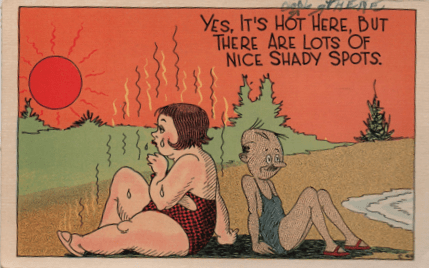
One of their most common examinations of the plight of those in the heat is the hunt for suitable shelter from the burning sun.
This shelter is almost always female, by the way, and sometimes big enough for two.
Naturally, it would be cruel to note that those of us in more fortunate climates don’t see all that much of the sun between, say, Thanksgiving and April Fool’s Day.
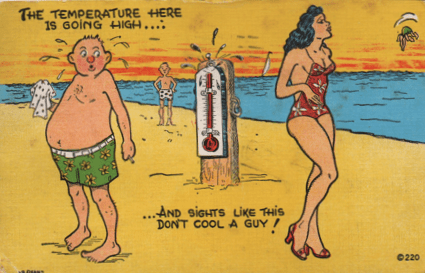
Because, after all, without things like a breeze or something else to help out, shade can only go so far. (You, in the back: I heard what you said about the wind in this chap’s situation. Just for that, you don’t get to shovel snow this afternoon.)
And sometimes shade is not available, so the snowbirds start changing into their summer plumage early.
Just like the postcard artists, we certainly feel compassion for those caught out on the beach, where, of course, there are no trees and what we do find on the beach just heats us up.
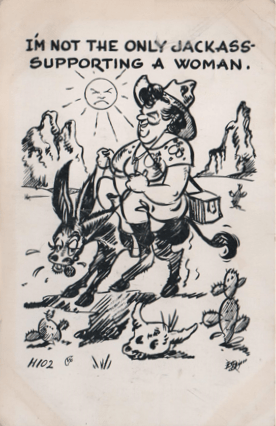
What kind of jackass, they ask, would willingly expose themselves to the heat when there is a whole world of wind chill waiting back home?
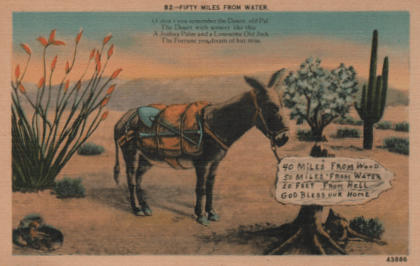
This little poem, written long ago by an anonymous author, appears on many postcards, almost always being complimented by four-legged philosophers.
A modern artist kept the philosopher but went for less poetic observations on his signs of summer.
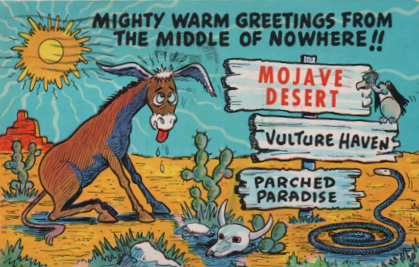
There ARE those who feel they MUST go to the desert come December, of course. My theory is that they’ve been out in the sun too long.
So let us not revile our misguided brethren who head west or south during these joyful days, and simply relish the fact that WE are in a spot where, when it gets too warm, we can just take off one or two blankets. Now, if you’ll excuse me, I must run to the grocery store, and it will take about an hour for me to assemble all the layers of sweaters, scarves, and loholty-koholoties. Have fun in the snow!
Now, as several scholars (or simply wiseguys on the Interwebs) have pointed out, not every Christmas song we sing or listen to or tolerate in the store, is strictly a Christmas song. A large number of songs—Let it Snow, Winter Wonderland, Suzy Snowflake, Frosty the Snowman—are technically snow songs, songs about the joys of winter. They celebrate the magic spell cast by cold white stuff spread like frosting over all the world.
Postcard artists were just as ready as songwriters to exploit the magic of a snow-covered landscape, with or without a reference to the time of year. The cozy scene at the top of this column dates to 1907, but over a century later, you can see pretty much the same scene if you happen through the right neighborhood.
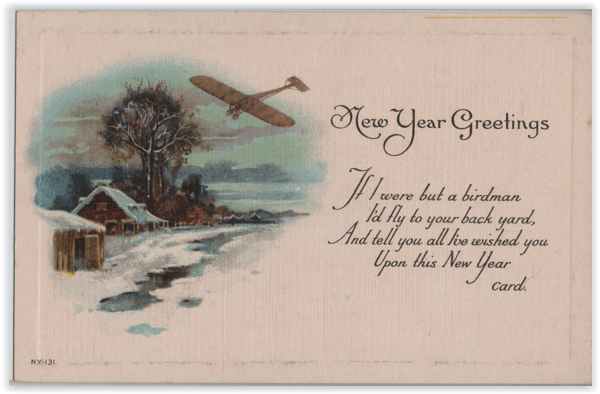
This cozy aerial view comes with no date at all, but the style of that airplane puts it somewhere in the zeroes or tens of the last century. I wonder if the folks snowed into the farmhouse were expecting company, or resented the intrusion of engine sounds on their silent night.
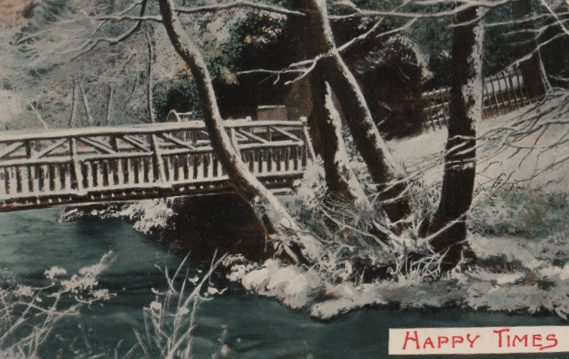
The old footbridge also puts us clearly in the country for a nice, heavy snowfall (not terribly cold, I expect, since the creek is burbling along as cheerfully as ever.)
The artists seem to have figured that snow on the countryside was a lot more picturesque than a snowy street in the city. Here, as in the poem, we see the moon on the breast of newfallen snow, along with a stately church and a mountain which will make getting downhill for the evening service quick and easy. (Perhaps someone with a sleigh will give you a lift home.)
Speaking of downhill, we mustn’t forget there is more to a field filled with snow than just looking at it. The fun side of snow is at least as important as the picturesque angle.
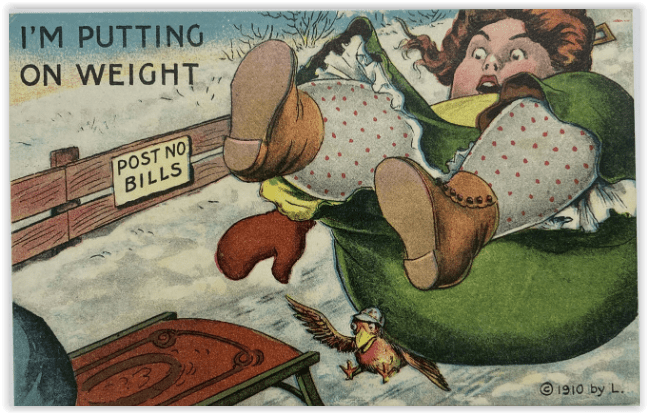
Postcards certainly did not neglect the joys of taking a ride on a sled.
In fact, all the joys of playing in, and with, snow were covered by the postcard companies.
This is not to say that they neglected the quiet joys of a leisurely walk in the newly-decorated landscape.
Or perhaps a boat ride, so you could experience even more of the view.
While taking a ride in the family car was a sure way to make you feel sorry for your snowbird neighbors who headed off somewhere else where they didn’t have any snow at all. I see no teardrops on this card, so it was sent by someone who was being brave about the poor souls who miss all the fun.
To win a wreath of oak leaves, a Roman had to win a battle, kill an enemy, or save the life of another Roman. The oak leaf naturally became associated with valor in war. Today, a Major or a Lieutenant Colonel in the U.S. Army wears a stylized oak leaf as an emblem of rank.
*OAK, AUSTRIAN “You Irritate me Excessively”
OAK, LIVE “Liberty”
OAK, WHITE “Independence”
She never seems to have been promoted to the status of Goddess of Horticulture, but a nymph named Pomona was legendary in Rome for being so crazy about gardens and orchards that she hardly ever talked to anybody except the occasional farmer. She was remarkably
beautiful (all that time spent outdoors, I suppose) and attracted a lot of suitors, but if they didn’t want to talk about keeping aphids off the roses or where to put in the new seedlings, she wouldn’t give them the time of day.
The most diligent of her fans was a satyr named Vertumnus, who made a habit of slipping into her garden disguised as a farmer or rural peasant. One day he came around dressed as an elderly lady who wanted to talk about pollination in the garden, and shifted into a lecture about how unnatural it was for Pomona to be so single-minded. Every plant or animal knew nature demanded a little more than that. The lecture finished with a heart-rending story of a young woman who spurned love until she finally turned to stone, and a recommendation that Pomona look up a perfectly delightful young satyr named Vertumnus who would be glad to help her explore that side of nature.
Pomona was too polite to pitch the old busybody out of the garden, but just went on thinning out her carrots and showing no interest at all until Vertumnus finally cried out, “Oh, pshaw!”, tossed off his disguise, and marched out of the garden stark naked. Pomona had had no clue that old lady was anything but an elderly crank, and watched him go with some surprise. She apparently thought he looked really good from behind and decided trees and rutabagas weren’t everything, running after him to accomplish a happy ending (or more).
Some legends have morals, but this one has very few.
OATS “Music”
This comes from the hobby of Greek shepherds, making pipes and flutes of oat stalks. Watching sheep could be intensely boring, and music helped pass the time.
A number of books, swiping from some poem or another, make this “The Witching Soul of Music, Hers”. If I find out what this is all about, I’ll sure pass it along.
*OATS, ONE STALK “Be Careful”
*OBEDIENT PLANT, RED “Docility”
*OBEDIENT PLANT, WHITE “Assurance”
*OLD MAID “Sourness”
*OLD MAN “Meekness”
*OLD WOMAN “Kindness”
These last three meanings are from George O’Neill, who may have been trying to make a point. I decline to argue about it. After all, “Flowers are one of the few noncontroversial things in life”, Clarence Meyer, Fifty Years of the Herbalist Almanac
OLEANDER “Beware”
Almost all floriographers agree on this, and three of them add an exclamation point. Oleander is a swift and powerful poison; I believe one victim in an Agatha Christie story died just from eating something which had been cooked over a campfire on an oleander branch. I checked into this, and I find it really does happen a couple of times a year at somebody’s picnic. As if you didn’t have enough to do, watching for ants and poison ivy: now you have to check into the pedigree of any stick you shove a marshmallow on.
*OLEANDER WITH HELLEBORE “Beware of Slander”
It’s easy to make up all kinds of warning messages with oleander by adding it to something else. Oleander with watermelon tells your friend “Beware of Bulkiness”. That is, if you want to send a bouquet with watermelon in it to someone on a diet.
OLIVE “Peace”*
This is wellnigh unanimous. Even Mr. Morato agreed.
ONION “Everything Backward”
Only two floriographers mention the onion, which strikes me as unfair. Still, none at all mentioned the tomato, so things could be worse.
Morato explains that an onion gets smaller during a full moon, though every other plant in creation expands, hence the backward meaning. See what useful information you can pick up when all you’re trying to do is write a flower language dictionary and get on with your life?
Josephine Addison, however, goes all out, giving the onion six different meanings, all related to a perception of the onion as a symbol of the oneness and diversity of the universe. Frankly, I think we covered the onion as symbol of the universe when we said “Everything Backward”.
*ONION LEAF “I Retreat Immediately”
You’re going backward, see?
OPHRYS, BEE “Error”
If you don’t look a second time, you’ll think the ophrys has a bee on it, but that’s just its little trick. An ophrys, by the way, is an orchis. I mention this because floriographers also mention a Bee Orchis, which is an ophrys. But the Bee Orchis cannot be a Bee Ophrys, because floriographers give them different meanings. Unless that’s just their little trick.
OPRHYS, FROG “Disgust”
OPHRYS, SPIDER “Adroitness”
This is a reference to the spider’s adroitness, or skill, in making webs.
OPRHYS, WINFREY “Just Making Sure You Were Still Alert”
ORANGE BLOSSOM “Chastity”
This is one of our most traditional wedding flowers, so traditional that the phrase “orange blossoms” has been used as a slang expression for a wedding. Every floriographer, just about, gives this flower some meaning related to marriage or to chastity, purity, and virginity, the sort of things one was supposed to assume about the bride. A popular minority meaning, in fact, is “Your Purity Equals Your Loveliness”, a sort of backhanded compliment, if one thinks about it. Claire Powell claims to have read a Victorian book which said orange blossoms can be carried only by virgin brides, but are withheld from non-virgins getting married, “particularly around Paris.”
ORANGE TREE “Generosity”
I mentioned this in a book of the last century, now out of print and rare. Fruit trees have traditionally been seen as symbols of nature’s generosity to mankind. That is to say, a tree works through a whole season to produce fruits to propagate their species, and then some human comes along, eats them, and says “How generous of you!”
Orange, Mock: see MOCK ORANGE
ORCHIS “A Belle”
They do seem to insist on spelling this “Orchis” despite the tendency of us civilians to say “Orchid”. I suppose there’s some very good reason for this, which someone will no doubt write and explain to me, whether I care or not. Anyway, Oliver Wendell Holmes (the father, not the Supreme Court Justice) wrote a poem comparing a beautiful woman to an orchid in beauty, exoticness, and fragility. Nobody reads Holmes Senior these days; we have all decided his son did more to make the world the way it is by practicing law than his father did by writing poems and funny stories. I’ll go along with that, but why is it considered a knock against Senior?
ORCHIS, BEE “Industry”
Busy as a bee, of course. But see also OPHRYS, BEE
ORCHIS, BUTTERFLY “Gaiety”
Humanity has never figured out why butterflies bob up and down and go off at odd tangents when they fly. If it were up to us, we’d figure out where we want to go and just go there, to attend to business. Those nature experts who proclaim that all species on earth, except us, are engaged every second in a grim struggle for survival (which only the most efficient can win) are thoroughly irritated by butterflies. Those of us who are not scientists have come to agree that butterflies do this because it’s fun. We could be wrong about this, but while the nature experts are looking for loopholes, we cling to the idea that butterflies are happy. Anyway, they’re so pretty.
ORCHIS, FLY “Error”*
Say, it has been brought to my attention that these flowers are pollinated because they use these bug-shaped decoys to get insects to come in and have sex with them. I do not recall my teachers mentioning this when they told me about the bees and the flowers.
ORCHIS, YELLOW “Jealously Inclined”
Orchids have long been associated with the exotic, expensive, passionate, voluptuous, and sinister. The Romans believed that satyrs were oversexed because they ate orchid roots. (Orchis is from the Greek for testicle, which is what the roots reminded the Ancient Greeks of.
A lot of things reminded the Ancient Greeks of sex.) Mystery writers seem to like them, too. the most famous example being that great detective and orchid fancier, Nero Wolfe. But we should not ignore those in Raymond Chandler’s The Big Sleep (particularly on the cover of the first paperback edition) and those in James Hadley Chase’s sadistic hardboiled thriller, No Orchids for Miss Blandish. I have been able to find nothing much about Orchids to You, by Hank Janson.
OSIER “Frankness”*
OSMUNDA “Dreams”
See also FERN, FLOWERING
Oxalis: see SORREL, WOOD
OX-EYE “Patience”
Dorothea Dix came up with this; she says it comes from Shakespeare.
Remember me? I’m the one whose mom kept getting me classic secondhand children’s books like Pollyanna and Honey Bunch and the Dachshund of Doom when what I ASKED for were graphic novels about the zombie apocalypse. I wrote to my uncle, suggesting he look into collectibles, figuring he was loaded enough to send a few NFTs my way. But (unlike me) he believes in you, so I bet you’ve convinced him to send me a bunch of cheap used doodads. Could you cut that out, you white-haired crypto-creep?
IRATE, WITH SHORT FUSE
Dear Irafuse:
This IS a wonderful time of year, isn’t it? Sitting under the tree and opening up…our phones to see the images of the gifts we now own but can’t actually touch. It brings tears to the eyes (if you use the right filter on your Tik Tok video.)
Forgive me for being one half fuddy and the other half duddy, but I would like to make a plea, in retreat, for things which are tangible, or fungible if you prefer. Nothing beats the rustle of the paper, the first glimpse of what’s inside, the new present aroma of those wool socks two sizes too big that Aunt Booney knitted. I know, having inside information, that your father is going the smell the fresh leather of a new belt, and hope you get to experience that as well. You do seem to need it.
Since it’s my trade, I have nothing against the giving of secondhand wonders, either: those old-fashioned collectibles you feel your generation has outgrown. The cheap used postcards I hope people are giving by the boxful this Christmas are merely things living people have laughed at, growled about, or even cried over, when they received these, or later, reflecting on how the cards made them feel when the sender was still sending messages from this plane of existence
Not everyone has sympathy for what their ancestors felt about something. If you are one of these, which is probably a good, solid bet, all is not yet lost for you, pumpkin spice sauerkraut. You can make use of the secondhand postcards you are given, or you may join the horde of freeloaders who look at postcard auctions online to swipe the images and use them to make NFTs of their own. You can thus make enough money to buy wonderful Christmas presents in 2023.
But here’s hoping you find something under the tree that makes you reel back with shock and cheer. And, as always at Christmas, I wish you something rather better than you deserve in the next 365 days. L’chaim!
I’ve been checking all over these sno-=covered Interwebs, and I am still confused about the True Meaning of Christmas. I figured you had nothing better to do, so can you explain, please?
PHILOSOPHER
Dear Phil:
On the whole, I would rather deal with a battalion of kids asking for working submarines and ponies and hula hoops, but I’ll give it a try.
Santa Blogs got into trouble with his study of Christmas specials which discovered a certain lack of unanimity on the theme. A goodly number of versions of A Christmas Carol insist that the True Meaning involves generosity not only of spirit but of deed, that seeing to the emotional and physical needs of those who are unfortunate is the point. But an equally large number of moving pictures cry out that the True Meaning of Christmas is having strong family ties (see roughly sixty percent of Lifetime, Hallmark, and BET Christmas movies.)
How the Grinch Stole Christmas reaches a bit wider, reminding us that the True Meaning does not deal with packages, boxes, or bags, but in togetherness with friends and community. Some specials point out that much of this is meaningless, in a True Meaning sort of way, if it does not involve sacrifice to make Christmas things happen. And we have A Charlie Brown Christmas, which historically went out on a limb and suggested that the nativity of Christ was the meaning of Christmas. (Network executives warned that would never sell.)
What are we to make of this cacophonous jingling of bells at different tunes, keeping in mind that many of these movies are themselves inseparable from Christmas for people who love a good Christmas movie at the right time of year? Well, Egg Nog Muffin, Santa Blogs long ago came to a shocking conclusion which has neither pleased nor convinced anybody.
There ain’t no one single True Meaning of Christmas. Christmas means a lot of things, and they all get mixed together, the way Silent Night and Grandma Got Run Over By a Reindeer alike mean Christmas to a listener. None of those Christmas specials and movies mentioned above are WRONG: it’s just that Christmas, as practiced in modern times, mixes all of that and more. It’s about peace and love and family and generosity just the way it’s about running around like a mad soul trying to buy, bake, sing, wrap, and even watch everything that needs to be blended into a Christmas.
What Santa Blogs is telling you, Cranberry Souffle, is that the True Meaning of Christmas, as the Grinch and Garfield and Charlie Brown and Scrooge discovered, has to come from inside you, not from any electronic helper. You have to decide for yourself how much of each True Meaning you want in your personal mix. To you, that will be the True Meaning of Christmas, and it will be that for you and nobody else because it’s your holiday mix.
If you can, keep this mixture on hand and spread it where you feel it is needed, you will be doing what is required during the holiday season. And don’t be discouraged by the Interwebs, which is where everyone practices the One True Tradition of Christmas, which is the right to tell everyone else they’re doing it wrong. That’s part of the mix, too, and you are as entitled as anybody else to it. If you can laugh while you do it, and shake like a bowlful of jelly, Phil, it’ll blend perfectly well with the rest.
Be true to your own Christmas, Phil. Even if it involves playing that stupid song I wish had never been written and could be lost forever in….
Wait. Right. Gotta shove my nose against the wreath and inhale quietly for a while.
I have a niece who is interested in collectibles, but I have had hints from her parents that something small and easy to store would be the best choice. Naturally, I thought of your postcard blog. Can you tell me, in words understandable to a layman, which postcards are the most collectible? Thanks,
LOVING UNCLE, HEADING FOR HOLIDAY
Dear LUNCHEAD,
I am encouraged to hear that the younger generation is still collecting the doodaddery left behind by their elders. And you are wise to consider the possibility of postcards. These come in so many types and traditions that some of them are bound to be collectible, no matter how the winds of fashion blow. (Tried to get ahead of the trend when Ronald Reagan was elected President by buying up a lot of vintage paperback westerns that I was sure would…for what these have cost me in storage since that time, I could have bought stacks and stacks of postcards.)
So you want to be sure the postcards you pick up are collectible, and you want the crash course. I can handle that for you. Something is really collectible if people collect it. No, no, don’t applaud so loudly; if I blush any more, I shall have to lead the sleigh myself this year.
Of course, the more people who collect something, the more collectible it becomes. Let us consider, say, holiday postcards. There will always be people who collect holiday postcards, until such time as we ban all holidays because they get in the way of people working full time to raise the Gross National product. (No, honest: there are people who believe that. I expect they’re all in Administration.) People glory in the variety of images for their holiday: turkeys and pumpkins for Thanksgiving, black cats and pumpkins at Halloween, pumpkins and red leaves for Harvest Festival…it just occurred to me. Is the whole postcard and greeting card industry just a front for the Pumpkin Board? Must check that among online conspiracy theories. (If no one else has done it yet, I have dibbies.)
But, Lunc, there are levels of collecting. Halloween is more popular to collectors than, say, Washington’s Birthday. (There were LOTS of Washington’s Birthday postcards once. Honest.) More people collect Valentine postcards than collect Thanksgiving postcards. As for Christmas postcards, well!
See, within the holiday, some symbols are more collectible than others. I have any number of postcards with arrangements of holly on them. So has anybody else with Christmas cards. Postcard companies knew our ancestors would buy just scads of postcards showing a good old sleighride through the snow, and they were correct. But generations later, the number of people who recall an actual horse-drawn sleighride through the snow is mighty minor. It’s NICE, but not as relevant to the modern Christmas as a tree, or a stocking, or (I’m blushing again) Santa himself.
And even there, we have varying demand. A Christmas tree is generally less interesting than a Christmas stocking (either is more popular if vintage toys are included in the picture.) By far, the most popular image to collect is Santa Claus, simply because he is still well=known, and to this day is drawn by every artist in a particular way. Once upon a time, Lunc, Santa Claus wore green, blue, and even yellow suits trimmed with fur (red was standardized, as the ads keep telling us, by Coca-Cola). The beard varies, the suit is sometimes the jacket and pants of Santa or the red gown of Father Christmas, varies. Even his waistline is a matter of study by your collectors. (Look, it’s not my fault. It’s all those cookies.)
I guess the easiest rule of thumb for you is that if a postcard is largely unavailable, or costs a whole lot more than you want to spend on your niece, it’s probably collectible. Of course, you could follow the advice of A. Edward Newton, and simply buy her something she likes. Then she’ll always have something nice even if it never becomes a rarity with a seven-digit price. Not only is that more in the spirit of the holiday; it’s cheaper. (And maybe that’s your spirit of Christmas.)
Also known as the Sensitive Plant, because it closes its leaves when touched. According to the Greeks, it was originally a woman named Cephisa who, fleeing from Pan, was turned into a plant. She still shrinks from the touch of men. (And women, by the way.)
Some books list “Sensibility” for this plant. Once upon a time, sensibility and sensitivity meant the same thing. We’ve fixed things up since then.
MINT “Virtue”
And this plant was a nymph named Minthe. Pluto, CEO of Hades, fell in love with her. His wife Persephone, whom he had kidnapped, for goodness sake, became so jealous that she killed Minthe, even though the nymph had been strictly virtuous and wasn’t playing around with Pluto at all.
MISTELTOE “I Surmount Difficulties”
That’s it: no Druids with copper sickles or kissing at Christmas or any of that good stuff. There are times when I have my doubts about the floriographers. This comes from the way mistletoe climbs trees.
*MISTELTOE SEED “I Love the White-haired One”
MITRARIA COCCINEA “Indolence, Dullness”
MOCK ORANGE “Counterfeit”
Because it’s a mock orange, and not a real one. There are some who want it to have the meaning “Brotherly Love” because its scientific name is Philadelphius. Hasn’t caught on yet.
MINARDA AMPLEXICAULIS “Your Whims Are Unbearable”
MONK’S HOOD “Knight Errantry”
The problem is that this plant has several very common folk names; it is known as Monk’s Hood, Helmet Flower, Wolfsbane, and Aconite, as Professor Snape points out. Helmet Flower, of course, is the source of its usual meaning, above, though it is seldom listed under the name Helmet Flower in the floriography books. Many of the meanings given to Monk’s Hood are thoroughly nasty, our pioneer floriographers tending to be militantly Protestant, while people who called it Aconite knew it for a poisonous plant, and gave it the meaning “Misanthropy”. The Greeks said this sprouted from the spittle of Cerberus, the three-headed hound of Hell. I gather it was not a favorite among them.
MOONWORT “Forgetfulness”
This may come from Orlando Furioso, one of those great works no one ever reads. Orlando lost his memory and his marbles, so his best friend flew to the moon to get them back, as everything which is lost winds up on the moon. (That’s what those craters really are: odd socks.)
The floriographers also lost their memory, as this is also Lunaria, or Honesty, which they said meant something else altogether.
Claire Powell, for once, tells a simpler story. The flower, she says, looks like a French cake, a moon-shaped one, called the oublie, which comes from the word oublier, to forget. This is entirely too reasonable to be true.
MORNING GLORY “Affectation”
MOSCHATELL “Weakness”*
This plant has a musky scent, but it is too weak to be unpleasant, according to Claire Powell. And here I was waiting to write about people who have a weakness for muscatel.
MOSS “Maternal Love”*
Claire Powell says mothers in Lapland wrap their babies in ermine and cradle them in moss. I don’t know why she goes on and on about Lapland; I bet lots of mothers cradled babies in moss.
*MOSS, GREEN OR GRASSY “Laziness”
MOSS, ICELAND “Health”
Joseph E. Meyer says this was once used as a cure for consumption. He doesn’t come right out and say how well it worked, but I guess it was better than nothing at all.
*MOSS, WHITE OR GREY “Old Age”
*MOTHER OF THOUSANDS “Amazement, Astonishment”
I should say so.
MOTHERWORT “Concealed love”
Not that it has anything to do with the meaning, but Charles M. Skinner says you have to dip this in your sake before you take a drink.
Mourning Bride, Mourning Widow: see SCABIOUS
MOVING PLANT “Agitation”
I’d be agitated at the sight of a plant coming at me, myself.
MUDWORT “Tranquility”
There is a flower called the Mudwort, but I believe it owes its place in flower language to someone who misprinted Madwort, which also has the meaning “Tranquility”. Mind you, three floriographers broke away and gave it the meaning “Happiness”, making a misprint for the following.
MUGWORT “Happiness”
MULBERRY “Wisdom”
According to those who know about such things, the Mulberry was considered the temperamental opposite of the Almond, which see. Unlike that tree, the Mulberry waits to put out fruit and leaves until it can be sure the weather will cooperate. Red and white mulberries sometimes get separate listings, but have very much the same meaning.
*MULBERRY LEAF “Hidden Treasure”
MULBERRY, BLACK “I Will Not Survive You”*
Once upon a time, there lived a pair of lovers named Pyramus and Thisbe, and if you know the story of Romeo and Juliet, you know pretty much all you need to know about Pyramus and Thisbe. Anyway, when Pyramus killed himself, his red blood hit the white mulberry and stained it purple, so that it was afterward known as the Black Mulberry. Some floriographers, trying to make a point, define this as “I Shall Not Survive You”, but I will not get mixed up in it.
*MULBERRY, WEEPING “Wretchedness”
*MULLEIN, MOTH “Another Has Taken the Place”
MULLEIN, WHITE “Good Nature”
A facet of folk agriculture known as companion planting started to come back into fashion in the 1980s or so. In this, the planting of one kind of plant can attract bugs or disease away from a more valuable plant. White Mullein, I am told, draws stinkbugs away from your apple trees, which I must say is mighty good-natured of the White Mullein, since it then has to put up with the stinkbugs.
MUSHROOM “Suspicion”*
Some floriographers prefer to say Champignon, perhaps picking it up from Mme. De Latour, since that is the French for “mushroom”. In English, though, Champignon is used to refer only to nonpoisonous mushrooms. Of course, even with those there’s the suspicion….
*MUSHROOM ON A GREEN TURF “An Upstart”
Nobodies who pretended to be Somebodies were once referred to as mushrooms, from the mushroom’s habit of springing up out of nowhere.
MUSK PLANT “Weakness”
See also MOSCHATELL
*MUSTARD, BLACK “Unpleasant Charm”
MUSTARD SEED “Indifference”
The most famous mustard seed is the Biblical one which some people’s faith is no bigger than. The floriographers regarded such a person as mighty indifferent.
Myosotis: see FORGET-ME-NOT
MYROBALAN “Privation”*
MYRRH “Gladness”
The story has nothing to do with the meaning, but far be it from me to ignore the public’s right to know. Myrrh was another ancient Greek who got in bad with the gods. She or her father said something to tick off Aphrodite, who retaliated by inflicting the girl with a mad lust for her father. She sneaked into his bed twelve nights in a row, but he figured it out on the thirteenth and lit out after her with his sword to avenge the crime she’d made him commit. Praying mightily for rescue, she was at last turned into this tree. Nine months later, the bark split and out popped baby Adonis, who grew up to be Aphrodite’s great love, and a future flower himself. Funny how these things work out.
MYRTLE “Love”
Brides in ancient Rome wore this, for it was associated with Venus, the Goddess of Love. They got this from Greece, where the planet was sacred to Aphrodite, their Goddess of Love. This may have come from Egypt, where the plant was sacred to THEIR Goddess of love. Where myrtle got this reputation originally, and what it all means to women named Myrtle, I cannot say.
Some Greek legends said it was a priestess of Aphrodite who married without Aphrodite’s permission and was turned into it. But other stories say it was the first plant Aphrodite took hold of when she was born out of the sea foam. (So she could hardly have turned her priestess into it later on.) A third story says that once, surprised by a bunch of satyrs when she was in swimming, Aphrodite jumped out of the water and ran to hide behind a myrtle bush. I don’t know any more of that particular story. Sorry.
*MYRTLE WITH CYPRESS AND POPPIES “Despair”
*MYRTLE, WAX “I Will Enlighten You”
N
*NANDINA “My Love Will grow Warmer”
NARCISSUS “Egotism”
Sometimes spelled Egoism, and sometimes spelled Self-love. Or you can just go with Narcissism.
As you probably know, Narcissus was the most beautiful boy who ever lived. People fell in love with him as he walked by, though he never noticed, because he knew nothing of love. One lass named Echo pined away for him until she wasted down to nothing but a voice. A man spurned by young Narcissus was made of sterner stuff, and prayed to the gods to teach the lad a lesson. This was right up the alley of Nemesis, the god in charge of revenge, who saw to it that when Narcissus turned sweet sixteen, he got a look at himself in a reflecting pool. He fell madly in love with his reflection, and spent the rest of his life trying to figure out how to embrace that fine-looking young man. He starved to death and was turned into this beautiful yellow flower. You know, I suspected all along that he was a blond.
By the way, those of you who are given a narcissus can take heart. Sheila Pickles says giving this flower indicates that the giver, not the recipient, is an egotist.
*NARCISSUS, DOUBLE “Female Ambition”
Is this a White Hollyhock, then? If so, why can’t they say so, and make life easier for the rest of us?
Narcissus, False: see DAFFODIL
*NARCISSUS, YELLOW “Disdain”
Claire Powell calls this the hardest narcissus to grow, and the least pleasant to have around once it has grown.
NASTURTIUM “Patriotism”
C.F. Leyel says this sprang from the blood of a Trojan soldier who died defending his homeland. Not everyone joins him on this. Nor are they rock solid on what plant it is (see CRESS). OR why it’s called nasturtium. Nasturtium means “Nose twister”. (So I presume Austurtium is an Eye twister.) Some say you twist your nose in this direction because the flower smells so sweet, and others because it is so peppery. Others claim you wrinkle your nose when you bite into it. Not me, buster. And some books spell it “Nasturtion”. What about that, huh?
*NASTURTIUM, DWARF “Well-meaning”
NASTURTIUM, SCARLET “Splendor”
*NEMESIA “Shadowed”
NEMOPHILA “Success Everywhere”
This is supposed to be very easy to grow, blooming successfully everywhere. One variety is called Baby Blue-Eyes.
NETTLE “Slander”
“Cruelty” is a popular minority meaning. This plant stings or burns your hand if handled incorrectly. You get the general idea.
NETTLE TREE “Conceit”
This was originally “Concert”, but someone along the line misprinted it, and this became the preferred meaning.
*NICOTINE “No Obstacle Shall Stand In My Path”
Nigella Damascena: see LOVE-IN-A-MIST
NIGHTSHADE “Dark Thoughts”
NIGHTSHADE, BITTERSWEET “Truth”*
Clarence Hylander traces this symbolism to the days of the pioneers, who seem to have spent their time biting into plants. This one, they said, was bitter when first tasted, but gradually turned sweet, the way truth slowly becomes palatable. It is also somewhat poisonous; I don’t know how the pioneers worked around that.
Nightshade, Deadly: see BELLADONNA
NIGHTSHADE, ENCHANTER’S “Witchcraft”
Also known as Circaea, after Circe, the sorceress who turned Odysseus’s men into pigs, this plant got its reputation by growing in dark places. Henry Phillips, however, claims it is because the plant has little hooklike stickers that drag you in the way Circe brought in the sailors. Well, not exactly like.
*NONE-SO-PRETTY “Beautiful”
This plant is also known as Nancy Pretty. The experts don’t seem to agree on what plant it is, though.
NOSEGAY “Gallantry”
A nosegay is a bouquet; very gallant of you to bring one to your lady.
It is ungallant to discuss a lady’s age, and perhaps a bit silly to point out a flaw in my own story. If I have not made this clear, I believe that Louise Cortambert, and not Louis-Aime Martin, was Charlotte de Latour, founder of modern floriography. I have not been able to find any source for Louise’s birthdate. We know that her book came out at some time before 1820; most authorities assign it a date of 1817 or 1818. Well, in 1817, Louis-Aime Martin was 31 years old. Pierre Cortambert, Louise’s husband, was just eleven.
Now, there is no requirement that Louise be the same age as the man she would eventually marry. Had she been a mere five or six years older, the thing is more plausible. But I will say it makes me nervous.














 Blogsy Babbles