Meredith sat up and cursed. When WOULD he remember to push back the lid of the casket first?
Once the obstruction had been pushed aside, he stretched his arms and sighed. This was, of course, only his second day in the tomb. There would be time to work out the details.
Last night’s brief inspection indicated his instructions had been followed to the letter. Most intimidating suit, imposing silk tie (no mirror, of course, so this inventory had taken extra time), contents of his pockets just as they were when he strode through the office….
He checked his Rolex, which had been entombed with him even though Cousin Alice had lusted after it. Past midnight: it was safe to climb out and check his new home more thoroughly. No sunlight could penetrate this far anyhow. Meredith just wanted to keep quiet. If he did too much during the day, some passerby might hear the pop of a champagne cork and wonder.
Last night, he had merely checked the placement of the furniture and the contents of wine cellar. His hungers and thirsts would be different now: he knew that. Most life extension programs involved a change of diet. But he had found to his pleasure that he could still enjoy a glass of champagne and a couple of chocolate truffles, simply to salute his new life after death.
It had taken him months to plan this sanctuary, but years to achieve his goal. For beings so omnipresent on cable, vampires were reclusive and not very cooperative. Fortunately, money remained a good lubricant.
Meredith considered the mountain of boxes: yesterday he had just nudged them a little, verifying they were full. The earphones sat with the sound system, but there should be plenty of music and television on the discs packed away. (No cable or Internet here: such things were traceable.) Books, thousand-piece jigsaws, magazines: amusements to keep him occupied as he sat back in his favorite chair.
He switched on the lamp as he passed, more for the familiar glow than that he needed it, with his newfound nightsight. A vampire needn’t spend ALL his waking time on the prowl for delectable prey. Especially not once he had established his army of undead slaves, who could do the hunting for him, commute and all. (Damn city planners: they never put unhallowed ground in a really convenient location.)
Pity he had to start with his Becky, his airheaded niece. Biddable she was, but she had trouble getting through the Junior Jumble. Nice torso—he knew just which of her dresses he would order her to be entombed in so he’d have something to look at when she wasn’t out luring men to this lonely place. She had obviously insisted on following his will down to every last particular. AND she had gotten the vintages right on the wines. True, not to give her too much credit, he HAD written it all out for her, just as he had directed her to make sure there were no Bibles mixed among the books, nor Father Brown nor Reverend Randolph stories among the mysteries. But for someone whose MBA he had bought to read the wine labels (lips moving the whole time, no doubt) and not make mistakes: well, perhaps he could name her Assistant Imperial Supervisor of the slaves or something.
His chair looked inviting. He walked past it to the tall, stainless steel refrigerator. A nice bit of Gouda, a glass of wine, and something to read would serve to pass the time. Meredith had decided not to try venturing outside for a few days: there had been too many reporters at the funeral, all abuzz about the crazy rich man and his eccentric burial. A few of them would serve in his army. He had amused himself during the funeral thinking through a few things :serve” would cover.
Having selected the right wine to accompany this Gouda, he set them down on the end table and turned again to the stack of boxes. The topmost said “Magazines”. He nodded. Another nice thing about the life of an undead: he would have time to catch up on all his New Yorkers.
The lid tore away from the box at a touch: he’d have to watch this new strength when he turned pages. Ah, these would do nicely. Feeling with one hand for his mechanical pencil, he used the other to take up first half dozen magazines.
These tumbled to the floor as he leapt back in pain. Skin peeled back from his fingers, releasing steam. His dimming eyes searched the floor for a clue. Search-a-Word, Trivia Masters, Maze Quest….
His chest heaved with the collapse of his lungs and heart. She should have thought of this. HE should have thought of this.
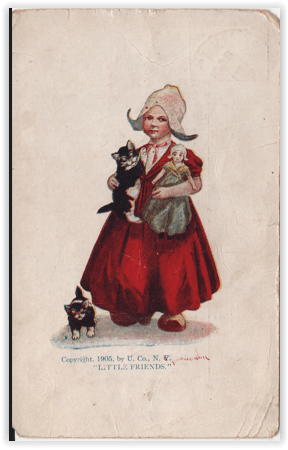
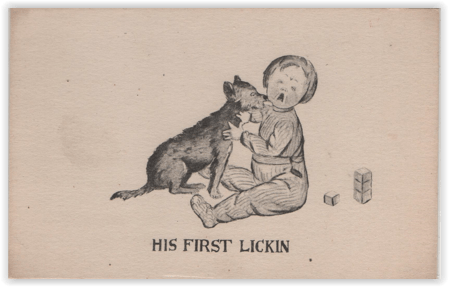
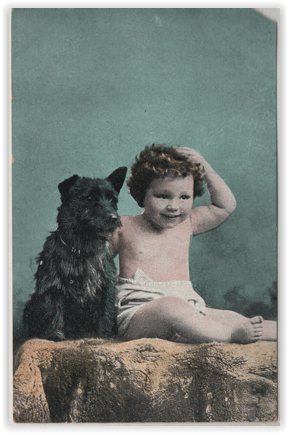
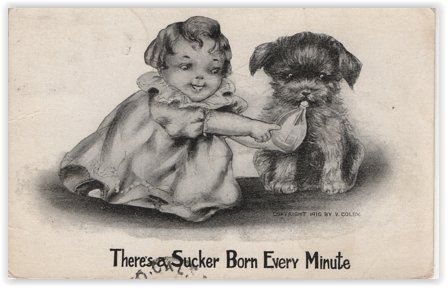
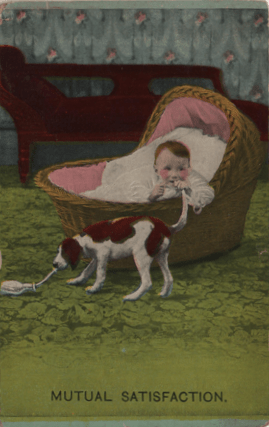
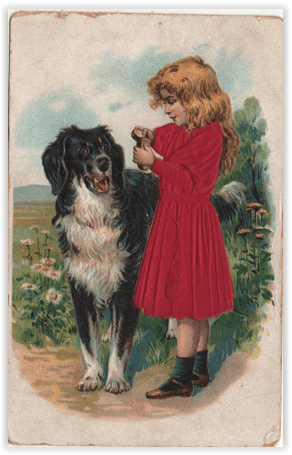
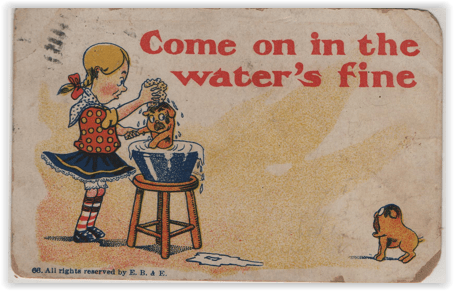
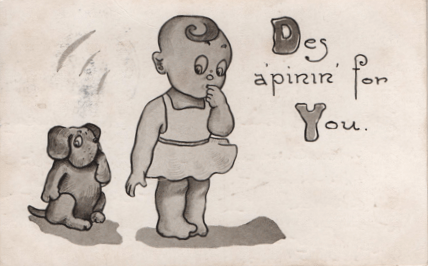
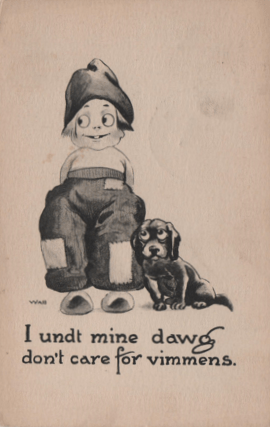
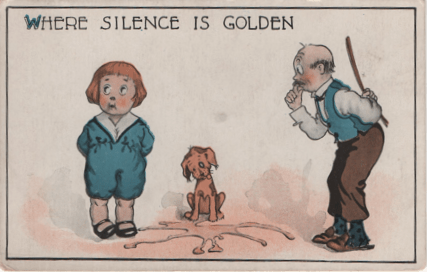
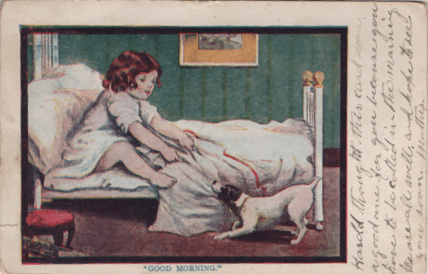
Now, in nature, children and small animals are not necessarily the best of friends. It depends a lot on that first encounter. Are they going to be in competition or cahoots?
Sometimes likes repel, after all.
But the world of postcards and the world of what we consider reality both see that what we have are two types of small creature which are difficult to control, hard to train, and given to impulsive action. So they can become fast friends, in a bond which is no less deep for being impulsive. Postcards display all the facets of the polished gem of camaraderie.
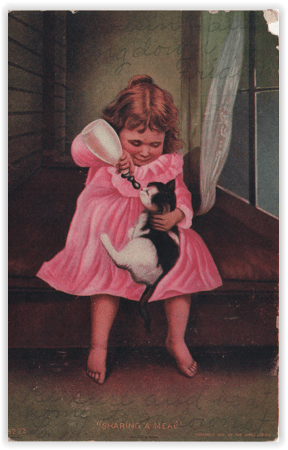
A friend is aware when you get hungry, and will jump in to help out.
Even if that means giving up part of their own food supply.
It’s share and share alike among buddies.
You can count on it.
A friend will give you advice on personal care.
A friend will be in sympathy with your mood when you are worried, sad, or feeling neglected.
Your friend and you form a team, united against mysterious powers over which you have no control.
A friend has your back in times of need, always standing with you when the rest of the world has doubts.
In short, a friend will give you reasons to get up in the morning.
After several turns, he sat down again. As he threw his head back in the chair, his glance happened to rest upon a bell, a disused bell, that hung in this room, and communicated for some purpose now forgotten with a chamber in the highest story of the building. It was with great astonishment, and with a strange, inexplicable dread, that as he looked, he saw this bell begin to swing. It swung so softly in the outset that it scarcely made a sound; but soon it rang out loudly, and so did every bell in the house.
This might have lasted half a minute, or a minute, but it seemed an hour. The bells ceased as they had begun, together. They were succeeded by a clanking noise, deep down below; as if some person were dragging a heavy chain over the casks in the wine-merchant’s cellar. Scrooge then remembered to have heard that ghosts in haunted houses were described as dragging chains.
The cellar-door flew open with a booming sound, and then he heard the noise much louder, on the floors below, then coming up the stars; then coming straight towards his door.
“It’s humbug still!” said Scrooge. “I won’t believe it.”
His colour changed though, when, without a pause, it came on through the heavy door, and passed into the room before his eyes. Upon its coming up, the dying flame leaped up, as though it cried “I know him! Marley’s Ghost!” and fell again.
The same face, the very same. Marley in his pig-tail, usual waistcoat, tights, and boots; the tassels on the latter bristling, like his pig-tail, and his coat-skirts, and the haor upon his head. The chain he bore was clasped about his middle. It was long, and wound about him like a tail, and it was made (for Scrooge observed it closely) of cash-boxes, keys, padlocks, ledgers, deeds, and heavy purses wrought in steel. His body was transparent: so that Scrooge, observing him, and looking through his waistcoat, could see the two buttons on his coat behind.
Scrooge had often heard it said the Marley had no bowels, but he had never believed it until now.
No, nor did he believe it even now. Though he looked the phantom through and through, and saw it standing before him; though he felt the chilling influence of its death-cold eyes, and marked the very texture of the folded kerchief bound about its head and chin, he was still incredulous, and fought against his senses.
“How now!” said Scrooge, caustic and cold as ever, “What do you want with me?”
“Much!”—Marley’s voice, no doubt about it.
“Who are you?”
“Ask me who I was.”
“Who WERE you, then?” said Scrooge, raising his voice. “You’re particular—for a shade.” He was going to say “to a shade”, but substituted this, as more appropriate.
“In life, I was your partner, Jacob Marley.”
“Can you—can you sit down?” asked Scrooge, looking doubtfully at him.
“I can.”
“Do it then.”
Scrooge asked the question, because he didn’t know whether a ghost so transparent might find himself able to take a chair; and felt that in the event of its being impossible, ot might involve the necessity of an embarrassing explanation. But the Ghost sat down on the opposite side of the fireplace, as if he were quite used to it.
“You don’t believe in me,” remarked the Ghost.
“I don’t,” said Scrooge.
“What evidence would you have of my reality, beyond that of your senses?”
“I don’t know,” said Scrooge.
“Why do you doubt your senses?”
“Because,” said Scrooge, “a little thing affects them. A slight disorder of the stomach makes them cheat. You may be an undigested bit of beef, a blot of mustard, a crumb of cheese, a fragment of an underdone potato. There’s more of gravy than of grave about you, whatever you are!”
Scrooge weas not much in the habit of cracking jokes, nor did he feel, in his heart, by any means waggish then. The truth is, that he tried to be smart, as a means of distracting his own attention, and keeping down his terror, for the spectre’s voice disturbed the very marrow in his bones.
To sit, staring at these fixed, glazed eyes, in silence for a moment, would play, Scrooge felt, the very deuce with him. There was something very awful, too, in the spectre’s being provided with an infernal atmosphere of its own. Scrooge could not feel it himself, but this was clearly the case; for though the Ghost sat perfectly motioness, its hair, and skirts, and tassels, were still agitated by the hot vapour from an oven.
“You see this toothpick?” said Scrooge, returning quickly to the charge, for the reason just assigned, and wishing, though it were only for a moment, to diovert the vision’s stony gaze from himself.
“I do,” replied the Ghost.
“You are not looking at it,” said Scrooge.
“But I see it,” said the Ghost, “nonetheless.”
“Well!: returned Scrooge, “I have but to swallow this, and be for the rest of my days persecuted by a legion of goblins, all of my own creation. Humbug, I tell you—humbug!”
At this, the spirit raised a frightful cry, and shook its chains with such a dismal and appalling noise, that Scrooge held on tight to his chair, to save himself from falling in a swoon. But how much greater was his horror, when the phantom taking off the bandage round his head, as if it were too warm to wear in-doors, its lower jaw dropped down upon its breast.
Scrooge fell upon his knees, and clasped his hands before his face.
“Mercy!” he said. “Dreadful apparition, why do you trouble me?”
“Man of the worldly mind!” replied the Ghost, “do you believe in me or not?”
“I do,” said Scrooge. “I must. But why do spirits walk the world, and why do they come to me?”
Look at that atmosphere. Look at the timing. Look at the way Dickens builds up Marley’s menace. And look quick, because you won’t see much of it on screen. As far as filmmakers are concerned, except for removing the head bandage customary for a Victorian corpse, Marley doesn’t do much for them but talk. They frequently take away even his main ghostly power—walking through the door—because making bolts slide back by themselves is more dramatic. They like the chinstrap, Scrooge’s discussion of indigestion (especially that line about more of gravy than of grave)and they keep Marley’s cry—sometimes anger, sometimes despair—right after that, but they really want to get on with this so we can see more active ghosts.
To save you the trouble of checking these things on the Interwebs: “particular to a shade” was a phrase meaning someone was extremely particular; Dickens makes Scrooge one of those miserable sinners who indulges in puns. In ancient days, when love was believed to reside in the heart and intellect in the brain, compassion as considered a function of the bowels, so that Marley, when living, was accused of having none of that quality, and Dickens is again making a little joke. Some filmmakers get his and some can’t be bothered. Oh, and that chinstrap was meant to hold the lower jaw up so the dead person did not lie open-mouthed through the viewing and funeral; there is, eerily, a deathbed sketch of Dickens himself, who is wearing just such a chinstrap.
Hicks is troubled, suspicious, as a bell starts to ring. The sound grows louder, more violent; his face becomes one of solid fear. He runs to the window, to look below and see if someone is ringing his doorbell. His bedroom door swings open, and a voice intones, “Look well, Ebenezer Scrooge, for only you can see me.” (There’s no one else in the room except, of course, those of us in the audience.) From the moment his name is pronounced, Scrooge believes implicitly. He needs no further convincing, so the rest of this passage is omitted.
When Owen looks at the swinging bell-pull, it stops. “Humbug!” It begins again, and the sound is joined by that of a church bell, and some alarm bells, outside. Mystified, Scrooge looks around; the sound stops short. Booming steps approach, and Marley steps through the door. He is well-dressed but transparent, with a face like that of a bad-tempered cat. Scrooge trembles. They discuss Marley’s existence; Scrooge does not mention gravy and the grave. When Scrooge refuses to believe, Marley cries out in despair. Scrooge orders him to be quiet, and runs to the window to call the nghtwatch. Marley seems offended; he made this visit for Scrooge’s benefit. When the watchmen arrive, there is, of course, no ghost to be seen; the head watchman suggests that Scrooge has been indulging in other spirits. The three old soaks then suggest they wouldn’t mind a sip of what Scrooge was enjoying. Scrooge orders them out; as soon as they have left, Marley reappears. Scrooge now believes, but is more angry than frightened.
At another moan of “Scrooge!”, Sim I lets his spoon drop into his bowl. Odd noises move him to clean his ears with his little fingers. Now he is sure he hears a bell, but the bells in his room are not moving. He glares several times with suspicion at the clock. When the ringing stops, he shrinks into his chair and reaches for his spoon. The sound of footsteps turns his face into a mask of “Not more!” The door bangs open; he leaps to his feet. A well-dressed man materializes. Marley’s head tips to one side as if he was hanged. His eyes roll up. When he delivers the line “Much!”, Scrooge laughs and replies, “In that case, CAN you sit down?” Marley does, shifting some of the noisiest chains in the business. This is the only version which includes the toothpick sequence (and nicely done, at that.) Marley is fairly dignified until he wails at Scrooge’s continued disbelief. Scrooge goes to pieces at once. Marley delivers his next lines as if in great pain.
March hears a whirl of sound: music and bells. He clutches his head. Marley fades through the door, dressed in garments of the Regency era, and moving like a sleepwalker. Turning slowly, he spots Scrooge: the sights seems to render him speechless. “I won’t believe it,” Scrooge growls, “He’s been dead these seven years. What do you want with me?” “Much.” “You a humbug or are you….” “Ask me who I was.” “Who were you, then? You’re particular, for a ghost.” “In life, I was your partner, Jacob Marley.” “No doubt a bad dream, brought on by something disagreeable I dined on.” Scrooge moves on to the speech about gravy and the grave. Marley demands, “I am nothing to you?” “Nothing at all. Often heard it said in your lifetime you had no bowels, and now I see it’s true. But that isn’t proof enough.” Marley moans softly, in anguish; he has escaped torment to try to rescue someone else and is not believed. He sits and solidifies in a chair, settling one hand on Scrooge’s wrist. “Look at me, Ebenezer.” This for some reason horrifies Scrooge, who cries “Mercy, dreadful being!” and so forth.
Rathbone watches a handbell rise from the mantel by itself and ring once. Scrooge is mildly surprised, and simply mutters, “Ah, humbug!” The sound of chains makes him turn. “No,” says he, “I won’t believe it. It’s humbug.” He looks a bit more troubled when Marley walks through the door. The speeches are reduced to a minimum. “Jacob Marley! What do you want with me?” “You don’t believe in me.” “I do I do I do!”
Blaming sour gruel for Marley’s face in the fire, Magoo sets off for bed. His candle blows out. He figures he forgot to lock the cellar door. Hearing footsteps and chains, he speculates “Rats?” You can tell from his face he does not believe this. “What nonsense is this?” Marley walks through the door and calls his name. “Don’t you believe in knocking?” “Would you have unbolted the door to let me in, Ebenezer?” “That door WAS bolted,” Scrooge recalls. They progress through the discussion of whether Marley exists, though here Scrooge blames all his hallucinations on that crummy gruel. Marley’s fists are clenched during the wail of anger.
Haddrick’s bell is a handbell, which rises into the air and rings by itself.. Scrooge trembles, but when the sound stops, says, “It’s humbug still. I won’t believe it.” There is a sound of footsteps and chains, and Marley simply appears in the room, a huge skull surrounded by flames atop a white nightgown. A hot wind may be involved. If the living Marley looked like this (Scrooge recognizes him at once), the firm must have had not trouble collecting its accounts receivable.
In Sim II, three bells on the wall ring briefly; the sound of wailing and the clank of chains reach Scrooge from outside. His candle flickers. Marley steps through the door, head tipped back, eyes staring, his lower teeth exposed; an infernal atmosphere makes his clothes rise. He wavers a bit left and right. The discussion of his existence is greatly abbreviated, but does include the gravy and the grave. When Marley undoes his chinstrap, his mouth drops a lot farther than possible for the living. Scrooge cowers at the sight. This lower jaw does not move when Marley speaks again.
As Finney investigates a draft, a cobwebbed bell begins to ring. Two bells next to it join in; the sound grows louder and louder. Scrooge backs away from the spectacle, and a church bell joins in, followed by other bells outdoors. He covers his ears, and the sound shuts off. Footsteps approach, accompanied by a sound of dragging chains. His candle goes out, and he rushes to lock the door. At a call of “Scrooge”, he catches up a fire iron. The bolts of the door slide back, and a pale delicate Marley strolls in,, walking as if his joints are no longer working together. He is not transparent. The door eases shut behind him. When he speaks, he is hoarse. When asked to sit, he draws up a chair and then seats himself in the empty air next to it. Scrooge expands on the underdone beef speech, defiantly eating his gruel, and finally snapping, “That’s what you are: an old potato!” Infuriated, Marley rises into the air, trembling, banging a pair of strongboxes from his chain together. Scrooge drops to his knees and begs the ghost to stop.
Matthau is asleep, dreaming bad dreams. Hearing chains, he wakes up; when he sits up in bed, his automatic candle blinks on. B.A.H. Humbug tells us a ghost appeared; we watch a dark, wispy shape resolve into a definite shadow, which then becomes Jacob Marley: a long-faced, hollow-eyed, big-nosed chap with a chinstrap. He announces his name, and Scrooge snaps, “Ridiculous! You’re nothing but a humbug!” “See me!” shouts Marley, “How can you doubt your senses?” Without waiting for an answer, his head expands to become nearly as tall as the bed, and wails. Cowering, Scrooge calls “What do you want of me?” “Much!” says Jacob Marley.
McDuck’s Marley walks through the door and slips on Scrooge’s cane. Scrooge is immediately convinced that this is his old partner.
In Scott’s room, a bell covered with cobwebs rings; other bells join in. Scrooge puts a hand to his head. His expression at the first clank of chains and thud of feet is one of alarm and disbelief and perhaps a few other things. His bolts slide back. Determined not to see this, he turns his back to the door. “It’s humbug still! I won’t believe it!” The door slams open and he charges up. A short, stiff, somewhat broken Marley ambles in, looking as if he has just risen from the grave and checked his worms at the door. He makes much of undoing his chinstrap. Scrooge tries to laugh on “Who WERE you then?” and again on “More of gravy than the grave.” Marley’s wail is a roar of anger.
Caine stares when a bell on the wall rings a bit. It rings again, more wildly; Scrooge becomes apprehensive. His fire goes out; he breathes faster and faster in the darkness. Up jump the chalky blue-white Marley Brothers, Jacob and Ribert, a sneering, jeering tag team of insult. From the moment they heckle his pun on gravy and the grave, he believes in them.
In Curry, green rays stream from beyond the door. Debit approaches the door first, with Scrooge behind. The bolts slide back; the key rattles and falls to the floor. A floating, slightly bloated Marley glides into the room, apparently held to earth only by the weight of the chain and strongboxes. Debit tries to bite him, and is terrified when those fangs touch nothing solid. Marley’s cry in response to the gravy/grave gag is one of fury; rays of green lightning flash around him. Scrooge retreats until he burns his backside at the fire. Extinguished, he implores, “Mercy! Why do you haunt me?”
Stewart hears one bell; others join it. He looks to his locks, and sees them secure. The sound of feet makes him jump. “No. I won’t believe it.” Marley more or less melts through the door. He has white hair; a strong wind seems to be blowing it back. After he sits, Scrooge looks at his long, long chain, shakes his head, and sits down, looking away. They exchange the dialogue Dickens provided, slightly abbreviated. Marley is visibly offended by the discussion of indigestion. “Moldy cheese?” he demands, “An underdone turnip?” He may be affronted by a topical jab at British beef. At the line about gravy and the grave, he rises, wailing. Then he undoes his chinstrap, and his lower jaw drops so far it gets stuck. Scrooge has to reach out and push it back up before Marley can speak again. This apparently convinces him.
Some other time, we shall discuss the weighty question of why our ancestors had so many jokes about bathrooms and their functions and the functions of people using them in their world of postcards. It could be because postcards were consider such a quick, informal form of communication that we could toss in a quick bathroom joke and no one would care. Or it may be that, as the twentieth century went on, postcards became associated with vacations and leisure time, and one could have a more relaxed attitude to humor. Or it may be, as discussed in a previous column, that people encountered outhouses more while on vacation (they were a fixture, apparently, in trailer parks before the Fifties or thereabouts).
Or it could be that we judge our ancestors by the most accessible data, and movies and radio shows were more heavily censored than other media, and we simply have our ancestors all wrong.
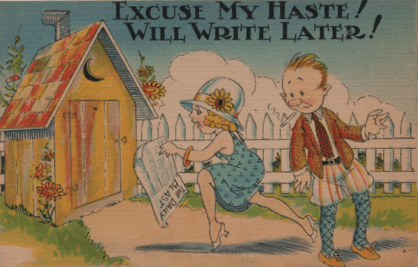
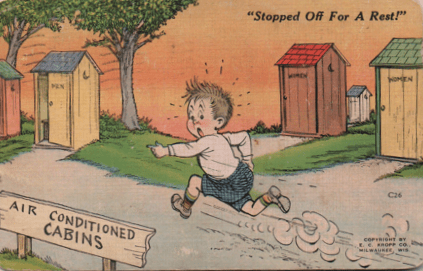
Today, however, I thought we might consider an equally controversial sociological topic which will require less research. What is it with that crescent moon on the outhouses we see here?
Outhouses, for reasons too obvious to require discussion, needed SOME sort of ventilation, so openings would be cut here and there about them for that purpose. Or others.
You didn’t want anything too big, I suppose, or too conveniently positioned, so one wouldn’t find oneself in the position (beg pardon) of the young lady who left her parasol on the outside of this outhouse.
And, if nothing else, a convenient opening in the door that you could grab so the door could be opened when you were in a hurry was necessary, too. But why a crescent moon? The traditional story is that the crescent moon represented womanhood. Men’s rooms had a round sun symbol cut into them. When asked why we never see outhouses with that sun sign on them, they tell us women are most likely to want to take care of business in private. There just weren’t as many men’s rooms. Another possible explanation is that the story, like the outhouses, is fulla…never mind. Most home outhouses were ungendered; it was more of a first-come, first-served thing. This story about the moon goddess and women’s rooms is now believed by absolutely no one except those who believe every strange but true fact they get sent by email.
Some people claim the symbol was simply traditional, and thus a handy signal to people who were in a hurry. Others state it was never traditional to begin with, and all outhouses we see with crescent moons nowadays had those moons put in them later because we expect them. Still, if they were never traditional, why WOULD we expect them?
One writer who is probably on the right track says we simply got used to seeing the crescent moon in cartoons and postcards, and THAT’S how it became traditional. He kind of slips off the rails when he points out that comic postcards of the 1930s and 1940s NEVER show crescent moons on outhouses, so obviously it’s a post-war convention. (By the way, a couple of the postcards shown here are from the 1940s and I’m pretty sure that young lady in a hurry dates to the 1930s.)
His suggestion, which associates the symbol with the habit of mooning people or just referring to the southern end of the body as the “moon” (also referred to on numerous postcards), is tempting. But he points out a glitch: why a crescent moon, then, when the association of one moon with the other has to do with roundness?
I am perfectly willing to muddy the waters (so to speak) by adding another possible explanation, which has just as much historical backing as his. People who are sitting around just thinking about other things and not getting anything useful done are referred to as “mooning”. I saw it started as a complaint from someone on the outside of the outhouse about what the person inside was doing all this time, and it just became a symbol of the one place people were free to sit and contemplate. There. Let’s see how long it takes THAT to spread across the Interwebs.
So, once upon a time, somebody came up with these discs of glass which could be used to focus the sun’s rays into a burning point. THEN someone realized they could be used to make small things look bigger, and, over the years, loupes and telescopes and microscopes and binoculars came to be. Somewhere at the beginning of that period, along about 1250 or thereabouts, people started making pairs of them and perching them on their noses.
But eyesight is not a perfectly balanced system, and some people had such a wild difference between the vision in their eyes that a few of them began wearing just one lens, which could be mounted in one half of a pair of spectacles, or just set into the eye socket ahead of the eyeball. These could be easily held in with the muscles of the face, but for those with more active lifestyles, a string or wire was extended from the lens to the wearer’s clothes, to keep the lens from hitting the ground.
And a new comic cliché was born.
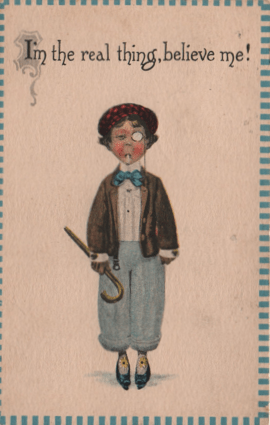
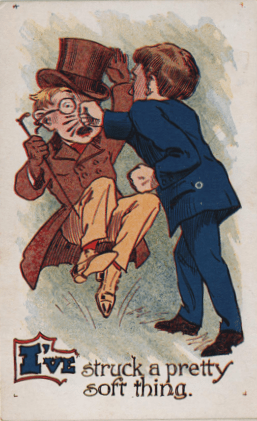
The Interwebs informs me that the monocle, as this style of eyewear is named, was high fashion in 1805 or thereabouts, and a common joke by 1840. Since no one can buy a monopoly on good eyesight, both rich and poor wore monocles. But somehow, they became associated with the rich and pompous: Regency dandies, German officers, and the haughty businessman of the 1890s, whose top hat, morning coat, and monocle guaranteed the viewer something funny was going to happen soon.
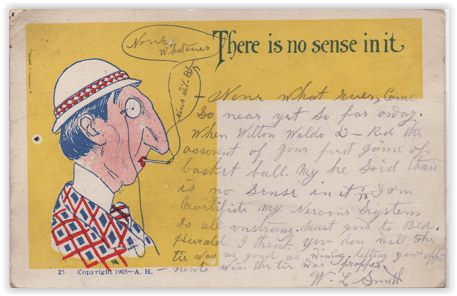
This pop culture cliché was not overlooked by our postcard cartoonists, who knew the monocle indicated a dandy, a rich sissy, a faker. In a world where monocles were becoming rare (they experienced a revival, especially in Germany, in the 1930s, when a woman wearing a monocle was advertising that she was dangerous) this cliché lived on for years. Charlie McCarthy, the famous dummy, always wore one. Batman started running into a monocled villain who called himself the Penguin in the 1940s. Eustace Tilley, the mascot of The New Yorker, actually flaunts his, as he studies a butterfly.
Thanks to the German military monocle (the monocle apparently originated in Germany and traveled to England in the late eighteenth century), picked up by autocratic movie directors, a monocle may be assumed to be in the arsenal of any good villainous, or villainous-looking, character with an accent. Hence, say, Colonel Klink on Hogan’s Heroes, James Bond’s Ernest Stavro Blofeld, and, on Sesame Street, The Count.
Monocles even come with their own set of cliches. In a comedy, if the person wearing a monocle does not see something surprising and let the thing pop free, the director is not making full use of his medium. (This is another one of those jokes which is POSSIBLE in day-to-day life but far more common on film.)
Monocles ARE still available for non-Halloween costume use: a nice one with a solid gold rim sells for one or two hundred dollars. And some people DO wear one against all comic intent. Mr. Peanut wouldn’t look the same without his. Lord Peter Wimsey used a serious monocle, first as a disguised high-powered magnifying glass for examining clues and second to make people think he was too silly to worry about, as Hercule Poirot used his occasionally fractured English. A villain with a monocle (I see that Captain Picard, in his Borg form, is considered a monocle-wearer) may do a great deal of serious damage.
Still, the monocle is still primarily used as a comic signal. Either the wearer is ridiculous, or something ridiculous is about to happen to him.
The sound resounded through the house like thunder. Every room above, and every cask in the wine=merchant’s cellars below, appeared to have a separate a peal of echoes of its own. Scrooge Was not a man to be frightened by echoes. He fastened the door, and walked across the hall, and up the stairs; slowly, too: trimming his candle as he went.
You may talk vaguely about driving a coach-and-six up a good old flight of stairs, or through a bad young Act of Parliament, but I mean to say you might have got a hearse up that staircase, and taken it broadwise, with the splinter-bar toward s the wall, and the door towards the balustrades: and done it easy. There was plenty of width for that, and room to spare;; which is perhaps the reason why Scrooge thought he saw a locomotive hearse doing on before him in the gloom. Hald a dozen gas-lamps out of the street wouldn’t have lighted the entry too well, so you May suppose it was pretty dark with Scrooge’s dip.
Up Scrooge went, caring not a button for that; darkness is cheap, and Scrooge liked it. But before he shut his heavy door, he walked through his rooms to see that all was right. He had just enough recollection of the face to desire to do that.
Sitting-room, bed-room, lumber-room. All as they should be. Nobody under the table, nobody under the sofa; a small fire in the grate; spoon and basin ready; and the little saucepan of gruel (Scrooge had a cold in his head) upon the hob. Nobody under the bed; nobody in the closet; nobody in his dressing-gown, which was hanging up in a suspicious attitude against the wall. Lumber-room as usual. Old fire-guard, old shoes, two fish-baskets, washing stand on three legs, and a poker.
Quite satisfied, he closed his door, and locked himself in; double-locked himself in, which was not his custom. Thus secured against surprise, he took off his cravat; put on his dressing-gown and slippers, and his night-cap; and sat down before the fire to take his gruel.
It was a very low fire indeed; nothing on such a bitter night. He was obliged to sit close to it, and brood over it, before he could extract the least sensation of warmth from such a handful of fuel. The fireplace was an old one, built by some Dutch merchant long ago, and paved all round with quaint Dutch tiles, designed to illustrate the Scriptures. There were Cains and Abels; Pharoah’s daughters, Queens of Sheba, Angelic messengers descending through the air on clouds like feather-beds, Abrahams, Belshazzars, Apostles pushing off to sea in butter-boats, hundreds of figures to attract his thoughts; and yet that face of Marley, seven years dead, came like the ancient Prophet’s Rod, and swallowed up the whole. If each smooth tile had been a blank at first, with power to shape some picture on its surface from the disjointed fragments of his thoughts, there would have been a copy of old Marley’s head in every one.
“Humbug!” said Scrooge, and walked across the room.
The image of Scrooge in his nightclothes, huddled over his gruel is, for some reason, one of the most constant favorite images from the tale. (Some versions, omitting the melancholy tavern before, make this Scrooge’s whole evening meal.) Most everything else is considered optional, though we do often see Scrooge on the stairs by candlelight. That helps define his isolation in the building. By the way, does anyone know what Dickens had in mind with that hearse he tosses into the description with such reckless abandon? Does Scrooge actually see such a thing? Is it a trick of the shadows? Or is it another touch to emphasize Scrooge’s state of mind? Or what?
Hicks enters a big dark room in which nothing much can be seen, thrusting his stick ahead of him. He moves on to the bedroom. Apprehensive, he jumps at the sight of his dressing gown; even after he has realized what it is, he gives it a poke to make sure. “Humbug!” Stepping into the lumber-room (a sort of back closet to store things for which you have no particular use at the moment, but may have one day), he leaps back when a draft knocks a small box to the floor. Taking the dressing gown, he makes sure the door is locked and then, with the gown across his knees, sits down to start in on the gruel.
Owen enters a house once elegant; there is a broad entryway. It also has a chandelier and decorative sculpture, but has fallen on hard times, to judge by the crates and barrels stowed around the place. The wrought iron staircase drips with cobwebs. He looks behind himself several times, unnerved, apparently, by the background music. Poking up his fire, he takes some cough medicine, licking his fingers afterward. Then he has a quick look around.
Sim I lives in a sparse but nice-looking house, and moves up steep stairs, looking more nervous as the musical background grows spookier. There is also a moan of “Scrooge!” After a few shaky humbugs, he locks his door and sits down to a comfortable bit of gruel, having donned fairly nice slippers and dressing gown.
Narch lives in a one-room flat which is warm, well-furnished, and well-lit: positively cozy. A housemaid has turned down his sheets, set his gruel and tea on the hob, and made sure the bedwarmer is heating by the fire. (Scrooge owns a writing desk on which sits a stuffed raven, adding a touch of Lewis Carrol rather than Edgar Allan Poe.) Before Scrooge enters, the maid opens the window, enjoying the song of carolers outside. Scrooge is abrupt on coming home. The housemaid eventually backs out of the room, starting to wish him “A merry….” “Don’t say it!” he barks. Later he slams the window to shut out the noise of the carolers (does nobody feel the cold?) Time passes, shown in the dying of the fire. Scrooge has changed into his dressing gown and nightcap, and works with pen and ledger. A clock strikes midnight.
Rathbone appears to warm his hands at the fire; there is no gruel in sight. He has donned a brocaded dressing gown with great big buttons and an absurdly high nightcap./
Magoo, sitting by the fire in nightshirt and cap, eats his gruel, and sees Marley’s face among the flames of his fire. “I’m seeing things. Perhaps I do need spectacles.”
Haddrick, in nightshirt and cap, steps into his bedroom, and, hearing a chain rattle, bolts the door. Then he sits by the fire with a candle and his bowl of gruel.
Sim II is passed on the stairs by a ghostly hearse. He mutters, “Hum…humbug. Humbug.” And moves on through the blackness. In a pointed ca[p and nightshirt (and blue socks) he settles by the fire to sup from a large bowl of gruel. He sets this bowl down to warm his hands at the fire.
Finney watches a ghostly hearse pass him, headed up the stairs. The driver sweeps off a high hat and wishes Scrooge a merry Christmas. Reaching his room, Scrooge locks his door and listens at it. He then lights a small fire and sets the free soup he extorted from Tom Jenkins there. When he sits to eat, a puff of smoke billows from the fireplace, accompanied by a cry of “Scrooge!” “It’s humbug still,” Scrooge declares, leaning forward to shout up the chimney, “I’ll not believe it!” He rises to investigate a draft from the window.
Matthau, we are told, gets himself upstairs and goes to sleep.
McDuck is followed up the stairs by Marley who, though invisible, casts a shadow. Marley lifts Scrooge’s hat; Scrooge, poking behind him with his stick, tickles the ghost. Looking back to find only a laughing shadow, Scrooge dashes up to his room. He slams the door and Marley lands against it with a thud. Scrooge locks the door five times and is terrified and someone knocks at it.
Scott moves through a house filled with dark, shiny paneling and dark, heavy furniture. He looks around his bedroom, rather walleyed, not quite believing something is wrong, and not quite not believing it. He locks his door three times. Later, in his dressing gown, he picks up gruel from the hob. After a moan of “Scrooge”< Marley’s face begins to flash from this tile and then that. “Humbug!” is Scrooge’s comment.
Caine’s progress is narrated by Charles Dickens, outside in the snow. “Darkness was cheap, and Scrooge liked it.” Vast impressive shadows surround Scrooge as he mounts the stairs and looks through his rooms. Seeing a figure in the shadows, he knocks it to the floor and strikes at it with his stick, only to find it is his best dressing gown. Fortunately, he admits, breathlessly, that he has done it no damage. Later, wearing it, he sits by the fire, dining on meat and bread.
Curry starts up the stairs with Debit, who hears chains. Later, in cap and dressing gown, Scrooge hears a call of “Ebenezer Scrooge”, locks his door three times, and listens. “Humbug!” Later, seated, he reads through his bankbook again, but it distracted by green rays emanating from one of the fireplace tiles. Moving to it, he finds Marley’s face calling to him. He slaps his bankbook over the phantom face, but it is still there when he looks again. “Go away! I won’t believe it!” Debit barks; Scrooge turns and tell him to shut up. When he looks at the tile again, it is normal, so he hits himself with the bankbook and calls himself a dunderhead. “No such thing as spirits.”
Stewart enters a building with an office directory lettered on the wall by the stairs. He moves up to his rooms and locks the door. A thumping makes him check his lumber-room; he then returns to the door and double locks it. In his dressing gown, he sits down to some very thin gruel. Marley’s face begins to appear in the tiles around the fireplace; the face of one Biblical character becomes Marley’s face and turns to regard Scrooge. Scrooge belches and blames indigestion.
I frankly regarded them with deep suspicion, and I still wonder at the sheer nerve of the hot lunch ladies in preparing such a dangerous dish. And the fact that, for the only time in my life, I was wondered to sit there until I ate that, I never did make my peace with them. Looking back, it’s hard for me to say exactly what it was that set me off.
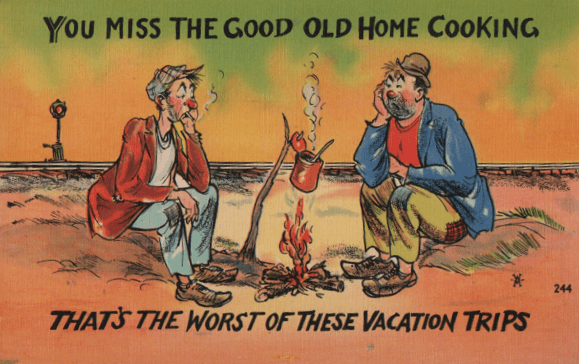
Anyhow, this is NOT a food blog, so I was not going to write any more investigative reports on edibles after last week’s column which covered, among other things, the history of S’Mores. But the association of campfires and things cooked on sticks naturally brought up hot dogs, and how you should choose your stick carefully (several people die every year from choosing a yew branch; we always had these nifty mid-century hot dog roasting forks of metal and red wood), and just generally how the hot dog is one of the great adaptations of sausage. Hot dog pennies, hot dog pizza, hot dogs in macaroni and cheese, and so on filled the minds of my readers until I wanted to complain about sausage fetishes in a way that would have gotten me banned from the sunlight side of the Interwebs.
And then someone asked “Why are they called Weiner Winks?”
And there I was, practically thrown down a new rabbit hole. For those of you who have not seen these (some people claim it’s a Midwestern thing while others cay it’s common in small towns but never encountered in cities), a wiener wink is a cooked hot dog which has been placed on a slice of American cheese (for the classic recipe, something you have just pulled out of its plastic snood) which has been place on a piece of plain white bread (from a mass-produced loaf) which has been buttered on the outside (NOT the side facing the hotdog.) This bread and cheese shawl is folded up over the hot dog and secured with a toothpick, and then baked until the cheese has melted and the buttered bread is toasty and golden) Some people like to dip these in ketchup or some similar viand (we didn’t HAVE Ranch in my day: that’s how old I am.)
No, they are NOT “Pigs in a Blanket”. These are hot dogs which have been wrapped in bread dough, or packaged crescent roll dough, ro something similar, and then baked. I think these would be superior for dipping, but they are NOT wiener winks.
As to the origin of this epicurean dish, some people trace it back to the 1965 Better Homes and gardens Meat Cookbook, where they are gussied up with chopped onion and, of all things, Parmesan Cheese, and have olives skewered on those toothpicks when they come out of the oven. This goes along with the whole fad for gimmicky party foods, and may be a corruption of an earlier, simpler recipe. (Parmesan? Where I came from, that was available only in green shakers.)
And, as to the name, we must first brush aside those people who claim they are “Weiner WINGS” (because theu look like wings?) and simply smile at people who call them “Weenie Winks” or “Frankfurter Friends” (A late expression of the fad for calling foods More Interesting Names. Has anybody studied Food Fads of the Twentieth Century? Do you know we are still suffering from a fad started by a Chicago hotel in the 1920s for weird salads? Basically anything on a leaf of lettuce could be…but that’s a whole nother blog, and perhaps a whole nother career.)
Anyway, taking easy, reliable ingredients—butter, bread, cheese, hot dogs—and turning them into something wild and wonderful won over the public, and the dish became something of a staple. The name is explained in enough ways to make it clear nobody’s quite sure. SOME claim the shape of the sandwich reminds them of a winking eye (the toothpick is an eyelash, I guess); others say the weiner is winking at you as it sticks out past the bread on each end. One cynical soul suggests the hostess served these at a party with a wink to let guests know SHE knew this was just a hot dog in exotic clothes. When you start delving into the history of any popular recipe, you need boots. The folklore gets deeper on every side the further you go.
I am, as I say, amazed by hot lunch ladies who trusted a group of elementary school kids with a dish involving a toothpick, and I have not forgiven them for their reaction to a kid who had never seen one before and didn’t trust it. But we all seem to have survived. There is no room here to discuss a friend of mine who developed a new variation on the recipe the day she was prepared with hot dogs and cheese and found out too late there was no bread in the house. And she had one of those bratty kids who won’t eat anything new that looks suspicious.
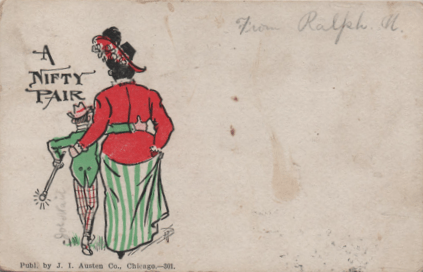
We have examined, from time to time, the pleasure our postcard artists took in the infinite mixings and matchings of romance, but we have been primarily concerned with girth. The artists found other ways to express romance in inches. (Mind. Gutter. Please.)
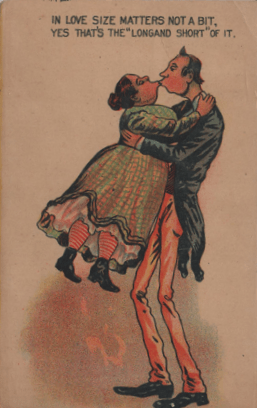
The tall, thin man and the short, round woman were very popular in this regard. The number of common, everyday phrases which could be used as captions made this very tempting. (I may have mentioned, by the way, that I’m not sure why the woman so often stands on a piece of paper. Could it be a marriage license? A deed to her rich uncle’s farm? Secret blueprints for a new and innovative stepladder?)
Here she’s just rising above her open-heeled shoes. And that’s the long and short of THAT.
“The long and short of it” was a frequent fallback in any picture of contrasts between the heights in a picture, but this puts it all more romantically. This image was popular, and appears on a number of cards with only slight differences in the coloring of the complexions and wardrobes (though the lady always has those stripey socks.)
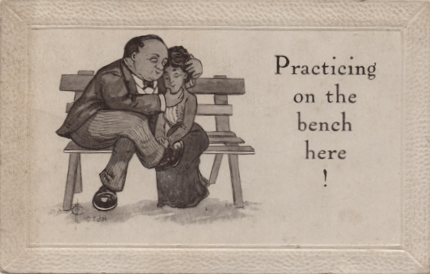
Sometimes there are variations in girth as well. The tall person doesn’t HAVE to be the skinniest one in the couple.
There are suggestions that the man is the taller creature in these romances to express his dominance. It doesn’t always work that way.
Besides, sometimes the woman is the tall person in these big/little couplings. We’ve gone back to considering differences of width again too, you’ll observe.
Some cartoonists, though, were perfectly happy with the traditional tall and thin vs. chubby and stubby (Here we toss in an ethnic angle just to flavor the joke.)
The point of the joke, though, was contrast. The bigger the difference, cartoonists always believe, the bigger the laugh.
One can’t help wondering, though, at some of these pairings. Could two people who are on completely different levels actually live happily ever after?
With all the other roadblocks life throws in the way of true love, doesn’t such a contrast just add a final, fatal obstacle?
The cartoonists said no. Love would find a way. The most mismatched couple can stride confidently off into the sunset. (By the way, why is the end of his stick…I did say “please”, remember.)
Scrooge took his melancholy dinner in his usual melancholy tavern; and having read all the newspapers, and beguiled the rest of the evening with his banker’s book, went home to bed. He lived in chambers which had once belonged to his deceased partner. They were a gloomy suite of rooms, in a lowering pile of building up a yard, where it had so little business to be, that one could hardly help fancying it must have run there when it was a young house, playing at hide-and-seek with other houses, and have forgotten the way out again. It was old enough now, and dreary enough, for nobody lived in it but Scrooge, the other rooms being let out as offices. The yard was so dark that even Scrooge, who knew its every stone, was faint to grope with his hands. The fog and frost so hung about the black old gateway of the house, that it seemed as if the Genius of the Weather sat in mournful meditation on the threshold.
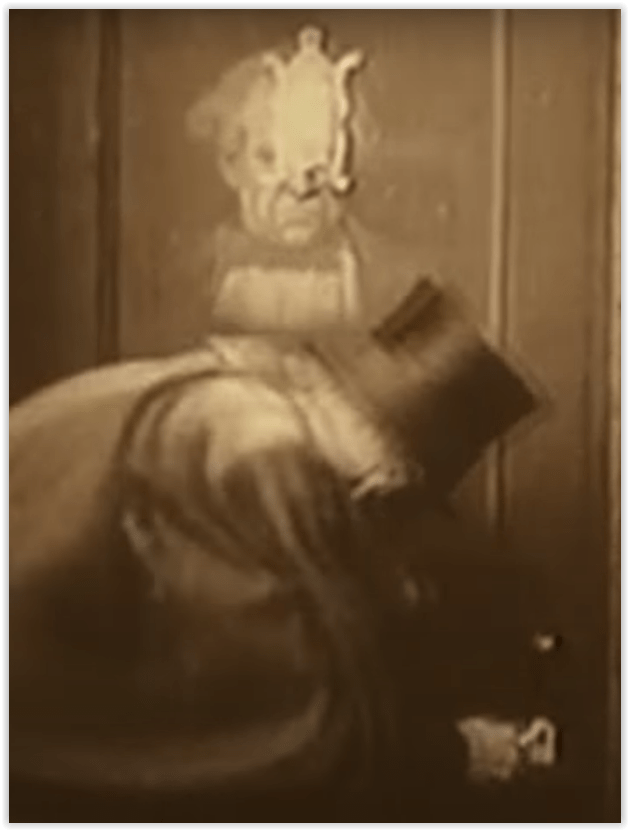
Now, it is a fact, that there was nothing at all particular about the knocker on the door, except that it was very large. It is also a fact, that Scrooge had seen it night and morning during his whole residence in that place; also that Scrooge had as little of what is called fancy about him as any man in the City of London, even including—which is a bold word—the corporation, aldermen, and livery. Let it also be borne in mind that Scrooge had not bestowed one thought on Marley, since his last mention of his seven-years’ dead partner that afternoon. And then let any man explain to me, if he can, how it happened that Scrooge, having his key in the lock of the door, saw in the knocker, without its undergoing any immediate process of change, not a knocker, but Marley’s face.
Marley’s face. It was not in impenetrable shadow as the other objects in the yard were, but had a dismal light about it, like a bad lobster in a dark cellar. It was not angry or ferocious, but looked at Scrooge as Marley used to look: with ghostly spectacles turned up upon its ghostly forehead. The hair was curiously stirred, as if by breath or hot-air; and though the eyes were wide open, they were perfectly motionless. That, and its livid color, made it horrible; but its horror seemed to be, in spite of the face and beyond its control, rather than a part of its own expression.
As Scrooge looked fixedly at this phenomenon, it was a knocker again.
To say that he was not startled, or that his blood was not conscious of a terrible sensation to which it had been a stranger since infancy, would be untrue. But he put his hand upon the key he had relinquished, turned it sturdily, walked in, and lighted his candle.
He DID pause, with a moment’s irresolution, before he shut the door; and he DID look cautiously behind it first, as if he half-expected to be terrified with the sight of Marley’s pig-tail sticking out into the hall. But there was nothing on the back of the door, except the screws and nuts that held the knocker on; so he said “Pooh, pooh!” and closed it with a bang.
That doorknocker is classic: it is to be found in the very first existing movie Christmas Carol, from 1901. Most versions do fiddle with the hardware, though. According to Dickens, the face of Jacob Marley simply takes the place of the knocker for a moment, without fanfare, and does not move, though the hair stirs a bit. Screenwriters feel the audience expects ghosts to DO something. (And though Dickens does not specify it, a large number like to make the original knocker a lion’s head, which transmutes neatly into a human face.)
Only about half the versions bother to have Scrooge stop at a tavern for supper, preferring to feed him only on gruel from his own hob, which seems likelier for a miser. Hicks and Curry, sixty years apart, do, however, turn this interlude into a major sequence.
Hicks bah humbugs the merry shopping crowds as he pushes through. Of all the miserable taverns visited by all the Scrooges in all the movies, he here walks into the most miserable. He is the only customer, as in some other versions. His meal is intercut with scenes of a linkboy showing Fred home, of Cratchit carrying a goose and what looks like a small tree, and finally scenes of the Lord Mayor’s holiday dinner. There is much humorous seasonal bustle here: preparations in the Mayor’s mammoth kitchen, the arrival of guests, assorted examples of The Poor moving here and there on the fringes of the grand affair. This probably reflects dickens’s mention, earlier, of the Lord Mayor’s Christmas dinner and the little tailor involved in the same sort of preparations. Eventually, the crowd attending the dinner and the poor outsiders beyond the walls all sing “God Save the King”, reinforcing a sense of common identity. Meanwhile, set apart in the tavern, Scrooge orders the waiter to go out and shut up the organ grinder playing “God Rest Ye, Merry Gentlemen.” This is the waiter who grimaces his opinion of Scrooge as the customer departs (certainly without leaving a tip). Scrooge walks through streets thick with fog. A dog barks; we find it to be the blind man’s dog mentioned earlier by Dickens. Scrooge, irritated, snarls back, and moves on to turn in at a small enclosed yard. A plain knocked with a large ring waits on the door; beneath this are the names Jacob Marley (scratched out) and Ebenezer Scrooge. Scrooge looks up just as Marley’s face materializes within the ring. When it vanishes, Scrooge hurries inside and checks the back of the door.
Curry takes his book and his dog to supper, shaking his head at the sight of Bob and Tim on the ice. Debit would stay and play, but Scrooge snarls. A soup seller makes a nasty crack about Scrooge as he passes, and Scrooge scowls at the knot of children—which includes the boy who came to his door earlier—admiring the prize turkey at the poulterer’s. He enters a warm, bright, busy tavern, filled with cheerful Christmas revelers, and orders the cheapest thing on the menu. The waitress decides to bring him more than he asked for, and sings a rowdy, rather “Les Miserables” style song about charity and how year’s end is a good time to look back and see whether you committed any “Random Acts of Kindness”. The point of this song seems to be that if you do charitable deeds without thought of reward, one day you will be rewarded. Nettled, Scrooge sings back a verse about how charity merely encourages the criminal and indolent. He finally leaves, casting aspersions on the cooking, and pushes past a freezing mother and child outdoors. His house is on the street; the door is reached via a short flight of stairs. A gold lion on the door turns into Marley, startling Scrooge, who trips over Debit. When Scrooge has gathered himself again, the knocker is a lion. Scrooge whacks it with his cane to be certain.
Three versions do without the doorknocker entirely. (On radio, where the doorknocker scene might have presented difficulties, Lionel Barrymore always saw Marley’s face in the fireplace as he ate his gruel.)
March leaves the counting house after Cratchit, pinning his coat shut at the throat and nearly forgetting his money-box. The streets are dark and deserted, the weather much worse. We do not see his front door.
In Rathbone, the narrator tells us that Scrooge went home to bed, explaining that Scrooge lived in chambers that belonged to his late partner. Though we do not see the doorknocker, Scrooge is looking back over his shoulder as he enters. “Ah, humbug!” he growls.
Haddrick walks home past the cemetery we saw earlier. He lives in a rather mean brick building on the corner of the block. His doorknocker is a lion, which does absolutely nothing.
Owen uses both the tavern and the doorknocker. His tavern is empty and cheerless; he bites his change before accepting it, and, in departing, is grimaced at by the waiter. On his way home, he knocks the hat out of the hand of the director of a group of street carolers. Entering a small enclosed yard, he opens his front door and sees a new face superimposed on that of the gargoyle on his knocker. He trembles violently. “Marley!”
Sim I is avoided by the blind man’s dog and goes to a fairly cheap tavern. In the course of his meal, he calls “More bread!” “Ha’penny extra, sir,” says the waiter. There is a pause. “No more bread.” When he reaches it, his front door is at street level. After a call of “Scrooge!”, Marley’s face is superimposed over the decorative knocker. “Jacob Marley,” Scrooge says, making a statement, if one of disbelief. He hurries inside, pauses, and looks back at the door once more.
Magoo has a short walk to a door on which a white lion doorknocker suddenly becomes Marley’s face. Scrooge polishes the face away with his handkerchief, but is still unnerved by it. “Very strange. Could I need spectacles?”
Sim II is avoided by the blind man’s dog; the narrator delivers a few lines from earlier in Dickens about how Scrooge kept all mankind at a distance. It is very foggy; only Scrooge and one streetlight can be seen, emphasizing his isolation. A pale lion doorknocker turns into Marley’s face while Scrooge’s gaze is diverted. When Scrooge does see this, he declares, “Jacob. Jacob Marley.” With a shudder, he hurries indoors.
Finney enters a lonely quarter and walks up to a door with a blackened metal lion doorknocker wearing quite as nasty an expression as Scrooge himself. While Scrooge has his key in the lock, he looks up to see the lion change into the face of his late partner. Its eyes open slowly, and it says “Scrooge” before becoming a lion again. Scrooge goes inside, several times looking back at the knocker and checking the back of the door. Finally, he declares “Humbug!”
Matthau locks up his money, after finding himself a coin short and resolving to dock Cratchit’s next payday by that amount. On his way out, he addresses the sign outdoors, telling Marley that Marley is lucky to be dead as a doornail and no longer burdened with Christmas. He admits that he is lucky as well, no longer having to share his profits with Marley. On his way home, he gives more evidence of his nature by cheating a match girl, chasing away a newsboy (and picking a newspaper out of the garbage), eating a meagre supper, and, when the waiter reaches for a tip, handing him the spoon. B.A.H. Humbug and a chorus of cats and dogs in the street sing the title song “The Stingiest Man In Town” through all this. When he reaches his house, it is shrouded in fog, looking fairly shabby. Humbug tells us Scrooge had to grope with his hands in places, and tries to improve on the “Genius of the weather” by suggesting that all the fog and frost made it seem “as if Death sat in meditation on the threshold”. He also informs us that the doorknocker suddenly turned into Jacob Marley. The doorknocker has a fairly unfriendly human face to begin with; it now becomes a grinning, gaping demonic ghoul rather in the style of EC Horror comics. Scrooge cries out that the man “has been dead these seven years! Oh, why have you come to haunt me? Away! Go away!” It returns to its previous sullen condition. Peering at it, Scrooge decides, “Just my imagination. Bosh! Ghosts! A lot of humbug!”
McDuck leaves his office at nine and trudges through streets filled with snow; everyone else seems to have gone home. At a brick house, a large gold lion doorknocker becomes Jacob Marley (Goofy), and wails “Scrooooooge!” “Jacob Marley? No! That can’t be!” To prove this, he reaches out and pinches Marley’s nose; when the spirit yelps, he rushes indoors.
Scott walks down a dark, lonely, foggy lane, fenced in so there is no way to escape when a hearse pulled by four horses drives up behind him. He does not seem to hear the approaching team, but he does catch a faint cry of “Ebenezer Scrooge!” When he turns to look, he sees no one, and the hearse and team are now in front of him, vanishing into the fog. His home sits on an utterly deserted, ramshackle part of the warehouse district, a place no one with sense would enter after dark. He moves into a small enclosed yard. The gold lion on the door calls his name; then Marley’s face is superimposed on it. This phantom is quickly gone. Scrooges moves inside, locs the door, and lights his candle.
Caine’s house is on a dark and lonely street; his door sits just two steps up. The decorative knocker stretches and shifts to become a face. “Jacob Marley?” The face howls, scaring Scrooge’s horse. When Scrooge looks again, the face is a knocker once more. “Humbug!” he declares, and marches inside.
Stewart walks through a lonely street sparsely splotched with snow. His door is four steps up from street level. The ring of the decorative knocker widens to encircle Marley’s face; it wails. Scrooge, deadpan, is stunned. “Jacob. Jacob Marley.” The ring narrows and the face is gone. Scrooge looks around to see if someone has been playing some sort of prank, and concludes “Humbug.”
FUSS FUSS FUSS #6: Bah!
No matter what else you do with A Christmas Carol—set it in the Las Vegas Strip, produce it underwater, convert it into an episode of this winter’s hottest sitcom—there is one inviolable rule. Scrooge must at some point say, or attempt to say, “Bah! Humbug!” Scrooge without his Humbug would be like Sherlock Holmes without his Elementary, Spock without his Fascinating, or Santa without his Ho Ho Ho.
This being an era of statistics, I have attempted to track down how much this expression is used, lest it be like Sherlock’s Elementary,. More used by the movies than the original. You’ll notice, for example, in Dickens’s rendition of the doorknocker sequence, he actually says “Pooh, pooh!”
My census gives us, in the original:
“Bah! Humbug!” twice, within moments of each other.
:It’s humbug still!”
“Humbug!”
“Humbug, I tell you—humbug!”
“Hum….” He lacks the strength of will to finish the word.
Scrooge uses the phrase not at all in the second half of the story, making it a feature of the original, unrepentant Scrooge, a phrase for anything he doesn’t understand, doesn’t wish to see, or simply doesn’t like.
It’s a less easy trick to sit through movies counting humbugs, but such things must be attempted. The census put the Screen Scrooges in this order of usage.
Sim II gives us three humbugs and one bah humbug.
Caine has three humbugs and a bah humbug.
Stewart gives us three humbugs and an “Ah, humbug!”
Rathbone delivers a bah humbug, two ah humbugs, and one humbug.
Sim I gives us five humbugs, and delivers one very late in the show, cheerfully calling his own reflection in a mirror that after his reclamation.
Hicks has five bah humbugs and one “Hum….”
Curry uses four humbugs and two bah humbugs; he is one of the Scrooges who delivers the latest humbug of disbelief, saying it to the Ghost of Christmas Present.
Finney gives us six humbugs and one “Hum….”
McDuck delivers three bahs, four humbugs, and one bah humbug.
Haddrick gives us four bahs, four humbugs, and two bah humbugs.
Magoo produces seven humbugs and two bah humbugs.
Owen uses one bah and nine humbugs.
Matthau similarly has one bah and nine humbugs (plus the character of B.A.H. Humbug.)
Scott declaims one bah, eight humbugs (two of which are used toward the end, to describe his former self) and one iconoclastic “Humbug…bah!”
March makes use of seven humbugs, two bah humbugs, and one ah humbug.
Okay, I’ll say it out loud and get it over with. I have never, in all my life, eaten a genuine S’More. First off, a REAL S’More must apparently be cooked over an open fire, preferably on a camping trip, and camping trips were not part of my childhood. (My mother, offspring of a Boy Scout Leader and a Girl Scout Leader did so much camping in her childhood that she swore off it once she was old enough to decline.) My mother DID indulge us in letting us toast marshmallows over candles, but we may never have had the other two ingredients required.
The S’More is a folk recipe, invented, it seems, by Boy Scouts. Anyway, the first S’Mores recipe, which called them “Graham Cracker Sandwiches” and was published in an undated booklet from Campfire Marshmallows in the 1920s, attributes the recipe to Boy Scout tradition. (S’Mores must be considered a Great American Recipe since it consists of three ingredients, all primarily available as packaged foods: marshmallows, graham crackers, and candy bars. And how much of a coincidence is the name of the fine old marshmallow company that first printed the recipe?)
Half the fun in a lot of folk recipes is the occasion, the gathering, the whole process of making the recipe (a fact apparently lost on all the S’Mores cereals, candy bars, and other products which have emerged during the current burst of popularity.) The ingredients were handy and somebody who was having fun decided to play around with them. Who DID first toss a slice of cheese on a hot hamburger: some tired cook in a diner or some goofball kidding around at a campfire?
Consider, for example, what my piano teacher called “Stomach Ache Medicine” (she called it that because it was guaranteed to give you a stomach ache; must’ve been a family joke.) This was a personal recipe for a snack food with origins lost in the ists of time. It started with corporate marketing, but then what?
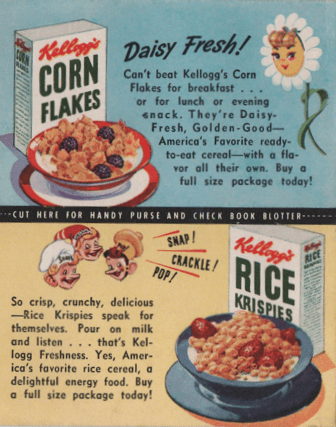
Breakfast cereal was a new and radical idea at the turn of the last century. Breakfast was supposed to be a leisurely meal involving appetizers, main courses, and sides, as well as dessert. A farm breakfast might include potatoes, pancakes, fried meat or one or three kinds, and pie for dessert. It was the health food folks who started suggesting a hearty bowl of cereal with toast and orange juice instead. Breakfast cereal was invented about the same time as modern marketing, and the rest is history.
But corporate America did not become what it is today without hedging its bets. Cold cereal (also marketed as ready-to-eat cereal because, unlike oatmeal or Cream of Wheat, it required no cooking) was marketed for other purposes as well. I stare at the advertisements showing people serving a side dish at dinner composed of a large Shredded Wheat biscuit covered with gravy. The custom of topping casseroles with crushed Corn Flakes must date from around the same time.
But someone discovered a box of cereal also provided a ready snack: the only thing in the kitchen, once upon a time, which was just “Open and Eat”, without even having to add a plate. Since breakfast cereal in those days was largely unflavored, though, it did lack a little something. So someone, realizing the difference between Puffed Rice and popcorn was just one of perception, started heating it up with a coating of butter and whatever seasonings were desired.
Corporate America caught on to this, and at some point in the early 1950s, Ralston began printing a recipe for “Party Mix” on the sides of its Wheat Chex and Corn Chex boxes. They pushed this so well (besides having a cereal that worked very well with the recipe), that the result became known as Chex Mix. That poor, deprived generation had to make its own batches though, using their own or Ralston’s recipe, because it was not until the 1980s that somebody said “Hey, why not sell it pre-packaged? That might cut back on sale of cereal, but it’s all money coming in!”
Like S’Mores, though, it’s the most fun to make your own. You can toss in almonds instead of bagel chips, or shove a gumdrop into your marshmallow before S’Moring it. If it’s going to be YOUR stomach ache, customize it all you want.














 Blogsy Babbles