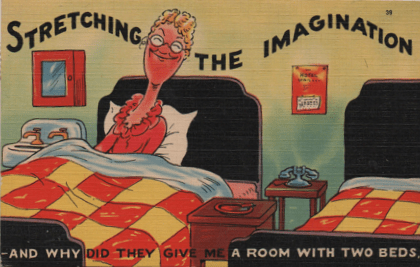
So, once upon a time, somebody came up with these discs of glass which could be used to focus the sun’s rays into a burning point. THEN someone realized they could be used to make small things look bigger, and, over the years, loupes and telescopes and microscopes and binoculars came to be. Somewhere at the beginning of that period, along about 1250 or thereabouts, people started making pairs of them and perching them on their noses.
But eyesight is not a perfectly balanced system, and some people had such a wild difference between the vision in their eyes that a few of them began wearing just one lens, which could be mounted in one half of a pair of spectacles, or just set into the eye socket ahead of the eyeball. These could be easily held in with the muscles of the face, but for those with more active lifestyles, a string or wire was extended from the lens to the wearer’s clothes, to keep the lens from hitting the ground.
And a new comic cliché was born.
The Interwebs informs me that the monocle, as this style of eyewear is named, was high fashion in 1805 or thereabouts, and a common joke by 1840. Since no one can buy a monopoly on good eyesight, both rich and poor wore monocles. But somehow, they became associated with the rich and pompous: Regency dandies, German officers, and the haughty businessman of the 1890s, whose top hat, morning coat, and monocle guaranteed the viewer something funny was going to happen soon.
This pop culture cliché was not overlooked by our postcard cartoonists, who knew the monocle indicated a dandy, a rich sissy, a faker. In a world where monocles were becoming rare (they experienced a revival, especially in Germany, in the 1930s, when a woman wearing a monocle was advertising that she was dangerous) this cliché lived on for years. Charlie McCarthy, the famous dummy, always wore one. Batman started running into a monocled villain who called himself the Penguin in the 1940s. Eustace Tilley, the mascot of The New Yorker, actually flaunts his, as he studies a butterfly.
Thanks to the German military monocle (the monocle apparently originated in Germany and traveled to England in the late eighteenth century), picked up by autocratic movie directors, a monocle may be assumed to be in the arsenal of any good villainous, or villainous-looking, character with an accent. Hence, say, Colonel Klink on Hogan’s Heroes, James Bond’s Ernest Stavro Blofeld, and, on Sesame Street, The Count.
Monocles even come with their own set of cliches. In a comedy, if the person wearing a monocle does not see something surprising and let the thing pop free, the director is not making full use of his medium. (This is another one of those jokes which is POSSIBLE in day-to-day life but far more common on film.)
Monocles ARE still available for non-Halloween costume use: a nice one with a solid gold rim sells for one or two hundred dollars. And some people DO wear one against all comic intent. Mr. Peanut wouldn’t look the same without his. Lord Peter Wimsey used a serious monocle, first as a disguised high-powered magnifying glass for examining clues and second to make people think he was too silly to worry about, as Hercule Poirot used his occasionally fractured English. A villain with a monocle (I see that Captain Picard, in his Borg form, is considered a monocle-wearer) may do a great deal of serious damage.
Still, the monocle is still primarily used as a comic signal. Either the wearer is ridiculous, or something ridiculous is about to happen to him.
The sound resounded through the house like thunder. Every room above, and every cask in the wine=merchant’s cellars below, appeared to have a separate a peal of echoes of its own. Scrooge Was not a man to be frightened by echoes. He fastened the door, and walked across the hall, and up the stairs; slowly, too: trimming his candle as he went.
You may talk vaguely about driving a coach-and-six up a good old flight of stairs, or through a bad young Act of Parliament, but I mean to say you might have got a hearse up that staircase, and taken it broadwise, with the splinter-bar toward s the wall, and the door towards the balustrades: and done it easy. There was plenty of width for that, and room to spare;; which is perhaps the reason why Scrooge thought he saw a locomotive hearse doing on before him in the gloom. Hald a dozen gas-lamps out of the street wouldn’t have lighted the entry too well, so you May suppose it was pretty dark with Scrooge’s dip.
Up Scrooge went, caring not a button for that; darkness is cheap, and Scrooge liked it. But before he shut his heavy door, he walked through his rooms to see that all was right. He had just enough recollection of the face to desire to do that.
Sitting-room, bed-room, lumber-room. All as they should be. Nobody under the table, nobody under the sofa; a small fire in the grate; spoon and basin ready; and the little saucepan of gruel (Scrooge had a cold in his head) upon the hob. Nobody under the bed; nobody in the closet; nobody in his dressing-gown, which was hanging up in a suspicious attitude against the wall. Lumber-room as usual. Old fire-guard, old shoes, two fish-baskets, washing stand on three legs, and a poker.
Quite satisfied, he closed his door, and locked himself in; double-locked himself in, which was not his custom. Thus secured against surprise, he took off his cravat; put on his dressing-gown and slippers, and his night-cap; and sat down before the fire to take his gruel.
It was a very low fire indeed; nothing on such a bitter night. He was obliged to sit close to it, and brood over it, before he could extract the least sensation of warmth from such a handful of fuel. The fireplace was an old one, built by some Dutch merchant long ago, and paved all round with quaint Dutch tiles, designed to illustrate the Scriptures. There were Cains and Abels; Pharoah’s daughters, Queens of Sheba, Angelic messengers descending through the air on clouds like feather-beds, Abrahams, Belshazzars, Apostles pushing off to sea in butter-boats, hundreds of figures to attract his thoughts; and yet that face of Marley, seven years dead, came like the ancient Prophet’s Rod, and swallowed up the whole. If each smooth tile had been a blank at first, with power to shape some picture on its surface from the disjointed fragments of his thoughts, there would have been a copy of old Marley’s head in every one.
“Humbug!” said Scrooge, and walked across the room.
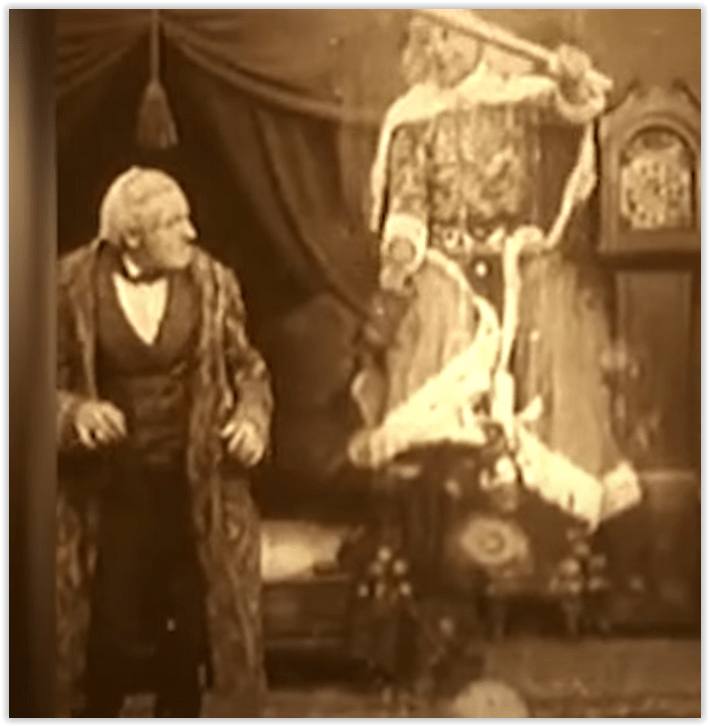
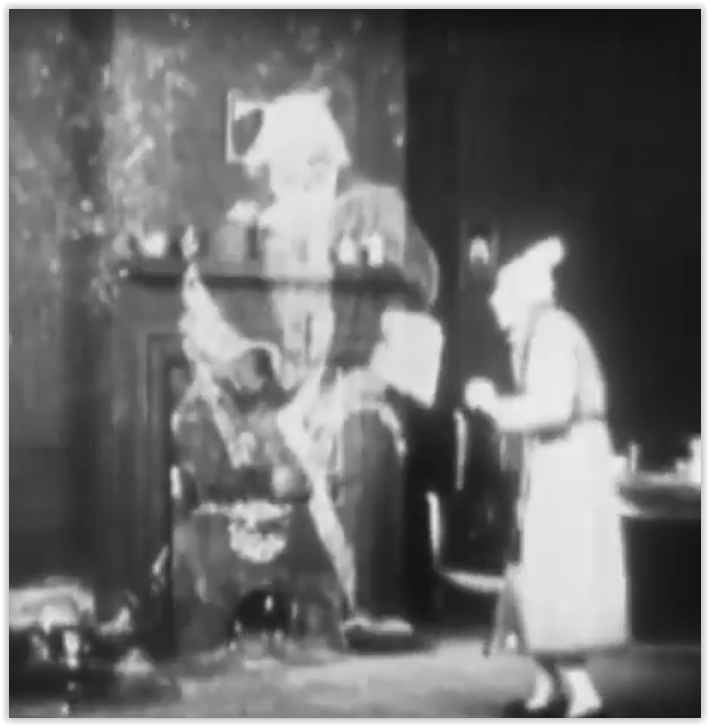
The image of Scrooge in his nightclothes, huddled over his gruel is, for some reason, one of the most constant favorite images from the tale. (Some versions, omitting the melancholy tavern before, make this Scrooge’s whole evening meal.) Most everything else is considered optional, though we do often see Scrooge on the stairs by candlelight. That helps define his isolation in the building. By the way, does anyone know what Dickens had in mind with that hearse he tosses into the description with such reckless abandon? Does Scrooge actually see such a thing? Is it a trick of the shadows? Or is it another touch to emphasize Scrooge’s state of mind? Or what?
Hicks enters a big dark room in which nothing much can be seen, thrusting his stick ahead of him. He moves on to the bedroom. Apprehensive, he jumps at the sight of his dressing gown; even after he has realized what it is, he gives it a poke to make sure. “Humbug!” Stepping into the lumber-room (a sort of back closet to store things for which you have no particular use at the moment, but may have one day), he leaps back when a draft knocks a small box to the floor. Taking the dressing gown, he makes sure the door is locked and then, with the gown across his knees, sits down to start in on the gruel.
Owen enters a house once elegant; there is a broad entryway. It also has a chandelier and decorative sculpture, but has fallen on hard times, to judge by the crates and barrels stowed around the place. The wrought iron staircase drips with cobwebs. He looks behind himself several times, unnerved, apparently, by the background music. Poking up his fire, he takes some cough medicine, licking his fingers afterward. Then he has a quick look around.
Sim I lives in a sparse but nice-looking house, and moves up steep stairs, looking more nervous as the musical background grows spookier. There is also a moan of “Scrooge!” After a few shaky humbugs, he locks his door and sits down to a comfortable bit of gruel, having donned fairly nice slippers and dressing gown.
Narch lives in a one-room flat which is warm, well-furnished, and well-lit: positively cozy. A housemaid has turned down his sheets, set his gruel and tea on the hob, and made sure the bedwarmer is heating by the fire. (Scrooge owns a writing desk on which sits a stuffed raven, adding a touch of Lewis Carrol rather than Edgar Allan Poe.) Before Scrooge enters, the maid opens the window, enjoying the song of carolers outside. Scrooge is abrupt on coming home. The housemaid eventually backs out of the room, starting to wish him “A merry….” “Don’t say it!” he barks. Later he slams the window to shut out the noise of the carolers (does nobody feel the cold?) Time passes, shown in the dying of the fire. Scrooge has changed into his dressing gown and nightcap, and works with pen and ledger. A clock strikes midnight.
Rathbone appears to warm his hands at the fire; there is no gruel in sight. He has donned a brocaded dressing gown with great big buttons and an absurdly high nightcap./
Magoo, sitting by the fire in nightshirt and cap, eats his gruel, and sees Marley’s face among the flames of his fire. “I’m seeing things. Perhaps I do need spectacles.”
Haddrick, in nightshirt and cap, steps into his bedroom, and, hearing a chain rattle, bolts the door. Then he sits by the fire with a candle and his bowl of gruel.
Sim II is passed on the stairs by a ghostly hearse. He mutters, “Hum…humbug. Humbug.” And moves on through the blackness. In a pointed ca[p and nightshirt (and blue socks) he settles by the fire to sup from a large bowl of gruel. He sets this bowl down to warm his hands at the fire.
Finney watches a ghostly hearse pass him, headed up the stairs. The driver sweeps off a high hat and wishes Scrooge a merry Christmas. Reaching his room, Scrooge locks his door and listens at it. He then lights a small fire and sets the free soup he extorted from Tom Jenkins there. When he sits to eat, a puff of smoke billows from the fireplace, accompanied by a cry of “Scrooge!” “It’s humbug still,” Scrooge declares, leaning forward to shout up the chimney, “I’ll not believe it!” He rises to investigate a draft from the window.
Matthau, we are told, gets himself upstairs and goes to sleep.
McDuck is followed up the stairs by Marley who, though invisible, casts a shadow. Marley lifts Scrooge’s hat; Scrooge, poking behind him with his stick, tickles the ghost. Looking back to find only a laughing shadow, Scrooge dashes up to his room. He slams the door and Marley lands against it with a thud. Scrooge locks the door five times and is terrified and someone knocks at it.
Scott moves through a house filled with dark, shiny paneling and dark, heavy furniture. He looks around his bedroom, rather walleyed, not quite believing something is wrong, and not quite not believing it. He locks his door three times. Later, in his dressing gown, he picks up gruel from the hob. After a moan of “Scrooge”< Marley’s face begins to flash from this tile and then that. “Humbug!” is Scrooge’s comment.
Caine’s progress is narrated by Charles Dickens, outside in the snow. “Darkness was cheap, and Scrooge liked it.” Vast impressive shadows surround Scrooge as he mounts the stairs and looks through his rooms. Seeing a figure in the shadows, he knocks it to the floor and strikes at it with his stick, only to find it is his best dressing gown. Fortunately, he admits, breathlessly, that he has done it no damage. Later, wearing it, he sits by the fire, dining on meat and bread.
Curry starts up the stairs with Debit, who hears chains. Later, in cap and dressing gown, Scrooge hears a call of “Ebenezer Scrooge”, locks his door three times, and listens. “Humbug!” Later, seated, he reads through his bankbook again, but it distracted by green rays emanating from one of the fireplace tiles. Moving to it, he finds Marley’s face calling to him. He slaps his bankbook over the phantom face, but it is still there when he looks again. “Go away! I won’t believe it!” Debit barks; Scrooge turns and tell him to shut up. When he looks at the tile again, it is normal, so he hits himself with the bankbook and calls himself a dunderhead. “No such thing as spirits.”
Stewart enters a building with an office directory lettered on the wall by the stairs. He moves up to his rooms and locks the door. A thumping makes him check his lumber-room; he then returns to the door and double locks it. In his dressing gown, he sits down to some very thin gruel. Marley’s face begins to appear in the tiles around the fireplace; the face of one Biblical character becomes Marley’s face and turns to regard Scrooge. Scrooge belches and blames indigestion.
I frankly regarded them with deep suspicion, and I still wonder at the sheer nerve of the hot lunch ladies in preparing such a dangerous dish. And the fact that, for the only time in my life, I was wondered to sit there until I ate that, I never did make my peace with them. Looking back, it’s hard for me to say exactly what it was that set me off.
Anyhow, this is NOT a food blog, so I was not going to write any more investigative reports on edibles after last week’s column which covered, among other things, the history of S’Mores. But the association of campfires and things cooked on sticks naturally brought up hot dogs, and how you should choose your stick carefully (several people die every year from choosing a yew branch; we always had these nifty mid-century hot dog roasting forks of metal and red wood), and just generally how the hot dog is one of the great adaptations of sausage. Hot dog pennies, hot dog pizza, hot dogs in macaroni and cheese, and so on filled the minds of my readers until I wanted to complain about sausage fetishes in a way that would have gotten me banned from the sunlight side of the Interwebs.
And then someone asked “Why are they called Weiner Winks?”
And there I was, practically thrown down a new rabbit hole. For those of you who have not seen these (some people claim it’s a Midwestern thing while others cay it’s common in small towns but never encountered in cities), a wiener wink is a cooked hot dog which has been placed on a slice of American cheese (for the classic recipe, something you have just pulled out of its plastic snood) which has been place on a piece of plain white bread (from a mass-produced loaf) which has been buttered on the outside (NOT the side facing the hotdog.) This bread and cheese shawl is folded up over the hot dog and secured with a toothpick, and then baked until the cheese has melted and the buttered bread is toasty and golden) Some people like to dip these in ketchup or some similar viand (we didn’t HAVE Ranch in my day: that’s how old I am.)
No, they are NOT “Pigs in a Blanket”. These are hot dogs which have been wrapped in bread dough, or packaged crescent roll dough, ro something similar, and then baked. I think these would be superior for dipping, but they are NOT wiener winks.
As to the origin of this epicurean dish, some people trace it back to the 1965 Better Homes and gardens Meat Cookbook, where they are gussied up with chopped onion and, of all things, Parmesan Cheese, and have olives skewered on those toothpicks when they come out of the oven. This goes along with the whole fad for gimmicky party foods, and may be a corruption of an earlier, simpler recipe. (Parmesan? Where I came from, that was available only in green shakers.)
And, as to the name, we must first brush aside those people who claim they are “Weiner WINGS” (because theu look like wings?) and simply smile at people who call them “Weenie Winks” or “Frankfurter Friends” (A late expression of the fad for calling foods More Interesting Names. Has anybody studied Food Fads of the Twentieth Century? Do you know we are still suffering from a fad started by a Chicago hotel in the 1920s for weird salads? Basically anything on a leaf of lettuce could be…but that’s a whole nother blog, and perhaps a whole nother career.)
Anyway, taking easy, reliable ingredients—butter, bread, cheese, hot dogs—and turning them into something wild and wonderful won over the public, and the dish became something of a staple. The name is explained in enough ways to make it clear nobody’s quite sure. SOME claim the shape of the sandwich reminds them of a winking eye (the toothpick is an eyelash, I guess); others say the weiner is winking at you as it sticks out past the bread on each end. One cynical soul suggests the hostess served these at a party with a wink to let guests know SHE knew this was just a hot dog in exotic clothes. When you start delving into the history of any popular recipe, you need boots. The folklore gets deeper on every side the further you go.
I am, as I say, amazed by hot lunch ladies who trusted a group of elementary school kids with a dish involving a toothpick, and I have not forgiven them for their reaction to a kid who had never seen one before and didn’t trust it. But we all seem to have survived. There is no room here to discuss a friend of mine who developed a new variation on the recipe the day she was prepared with hot dogs and cheese and found out too late there was no bread in the house. And she had one of those bratty kids who won’t eat anything new that looks suspicious.
We have examined, from time to time, the pleasure our postcard artists took in the infinite mixings and matchings of romance, but we have been primarily concerned with girth. The artists found other ways to express romance in inches. (Mind. Gutter. Please.)
The tall, thin man and the short, round woman were very popular in this regard. The number of common, everyday phrases which could be used as captions made this very tempting. (I may have mentioned, by the way, that I’m not sure why the woman so often stands on a piece of paper. Could it be a marriage license? A deed to her rich uncle’s farm? Secret blueprints for a new and innovative stepladder?)
Here she’s just rising above her open-heeled shoes. And that’s the long and short of THAT.
“The long and short of it” was a frequent fallback in any picture of contrasts between the heights in a picture, but this puts it all more romantically. This image was popular, and appears on a number of cards with only slight differences in the coloring of the complexions and wardrobes (though the lady always has those stripey socks.)
Sometimes there are variations in girth as well. The tall person doesn’t HAVE to be the skinniest one in the couple.
There are suggestions that the man is the taller creature in these romances to express his dominance. It doesn’t always work that way.
Besides, sometimes the woman is the tall person in these big/little couplings. We’ve gone back to considering differences of width again too, you’ll observe.
Some cartoonists, though, were perfectly happy with the traditional tall and thin vs. chubby and stubby (Here we toss in an ethnic angle just to flavor the joke.)
The point of the joke, though, was contrast. The bigger the difference, cartoonists always believe, the bigger the laugh.
One can’t help wondering, though, at some of these pairings. Could two people who are on completely different levels actually live happily ever after?
With all the other roadblocks life throws in the way of true love, doesn’t such a contrast just add a final, fatal obstacle?
The cartoonists said no. Love would find a way. The most mismatched couple can stride confidently off into the sunset. (By the way, why is the end of his stick…I did say “please”, remember.)
Scrooge took his melancholy dinner in his usual melancholy tavern; and having read all the newspapers, and beguiled the rest of the evening with his banker’s book, went home to bed. He lived in chambers which had once belonged to his deceased partner. They were a gloomy suite of rooms, in a lowering pile of building up a yard, where it had so little business to be, that one could hardly help fancying it must have run there when it was a young house, playing at hide-and-seek with other houses, and have forgotten the way out again. It was old enough now, and dreary enough, for nobody lived in it but Scrooge, the other rooms being let out as offices. The yard was so dark that even Scrooge, who knew its every stone, was faint to grope with his hands. The fog and frost so hung about the black old gateway of the house, that it seemed as if the Genius of the Weather sat in mournful meditation on the threshold.
Now, it is a fact, that there was nothing at all particular about the knocker on the door, except that it was very large. It is also a fact, that Scrooge had seen it night and morning during his whole residence in that place; also that Scrooge had as little of what is called fancy about him as any man in the City of London, even including—which is a bold word—the corporation, aldermen, and livery. Let it also be borne in mind that Scrooge had not bestowed one thought on Marley, since his last mention of his seven-years’ dead partner that afternoon. And then let any man explain to me, if he can, how it happened that Scrooge, having his key in the lock of the door, saw in the knocker, without its undergoing any immediate process of change, not a knocker, but Marley’s face.
Marley’s face. It was not in impenetrable shadow as the other objects in the yard were, but had a dismal light about it, like a bad lobster in a dark cellar. It was not angry or ferocious, but looked at Scrooge as Marley used to look: with ghostly spectacles turned up upon its ghostly forehead. The hair was curiously stirred, as if by breath or hot-air; and though the eyes were wide open, they were perfectly motionless. That, and its livid color, made it horrible; but its horror seemed to be, in spite of the face and beyond its control, rather than a part of its own expression.
As Scrooge looked fixedly at this phenomenon, it was a knocker again.
To say that he was not startled, or that his blood was not conscious of a terrible sensation to which it had been a stranger since infancy, would be untrue. But he put his hand upon the key he had relinquished, turned it sturdily, walked in, and lighted his candle.
He DID pause, with a moment’s irresolution, before he shut the door; and he DID look cautiously behind it first, as if he half-expected to be terrified with the sight of Marley’s pig-tail sticking out into the hall. But there was nothing on the back of the door, except the screws and nuts that held the knocker on; so he said “Pooh, pooh!” and closed it with a bang.
That doorknocker is classic: it is to be found in the very first existing movie Christmas Carol, from 1901. Most versions do fiddle with the hardware, though. According to Dickens, the face of Jacob Marley simply takes the place of the knocker for a moment, without fanfare, and does not move, though the hair stirs a bit. Screenwriters feel the audience expects ghosts to DO something. (And though Dickens does not specify it, a large number like to make the original knocker a lion’s head, which transmutes neatly into a human face.)
Only about half the versions bother to have Scrooge stop at a tavern for supper, preferring to feed him only on gruel from his own hob, which seems likelier for a miser. Hicks and Curry, sixty years apart, do, however, turn this interlude into a major sequence.
Hicks bah humbugs the merry shopping crowds as he pushes through. Of all the miserable taverns visited by all the Scrooges in all the movies, he here walks into the most miserable. He is the only customer, as in some other versions. His meal is intercut with scenes of a linkboy showing Fred home, of Cratchit carrying a goose and what looks like a small tree, and finally scenes of the Lord Mayor’s holiday dinner. There is much humorous seasonal bustle here: preparations in the Mayor’s mammoth kitchen, the arrival of guests, assorted examples of The Poor moving here and there on the fringes of the grand affair. This probably reflects dickens’s mention, earlier, of the Lord Mayor’s Christmas dinner and the little tailor involved in the same sort of preparations. Eventually, the crowd attending the dinner and the poor outsiders beyond the walls all sing “God Save the King”, reinforcing a sense of common identity. Meanwhile, set apart in the tavern, Scrooge orders the waiter to go out and shut up the organ grinder playing “God Rest Ye, Merry Gentlemen.” This is the waiter who grimaces his opinion of Scrooge as the customer departs (certainly without leaving a tip). Scrooge walks through streets thick with fog. A dog barks; we find it to be the blind man’s dog mentioned earlier by Dickens. Scrooge, irritated, snarls back, and moves on to turn in at a small enclosed yard. A plain knocked with a large ring waits on the door; beneath this are the names Jacob Marley (scratched out) and Ebenezer Scrooge. Scrooge looks up just as Marley’s face materializes within the ring. When it vanishes, Scrooge hurries inside and checks the back of the door.
Curry takes his book and his dog to supper, shaking his head at the sight of Bob and Tim on the ice. Debit would stay and play, but Scrooge snarls. A soup seller makes a nasty crack about Scrooge as he passes, and Scrooge scowls at the knot of children—which includes the boy who came to his door earlier—admiring the prize turkey at the poulterer’s. He enters a warm, bright, busy tavern, filled with cheerful Christmas revelers, and orders the cheapest thing on the menu. The waitress decides to bring him more than he asked for, and sings a rowdy, rather “Les Miserables” style song about charity and how year’s end is a good time to look back and see whether you committed any “Random Acts of Kindness”. The point of this song seems to be that if you do charitable deeds without thought of reward, one day you will be rewarded. Nettled, Scrooge sings back a verse about how charity merely encourages the criminal and indolent. He finally leaves, casting aspersions on the cooking, and pushes past a freezing mother and child outdoors. His house is on the street; the door is reached via a short flight of stairs. A gold lion on the door turns into Marley, startling Scrooge, who trips over Debit. When Scrooge has gathered himself again, the knocker is a lion. Scrooge whacks it with his cane to be certain.
Three versions do without the doorknocker entirely. (On radio, where the doorknocker scene might have presented difficulties, Lionel Barrymore always saw Marley’s face in the fireplace as he ate his gruel.)
March leaves the counting house after Cratchit, pinning his coat shut at the throat and nearly forgetting his money-box. The streets are dark and deserted, the weather much worse. We do not see his front door.
In Rathbone, the narrator tells us that Scrooge went home to bed, explaining that Scrooge lived in chambers that belonged to his late partner. Though we do not see the doorknocker, Scrooge is looking back over his shoulder as he enters. “Ah, humbug!” he growls.
Haddrick walks home past the cemetery we saw earlier. He lives in a rather mean brick building on the corner of the block. His doorknocker is a lion, which does absolutely nothing.
Owen uses both the tavern and the doorknocker. His tavern is empty and cheerless; he bites his change before accepting it, and, in departing, is grimaced at by the waiter. On his way home, he knocks the hat out of the hand of the director of a group of street carolers. Entering a small enclosed yard, he opens his front door and sees a new face superimposed on that of the gargoyle on his knocker. He trembles violently. “Marley!”
Sim I is avoided by the blind man’s dog and goes to a fairly cheap tavern. In the course of his meal, he calls “More bread!” “Ha’penny extra, sir,” says the waiter. There is a pause. “No more bread.” When he reaches it, his front door is at street level. After a call of “Scrooge!”, Marley’s face is superimposed over the decorative knocker. “Jacob Marley,” Scrooge says, making a statement, if one of disbelief. He hurries inside, pauses, and looks back at the door once more.
Magoo has a short walk to a door on which a white lion doorknocker suddenly becomes Marley’s face. Scrooge polishes the face away with his handkerchief, but is still unnerved by it. “Very strange. Could I need spectacles?”
Sim II is avoided by the blind man’s dog; the narrator delivers a few lines from earlier in Dickens about how Scrooge kept all mankind at a distance. It is very foggy; only Scrooge and one streetlight can be seen, emphasizing his isolation. A pale lion doorknocker turns into Marley’s face while Scrooge’s gaze is diverted. When Scrooge does see this, he declares, “Jacob. Jacob Marley.” With a shudder, he hurries indoors.
Finney enters a lonely quarter and walks up to a door with a blackened metal lion doorknocker wearing quite as nasty an expression as Scrooge himself. While Scrooge has his key in the lock, he looks up to see the lion change into the face of his late partner. Its eyes open slowly, and it says “Scrooge” before becoming a lion again. Scrooge goes inside, several times looking back at the knocker and checking the back of the door. Finally, he declares “Humbug!”
Matthau locks up his money, after finding himself a coin short and resolving to dock Cratchit’s next payday by that amount. On his way out, he addresses the sign outdoors, telling Marley that Marley is lucky to be dead as a doornail and no longer burdened with Christmas. He admits that he is lucky as well, no longer having to share his profits with Marley. On his way home, he gives more evidence of his nature by cheating a match girl, chasing away a newsboy (and picking a newspaper out of the garbage), eating a meagre supper, and, when the waiter reaches for a tip, handing him the spoon. B.A.H. Humbug and a chorus of cats and dogs in the street sing the title song “The Stingiest Man In Town” through all this. When he reaches his house, it is shrouded in fog, looking fairly shabby. Humbug tells us Scrooge had to grope with his hands in places, and tries to improve on the “Genius of the weather” by suggesting that all the fog and frost made it seem “as if Death sat in meditation on the threshold”. He also informs us that the doorknocker suddenly turned into Jacob Marley. The doorknocker has a fairly unfriendly human face to begin with; it now becomes a grinning, gaping demonic ghoul rather in the style of EC Horror comics. Scrooge cries out that the man “has been dead these seven years! Oh, why have you come to haunt me? Away! Go away!” It returns to its previous sullen condition. Peering at it, Scrooge decides, “Just my imagination. Bosh! Ghosts! A lot of humbug!”
McDuck leaves his office at nine and trudges through streets filled with snow; everyone else seems to have gone home. At a brick house, a large gold lion doorknocker becomes Jacob Marley (Goofy), and wails “Scrooooooge!” “Jacob Marley? No! That can’t be!” To prove this, he reaches out and pinches Marley’s nose; when the spirit yelps, he rushes indoors.
Scott walks down a dark, lonely, foggy lane, fenced in so there is no way to escape when a hearse pulled by four horses drives up behind him. He does not seem to hear the approaching team, but he does catch a faint cry of “Ebenezer Scrooge!” When he turns to look, he sees no one, and the hearse and team are now in front of him, vanishing into the fog. His home sits on an utterly deserted, ramshackle part of the warehouse district, a place no one with sense would enter after dark. He moves into a small enclosed yard. The gold lion on the door calls his name; then Marley’s face is superimposed on it. This phantom is quickly gone. Scrooges moves inside, locs the door, and lights his candle.
Caine’s house is on a dark and lonely street; his door sits just two steps up. The decorative knocker stretches and shifts to become a face. “Jacob Marley?” The face howls, scaring Scrooge’s horse. When Scrooge looks again, the face is a knocker once more. “Humbug!” he declares, and marches inside.
Stewart walks through a lonely street sparsely splotched with snow. His door is four steps up from street level. The ring of the decorative knocker widens to encircle Marley’s face; it wails. Scrooge, deadpan, is stunned. “Jacob. Jacob Marley.” The ring narrows and the face is gone. Scrooge looks around to see if someone has been playing some sort of prank, and concludes “Humbug.”
FUSS FUSS FUSS #6: Bah!
No matter what else you do with A Christmas Carol—set it in the Las Vegas Strip, produce it underwater, convert it into an episode of this winter’s hottest sitcom—there is one inviolable rule. Scrooge must at some point say, or attempt to say, “Bah! Humbug!” Scrooge without his Humbug would be like Sherlock Holmes without his Elementary, Spock without his Fascinating, or Santa without his Ho Ho Ho.
This being an era of statistics, I have attempted to track down how much this expression is used, lest it be like Sherlock’s Elementary,. More used by the movies than the original. You’ll notice, for example, in Dickens’s rendition of the doorknocker sequence, he actually says “Pooh, pooh!”
My census gives us, in the original:
“Bah! Humbug!” twice, within moments of each other.
:It’s humbug still!”
“Humbug!”
“Humbug, I tell you—humbug!”
“Hum….” He lacks the strength of will to finish the word.
Scrooge uses the phrase not at all in the second half of the story, making it a feature of the original, unrepentant Scrooge, a phrase for anything he doesn’t understand, doesn’t wish to see, or simply doesn’t like.
It’s a less easy trick to sit through movies counting humbugs, but such things must be attempted. The census put the Screen Scrooges in this order of usage.
Sim II gives us three humbugs and one bah humbug.
Caine has three humbugs and a bah humbug.
Stewart gives us three humbugs and an “Ah, humbug!”
Rathbone delivers a bah humbug, two ah humbugs, and one humbug.
Sim I gives us five humbugs, and delivers one very late in the show, cheerfully calling his own reflection in a mirror that after his reclamation.
Hicks has five bah humbugs and one “Hum….”
Curry uses four humbugs and two bah humbugs; he is one of the Scrooges who delivers the latest humbug of disbelief, saying it to the Ghost of Christmas Present.
Finney gives us six humbugs and one “Hum….”
McDuck delivers three bahs, four humbugs, and one bah humbug.
Haddrick gives us four bahs, four humbugs, and two bah humbugs.
Magoo produces seven humbugs and two bah humbugs.
Owen uses one bah and nine humbugs.
Matthau similarly has one bah and nine humbugs (plus the character of B.A.H. Humbug.)
Scott declaims one bah, eight humbugs (two of which are used toward the end, to describe his former self) and one iconoclastic “Humbug…bah!”
March makes use of seven humbugs, two bah humbugs, and one ah humbug.
Okay, I’ll say it out loud and get it over with. I have never, in all my life, eaten a genuine S’More. First off, a REAL S’More must apparently be cooked over an open fire, preferably on a camping trip, and camping trips were not part of my childhood. (My mother, offspring of a Boy Scout Leader and a Girl Scout Leader did so much camping in her childhood that she swore off it once she was old enough to decline.) My mother DID indulge us in letting us toast marshmallows over candles, but we may never have had the other two ingredients required.
The S’More is a folk recipe, invented, it seems, by Boy Scouts. Anyway, the first S’Mores recipe, which called them “Graham Cracker Sandwiches” and was published in an undated booklet from Campfire Marshmallows in the 1920s, attributes the recipe to Boy Scout tradition. (S’Mores must be considered a Great American Recipe since it consists of three ingredients, all primarily available as packaged foods: marshmallows, graham crackers, and candy bars. And how much of a coincidence is the name of the fine old marshmallow company that first printed the recipe?)
Half the fun in a lot of folk recipes is the occasion, the gathering, the whole process of making the recipe (a fact apparently lost on all the S’Mores cereals, candy bars, and other products which have emerged during the current burst of popularity.) The ingredients were handy and somebody who was having fun decided to play around with them. Who DID first toss a slice of cheese on a hot hamburger: some tired cook in a diner or some goofball kidding around at a campfire?
Consider, for example, what my piano teacher called “Stomach Ache Medicine” (she called it that because it was guaranteed to give you a stomach ache; must’ve been a family joke.) This was a personal recipe for a snack food with origins lost in the ists of time. It started with corporate marketing, but then what?
Breakfast cereal was a new and radical idea at the turn of the last century. Breakfast was supposed to be a leisurely meal involving appetizers, main courses, and sides, as well as dessert. A farm breakfast might include potatoes, pancakes, fried meat or one or three kinds, and pie for dessert. It was the health food folks who started suggesting a hearty bowl of cereal with toast and orange juice instead. Breakfast cereal was invented about the same time as modern marketing, and the rest is history.
But corporate America did not become what it is today without hedging its bets. Cold cereal (also marketed as ready-to-eat cereal because, unlike oatmeal or Cream of Wheat, it required no cooking) was marketed for other purposes as well. I stare at the advertisements showing people serving a side dish at dinner composed of a large Shredded Wheat biscuit covered with gravy. The custom of topping casseroles with crushed Corn Flakes must date from around the same time.
But someone discovered a box of cereal also provided a ready snack: the only thing in the kitchen, once upon a time, which was just “Open and Eat”, without even having to add a plate. Since breakfast cereal in those days was largely unflavored, though, it did lack a little something. So someone, realizing the difference between Puffed Rice and popcorn was just one of perception, started heating it up with a coating of butter and whatever seasonings were desired.
Corporate America caught on to this, and at some point in the early 1950s, Ralston began printing a recipe for “Party Mix” on the sides of its Wheat Chex and Corn Chex boxes. They pushed this so well (besides having a cereal that worked very well with the recipe), that the result became known as Chex Mix. That poor, deprived generation had to make its own batches though, using their own or Ralston’s recipe, because it was not until the 1980s that somebody said “Hey, why not sell it pre-packaged? That might cut back on sale of cereal, but it’s all money coming in!”
Like S’Mores, though, it’s the most fun to make your own. You can toss in almonds instead of bagel chips, or shove a gumdrop into your marshmallow before S’Moring it. If it’s going to be YOUR stomach ache, customize it all you want.
Today, we are going address unfair animadversions against human qualities. I realize that this material has been presented from other angles, but bloggery can be a haven for unpopular viewpoints. Why don’t people speak more pleasantly about
WRATH: Despite its popularity on social media, recognition of this as a major virtue goes back generations. The evidence is simply this: if you truly care about something, disrespect for it MUST make you angry. The focal moment of Network—“I’m mad as hell and I’m not going to take this any more!”—is the moment at which we are shown how virtuous wrath is. The number of politicians who have made mighty careers based on fanning people’s wrath is massive, and our politicians have always been champions of virtue.
AVARICE: And what about “Greed is good”? The great measurement of success is the amount of money something made. A movie is no good without blockbuster box office receipts; the fact that a great invention is nothing if no one wants to pay money for it was a lesson learned by the young Tom Edison, who vowed never again to spend his time on anything that wouldn’t make him rich. Some people have called this the greatest of all American values, but as I look over the rest of this list, I’m not so sure about that.
SLOTH: How many major industries tell you to take all that money you’ve made and spend it on taking life easy? We look on aghast at people who put in seventy-hour workweeks, using up their lives moving from job to job or project to project without ever contemplating a few months spent stretched out on a beach. At heart, we are told, all of us are really working for the weekend, and what is so normal must be a virtue.
PRIDE: Check the calendar. I’m sure it’s Something Pride Week, be it Freckle Pride Week or Moravian Pride Week, with a parade and forty YouTube videos in its honor. It started as a cure for people who had been made to feel ashamed of being a redhead, or being from a low-rent part of town. Now we must be loud and proud of whatever we are, with the accent on the loud, and those of you who aren’t can go slink off to a corner somewhere (unless you at LEAST carry a banner for us.)
LUST: Once upon a time, Jimmy Carter got into trouble for admitting to Playboy magazine that he “lusted in his heart.” That was then. Now, if you haven’t been loud and proud about whom you lust after, the world is suspicious. We assume that everybody normal is lusting after something or somebody else; for a while audiences fell silent as a stand-up comic identified as “inary—because I usually just have sex with myself.” But then it was decided that as long as he WAS lusting, it still counted as normal.
ENVY: We all want what other people have; this is partly our nature and partly because society at large is built on advertising to let us know what we don’t have yet. Wanting something because it is new, or expensive, or because Kumquat Kardashian has two of them is the way life was meant to be. If you are content with what you have, you’re not only suspicious but guilty of sabotaging the economy.
GLUTTONY: Unless, of course, you simply want a lot more of what you already have. We still all super-size things, even if that has been dropped from the vocabulary of fast food joints who took so much grief for using the phrase. I, personally, still react with a shudder to the memory of the time I bought something, was told they were having a two-for-one sale so I could get another one, and replied, “No, I just want one.” I have friends who reconsidered being seen with me for a long time after that.
All I’m saying, I guess, is give the Seven Deadlies a chance. “Sin” seems such an unnecessarily derogatory term for the qualities which make up modern life. We should be Proud to be upholding our end of the bargain. Anyway, I intend to exercise my Pride in my virtues by going off now to take that nap I earned. After I take care of Sloth, it’ll be time for dinner, so there’s Gluttony. If I’m Envious that someone else has even more pizza, that takes care of too more. As for how I handle Lust and Avarice after that…well, I guess we’re out of space right now, so you can’t check my Personals ads over on….
At length the hour of shutting up the counting-house arrived; with an ill-will Scrooge dismounted from his stool, and tacitly admitted the fact to the expectant clerk in the Tank, who instantly snuffed his candle out and put on his hat.
“You’ll want all day tomorrow, I suppose?” said Scrooge.
“If quite convenient, sir.”
“It’s not convenient,” said Scrooge, “and it’s not fair. If I was to stop half-a-crown for it, you’d think yourself ill-used, I’ll be bound.”
The clerk smiled faintly.
“And yet,” said Scrooge, “you don’t think ME ill-used, when I pay a day’s wages for no work.”
The clerk observed that it was only once a year.
“A poor excuse for picking a man’s pocket every twenty-fifth of December!” said Scrooge, buttoning his great-coat to the chin. “But I suppose you must have the whole day. Be here all the earlier next morning!”
The clerk promised that he would, and Scrooge walked out with a growl. The office was closed in a twinkling, and the clerk, with the long ends of his white comforter dangling below his waist (for he boasted no great-coat), went down a slide on Cornhill, at the end of a lane of boys, twenty times, in honour of its being Christmas-eve, and then ran home to Camden Town as hard as he could pelt, to play at blindman’s-buff.
There is little more indicative of Scrooge’s nature than a delicious “You’ll want all day tomorrow, I suppose?” Most screenwriters can’t resist it, and any actor playing Scrooge who doesn’t insist on full stage during it just isn’t taking advantage of the role.
Note that Dickens’s Scrooge takes it for granted, albeit crankily, that he must give Bob some time off, and pay for it. In two versions, Cratchit gets nowhere near that kind of understanding.
At 5 P.M., Matthau says he supposes Bob will want the whole day tomorrow. “I didn’t think I’d have to ask for it, sir. It is Christmas, sir.” “A poor excuse for picking a man’s pocket every twenty-fifth of December,” Scrooge snarls, but then goes on to work himself up into a tearful state about having to pay a whole day’s wages for no work when business is so bad. In spite of B.A.H. Hum bug’s warning, Cratchit weakens, and finally says he doesn’t need that day’s pay. Scrooge brightens at once. “First sensible thing you’ve said all day. Be here all the earlier the day after. Now, be off with you.” Bob moves out, groveling a bit more as he does so. “Oh yes, sir. Thank you, sir. Merry Christmas! Sorry, sir. I know, sir. Bah humbug, sir. Said it with you, sir. Good day, sir.” He then slips and falls in the snow. “Fool!” mutters Scrooge.
McDuck puts this right after the coal scene, to continue the persecution of Bob Cratchit. Bob here asks for only half a day off, and gets it, but loses half a day’s pay into the bargain. We learn that he has been paid two shillings a day until three years ago, when he started doing Mr. Scrooge’s laundry, and was raised to two shillings ha’penny. Scrooge tosses him another bag of shirts. Later, as night falls, Cratchit hears the clock strike seven and cheerfully closes his book. Scrooge casually checks his pocket watch. “Two minutes fast.” Bob jumps back onto the stool and re-opens the book, but Scrooge grants him those two minutes off. “Oh, thank you! You’re so kind!” “Never mind the mushy stuff! Just go! But be here all the earlier next day!” (Hmmm?) Bob wishes him a merry Christmas in leaving; Scrooge growls “Bah!” Scrooge himself does not leave the office until nine P.M.
In Owen, this sequence is a turning point in the plot. Cratchit here actually puts an ear to the clock to make sure it’s still running. At 6:30, Scrooge catches him checking the time again. “You keep close watch on closing time.” Bob replies that it is a half hour past closing time. “Then close up, close up!” Scrooge barks. “Don’t work overtime! You might make something of yourself!” As they move through the dialogue about the whole day off, Scrooge takes a sharp, scolding tone, and concludes with “Then be off!” Bob lingers, finally having to remind Scrooge that his wages fall due today. Scrooge grumbles about people who can’t wait to spend their money, but does count out the coins. Cratchit departs. Scrooge spots the bottle of port Fred left behind and is about to throw it away when he realizes there is some left; he slips the bottle into his tail pocket. Outside, in place of the ice-sliding scene, Bob becomes the target of a volley of snowballs. He takes this in good spirit, and rushes over to show the young rascals how to make snowballs. There is a call that a man in a tall hat, traditional target for rascals with snowballs, is coming. Bob lets a snowball fly with deadly accuracy, realizing too late he has just knocked off his employer’s hat. Running to retrieve it, he is too late; Scrooge’s hat has been run over by a passing carriage. Bob is summarily dismissed. The clerk summons his courage to point out that his contract allows him a week’s notice; Scrooge snaps that that week’s pay will do to buy him a new hat. No, in fact, that hat cost more than a week’s wages for the clerk, so Bob owes him an additional shilling. Bob pays him and Scrooge stalks off. The boys apologize to Cratchit for getting him into trouble, calling Scrooge an old stinker.
Two other versions bring Tiny Tim to the office for a first meeting with Ebenezer Scrooge. Scott is leaving for the exchange when he has the discussion with Bob about having the whole day off. On his way out, he growls at Tim, whom he thinks is a beggar; Tim replies cheerfully, and waits outside for his father. When Bob finally does reach closing time, Tim asks if they can go home by way of Cornhill, so he can watch the boys and girls gliding and playing in the snow. Bob agrees to this, and tells Tim about having tomorrow off. “Hurrah for Christmas!” cries Tim. They watch the children play; Bob tells Tim that he’ll be doing that himself soon. Tim says he is sure he’s getting stronger every day.
Curry’s Cratchit blows out his candle as the clock strikes seven. A small boy enters the counting house; Scrooge, thinking this is another beggar, prepares to strike him with a walking stick. Cratchit’s dives to stop him, explaining the boy is Tim Cratchit. Scrooge was unaware that his clerk had a family, and notes, “He’s awfully…Tiny.” While Bob and Scrooge discuss the day off, Tim gets acquainted with Debit. The dog, dubious at first, warms to the boy. Scrooge snuffs out the candles, setting one in his pocket to use at home. Dismissed, Bob tells his employer “And a very merry…er, merry evening.” Bob and Tim leave; Debit is sent to put out the rest of the lights.
Versions which do not materially change the scene still add their bits of business. Scrooge’s belief that Cratchit is leaving early, the fact of payday coming around, and Cratchit’s pause to wish, or not wish, his employer a merry Christmas become almost standard.
Hicks is upset to see Cratchit blowing out his candle while the clock is still striking seven; he reminds Bob that this clock is fast. They move through the dialogue as Bob helps Scrooge on with his coat. At the end, for one fleeting moment, it seems as if Scrooge might give Bob some little gift of the season. He is merely reaching for the key, so Cratchit can do the locking upBob wishes his employer a merry Christmas; with a “Bah! Humbug!”, Scrooge marches out, giving not so much as a glance to the beggar on the street. Bob locks up and walks out among the jovial crowd. When he sees the boys sliding, he has one go at it himself before hurrying home.
Sim I checks his pocket watch, closes his book, deliberately closes and sets away a bag of money, and turns down the lamp, all without a word. Cratchit fetches Scrooge’s coat; during the discussion of the day off, he tries to excuse himself. He’s asking for the time off just for the sake of his family, who :put their hearts and souls into Christmas, as it were, sir.” “And their hands into my pockets, as it were, sir!” When finally granted the day, Bob says “Thank you, sir. It’s more than generous of you.” “Yes, I know it is. You don’t have to tell me.” Bob wishes him “Merry Christmas, sir.” Turning, Scrooge demands, “Merry Christmas, sir?” and moves to the “I’ll retire to Bedlam” speech, with a chuckle of contempt. After he has departed, Bob joyously locks up.
March is told by his clerk, “It’s six o’clock, if you don’t mind, sir.” March snaps at him about having the whole day. After they have performed a shortened version of the scene, Bob turns for the door. He pauses there, as if to wish Scrooge a merry Christmas, thinks better of it, shrugs a little, and moves on out.
Having disposed of Fred, Rathbone barks, “Cratchit! Time to close up! And don’t forget to put your candle out!” He shuffles on his coat, and then steps out to stand nose-to-nose with his clerk to deliver “You’ll want all day tomorrow, I suppose.” They perform the dialogue much as written; Cratchit even smiles faintly when he’s supposed to. Scrooge concludes the scene, taking himself off with a “Merry Christas! Bah! Humbug!”
Magoo observes that it is closing time, and adds “We’ll finish tomorrow.” “Oh, but sir,” says Cratchit, “Tomorrow is Christmas Day. I have a holiday tomorrow.” Scrooge squints at him. “You’ll want all day, I suppose?” “Oh, yes, sir. Please, sir. You see, I….” “I know!” Scrooge snaps. “It’s Christmas! Oh, Lord help us. The whole population is mad!” He has been having trouble fixing his scarf; he now pushes Cratchit away, cutting off Bob’s attempts to help. “Fool! I’m quite capable!” As Scrooge stalks out, Bob calls “Merry Christmas to you, sir!” “Christmas! Ha! Bah, humbug!” Scrooge slams the door and turns to address it. “Merry Christmas! Out upon Merry Christmas!” and declaims that bit about every fool being boiled in his own pudding, and so on.
In Haddrick, we watch the gaslights being lit. Once Cratchit has been through the usual dialogue, and achieved his day off, he leaves quickly, kicking up his heels with a cry of “Tally-ho!” He enjoys a goofy bit of business with an organ-grinder’s monkey.
Cratchit helps Sim II don a coat through the dialogue. They leave the building together. We can see clearly that Scrooge is taller and wider of shoulder than his clerk.
When the clock strikes, tinnily, a smiling Cratchit moves to Finney to announce, “It’s seven o’clock, sir.” There is a long pause before Scrooge replies, not looking up, “Correct, Cratchit.” Cratchit does not like to be impertinent, but he would appreciate receiving his wages. The trouble with Cratchit, Scrooge declares, is that he thinks only of pleasure and of squandering money. “You’ll be wanting the whole day,” he continues, and they move through the written dialogue. Scrooge closes the discussion by stating that he does not pay good money for Cratchit to be forever on holiday. “I appreciate your kindness, sir.” “It’s my weakness. I’m a martyr to my own generosity. Give you one Christmas Day off and you expect them all.” “Merry Christmas, mr. Scrooge.” “Be gone from here and take your infernal merry Christmas with you.” “:Beg your pardon, sir. No offense, sir.” Finney closes with the “I’ll retire to Bedlam” speech.
Cratchit enters Caine’s office to explain that it is closing time. “Very well,” says his employer, “I’ll see you at eight tomorrow morning.” Pushed to it by the bookkeepers, Cratchit points out, “Sir, tomorrow’s Christmas.” Scrooge acknowledges this, saying “Eight-thirty, then.” Gathering his courage, Cratchit suggests rhat half an hour for Christmas hardly seems customary. “How much time off is customary, Mr. Cratchit?” Bob’s courage is flagging, but he swallows and replies, “The whole day.” When Scrooge demands “The entire day?”, the bookkeepers back off, murmuring about that being a mistake of Cratchit’s. But Bob persists. Everything else will be closed, he informs his employer; there will be no one to do business with. Opening the office will merely waste valuable coal. “It’s a poor excuse for picking a man’s pocket every twenty-fifth of December,” grumbles Scrooge, dashing everyone’s hopes. “But as I seem to be the only person around who knows that,” he continues, “Take the day off.” The bookkeepers cheer him until he barks at them to stop it. He departs, and Charles Dickens explains, in credibly Dickensian dialogue, that the bookkeepers can now enjoy their holiday. The musical number “One More Sleep ‘til Christmas” accompanies the closing of the office and their participation in a penguin party, which involves a lot of sliding on the ice. We close with Cratchit looking at the moon and stars; just back of him we see the little caroler from the previous segment, who sits, teeth chattering, in the shelter of a heap of trash.
Stewart finds the clock striking seven as he returns from chasing the carolers. Without a word, he fetches his coat. Almost reflectively, he begins the discussion of the next day’s work; he becomes fierce as the dialogue continues. Cratchit does try to smile on “It’s only once a year, sir.” At the end, departing, he says “Merry….” Before remembering where he is. Scrooge turns on him, alert for weakness. “You were about to say something, Cratchit?” Bob smiles in an ingratiating way. “Nothing, sir.” With a sneer, Scrooge marches out.
INTERLUDE
In Owen and in Finney, we find this section followed by episodes in which Cratchit shows a little of what he is like outside the office.
Fired by Owen over that incident with the snowball and the hat, Bob walks morosely through the streets. He gradually notices that the man walking ahead of him is carrying a freshly killed goose over his shoulder. The way the goose’s head sways back and forth as the man walks fascinates Bob, who starts to laugh and ends by wishing everyone a merry Christmas. Those within earshot return the greeting, and he jumps to complete his errands. He has what’s left of his wages, and he has a shopping list, and Christmas is coming.
Laden with his own goose, apples, lemons, potatoes, oranges, and hot chestnuts, he struggles through the little door of his house. Mrs. Cratchit is thrilled to see him, and the children, dressed for bed, rush to see what he has brought. They take turns guessing what’s in the big bundle, but no one gets it right until Bob has unwrapped it to display the goose. The children rush to stroke the bird.
“Go to the fire and have a warm, Bob,” says Mrs. Cratchit. “Did you get the day off for the holiday?”
“Without hardly any trouble at all.”
“Wasn’t Mr. Scrooge angry?”
“Well, you might say he was and you might say he wasn’t.”
“Meaning what?”
“Meaning I got the day off and we don’t want to talk about Mr. Scrooge tonight.” He then calls the children over to share out the hot chestnuts in his tail pocket.
In Finney, Bob comes upon his youngest daughter, Cathy, standing with Tim peering through a window at some mechanical toys. (Mechanical toys seem to say “Victorian Christmas: to filmmakers.) He apologizes for being late. “Mr. Scrooge and I had a lot of last-minute business to attend to.” Then he asks which toy each child likes best.
Cathy at once chooses the doll in the corner, but Tim won’t budge from the statement that he likes them all. “You said I couldn’t have none of them, so I might as well like ‘em all.” His father tells him he is a philosopher and a gentleman.
Bob now reveals he has fifteen shillings in his pocket, thrilling the children. They move on to buy supplies, to a song about the joy of being young during Christmas preparations. Everything Bob buys is contrasted with what someone richer is buying nearby. Bob purchases “mystery presents” wrapped in brown paper, four for a shilling, from a man dressed as Father Christmas. This man knows Bob has five children, and slips in an extra for free as another shopper staggers out of a store with huge presents wrapped in shining paper. Bob buys apples from a street vendor while a customer in the fruiterer’s shop is choosing oranges and pineapples. A man is buying fine wine (the 1846 vintage, specifically) while Bob fills a bottle from a keg, so as to have the basic ingredient for Christmas punch. “Christmas punch is a Cratchit specialty.” They also pay fourpence for a ready-made pudding.
Reaching home, they find it well-decorated. Mrs. Cratchit wants to show off what she and the older children have been doing. As Bob reaches to light another candle, the scene shifts to Scrooge blowing out his own candle.
Spring is here now, more or less. (One forecaster spoke of snow this weekend, but it IS only April.) It is the time of year when folks start getting out on their boats again. And seasonal though they might be, boats were regarded with just as much joy by postcard cartoonists as cars.
The joy of getting out on a boat, be it a vessel of your own or something larger where you were only a passenger, is celebrated on many cards. The images of sailboats against a serene sky are legion, and the photographs or even reproduced paintings of great ships under steam or sail are to be found everywhere.
But we spoke of cartoonists, who were paid to show off the misadventures of the poor dub who could not ride a bicycle without running over hapless pedestrians. So what could be expected of them when they went a-sailing?
Well, one thing above all else, really. This was an age, if you’ll recall from previous bloggery here, that did not shy away from the suspense of having just consumed Cascarets or castor oil or some other high powered intestinal cleansing agent.
So the enjoyment of wave-induced motion sickness was a constant.
It was so common a phenomenon, at least on postcards, that it brought new meaning to old phrases.
Take, for example, “fellow traveler”.
We regard our ancestors as being rather squeamish, afraid to mention or even suggest certain body functions. I am sure those of us who have been through the exploration of, say, chamber bot postcards have learned better. Well, they were the same way about the side effects of seasickness.
They might be restricted by postal authorities in what they could SHOW, but what the could suggest about the plight of people on a boat was less limited.
These postcards were not just printed and put out for sale (the pun just slipped out, if you’ll pardon the expression) but were actually sold and mailed. So among our ancestors there were those who really enjoyed these jokes. (Now I think I must conclude and go lie down for a while. WHICH generation is squeamish?)
One of the questions which comes up in considering of old-time comedy is “Why that?” Why do some things come up in jokes more than others? As noted hereintofore, we have plenty of cartoons about dogs peeing and horses pooping: how did we decide THAT was funny, when each animal obviously does both? Customer demand must have had something to do with it, but that just switches the responsibility for the attitude to the buyer instead of the seller.
Multiple births have been a source of wonder and humor for generations. Identical twins confusing their friends have been plot material for stage humor since well before Shakespeare; the trials and tribulations of parents dealing with duplicate children is an ancient theme. (Heard the one about the parents who named their identical twins Kate and Duplikate? No? How about the ones who named the kids Pete and Repete? I’ll stop now.)
But as I check through this inventory of postcards for sale, I find that though the postcard companies considered twins funny, they found triplets MUCH funnier. And quadruplets hardly appear at all? What determined the number that was funny? Two is good, three is better, but four is too much?
Maybe, as in the case shown above, it deals with a parent having only two arms to prop the babies on. That’s just enough to cause trouble. (Although the same sort of joke, when applied to entire families, seldom had fewer than four children, of different ages so some could be standing up to get into higher mischief while their crawling young siblings took care of disaster below.)
Or was it simply easier to fit three babies into the picture, and any more would have complicated things for the viewer? You want a scene where the main joke is clearly detectable, and not littered with distractions. (Sorry.)
The joke was a perennial one, not limited to the cards issued before World War I seen in the first part of this triple-header (no, really, I’m going to stop these.) This postcard is from a later generation, probably in the late 1930s.
While this one takes the situation into the 1950s or thereabouts.
Note that Mom appears in only a couple of the cards. That’s another convention of cartoon humor. Somehow, fathers dealing with squawling, disobedient, or simply numerous children was considered funnier than mother doing the same thing.
There seems to have been a sense, in the background of these jokes, that not only was Dad less likely to know how to handle kids, but that he was also responsible for the size of the delivery. As seen several times above, Papa is frequently dismayed at the outcome.
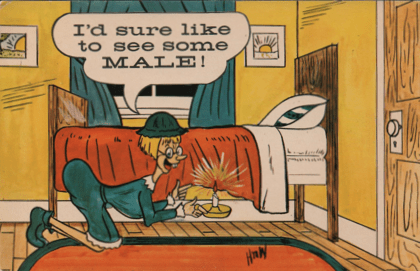
While others, like this big time gambler, are gratified by their winnings. Or maybe this is a CEO, taking pride in the efficient production at the home office. Perhaps so dedicated to thorough bookkeeping and liked his daughters in triplikate. (Enough, as the dads above might say.)