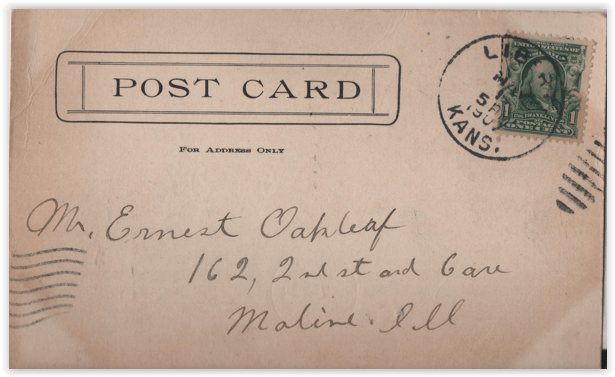
When we mail a letter, we do not have to write LETTER on the envelope. Our packages may have notes on them about Media Mail or International Ground, but we don’t need to label them PACKAGE. Still, postcards go right on explaining to people what they are, with the word POSTCARD (or sometimes the words POST CARD. But that’s a whole nother blog.)
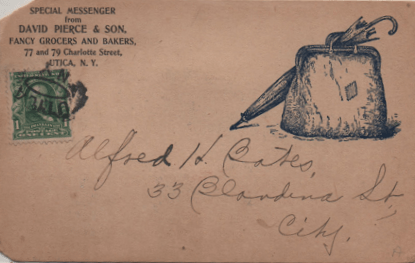
It was not always thus, as can be seen from this advertising postcard from 1894 or thereabouts. A card could be plunked in the mail and left to the wise decisions of the U.S. Post Office.
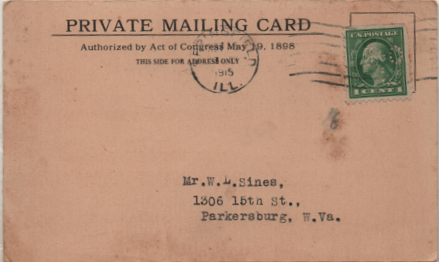
This was way too simple for the government, however, and in 1895, a law was past allowing people to send postal cards OR private mailing cards. (This one, from 1915, is from long after most of us stopped using Private Mailing Cards, but some companies like to do things the same way year after year without a lot of contradictions or concerns.)
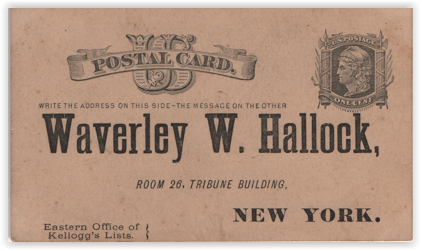
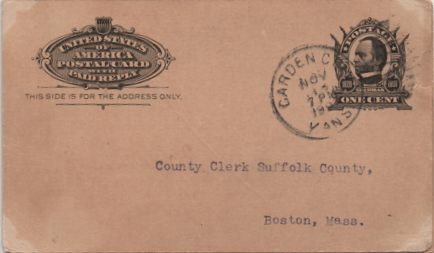
A Postal Card was an official U.S. Post office publication, and cost a penny when purchased at your local post office. This covered the price of the card AND postage, whereas a Private Mailing Card (or Post Card, as it came to be known, in the belief that someone at the post office would be able to tell the Post cards from the Postal cards) cost TWO cents. This is the kind of strategic thinking which has made Congress the guiding light of American Wisdom.
Postal Cards also came with the postage (which you’d already paid for) printed on it, which led to numerous designs honoring this or that president. (This was at a time when most of our postage stamps had either Benjamin Franklin or George Washington on them, so it allowed for variety.)
There were also special Postal Cards which could be purchased with prepaid reply cards, if you wanted to make sure your customers replied.
OBVIOUSLY, to help the Post Office know what they were dealing with, U.S. Government Postal cards SAID they were Postal Cards, and Post Cards had to follow suit. Since the postcard craze spread around the world in no time at all, and other governments were as picayunish as our own, some companies made sure their cards were labeled in more than one language.
Ambitious companies going for wide international sales went further. I think my record so far is one card which had the word in twenty-four different languages, an important thing in the era before World War I when a card might cross several different language areas without ever leaving, say, the Austro-Hungarian Empire.
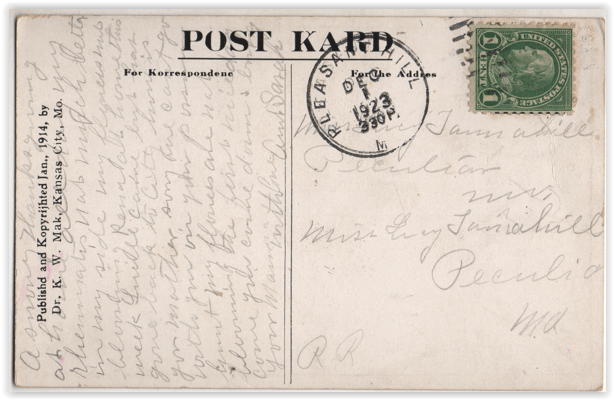
Other publishers went their own way. Remember Dr. Mak, the multi-talented alphabet reformer who made his own postcards? Well, he labeled his, but in accordance with his spelling regulations.
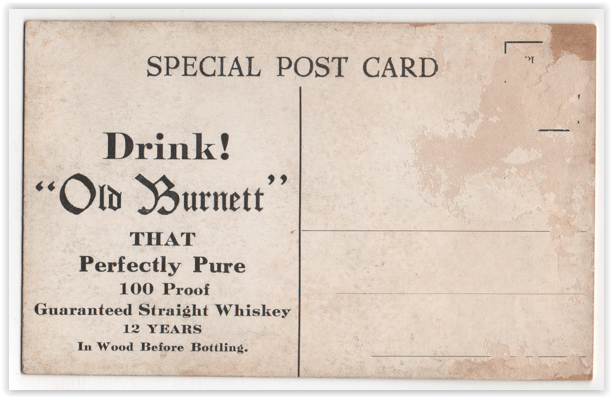
I don’t know if “Special Post Card” was an official U.S. Post office category, or this whiskey company came up with the idea on its own.
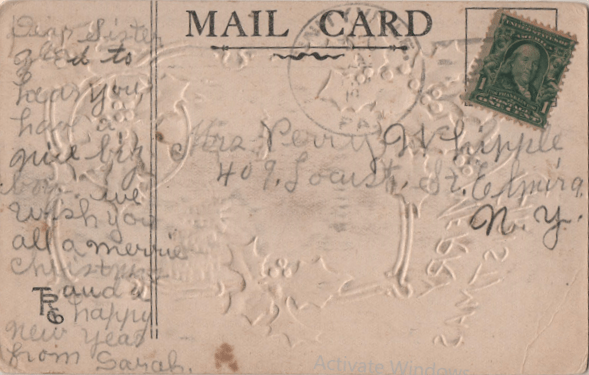
And, of course, there’s always somebody who doesn’t QUITE read the whole memo. But this is why our postcards put their names on the front (You may remember that rule, too: according to the U.S. Post office, the front of a postcard is the side with the address on it. Well, it’s the side THEY have to deal with.)
“And how did little Tim behave?” asked Mrs. Cratchit, when she had rallied Bob on his credulity and Bob had hugged his daughter to his heart’s content.
“As good as gold,” said Bob, “and better. Somehow he gets thoughtful sitting by himself so much, and thinks the strangest things you ever heard. He told me, coming home, that he hoped the people saw him in the church, because he was a cripple, and it might be pleasant to them to remember upon Christmas Day, who made lame beggars walk and blind men see.”
Bob’s voice was tremulous when he told them this, and trembled more when he said that Tiny Tim was growing strong and hearty.
His active little crutch was heard upon the floor, and back came Tiny Tim before another word was spoken, escorted by his brother and sister to his stool before the fire; and while Bob, turning up his cuffs—as f, poor fellow, these were capable of being made more shabby—compounded some hot mixture in a jug with gin and lemons, and stirred it round and round and put it on the hob to simmer; Master Peter, and the two ubiquitous young Cratchits went to fetch the goose, with which they soon returned in high procession.
Such a bustle ensued that you might have thought a goose the rarest of all birds; a feathered phenomenon, to which a black swan was a matter of course, and in truth, it was something very like it in that house. Mrs. Cratchit made the gravy (ready beforehand in a little saucepan) hissing hot; Master Peter mashed the potatoes with incredible vigour; Miss Belinda sweetened up the apple-sauce; Martha dusted the hot plates; Bob took Tim beside him in a tiny corner at the table; the two Cratchits set chairs for everybody, not forgetting themselves, and mounting guard upon their posts, crammed spoons into their mouths, left they should shriek for goose before their turn came to be helped. At last the dishes were set on, and grace was said, It was succeeded by a breathless pause, as Mrs. Cratchit, looking slowly all along the carving-knife, prepared to plunge it in the breast; but when she did, and when the long expected gush of stuffing issued forth, one murmur of delight arose all round the board, and even Tiny Tim, excited by the two young Cratchits, beat on the table with the handle of his knife, and feebly cried Hurrah!
There never was such a goose. Bob said he didn’t believe there ever was such a goose cooked. Its tenderness and flavour, size and cheapness, were the themes of universal admiration. Eked out by the apple-sauce and mashed potatoes, it was a sufficient dinner for the whole family; indeed, as Mrs. Cratchit said with great delight (surveying one small atom of bone upon the dish), they hadn’t ate it all at last! Yet every one had had enough, and the youngest Cratchits in particular, were steeped in sage and onion to the eyebrows! But now, the plates being changed by Miss Belinda, Mrs. Cratchit left the room alone—too nervous to bear witnesses—to take the pudding up, and bring it in.
Suppose it should not be done enough! Suppose it should break in turning out! Suppose someone should have got over the wall of the back-yard, and stolen it, while they were merry with the goose: a supposition at which the two young Cratchits became livid! All sorts of horrors were supposed.
Hallo! A great deal of steam! The pudding was out of the copper. A smell like washing-day! That was the cloth. A smell like an eating-house, and a pastry-cook’s next to each other, with a laundress’s next door to that! That was the pudding. In half a minute, Mrs. Cratchit entered: flushed, but smiling proudly, with the pudding, like a speckled cannon-ball, so hard and firm, blazing in half of half-a-quatern of ignited brandy, and bedight with Christmas holly stuck into the top.
Oh, a wonderful pudding! Bob Cratchit said, and calmly, too, that he regarded it as the greatest success achieved by Mrs. Cratchit since their marriage. Mrs. Cratchit said now the weight was off her mind, she would confess she had had her doubts about the quantity of flour. Everybody had something to say about it, but nobody said or thought it was at all a small pudding for a large family. Any Cratchit would have blushed to hint at such a thing.
At last the dinner was all done, the cloth was cleared, the hearth swept, and the fire made up. The compound in the jug being tasted, and considered perfect, apples and oranges were put upon the table, and a shovel-full of chestnuts on the fire. Then all the Cratchit family drew round the hearth, in what Bob Cratchit called a circle, meaning half a one; and at Bob Cratchit’s elbow stood the family display of glass; two tumblers, and a custard-cup without a handle.
These held the hot stuff from the jug, however, as well as golden goblets would have done; and Bob served it out with beaming looks, while the chestnuts on the fire sputtered and crackled noisily. Then Bob proposed:
“A Merry Christas to us all, my dears. God bless us!”
Which all the family re-echoed.
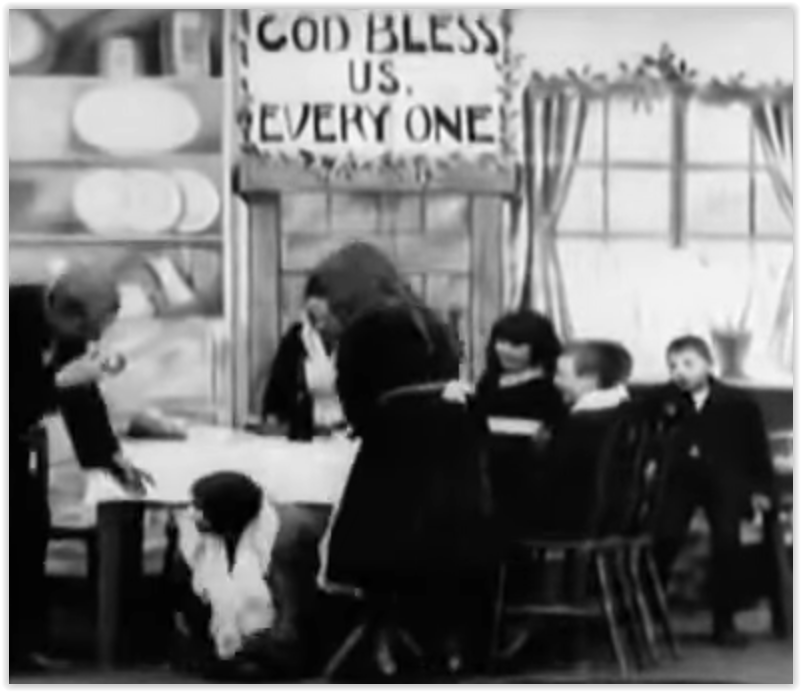
“God bless us every one!” said Tiny Tim, the last of all.
Dinner at the Cratchits’ was one of the high points of Dickens’s public readings of the Carol: audiences rose to their feet and cheered when the pudding finally reached the table.
This sequence, and those which immediately follow, are frequently mixed, matched, and otherwise rearranged. Film-makers want to move the story along, and we really CANNOT sit and watch the family devour an entire goose (not to mention the mashed potatoes and applesauce.) You need “How did Tim behave in church?” at the start and “God bless us every one” at the end; since Tim is a hard act to follow, you can toss all the other Cratchit material in wherever it fits in between these.
In Hicks, a knock on the door proclaims the arrival of the goose. The children rush to it while Mrs. Cratchit ushers Bob to the fire. She takes his comforter while Bob brings his slippers. They discuss Tim’s behavior in church; both have to look away when Bob says he thinks Tim is growing stronger. His wife replies, “I wish I could believe you, Bob, but I’m afraid.” The goose is ushered in now by the little Cratchits. “There never was such a goose!” Bob declares, “There never will be such a goose.” Preparations move quickly while he predicts that its flavor will exceed all expectations. He mentions the applesauce and the mashed potatoes, and the family set to. The scene jumps to the end of the meal. These are the least elegant Cratchits on film: a stubby candle sits on the table, and we watch one the girls wiping her mouth on the tablecloth. ”And even now we haven’t eaten it all,” crows Mrs. Cratchit, tapping a bone on the platter. They laugh. Scrooge chuckles, which the Ghost observes. “I envy them,” Scrooge admits. Now Bob Notes “Regarding the momentous question: pudding.” There is a tumult; he further observes that his wife looks pale, maybe, and nervous. She says she prays all will be well with the pudding. She and Tim go to fetch it while the other Cratchits clear away and wash the dishes. Bob troubles the children with horrible suppositions regarding the pudding while Tim, in the next room, lights the brandy. Bob dims the lights as the pudding arrives, flaming; he pronounces it a beautiful pudding. “A Merry Christmas to us all, my dears!” he exclaims, dishing it out. “God bless us all!” cry his children. “Good bless us all!” says Tim, who, exhausted by all this adventure, leans heavily on his crutch. He raises his eyes to his father.
In Owen, Bob and Martha have moved into the kitchen to mix the punch. Martha senses something is wrong. Closing the door so the others won’t hear, Bob admits that he has been sacked by Mr, Scrooge, but asks her not to mention it to her mother. They move into a very well-appointed dining room, airy and nicely furnished. Peter is sent for the goose, which shortly appears on the table. Everyone eyes it hungrily; Tim can’t keep his hands still for all the excitement. “There never was such a goose!” Mother carves, and we fade to the finish of the meal. “We haven’t eaten it all at last!” Bob suggests the possible theft of the pudding as a joke to Tim; an anxious wait follows. One of the girls give bulletins from the kitchen door; by the time the pudding arrives, Scrooge’s face is as alive with anticipation as any of the others. Mrs. Cratchit serves the pudding around, taking none herself. Martha forces a spoonful on her. The Spirit repeatedly beams his light on the family. The two toasts—blessing us from this segment and the founder of the feast from the next—are blended.
In Sim I, we get a bit of Martha’s speech from the previous segment, and then the discussion of Tim’s behavior in church. Immediately after Bob fails to convince himself that Tim is growing stronger every day, we insert the “Will Tiny Tim live?” sequence. The arrival of the pudding is discussed; we then cut to the empty table and the punch.
When March fades in at the Cratchits’, they are singing the Ghost’s song themselves, decorating their light, airy front room while preparing food. Peter, a tall young man, is snitching bits of this and that; the goose is roasting on a spit. They borrow the riddle game from Fred’s party; Scrooge plays along eagerly but is offended by the solution. Bob repeats “He said Christas was a humbug!” While the children finish trimming the Christmas tree, the parents discuss Tim’s behavior in church; Bob tries to convince himself “He’ll see many a Christmas after us.” Mrs. Cratchit finds the cheer fantasy of this devastating; even Bob mutters “A few more shillings a week.” Mrs. Cratchit tries to cheer him up, saying “A cheerful heart is the best healer.” Tim sets the star on top of the tree and then sings “God Bless Us, Every One”. Scrooge is transfixed. (I hate to complain, by the way, but what in the WORLD is Tim wearing?)
In Rathbone, all the Cratchit scenes are compressed into a kind of medley. Bob sets Tim by the fire and compliments Martha on her mashing of the potatoes. The Cratchits go into raptures at having a whole goose to themselves. (The bird involved is the size of a modest chicken.) Four of them pull up to the table now; Bob cries, “Three cheers for the Cratchits!” They appear to have completely forgotten about Tim, who is still sitting by the fire, and now asks if he can come to the table. Bob, unabashed, lifts the boy and brings him over. Bob then says grace and suggests that God bless them; Tim augments the toast as in the text.
Magoo’s Mrs. Cratchit brushes away a tear as Bob discusses Tim’s behavior in church. The smallest of Cratchit dinners—basically bread and soup—is set out as everyone sings “Razzleberry Dressing” (officially known as “The Lord’s bright Blessing”.) This is a rousing little number completely at odds with Dickens’s uncomplaining Cratchits. (On the other hand, Dickens gives them more food.) In any case, the young Cratchits are quickly convinced that being together is better than having a lot of stuff at Christmas. The song concludes with a request that “God bless us, every one!”
In Haddrick, Bob concludes the discussion of Tim’s behavior in church with “As good as gold. He’ll see many a Christmas yet, I’m sure.” Tim doesn’t look it; as Peter goes off with the two little Cratchits to fetch dinner, a fragile, dispirited Tim slumps by the fire. Scrooge, meanwhile, asks how such a dull and rational fellow as Cratchit can become so irrational this night. “He is with his family, and they make him happy.” “They make him poor, that’s for certain. But poverty seems to weigh light enough on him.” “It’s Christmas!” “But they have nothing to celebrate Christas wth!” “It is the spirit of the evening that makes small things great and inadequate things seem beautiful.” “I don’t understand you.” “That is why you are here.” Scrooge insists he need no such intangibles to make things meaningful. “Now, take money…..” “You do that often enough. I don’t want to hear about it.” The family sit down to what Scrooge has called a sad, inadequate dinner; his is now amazed to watch them enjoy it. “Bless my soul!” “That is our intention, Ebenezer Scrooge. I think we may be achieving it. Slowly.”
Sim II gives us only the discussion of Tim’s behavior in church. Scrooge lowers his eyes, abashed, at being reminded of who made lame beggars walk and blind men see. We skip ahead to the family gathered around the fireside; Tim sings one line of “The Little Boy lost in the Snow” and then we bless us, every one.
Finney watches the goose and the punch being prepared. Bob is quite over the top enjoying the preparations; everyone else seems to enjoy how much he enjoys them. The goose is not much larger than Bob’s two hands. Tim and a brother return from carol-singing, having earned tenpence ha’penny. Tim is toasted as a breadwinner by his father, which takes us to the next scene.
In Matthau, Tim proceeds to a teeny Christmas tree and exclaims at Santa Claus’s generosity. “Not at all like Mr. Scrooge,” says one of his sisters. Everyone else boos at the mention of the name, but Tim tells them not to think unkindly of Mr. Scrooge: not at Christmas. “Why not? It’s his thinking that keeps us poor.” Bob, skipping around in the text, joins Tim by saying “Now, Mr. Scrooge is the founder of the feast.” “:Feast?” his wife demands. “With a goose no bigger than a canary bird?” Scrooge turns to the Ghost and demands, “Must I listen?” :Surely you’re not surprised.” Surprised or not, Scrooge is stricken. “Oh, instead of docking Bob, why didn’t I give him exytra for Christmas?” Tim hobbles off to get his new toy, a wooden soldier. Mrs. Cratchit admits that sometimes she loses hope that Tim will ever get well, and wishes they had the money to see him cured. Bob replies that Tim has the hope and faith he needs. In fact, in church, he said he hoped the people saw him, and so forth, at last, from the original text.
All we get of this from McDuck is Tim exclaiming, “Look at all the wunnerful things to eat!”
In Scott, Bob remarks on Tim’s behavior in church, but Scrooge is watching the two children escort Tim from the room. “Look at how they support him!” “What did you say?” the Ghost inquires. “Nothing. It’s…. Nothing.” Mrs. Cratchit looks tragic when Bob notes how Tim is growing stronger every day. “Yes, Bob. I’m sure you’re right. He is getting stronger.” In every version, Mrs. Cratchit declines to believe this, but here you can tell from Bob’s face that he knows she doesn’t. He tells her, clutching the crutch to him, that the important things is that they’re all JHERE. Pulling a later section out of the text, Bob reveals that he has a position in mind for Master Peter, working for Mr. Scrooge’s nephew, Fred Halliwell. Scrooge is affronted: who would hire a child at such an exorbitant salary? Fred must be doing it to spit him. The goose comes to the table and is much praised. Bob carves this goose; he also says grace, to which Scrooge says “Amen.” “Did you say something?” “No.” “I thought I heard….” “I said nothing.” “Oh.” The family dines. “A very small goose,” Scrooge observes. “It is all Bob Cratchit can afford.” Scrooge is offended again. “Berry Christmas to us all!” “And God bless us, every one!” Bob is much struck by Tim’s addition of this.
In Caine, Tim is so excited by the feast that he begins to cough. His mother makes him sit down, and asks how he h=behaved in church. Bob tells her, his voice breaking. “A remarkable child,” says Scrooge. The food is spread out on the table and they set to. Scrooge observes, “Such a meagre feast.” “But very much appreciated.” Scrooge will not be comforted. “O pay Bob such a small amount.” Then he hears his name, and we are brought to the toasts.
In Curry, we hear how Tim behaved in church, but Scrooge is confused by “As good as gold. No, better.” “There’s something better than gold?” he demands. We move quickly to empty plates and the Toast.
In Stewart, we are told how Tim behaved in church as Bob tries to ease his shoulders. Mrs. Cratchit replies to who made lame beggars walk and blind men see by saying “Not many remember that. You can count on it.” Bob says he thinks Tim is growing stronger; Martha seconds this notion. The goose is brought to the table and Mother carves; there is a decent attempt to reproduce the text on screen. They joke with Tim about the food; Scrooge injects “Will Tiny Tim live?” at this point. Meanwhile, the Cratchits have arrived at worrying whether the pudding is all right. Martha helps her mother lift it out of the copper; lighting the brandy produces a tiny flame. There is much business as Bob takes the first taste; Mrs. Cratchit’s relief when he pronounces judgement is profound. The Ghost explains to Scrooge “There’s nothing wrong with that pudding except that it’s a very small pudding for such a large family.” Scrooge replies that nobody complained. “Any Cratchit would blush to even hint at such a thing.” We proceed to “God bless us, every one!”
In the folktales of just about every group of people around the world, the Apex Predator holds a serious place. Whatever animal this is—the lion, the tiger, the wolf, the shark—is the supervillain, the great threat, the ever-present menace, the shadow in the wilderness (In fact, the traditional folk villain role was sometimes denied to the lion, which people could see napping in the sun WAY too often.)
The bear, however, which is a big and powerful animal, and certainly willing to kill unwary humans who got too close, is almost never accorded that role. Part of the reason is that it had a power which had been denied to the tiger and the wolf. It could walk for long distances on its hind legs. Primitive humans were amazed and terrified by an animal more massive than they who could take on this human custom. It occupied a nearly unique mystic status; in Finland, for example, it was customary to perform a ritual apology to any bear you killed, explaining that it was not actually killed by YOU but by the Russians.
You don’t often see bears on their hind legs on postcards, but they DO spend a lot of time chasing unwary humans. This results both from the ferocity of the angry bear and partly because it was so easy to make puns on “bear”.
We have covered elsewhere the many, many postcards about people running off with a bear behind, so we will not repeat any of that here. Nor, by special request, will I tell any more variations on the classic joke about the preacher and the bear.
The role of bears in tales and on postcards is complicated, however, because of the fact that the bear is so dang cute. Okay, maybe this is not our best example.
Cute and kind of slow-moving, you see. So particularly as time went by, his role in stories became that of the Assistant Villain, the Apex Predator’s hired muscle, the strong enforcer who, on his own, thinks very slowly and is easily distracted.
This became further complicated after Teddy Roosevelt famously spared a bear cub while hunting, and became the namesake of the Teddy Bear.
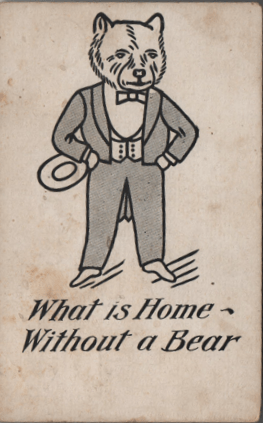
In American history, particularly, you don’t see a LOT of stuffed wolf toys for children. Lions and tigers were kitties and cuddly and far, far away, but the wolf continued to be a menace on the verge of civilization. But bears were suddenly as cuddly as could be. (The gag here is that this bear is made of felt, and “stuck on tight” to the postcard since 1907.)
Bears were your friends, trustworthy in winter and summer. (A wolf would sneak up on you.)
There were plenty of postcards which asked “What is Home without a Mother?” or “What is Home without a Father?” But you never saw a wolf on a card like that.
We have been going through my inventory looking at birds which are not storks or chickens, which seem to be out most popular postcard avians. We have covered such obvious choices as vultures and ostriches, and looked briefly into the postcard lives of pelicans, ducks, and geese. For reasons not known to me, I have found no cartoon woodpeckers in my files (sorry, Woody) while flamingos, a postcard staple, are valued manly for their decorative qualities, and almost never appear in cartoon postcards.
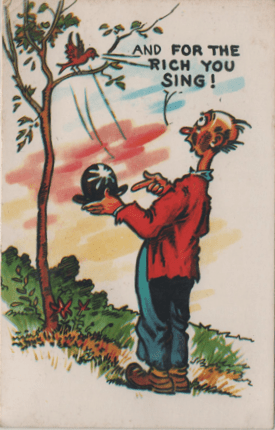
Songbirds are fairly generic. They seem to appear on postcards to do two things, one of which is singing.
This is a bit of folk wisdom passed along the generations. We have examined elsewhen the sparrows which watch behind the once omnipresent horse, looking for undigested seeds in horse droppings. (Interesting how our ancestors, whom we accuse of being too prudish for everyday life, were interested in bathroom functions out in the wild.
Though there were some cartoonists who found the other function of songbirds to be just as annoying. (Rather like humor immortal Will Cuppy, who preferred to sleep during the daylight hours and felt songbirds particularly were out to get him.)
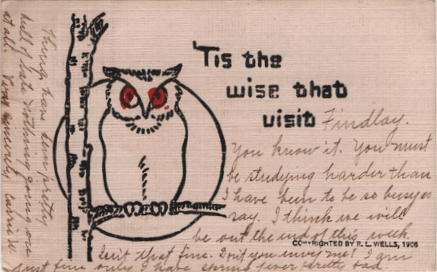
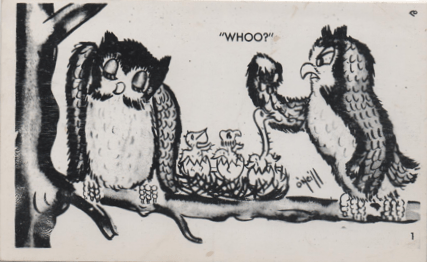
Meanwhile, in another part of the forest, we have the owl, who had three basic purposes on postcards. As mentioned here and there, I have virtually no Halloween postcards. On Halloween, an owl’s function was closest to its role in real life and folklore: terrifying apex predator. But the rest of the year, it weas usually a symbol of wisdom (a result of its large eyes and tendency to stand there watching you with apparent disapproval. The ancient Greeks made the owl a sidekick of Athena, Goddess of Wisdom, essentially for its face alone.
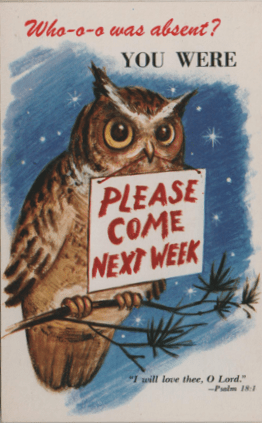
Wisdom not being all that useful in comedy, however, its OTHER job was to say “Who?”
We mentioned a few weeks ago an era of postcard cartooning which seemed to derive its aesthetic from grade school Valentines. Well, “whooooo” fit in just as well on postcards. This was especially useful when combined with some sort of pursuit of learning, as can be seen from these two cards reminding you that you missed Sunday School last week.
Scrooge promised that he would’; and they went on, invisible, as they had been before, into the suburbs of the town. It was a remarkable quality of the Ghost (which Scrooge had observed at the baker’s) that notwithstanding his gigantic size, he could accommodate himself to any place with ease; and that he stood beneath a low roof quite as gracefully and like a supernatural creature, as it was possible he could have done in any lofty hall.
And perhaps it was the pleasure the good Spirit had in showing off this power of his, or else it was his own kind, generous, hearty nature, and his sympathy with all poor men, that led him straight to Scrooge’s clerk’s; for there he went, and took Scrooge with him, holding to his robe; and on the threshold of the door the Spirit smiled, and stopped to bless Bob Cratchit’s dwelling with the sprinkling of his torch. Think of that! Bob had but fifteen ‘Bob’ a-week himself: he pocketed on Saturdays but fifteen copies of his Christian name; and yet the Ghost of Christas Present blessed his four-roomed house!
Then up rose Mrs. Cratchit, Cratchit’s wife, dressed out but poorly in a twice-turned gown, but brave in ribbons, which are cheap and make goodly show for six-pence; and she left the cloth, assisted by Belinda Cratchit, second of her daughters, also brave in ribbons; while Master Peter Cratchit plunged a fork into the saucepan of potatoes, and getting the corners of his monstrous shirt-collar (Bob’s private property, conferred upon his son and heir in honour of the day) into his mouth, rejoice to find himself so gallantly attired, and yearned to show his lenen in the fashionable parks. And now two smaller Cratchits, boy and girl, came tearing in, screaming that outside the baker’s they had smelt the goose, and known it for their own; and basking in luxurious thoughts of sage and onion, these young Cratchits danced about the table, and exalted Master Peter to the skies, while he (not proud, although his collars nearly choked him) blew the fire, until the slow potatoes bubbling up, knocked loudly at the saucepan-lid to be let out and peeled.
“What ever has got your previous father then,” said Mrs. Cratchit, “And your brother, Tiny Tim, and Martha warn’t this late last Christmas Day by half-an-hour!”
“Here’s Martha, mother!” said a girl, appearing as she spoke.
“Here’s Martha, mother!” cried the two young Cratchits. “Hurrah! There’s SUCH a goose, Martha!”
“Why, bless my heart alive, my dear, how late you are!” said Mrs. Cratchit, kissing her a dozen times, and taking off her shawl and bonnet for her, with officious zeal.
“We’d a deal of work to finish up last night,” replied the girl, “and had to clear away this morning, Mother!”
“Well! Never mind as long as you’ve come,” said Mrs. Cratchit. “Sit down before the fire, my dear, and have a warm, Lord bless ye!”
“No no! There’s father coming,” cried the two young Cratchits, who were everywhere at once. “Hide, Martha, hide!”
So Martha hid herself, and in came little Bob, the father, with at least three feet of his comforter exclusive of the fringe, hanging down before him; and his thread-bare clothes darned up and brushed, to look seasonable; and Tiny Tim upon his shoulder. Alas for Tiny Tim, he bore a little crutch, and had his limbs supported by an iron frame!
“Why, where’s our Martha?” cried Bob Cratchit, looking around.
“:Not coming,” said Mrs. Cratchit.
“Not coming!” said Bob, with a sudden declension of his high spirits; for he had been Tim’s blond horse all the way from church, and had come home rampant. “Not coming upon Christmas Day!”
Martha didn’t like to see him disappointed, of it were only in a joke; so she came out prematurely from behind the closet door, and ran into his arms, while the two young Cratchits hustled Tiny Tim, and bore him off to the wash-house, that he might hear the pudding singing in the copper.
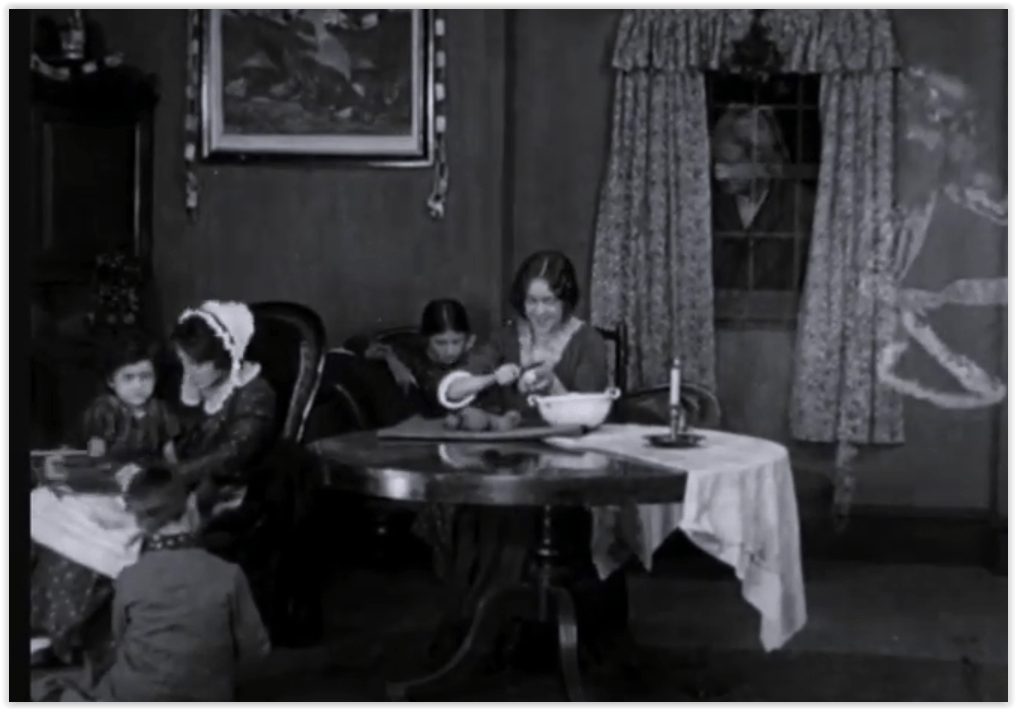
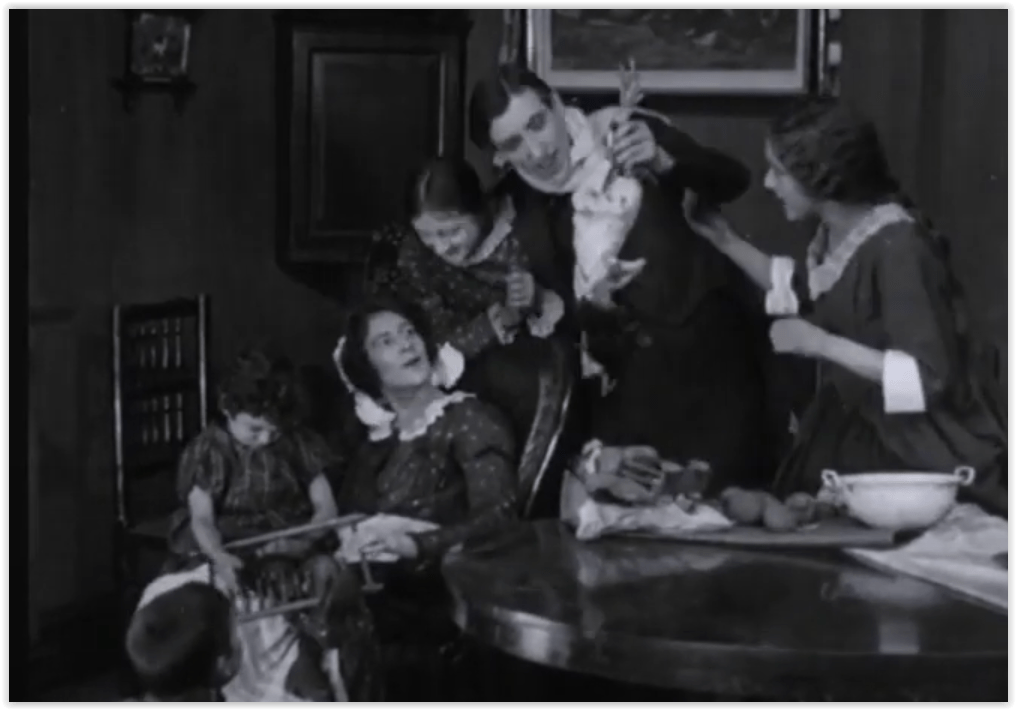
We come to what it, for many people, the point of the whole show: the home of the Cratchits. Bob Cratchit is finally given a name and, with it, a house and a family. These are fairly warm and cosy, in the pictures: virtually every version gives us Mrs. Cratchit in the kitchen, and Tiny Tim riding Bob’s shoulder. Martha’s little trick is frequently included, and the food is often on full view. Sometimes the goose cooks here and sometimes at the baker’s: either way, the kitchen is the center of activity.
Hicks begins with Bob and Tim travelling along the streets, Tim on Bob’s shoulder. The scene is festive, with people playing in the snow, and more snow falling. Bob buys Tim a small toy boat from a street vendor, and we jump ahead into the kitchen to wait for them to join us. The two small Cratchits rush in, exclaiming that they’ve smelled the goose and knew it was theirs because the smell was so delicious. They begin to dance around celebrating “A happy goose! A happy goose!” Mrs. Cratchit wonders whatever has happened to their precious father and Tiny Tim, but is distracted by the entrance of Martha, a solid older teen with an amiable face. Martha explains how much work there was to clear away. She is urged to have a warm, but her younger siblings bustle her over to hide behind her own coat, which the front door conceals when it opens. Bob is suitable stunned to learn she isn’t coming, and thoroughly gratified when she takes pity on him and comes out from behind the door to throw her arms around him.
Owen and the Spirit watch Bob carry Tim home. Jumping ahead in the text, Scrooge asks if Tiny Tim will live. Oblivious to this, Bob and Tim get home, Tim crying “Whoa!” and Bob replying “Whoa it is” The two small Cratchits having smelled the goose, have hidden martha in the closet. She peeks out, takes pity on her father, and appears, to his great relief.
Sim I watches Bob come home with Tim on one shoulder. We jump to the kitchen, where it is Mrs. Cratchit who urges Martha to hide behind the scullery door. The scene proceeds much as described, even unto Peter’s positively monstrous collar.
March omits the scene.
Rathbone and the Spirit come to a window shrouded in fog. “Your clerk Bob Cratchit’s house,” the Spirit informs him. Scrooge peeks in to watch Bob and peter and Tim come home. There is none of the byplay with Martha.
Magoo assures the Spirit he’s never seen this place, and at length demands to know why they’re here. “These people mean nothing to me.” When he learns who they are, he is amazed at how happy the family can be on so little money. The Spirit replies that their happiness is based on something unfamiliar to Scrooge. “Love.” Mrs. Cratchit is just demanding “What is keeping you father and your brother, Tiny Tim?” when those two enter.
Haddrick is more knowledgeable, telling the Ghost, “This is where my clerk lives: fellow named Bob Cratchit.” The remark is made about four room and fifteen shillings. “That is why I’m here,” the Spirit explains. Scrooge seems surprised: “To bless this lowly place?” “Of course! Because what seems lowly to you and what seems lowly to me are obviously different things.” The children dash in, declaring they smelled the goose at the baker’s. Peter snitches a little food. Bob and Tim are shown on their way home, discussing the church service. Scrooge takes snuff, as he has been doing earlier, and again fails to sneeze. He asks the ghost why he can’t get a good sneeze to clear his head, and is told he’s too mean to give away even a good sneeze. His values are confused: take that sovereign he constantly rubs. “This is the first sovereign I ever made.” But soon, the Ghost says, he will have worn it away, and will have lost it. Better to use it for some good purpose. Meanwhile, Martha a slightly younger version of her mother, hides behind a door until she can come out again to surprise her father. Peter, by the way, wears a cap in this version, and a modern-looking necktie.)
In Sim II, we watch Bob and Tim gallop home. The children cry “Hoorah! Father’s home! Father’s home!” Much of the rest is omitted.
The Ghost and Finney crash into a snowdrift; Finney is sober again, and indignant, demanding to know where they are. The Ghost informs him that they are outside the lavish home of one Robert Cratchit, Esquire, who owes the opulence of his home and the magnificence of his Christmas dinner to the high principles and generosity of his employer. “I’ll look in the window,” state Scrooge. “It will cost you nothing, which I’m sure will be good news to you.” “Will they be able to see me?” “No, which I feel sure will be good news to them.” Scrooge says he could use another drink of the Milk of Human kindness; the Ghost tells him it will be better for him to see things as they are, rather confusing the metaphor. Scrooge looks in at a very low, dark, kitchen; Bob is already there.
Matthau looks in at a fat Mrs. Cratchit who is very busy about the kitchen; when she hears a sound from the front room, she says to herself, “The children and Bob home from church.” The twins rush in, crying that the goose may be small, but they could smell it all the way up the street. “Where are your father and Tiny Tim?” “Who wants to know?” calls Bob. Tim asks about the pudding; his mother tells him it is “bubbling and singing away in its copper pot as if it was a Christmas caroler.”
McDuck demands “Why did you bring me to this old shack?” The Ghost explains, and he peers through the window. “What’s that cooking? A canary? Surely they have more food than that. Look on the fire!” The ghost studies a bubbling pot. “That’s your laundry.”
We pass with Scott through the torch and find ourselves in Camdentown. “Do you know this house?” inquires the Ghost. “No, I can’t say I do.” “It is the house of Bob Cratchit.” “Is it? He does very well on fifteen bob a week.” Scrooge demurs when told to go in, saying he’d hate to intrude, and is told that they shall be unable to see or hear him, as in the last ghost’s visions. Inside, Peter is snitching food. The two small Cratchits rush in, exclaiming at how beautiful the goos smells. Mrs. Cratchit tells them to go with Martha and butter the bread…thinly. Bob and Tim enter; Tim is carried off to listen to the pudding.
Caine comes here after his visit to Fred. “Why have we come to this odd corner of the town?” “It’s Christmas here, too, you know!” Dickens gives us an abbreviated version of the “Perhaps it was the Spirit’s own generous nature” speech, and we peek in at one of the few blonde Mrs. Cratchits, standing with her back to us. (She also has a first name, Emily.) Rizzo manages to fall down the chimney onto the goose roasting on a spit; the goose is smaller than he is. Mrs. Cratchit snitches a few chestnuts; when confronted by her twin daughters, she replies that she was merely tasting them. Scrooge and the Spirit then turn to watch the entrance of Bob and Tim, singing.
Curry has to be dragged into the house by the Spirit. Jolly children are enjoying themselves in a large, airy kitchen. The lady of the house asks Martha wherever are her father and Tiny Tim. Scrooge demands “Who ARE these people?” The Ghost won’t tell him. Bob and Tim enter; Scrooge is struck by this revelation. “The Cratchits? I had no idea Bob lived so humbly.” “What did you think, with the wage you pay him?”
Stewart demands, “Where are we going now, Spirit?” He is startled to learn they are going to Bob Cratchit’s home, and is given a lecture about that fifteen bob a week. Mrs. Cratchit and the four middle children are working and singing merrily in the kitchen. Martha enters, explaining how she had to work late. “She sounds a very hard-working young girl,” notes Scrooge. “She has to be,” replies the Spirit, the reproof in his tone surprising Scrooge. The children hide Martha in the scullery. Bob and Tim gallop home; Tim cries “Whoa!” “I didn’t know Cratchit had a crippled son,” Scrooge remarks; the Ghost snaps “Why didn’t you ask?” Martha is gradually released from the scullery, to her father’s relief.
FUSS FUSS FUSS #14: Assorted Cratchits
The people who delve into these things see the Cratchits as a fictionalized version of young Charles Dickens’s home, with Peter Cratchit as a self-portrait. (Tiny Tim is felt to be a merging of his nephew Henry with the older of Dickens’s two brothers named Fred.) He is not specific about their age or aspect, save when he describes their clothes. He doesn’t even give names to the fourth and fifth children: in the Lionel Barrymore radio version, even the Ghost of Christmas present refers to them as “two little Cratchits”.
In general, the earlier the movie, the older the Cratchits; even Tim gets tinier as we go on. Animated versions are likely to cut back on the number of Cratchits: makes for less complex drawings.
Hicks’s Mrs. Cratchit is a woman in late middle age, with six children. (“A round half dozen” Bob calls them, earlier, mentioning three boys and three girls.) Martha, Belinda, and Peter are all teenagers, though some critics put Martha in her 20s. Tim, who looks nine or ten, wears a leg brace.
Owen’s Mrs. Cratchit is a lively older o=woman; her children are all ten or over. Tim, who wears a brace on one leg, is fully two-thirds as tall as his parents.
Sim I gives us an older Mrs. Cratchit with five children well along in years: Peter, Martha, Mary, Belinda, and Tim. Tim is going to be taller than his parents in a year or two.
March begins a trend to younger Cratchits. The two little Cratchits, both girls in this version, are barely older than Tim. In fact, since this is possibly the tallest Tiny Tim ever, they may even be younger than he is. There are five children: Peter, Belinda, Susan (Suzy), Martha, and Tim.
Rathbone shows us a cheerful youngish Mrs. Cratchit who has only three children: Martha, Peter, and Tim.
Magoo gives us a plump Mrs. Cratchit, who wears a bonnet. She has four children: Martha, who is considerably taller and older than the others, a rather short brother Peter in high collars, an intermediate child who may be a girl, and Tim.
Haddrick has a plump older Mrs. Cratchit with four children evenly spaced in age: Martha, Peter, Belinda, and Tim.
Sim II has one of the oldest and plumpest Mrs. Cratchits, positively on a par with Mrs. Fezziwig, with five children of whom we don’t see much: Peter is the oldest and Tim, who seems to be six or seven, is the youngest.
Matthau presents us with a plump Mrs. Cratchit who has four children: Martha, Peter, Belinda, and Tim. This is probably the youngest collection of Cratchits: atypically, all but Tim are blond.
Finney begins a trend toward Mrs. Cratchits of streamline design: she is younger, too, so her children are correspondingly younger as well. Tim is stated to be just seven years old. The room being rather dark, it is difficult to count the children, but there seem to be three girls and two boys: Martha, Peter, Belinda, Cathy, and Tim.
McDuck brings us Minnie Mouse with three little mice, a boy, a girl, and a Tim.
Scott gives us a slender Mrs. Cratchit. Tim is six or seven, his immediately older siblings not so much older. There are five rather well-dressed children; the girls wear bonnets. Peter, Martha, and Tim are three of the children; the others are listed in the credits as “Little Boy Cratchit” and “Little Girl Cratchit”. (The dialogue will refer to this latter sometimes as Belinda and sometimes as Alice.)
Caine gives us Miss Piggy, of course, and four children: Peter and Tim are frogs like their father while the twins Belinda and Bettina are pigs.
Curry’s Mrs. Cratchit is slim, robust, and reasonably well-dressed. There are four children: Martha, the oldest, is a slim teen. Then come Peter, a girl with no name, and Tim, who must be seven or thereabouts.
Stewart has a similarly slim, healthy Mrs. Cratchit, who has six children. There are three teenagers—Peter, Martha, and Belinda—and three younger children, the two little Cratchits, not much older than Tim, and Tim himself. Tim’s tininess is not infinite; this is the only Bob Cratchit shown trying to ease a sore neck and shoulders after setting Tim down.
During our last outing, we discussed birds on postcards who were not chickens or storks. We covered ostriches and pelicans and doomed ducks and so forth. But, of course, we could not use up our whole supply of birds in one column. Today, I thought we might consider some of the birds who talk back to us.
Lots of birds can be claimed to talk to us, of course, from the turkeys who tell us what to do at Thanksgiving (gobble) to the poor doctor who was haunted by a flock of ducks who kept questioning his credentials (Quack!) to the classic definition between a rooster and an old maid (the rooster says Cock-a-doodle-doo and the old maid says any dude’ll do.)
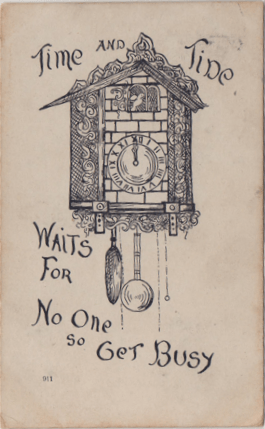
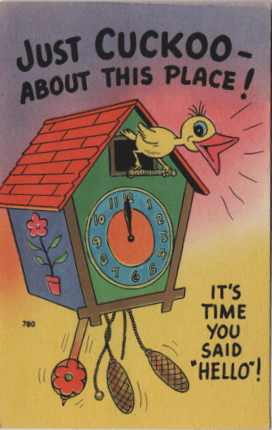
It may be cheating to include artificial birds like the cuckoo in the clock in this discussion. But it does get us into another paragraph where I don’t dredge up any more fine old jokes like the ones in that last paragraph.
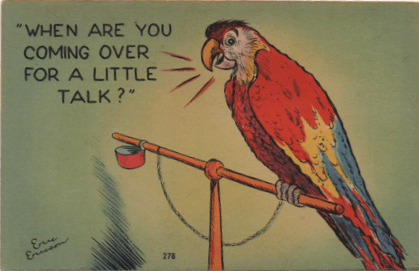
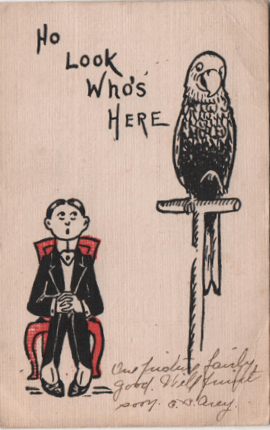
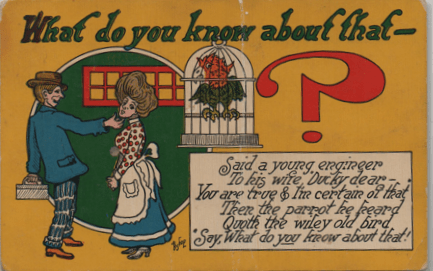
The classic bird talking back is the parrot, of course, which could be counted on to come up with something unexpected. Alas, I don’t have any postcards dealing with the perennial problem of parrots whose language was learned from the sailors who brought them home, and had to have their cages covered when children were in the room.
On postcards, their most common function was the sarcastic and disconcerting comment. How birds with beaks could sneer so completely is a mystery to me, but maybe it was the way they said it.
This unpleasant chatterer draws his inspiration from the old pop song “The Bird on Nelly’s Hat”, which kept remarking “You don’t know Nelly like I do” whenever a suitor spoke of her virtue and fidelity.
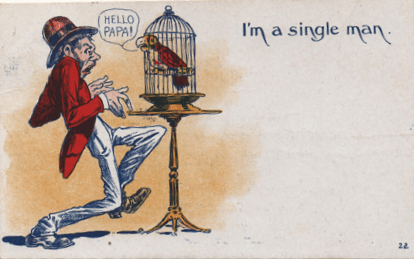
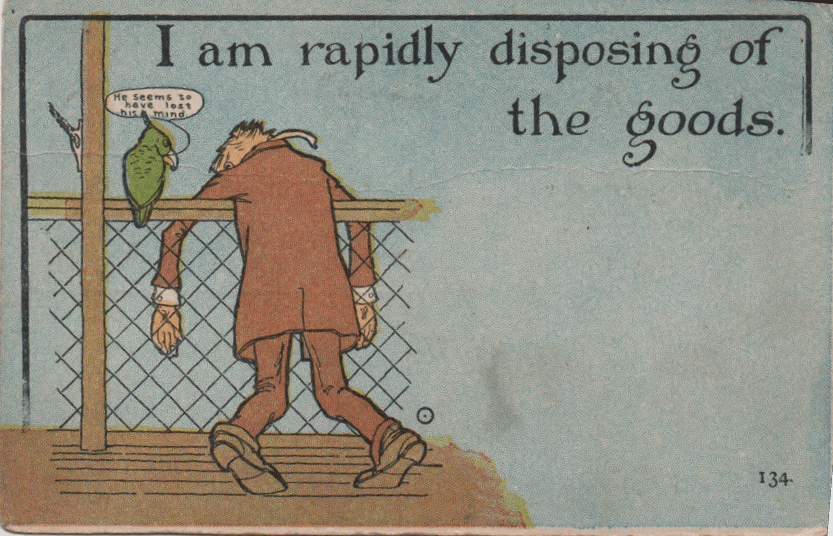
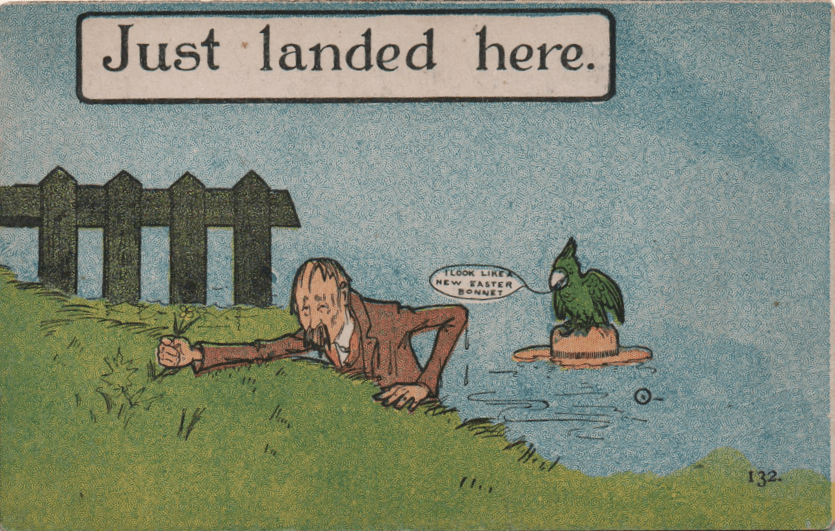
This artist took us on a wild journey with a man and his parrot, in which the weary traveler gave out the straight line and the parrot got the laugh.
Speaking of laughs, do you know the one about the parrot on the cruise ship. The one with the magician? Where the punchline was “Okay, Mac, ya got me. What….” Oh, you do. Kinda figured. You’re like that.
How about the one about the plumber who came to fix the sink? Fine. Be that way. I should have replaced you with a parrot weeks ago.
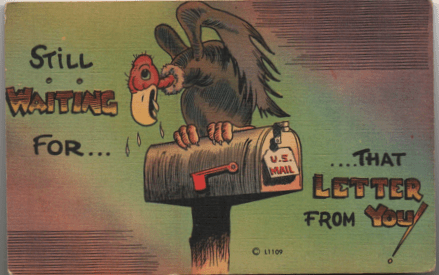
I was intrigued by a couple of postcards I listed for sale over the holiday weekend, and thought about expressing my opinions about them here. This may happen one day, but what the two cards had in common was that each featured a chicken. And though I grew up in an era of reruns, it is nonetheless true that I have featured chickens in this space on more than one occasion. I feared that my many, many readers (at least half a dozen, when last tallied) might worry, “Is that all the birds he’s got?”
That brought to me my columns dealing with storks and their ancient delivery job. And I heard the echo “Okay, chickens and storks. What else ya got goin’?”
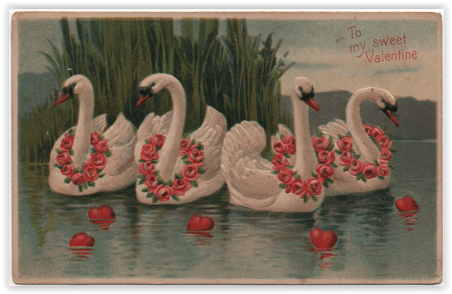
Well, there ARE other birds who have had their jobs on postcards, as I may demonstrate if I get around to it. Swans, for example. As seen above, swans are usually seen as elegant watercraft, frequently bearing wreaths or Valentines or Cupids to a person who needed ‘em. I have not inquired into this phenomenon, but I understand that swans are not you’re most easily trained avian messengers. They just LOOK prettier than carrier pigeons.
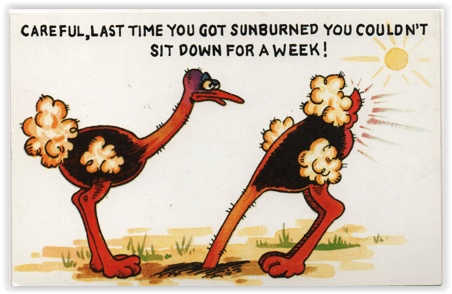
And then there are ostriches, whose chief job is to bury their heads in the sand. (I have seen not ONE postcard featuring the equally popular folklore job of swallowing rubber boots, tin cans, and anything else handy. Maybe I just don’t hang out with the right postcards.)
Geese are traditionally foolish, and frequently turn up as grim warnings. (A friend of mine recalls a flock of tame geese on her father’s farm who, during a sudden cold snap, did not seek shelter like the ducks, and were found complaining about being frozen in the pond next morning.)
Geese are also known for stretching their necks to look at thinks, which led to the phrase “to take a gander”, or take a look. The gander is the male goose, and gendering around is given several meanings here. Usually a rooster turns up in this sort of cartoon.
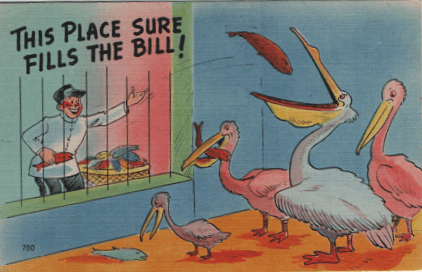
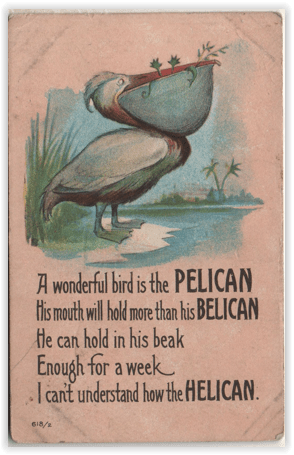
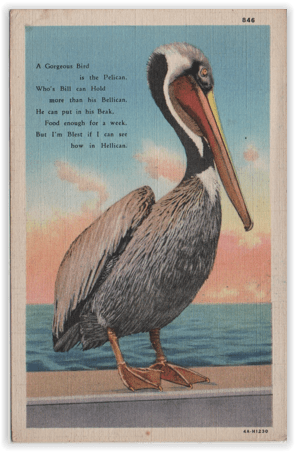
Then there are all the cards featuring pelicans. This is an exceedingly rare example.
Because it does not involve THE POEM. There is one poem about pelicans, though it exists in all sorts of variations.
It is the work of professional humorist and founder of the Tennessee Ornithological Society Dixon Lanier Merritt, who was, it says here on the Interwebs, inspired to write it by being sent a POSTCARD with a picture of a pelican on it. He wrote this in 1910, and lived long enough to see it attributed to just about every other poet on the planet.
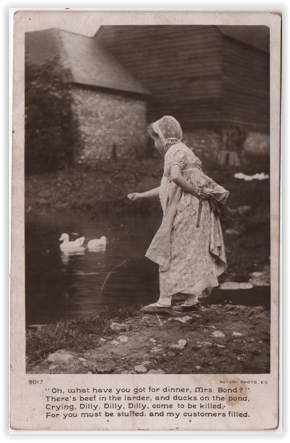
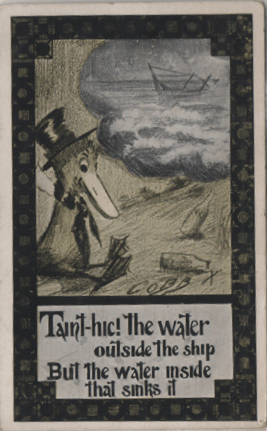
Speaking of poems, I had to look up this little ditty on ducks to make sure it actually existed. Yep, this is one of those nursery rhymes your parents may have forgotten to teach you.
Ducks frequently turn up on postcards (frequently in conjunction with chickens, amid fowl rumors of marital infidelity). I’m not altogether certain how I came up with two rather grim, dark duck postcards for this little essay.
“Spirit,” said Scrooge, after a moment’s thought, “I wonder you, of all the beings in the many worlds about us, should desire to cramp these people’s opportunities of innocent merriment.”
“I!” cried the Spirit!
“You would deprive them of their means of dining every seventh day, often the only day on which they can be said to dine at all,” said Scrooge. “Wouldn’t you?”
“I!” cried the Spirit.
“You seek to close these places on the Seventh Day!” said Scrooge, “And it comes to the same thing.”
“I seek!” exclaimed the Spirit.
“Forgive me if I am wrong. It has been done in your name, or at least that of your family,” said Scrooge.
“There are some upon this earth of yours,” returned the Spirit, “who claim to know us, and to do their deeds od passion, pride, ill-will, hatred, bigotry, and selfishness in our name, who are as strange to us and all our kith and kin, as if they had never lived. Remember that, and charge their doings to themselves, not us.”
Gosh, it’s nice to know that after 180 years, Dickens is still a dangerous radical. Fred Guida, who saw every version of A Christmas Carol worth seeing (and plenty that were not) found only one, in Spanish, which includes this scene. Why do you suppose that is?
IT REQUIRES A FOOTNOTE: Bakers, forbidden to sell bakery on Sunday, nonetheless had to keep their ovens running, for starting up a cold oven on Monday would not have provided good baking. Poor people, having no oven at home, would pack up a Sunday dinner and take it there to rent a little space in the oven, as we saw people doing last time around and and we shall wee the Cratchits doing later. Some people felt this honored the letter of the law but violated the spirit, and wanted this practice shut down.
THE GHOST OF CHRISTMA PRESENTS, SPEAKING FOR ALL CRHISTANITY, COMES OUT IN FAVOR OF INNOCENT MERRIMENT RATHER THAN STRICT ADHERENCE TO THE COMMANDMENTS.
THE GHOST OF CHRISTMAS PRESENT, SPEAKING FOR ALL CHRISTIANITY, MAKES THE POINT THAT CHRISTIANITY SHOULD NOT BE BLAMED FOR ALL THE IDIOTIC THINGS PEOPLE DO IN ITS NAME.
SCROOGE IS SHOWN SOFTENING. This is probably the main reason: the Scrooge we heard back in the office chatting with the Charity Solicitors would not have worried about eh Sunday dinners of the poor. And some filmmakers are just not ready for Scrooge to be reasonable yet.
FUSS FUSS FUSS #13 The Reading version
A Christmas Carol was Dickens’s second most popular public performance, surpassed in the number of times he gave it only by his performances of the trial scene from the Pickwick Papers. What this meant was that he went on tinkering with it long after the official text was published. Like a lot of authors, he felt he could have done better, given a second chance. For the twenty-fifth anniversary edition, he replaced the charming original preface with another one in which he apologizes for not having spent more time on it, fleshing the characters out better, giving more of their background (and generally destroying his chance of producing a Christmas Classic.)
What remains of his tinkering goes the other way, however. He cut the Carol down into a two hour reading, and later cut it back farther to 85 minutes. We know he added bits as well, but he doesn’t seem to have written these down and they are lost. But his cuts, along with his performance notes, did survive, and can be seen in “A Christmas Carol: The Reading Version”, published in 1971 by the New York Public Library (which holds the prompt books) with notes and introduction by Charles Collins.
What is interesting, not to say alarming, is the number of what we consider classic bits that he cut. In the one hand, of course, they were not as classic when he did his readings. On the other, it would seem to prove that the author is not always the best judge of his own text.
Among the cuts were
The doornail
“Business! Mankind was my business!”
The wandering spirits outside Scrooge’s window
“She died a woman, and had, as I think, children.”
“Why to a poor one most?”
The two Significant Children under Christmas Present’s robe (he felt this would be a turn-off to certain audiences)
“It’s likely to be a very cheap funeral.”
“You don’t mean to say you took ‘em down, rings and all, with him lying there!”
“However and whenever we part from one another, I am sure we shall none of us forget Tiny Tim.”
“Heaven, and the Christmas Time, be praised for this! I say it on my knees, old Jacob; on my knees!”
“The Spirits have done it all in pone night.”
The meeting with the Charity Solicitors on Christmas morning
Our last time out, we were discussing Summer Romance, a time of young love filled with deep devotion, true emotion, and anything else that rhymes. We showed pictures and sayings of reasonably young people in the throes of a romance on vacation, where one could be young, free (when Mom and dad weren’t watching) and reckless (because, hey, it wraps up in two weeks anyhow.)
The postcards were not prepared to leave it at that, of course, so today we will look over some of the pitfalls of summer romance, whether those deals with romance….
Or finance….
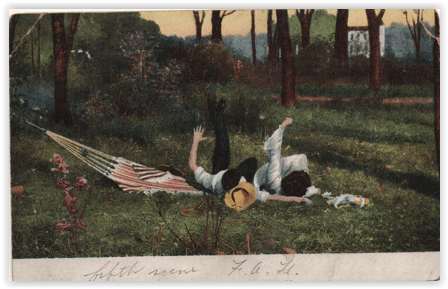
Or happenstance. Um, by the way, was that trunk way over there on the right where the other end of the hammock was attached? You want a little more slack than that, kids. It’s not a trampoline. Well, wait, if that’s what you WANTED…. Anyway, another unrealistic dream of summer romance.
And there is, always, the case of someone just choosing somebody else. (One of three possible endings Ernest Hemingway would allow in cases of true love. The other two involved death. Ernest was a real card when he got down to basics.)
The endings of romance probably fill as many cards as the beginnings: if the second type of card was sweeter, the first waa funnier. Naturally, your friends would be far too polite to tease you about your summer romance break-up, but somehow these did sell.
And, of course, there was no end of advice for the bereaved.
Or passing commentary of great sympathy.
Even if no emotional break-up is involved, there is simply that about the summer romance. Eventually, September came.
Was it easier on the heart to break up before the inevitable day when she had to return to her senior year at West Paltaukey Central and HE was forced to journey miles to his life as a junior at East Paltaukey West Central? A last kiss, many tearful promises, and….
Memories to last a lifetime. Ah well, best get your mind tuned to how much you’ll be able to say in that essay on “What I Did On My Summer Vacation”.
In my boy-days, it was traditional (by which I mean it may have happened three or four years in a row) for school to start today. It was a benevolent system, really, of easing us back into the daily grind. Three days of school, then a three day weekend for Labor Day, four days of school, a two day weekend, and then five days a week until the next legal holiday.
So I thought this might be a nice time to look back at postcards dealing with the summer romance. This was not an invention of modern times. As long as there have been ways to step away from work and/or home for a couple of weeks, there have been interesting romantic opportunities. Let parents and preachers warn against the dangers of giving your heart (to go no further) to someone you saw only fourteen days out of the year, the excitement of people from other places and other walks of life always attracted.
Even if it was just a matter of seventy or eighty miles away: the difference between town and country was far more marked in the days before the radio and television began to homogenize us. There was something piquant in meeting people who dressed completely differently from all your friends, and who not only thought YOU had an accent, but thought that that accent was cute.
Someone you might not have looked at twice back home was exotic in those clothes and with that vocabulary. And, in any case, it was summer.
Many of them had been looking forward to summer, too, and a sweet, no strings attached romance. (Or only strings of their tying.)
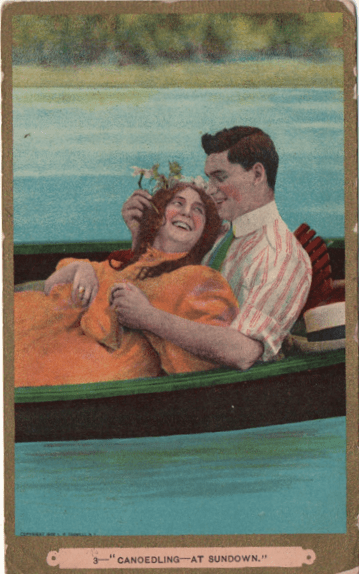
As always, people from the cities loved to go out on the water. Some people go for the swimming, while some look forward to the fishing. More are interested in a long ride, just the two of you, by moonlight, when no one among your elders can, er, correct your pronunciation of the names of the constellations the two of you have rowed out to see.
By the way, this is NOT the source of the word “canoodling”, but I do appreciate this caption writer’s work in the area of punning.
Just about any place your family went on its holidays, though, there were bound to be places your host knew about (and your parents didn’t, and with any luck, neither did theirs), where a young couple could do some serious discussion of current political and social issues.
Natural caution was advised in these matters, of course.























 Blogsy Babbles