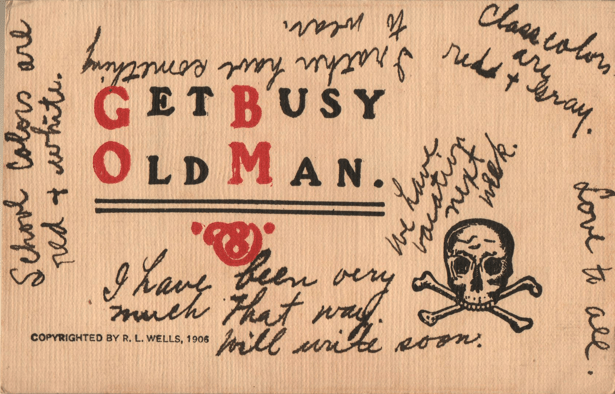
The skull, taken simply as a skull, was unobjectionable: clean and white, displayed on a black tablecloth for better contrast. Matt had seen photographs of skulls before: his mother owned at least a dozen such photos. Before committing murders (to paper), she liked to look at a few pictures to put her in the mood.
But for years she had been using the same photos. She changed them around occasionally: putting one away in the file cabinet and bringing out another. Over the years, Matt had seen them all, and this was not one of them. His memory was quirky, but one thing it could tell him, instantly, was whether he had seen an object, heard a voice, smelled a smell, at some time in the past. Anything he ran across seemed to get filed into memory. On encountering it again his brain checked it against the original, with any differences noted on a mental index card.
Which made him a pretty fair librarian, but also made it very difficult to tell him a joke.
Matt tapped the yellow box onto te desk. He didn’t really mind unusual disturbances. He just didn’t like them interfering with the usual ones. And there was work to be gotten through this morning.
The yellow box got halfway to a drawer. Then he brought it to the center of the desk. The skull picture was flat, down at the bottom of the box, but there was something underneath. Matt pried up the picture with a fingernail and found beneath it a dozen photographs of gravestones, all gray slate and all obviously photographed on a cloudy day.
He could see the stones were old, but didn’t know how old until he read the top one. “Phinehas Van Denover. Death Like a Mighty Quonker Laid Him Low, in1691 Ano Domino.” Poetry and proofreading had made no advances in three centuries.
His mother might have gotten a new assortment, he supposed. But these were not new pictures. They were printed on high quality paper that showed its age slowly, but Matt had handled plenty of pictures, and these had to date back at least a decade.
He looked at the skull again. It looked back. With a shrug, Matt sorted the macabre array back into a pile and pushed the stack back into the box. No way of finding out until he got home. And soon the working world would be staring into his face.
The box was filed away next to lunch, and more important drawers were pulled open for inventory. The paper clips were almost all gone. Lord, that was inexcusable. Civic government ran on paper clips. Everything else in Down might eventually be reduced to a blip of computer memory, but paper clips would go on. Why hadn’t his father invested in paper clip stock instead of squandering money on a bar on Diversey? Shaking his head over history, Matt rose and moved out to Maryann’s corner.
Maryann Hoxey, Executive Secretary, Office Manager, and Mistress of the Paper Clips, was just sliding her purse under the desk. “Morning, Matt,” she said, as she straightened up. She smoothed her skirt. “Cold enough out where you….”
Her eyes went past him, toward the door of Down. “Don’t turn around,” she murmured.
Of course, Matt turned around. The door was closing as a woman all in black leather except for flame red canvas boots strode along the corridor of filing cabinets toward them. She had easily six times as much hair as she had head, wearing it swept back and up, the better to display her ears and the peanut butter lids which hung from them. Her lashes had been worked over to make it appear humans were losing the war with spiders.
Holly L. (which she swore stood for Luya) MacTaggart was the newest of the slaveys at Down. Just out of college, she had stopped over at Down on her way to better things, to which she was entitled because she had a grandfather. She wasted as little energy as possible on her current position, conserving her efforts for the better place in city government her grandfather would certainly buy her.
“Hi-ho, everybody!” she called, swinging one arm up in bright salute.
“How can you be so springy in winter?” Maryan demanded. “It’s perverse.”
Holly chirped with laughter and was opening her sharp little mouth to reply when a voice of pure ice crawled, “Ah, MacTaggart.”
Holly sucked in her underlip and wrinkled her nose, showing that whatever else she was, she was a Down employee. A dark figure draped in an unfastened overcoat that drooped to the floor stepped out of a large cubicle. His hands held a sheaf of paper; his eyes held the gleam of bloodlust.
Walter Prince was not Number One at Down. He was Numbers One and Two and All Rational Numbers Through Ninety-Three Million. Everyone else was a distant decimal. The staff existed solely to give him headaches, which he returned. He knew all his subordinates loathed him; he took it as an indication of his superiority.
“MacTaggart,” he went on, enunciating with gloomy relish, “This summary is so one-sided I’m surprised to find it printed on both sides of the paper.”
Holly gathered her breath. “Why, Mr. Prince, my grandfather likes reports printed on both sides of the page.”
Walter Prince’s eyes opened wide. But he was a deliberate man, and before he pressed down on the detonator, he took in the presence and Matt and the hurried entrance of Linda Szarkowksi, the remaining inmate of the department. Matt watched his eyes narrow; he was choosing the nastiest course of action.
“Here, Benz,” he snarled, showing the papers into Matt’s midsection. “You know how to do it right.” He spun on one heel and marched back into the master cubicle.
Burned by twin glares from the witnesses, Matt could only back away. Peper clips could await a more auspicious moment.
Back in his cubicle, Matt tossed the report onto the stack of work in progress. As usual, Walter Prince would expect this done by last week at the latest. And Down had been understaffed since July.
That was when Charles A. Thaxter, who had previously held Matt’s meaningless position as Assistant to Walter Prince, had been killed by a housebreaker who was never caught. The newspapers had whined about that for a few weeks, claiming that a real reform mayor would have done something or other about upgrading the police department if one of his subordinates was offed. The mayor had fired a salvo in reply, but things never heated up because a complaint about the racial balance of repair crews on the expressways had come up, offering more ammunition, and the death of a longtime city hall crony retreated into the murk of the letters to the editor and then disappeared.
Of Thaxter’s four underlings, everyone’s choice as Least Likely to Succeed was Matthew Benz. So Walter Prince had maneuvered the process so that Matt moved into Thaxter’s cubicle and salary, correctly inferring that thus would alienate the largest number of people. Walter Prince had already begun to regret favoring immediate gratification over Long Range Consequences. Not only had Nelson Ryan, Thaxter’s obvious replacement, resigned in a huff, halving the staff, but Matt himself was very unsatisfactory in the position. Matt was competent, conscientious, unambitious, painstaking, and eager to please. Matt didn’t worry about maintaining the position; demotion would have been a relief, Walter Prince complained that threats and insults seemed to bounce from Benz’s thick skull. His arsenal was reduced to increasing Matt’s workload and turning the rest of Down against the new Assistant, particularly Linda Szarkowski, who had also been ahead of Matt for the position, and Holly, who had started in August to replace another suddenly deceased Downie.
This did not mean he abandoned threats and sarcasm. Not fifteen minutes later, he leaned into Matt’s cubicle to cry, “Lord, Benz! Working? Why risk tarnishing an otherwise shining record?”
Matt knew no answer was required, so he did no more than set down his pen and raise his eyes, awaiting the next disagreeable assignment.
“Got a replacement for Ryan,” Walter Prince went on. “Shows up just in time to qualify for the Christmas Bonus, of course.”
He stepped aside to let a smaller man move into view. “Nairn,” he said, “This is Matthew Benz. Benz, Carleton Nairn. Show him what to do.”
Then he abandoned his underlings to cope as best they could.
 Blogsy Babbles