
As I continue my hopeless quest to figure out why some writers a hundred years ago or thereabouts referred to a handgun as a “roscoe” (I keep waiting for Fatty Arbuckle to be the answer, but no one goes along with it) and my equally futile journey to find out what happened to the form of address “Ms.”, which was controversial in the 1970s and is now included on forms you can request this title but is entirely misunderstood by the modern generation half of whom pronounce it “Miss” and half of whom pronounce it as “Mrs.” The latter is more appropriate, as it misses the point of the word (which is pronounced Miz). I suppose this is not the only example of the survival of a bygone custom for which we have lost…where were we?

Anyway, I ran across the word “pesky” and paused to wonder where it came from. I was pretty sure where I learned it. It was not my parents nor yet my classmates at school. I am positive I picked it up from the fascinating display of vocabulary every time Yosemite Sam exploded onto the little television screen we huddled round in those days before the invention of the Interwebs, the wheel, and fire. This reflection sent my mind back to the rest of Sam’s poetic expostulations, and I went hunting for where his style of English came from.

Some words are self-explanatory. I knew at the time what phrase “dadgum” and “dadburn” were standing in for, and it seems that “lunkhead” derives simply from “lump head”, another synonym for “bonehead”. “Consarn” or “consarned” derive from “concern” and “concerned”, used by Englishfolk for whom “confounded” was too profane. But other words and phrases take more hunting.
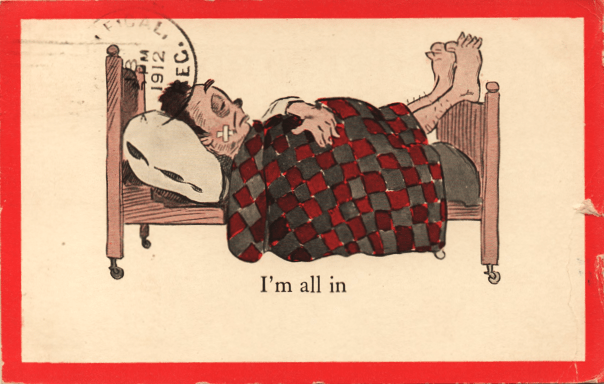
“Pesky” pretty surely comes from the word “pest” which was once just another word for “pestilence”, so that once upon a time pest and plague meant the same thing, which gives us the British “plaguey” as a synonym for “pesky”. Pesky and plaguey are both seen in the late eighteenth century, and were in reasonably common use at the start of the nineteenth. (Keep in mind that Sam is at least vaguely considered a denizen of the Old West.)

Running around the United States around the same time as “pesky” was “varmint”, which I am told is an American spelling of the sixteenth century English term “varment”. “Vermin” were any small animals who just made trouble, and therefore were not protected by any game laws. “Vermin” was plural: one on its own was a “varment”. One authority states that “varmint” is especially at home in Appalachia (which, of course, spent its own years as the Wild West.)
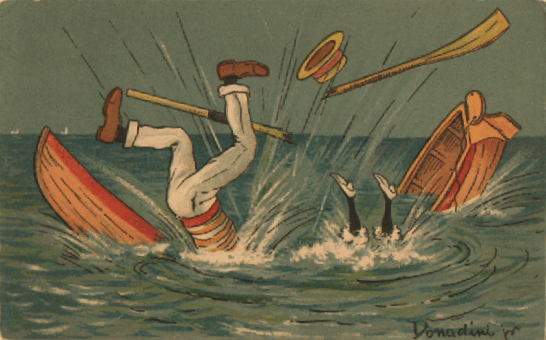
Another of Yosemite Samuel’s favorite epithets is “galoot”, also a staple of Wild West stories and movies. THIS has no such easy answer as our previous endearments. Some people insist it is a reference to Goliath, a large, slow-moving loser. Others derive it from a term for a rookie or clumsy sailor, tracing it to soldiers who made sneak attacks aboard a rowboat called a “galeote”, a small version of larger ships rowed by galley slaves. Since the soldiers were NOT going to be experienced sailors, the term “galoot” came to refer to anyone doing work they weren’t fit for. But still others find the word “galoose”, which meant loose or generally unfastened. We’ll just step aside and let THEM fight it out.

If you want a lifetime career, you might look into “rootin-tootin”. This is found in the nineteenth century, and certainly comes out of what I call the Davy Crockett Tradition. Any western hero would introduce himself with a long string of warning descriptions, often rhyming here and there: the longer and wilder the better. Sam is an honorable continuer of this tradition. (See also Phil Harris’s “Ding Dong Daddy From Dumas”.) HOWEVER, the etymologists (people bugged by words, as opposed to entomologists, who have words with bugs) insist on jumping down every adjacent {Bugs} rabbit hole, including, but not limited to “rooty-toot-toot”, “you’re darn tootin’” (related to “you’re damn tootin’” and just “You’re tootin’”), “sure as shootin’”, “whewtin’ and tootin’”, and….
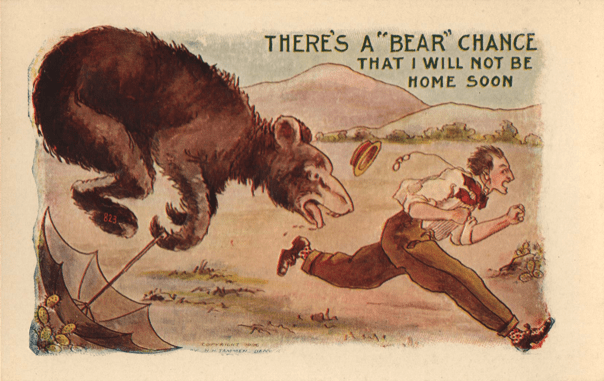
I shall abstain from that fascinating journey. If I devote my life to any of Sam’s explosive remarks, I will study “rackln’ frackin’”, the cartoon equivalent of the comic strips’ “#@##*&!*%*!” Because I recall Muttley, in a competing cartoon, muttering “rassenfrassen” while I believe other characters preferred “rattin’ frattin”” and…it’s one of those pesky things people don’t study nearly enough.
 Blogsy Babbles