
I am not sure we have ever discussed in this space the phenomenon of the pin-up joke, a classic of humor for decades. Of course, you know what a pin-up is: THAT goes back for centuries (possibly millennia, depending on whether those cave paintings and ancient sculptures were offerings to a fertility goddess or just proof of some guy sitting around with paint and clay and something predictable on his mind.) Here, for example, is a postcard of the early twentieth century, demonstrating that a young lady who knew what she was doing could show off knees and curves even in an ankle-length dress.

But we are discussing the pin-up JOKE, a little piece of make-believe in which we pretend the gag is the main point of the exercise. The actual point is the well-formed female centerstage, with the joke and everything else just props, or even after-thoughts. Cartoonist Irby did a series of postcards in which Scottie observes a number of different young ladies and makes a mild remark to give us another excuse to buy the card.

This goes back to the earliest days of postcards for the simple reason that cartoonists had been doing similar things since at least the eighteenth century. We’re not selling naughty pictures, said the cartoonists: we’re making wry observations on human life and there just happens to be a scantily (or un) clad lady in a prominent spot.
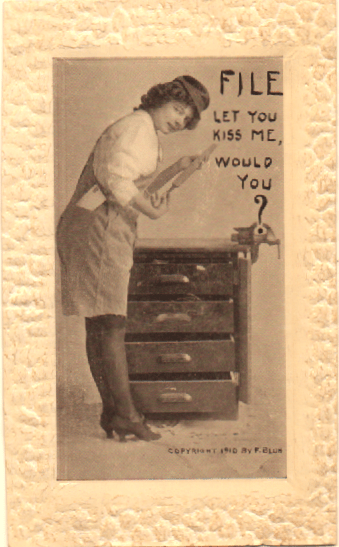
In the early twentieth century there was a popular theme (largely lost by the second half of the century) of photographs showing ladies whose garments were alluring because they were based on men’s outfits. We have examined how baseball uniforms gave several companies a profitable line of gags, and THIS company produced a series showing this young lady dressed for her own style of DIY projects.
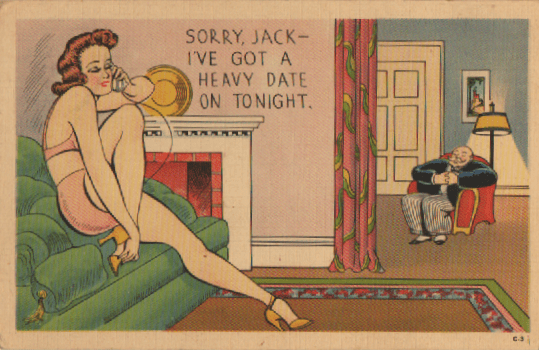
However the joke is framed, we never lose sight of the overall (sorry) plot. The large wealthy chap here is the punchline of the joke. But he is NOT the point of the cartoon. People dressed like the hero of the Monopoly board do not sell postcards.

At mid-century, a heavy sigh about modern fashion did the trick. In the good old days, a customer would complain while paying for a card that was going into the collection and not the mail, ladies were modest.

We must discuss the whole phenomenon of bathing suit pin-ups someday. Throughout the history of the genre, reality was optional. THIS card, for example, was produced at a time when, I have been informed by people who lived through it, women were expected to wear an uncomfortable rubber undergarment beneath their suits, simply to prevent scenes like this.

Of course, lingerie pin-ups were COMPLETELY authentic and true to the era.

A man frequently featured in these gags, sometimes to deliver the punchline but more often as a stand-in for you, the viewer. Or simply as another excuse. You bought the postcard because HE was funny. Right?
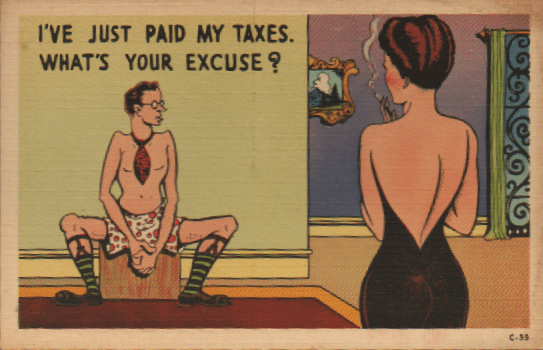
Of course not. No one was going around buying the postcards for the male commentator, even if he was topless.
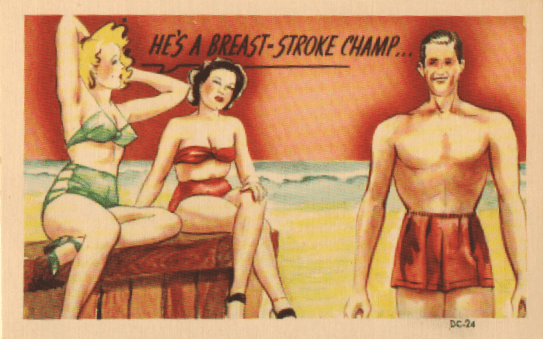
Of course, I have no statistics on this sort of thing. I wasn’t there.
 Blogsy Babbles