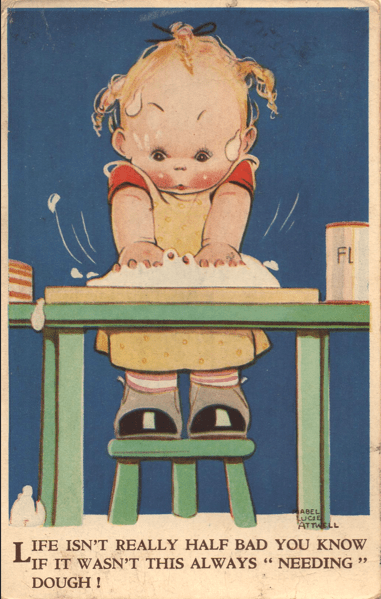
Years gone, when folks ate fresh bread every day, despite a lack of electric bread machines and the Baker Do-Maker, the baking of that bread was vital to the community. Recipes and techniques were handed down from grandparents to grandchildren, and handed down again when those grandchildren had grandchildren of their own. Many of these recipes were similar, of course, varying just a bit from town to town. And every resident of every town knew that the bread of THEIR town was the only REAL bread, the only bread worthy of its crust and crumbs.
Towns in Moraska were known for their excellent bread, but there were regional differences. In Kuczka, the baker added poppyseed to the bread dough, while in Kucera, caraway seed was used. To those of us far from Kucera and Kuczka, this may seem trivial, but it led to arguments every year when the two villages held their great market fair. Each village took its turn providing bread for the fair, but those years that the bread had caraway seed, no one from Kuczka would eat it, while in the other years, people from Kucera turned up their noses. This meant hungry marketgoers, and hunger leads to anger, so unfair words were inevitable on fair days, no matter which bread was brought.
Eventually, the mayors of the two towns talked it over, and announced that this year, bakers from both villages would bring dough to be baked the morning of the fair in the massive ovens always erected for the Great Market Fair.
“And so no unpleasantness can result,” each mayor told his village, “THIS Great Market Bread will contain NO seeds of ANY kind.”
People marveled at the simple wisdom of this decision, and the master bakers nodded in agreement. “Very wise is our mayor,” The Master Baker of Kucera told his assistant. “I’ll wager the Mayor of Kuczka never thought of that.”
“No seeds at all: it’s genius,” said the Master Baker of Kuczka to her helpers. “Obviously, OUR mayor thought of that. No one in that hamlet of poppyseed-eaters would have come up with it.”
As the day of the Market Fair approached the mayors the mayors reminded their bakers again and again, “The bread for this Fair must be the best bread available. Without seeds.”
“Without seeds,” said the Master Baker of Kucera.
“Without seeds,” said the Master Baker of Kuczka.
Each baker used the finest ingredients in stock, and mixed up a goodly batch of dough, to be taken to the fairgrounds. But as the dough was being packed into the wagons, each baker paused to consider.
“It won’t really be bread without poppyseed,” murmured the Master Baker of Kucera. “I can put in just a few. Then, when the bread is kneaded, I’ll set aside those loaves for people who know real bread when they taste it.” And he mixed in a bushel basket of caraway seed to his dough.
“I could make just a few loaves with caraway,” the Master Baker of Kuczka told her chief assistant. “Mix some seed in at this end of the dough, and we’ll see to it that that bit goes to the real bread eaters.”
“How much, Mistress?” said the assistant.
“Two bushels,” she told him.
So it was a pair of guilty-seeming bakers who rode with their bread dough to the fairgrounds, and set it in warm spots to raise and rest. The mayors nodded to the bakers, and then to each other, knowing that this year, at least, there would be no fighting over ingredients.
Two mounds of bread dough were quickly raised into mountains, with the warmth of the ovens and the sun becoming two and then three times as big. “Now,” the mayors announced to the crowds who had come around the ovens just to see thus amazing seedless bread, “To show how our two communities get along, all the raised dough will be kneaded together into one great ball of dough.”
“Oh dear,” thought the Master Baker of Kucera.
“Uh-oh,” muttered the Master Baker of Kuszka.
The bakers ran with their assistants to the bread dough. “Here, let us do the hard work,” said the Master Baker of Kucera, hoping to pull out the dough with poppyseed.
“No, no,” said the Master Baker of Kuczka, thinking of the caraway, “We’ll take care of it.”
“I insist,” said the master Baker of Kucera, stepping between her and the mountains of dough.
“So do I,” she replied, giving him a little push.
One of his assistants took up a big stirring spoon and swung it hard between her shoulders. One of her helpers snatched a ladle from one of the nearby soup pots and bashed it down into the other assistant’s ear.
The kitchens were right in the middle of the fairgrounds, out in the open, so of course everybody could see at once what was going on. “What’s going on?” demanded a rhubarb farmer, more to make conversation than anything else.
“Those cooks from Kuczka are poisoning the bread!” cried a parsnip salesman from Kucera.
“Nothing of the kind!” snapped a beer merchant from Kuczka. “That’s swine of a cook from Kucera was throwing rats in the soup!”
The rhubarb farmer and the parsnip vendor clutched at this man’s neck, but a farmer from Kuczka, seeing this, planted a fist square in the face of the parsnip man. A butcher came running with a knife, but tripped over a basket kicked between his legs by a plumseller.
In no time, people up and down the fairground were punching, kicking, and elbowing each other. As newcomers arrived at the Great Market, they located fighters from their village, and joined the melee. Screams and curses rose like fog of the fairgrounds.
And all this time, two mountains of bread dough continued to rise. Soon there was no room for two balls of dough, so they pulled together into one while the people around the ovens were busy observing that this year’s Fair had gotten to the exciting part much earlier than usual.
“This would never have happened if your baker hadn’t been so pushy,” shouted the mayor of Kucera, clinging to his hat as the battle raged around him.
“Our baker?” demanded the mayor of Kuczka, kicking him in the shins. “What about your baker?”
No one in the crowd paid much attention to the actual bread they were fighting about. So not one of them noticed that a bubble in the dough popped out a big shape kind of like an arm, and another a leg. They continued to roll in the dirt of the fairground, clawing and spitting, until they could not ignore a cold, dark shadow.
The first to see was the Master Baker of Kuczka, who screamed. This was not unusual, as she had been screaming for some time, laying about her with a bread board. What she screamed now, though, was “What is that?”
People looked where she swung the bread bord. Those not already on the ground fell to it. Teller than the trees surrounding the fairgrounds, smelling of yeast and radiating heat, was a blobby giant with eyes that scowled down at the crowd.
“What is it?” the people whispered to each other. “What is it?”
The Mayor of Kucera rose from the crowd, looked for his hat, and then decided to forget about it. Raising his face to the giant, he called, “What are you? What do you want?”
“I am bread of both of you!” the giant said, setting fat hands on doughy hips.
The people waited for more, but when there was no more, the mayor of Kuczka, wiping dirt from his face, called “What are you doing here, Master?”
A great yeasty wind came from the giant’s mouth. “I am no master. I am bread. I do what I am made to do. You made me; you command me.”
One big hand came up to spread over the fairgrounds. “I can grow larger. Each pf my feet could crush your villages to sticks. My hands can lay waste your fields. I can choke every one of you. I can leave your children hungry and homeless in a wasteland.”
The hand came down to its hip again. “Or I can be made into loaves, to feed everyone. You made me: it is your decision. The seeds of both results have been sown.”
“Seeds,” murmured the mayors.
“Seeds,” sobbed the master bakers.
Everyone knew in the same moment that this was their bread, and the argument they had put into it. The giant had spoken yeasty truth: they could let the argument grow until it destroyed both villages which would, of course, deprive the world of two mighty fine bread recipes, among other things.
“Loaves!” screamed the Master Baker of Kucera. “Leaves of bread for everyone, even if it has SESAME seeds in it!”
“Let it be loaves!” cried the Master Baker of Kuczka, looking to the two mayors.
“You are sure you can have it that way?” came a question on the yeast.
“Yes!” cried farmers and merchants and mayors.
“As you need.”
The blink of a rabbit’s eye, and the giant was gone. There was no bread dough anywhere. But a familiar aroma brought people rushing to the bread ovens, where they found hundreds of golden loaves, ready to be turned out. Half of these held caraway seeds, and half poppyseed.
“Gimme some of that caraway bread,” said the mayor of Kuczka. “It’ll be strange, but better than bread with no seeds, I guess.”
“Or no bread at all,” agreed the mayor of Kucera, still checking the sky above to be sure the giant was gone. It might be that each man was thinking if the giant came back it would be beast to eat the other village’s bread away first, but they smiled, and raised buttered slices of competing loaves.
And so it was that the villages of Kuczka and Kucera added to the usual adventures of a great festival, as they do to this day, the adventure of sampling their neighbors’ bread. The seeds of discord were not allowed to grow, and both breads are now baked in both villages, without any hint that preferring one seed over another signifies any lack of mental capacity or moral rectitude.
Mind you, there’s still that argument about putting ketchup on fried eggs at breakfast. But you should eat breakfast before setting out for the Fair.
 Blogsy Babbles