In the damp northern land of Tarrefol, a young man named Lyall worked as a shepherd. Every day, he took his village’s sheep to the hills north of town where they could feed on the green grass.
His job was to see that at least as many sheep came home at night as went out in the morning, and that all of them were fed. He kept the lambs and the older sheep from being pushed away from the tenderest grass by the sheep in their prime. It was his duty to nudge sheep back from pits or high rocks. And he had to have an eye out for people or wolves who might try to steal a sheep. His was a job which called for a deal of sitting and watching, which Lyall varied from time to time by standing and watching.
One morning, he found that a mighty rain had washed dirt and grass down from the hills. Lyall and the sheep had to go much farther north to find enough space for the whole flock to eat. Even there he found new gullies that had washed dirt down toward the village, and rocks which had been exposed for the first time in ages.
But there was grass enough left for a sheep’s content. Lyall mostly stood and watched here, for the sheep always managed to find a way into trouble in a new place. Sure enough, it wasn’t long before he heard a terrible ruckus. He hurried over to where a ram was thrashing about, and found it had both hind legs stuck right into the ground. The earth had been washed so thin at this point that the ram, just by walking over it, had broken through into a cave underneath.
The ram didn’t help much bucking and bawling as Lyall tried to haul it up without himself falling into the hole. He heard other sounds besides those made by the ram but had no time to worry about them. It did, though, sound a little like people shouting.
Once the ram was freed, Lyall gave it a shove in the direction he felt it should go. Then he knelt and peered into the hole in the ground, to make sure one of the lambs hadn’t fallen in first. The sounds he heard might well come from a small sheep crying out, and making echoes underground.
His eyes went wide and his breath came fast. In the shadows below were great grey chests covered with moss, but standing open and filled to the brimming with bright gold. Around these in the dirt sat gold cups and gold plates, golden bells, golden armlets, gold necklaces, gold chains, and the golden crowns of a dozen kings. Lyall might well have climbed down for a closer look, had that been all he saw.
But a shepherd needs to have eyes that see plenty, and what else Lyall was seeing was more eyes. Squinting, he could just make out the faces going with those eyes, little wizened faces. Lyall understood at once what had happened. The ram had broken through the roof of a cave that belonged to the little people of the hills. Sunlight now poured in through the gap, and the little people could work no magic.
“Well, you have a problem there and no mistake,” he called down. “But not to worry, good people. You’ve stolen none of my sheep, and I’ll be stealing none of your gold.”
Lyall made more than a promise. Moving around the hill, he took up twigs and sticks which had blown down in the storm. These he wove into a broad framework, a little bigger than the hole the ram had made in the hill. He smeared this framework with mud and carried it back to the hole.
“There you be,” he said, setting it down, “You can be sleeping again now. Night is the time for your waking.”
“True enough,” said a rough voice.
Lyall turned to find a small man dressed in grey and green, and wearing a red mustache as long as the man was tall. The little fellow was studying the patch in the hill. Paying no attention to Lyall at all, at all, he walked three times around the framework, murmuring “Soooo. Soooo.”
After the third turn, he stopped and looked up at Lyall. “It’s never so neat a job as we could do ourselves, understood, but it will no doubt hold until nightfall. Now I suppose you’ll be wanting some gold.”
The little man moved the patch a bit with one foot so Lyall could see the treasure again. “It’s the rule that you can ask us for any of it, or all of it,” he said. “I’d suggest you leave us a little, though, if you value our good will.”
Lyall shrugged. “What would I do with so much gold? How could I be carrying it, and where would I be putting it? And how would I be explaining where it came from? I can’t deny that a bit of gold now and then would be handy, but there’s a power of trouble in taking so much.”
“Take a little, then,” the man told him. “For you’ve done us a service and we’re in your debt. And if there’s any one thing we like less than a mortal stealing our gold, it’s for a mortal man to be putting us in debt to him.”
“Well, if you must be giving me something for a neighborly act,” Lyall replied, “I would not have you breaking your rules. But does it have to be gold?”
The little man stood back, hands on his hips. “No gold? Soooo. Soooo. What’s it to be, then?”
“Teach me to whistle,” said Lyal.
Now the little man took three steps backward. “Lad,” he said, “The world has changed for the worse since we started living in our castle down below. In my day, every lad in Tarrefol could whistle.”
“And so I can whistle,” Lyall retorted. “I can whistle to call a dog, and I can whistle a tune and recognize it when I hear myself whistling it. But my dad and my grand-dad could whistle to break the heart. They could whistle the birds down out of their very nests or whistle a song to make you think the sun shone in the dark dead of winter. And I’ve never been such a whistler myself. Can you teach me such a thing?”
I can give you that power,” said the little man, with a shrug. “But you’ll need to be coming back at night, since I can work no….”
“All I want given me is lessons,” Lyall informed him. “Don’t give me the power. Show me how it’s done, so I’ll know what I’m doing when I’m doing it.”
The little man grinned, which made the tips of his mustache bounce up. “You drive a hard bargain, my lad. Is it watching sheep all day a young man like you should be doing?”
Lyall shrugged. “Why not?”
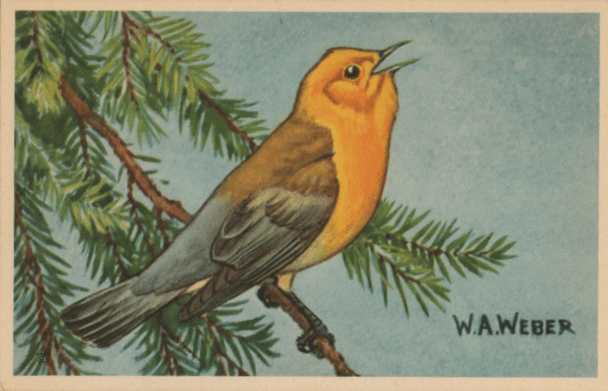
The little man said no more on that subject, but sat right down over the patch in the hill, and taught Lyall to whistle. By the end of that day each sheep bore on its back forty birds that had come down to listen.
“It’s a passable whistler you are, lad,” said the little man, as the sun slanted down.
“That’s fine,” said Lyall. “That’s mighty fine. Now I’ll have to be getting the sheep back.” He whistled a little tune and the birds whistled it back to him. “Ah, it’s a diner thing than gold you’ve passed along to me.”
“It is that,” the little man said to himself, watching Lyall herd the sheep down toward the village. “And because you had the wit to ask for music instead of gold, you shall have both.”
For days after that, Lyall herded the sheep as he’d always done, knowing nothing of the little man’s promise. To be sure, he had more visitors than before. People coming along the road, who had thought to pass the herd of sheep, would pause in their passing to listen to what sounded like the rose of all birds. More than one walked carefully between the sheep to ask Lyall to show them how to whistle that well. Knowing himself to be no more than a shepherd, Lyall never considered the possibility that there were more important things he might be doing. He’d give a few whistling lessons to anyone who asked, keeping his eyes on the sheep all the while.
And when one of his students tried to pay him, not a coin would he take, be it copper of silver or gold. “A pity it would be if there were one soul in Tarrefol who could not whistle,” he’d say.
And never did he see the little man with the red mustache, hiding among the rocks, murmuring, “Soooo. Soooo.”
The people took to calling him Lyall Whistle-Lips, and many’s the time he was called to a dance at the village or at the manor house, to whistle a tune now and again while the fiddler’s fingers rested. Not a penny would he take for that, either. “I walk into more dances than any shepherd in the land of Tarrefol,” Lyall said. “I dance when I will and eat my fill. What more could I possibly honestly ask?”
And he never noticed a little man outside the door, stroking a red mustache and saying “Soooo. Soooo.”
This made Lyall very popular, but it did not exactly make him a respected citizen. Any man who would turn down money honestly offered was little better than a fool, particularly when, with all that skill, he went on herding sheep. It was thought that, at the very least, he could buy a few sheep and go into business for himself. And of course he was no one’s choice for a son-in-law, and no woman really wanted a husband with so little money and less ambition, a man who seemed to want no more than to watch sheep and whistle his days away.
The only person who took Lyall Whistle-Lips seriously was the King of Tarrefol himself.
The King had difficulties with his only child, a daughter named Fianna. Princess Fianna was a beautiful and dutiful daughter to the King, but on one matter they disagreed. Fianna knew she was to be Queen, come the sad day when her father died. When that day came, she planned to be an unmarried Queen. The Kings from all the countries around Tarrefol would come in solemn procession then, offering gifts of jewels, rich clothes, and golden chains as they asked for her hand. She liked this idea.
Anything else her father asked of her, she was willing to perform, from hosting feasts to judging cattle. She wanted to be a real Queen, so she studied history, floriography, onomastics, and other sciences so she would understand the many things it was necessary for a Queen to be knowing. But she would marry no one.
The King worried about all of this and finally took himself to a quiet part of the garden. For centuries, whenever a King of Tarrefol had an especially sticky problem, it was the custom to resort to a magic well tucked away there. If the monarch dropped in a gold piece, one of the little people from the hills would appear, to answer questions. For rather more gold, the little people might actually help out with a magical favor or two. The King didn’t know if he was quite as desperate as all that yet.
So the King dropped his gold coin int the well and soon a little man all in grey and green, twirling a long red mustache, stood before him. The King told him all about Princess Fianna, and asked his advice.
“You need no advice,” the little man said, “For you have no problem. The next man the princess kisses will be her husband.”
The King was so happy to get a straight answer (the little people had been known to talk in riddles) that he kicked his heels and went running back to the castle. Knowing how stubborn Fianna could be, though, he told no one at all what the little man had said. Well, no one but his Prime Minister, who, besides being his most trusted advisor, was the sister of his dear, departed wife. She told no one about what the King had said. Except for her husband, who told no one but the Captain of the Guard, who swore to keep it a secret. And yet somehow the story got out.
And Fianna never so much as puckered her lips for weeks after this, lest someone should sneak up and kiss her. Even when a page boy slipped her a glass of straight lemon juice at breakfast one morning, not so much as a pucker did she make. The King was frantic. So when he heard of a personable young shepherd called Lyall Whistle-Lips, he wondered if this lad might have the answer to his troubles.
He sent for Lyall, who found someone to take care of the sheep that day, and explained the problem. “Now what I want you to do, Lyall, my lad,” the King said, “Is teach the princess to whistle, as you have taught the others. When the time is right, and her lips are puckered up tight, you’re to dive right in and kiss her.”
When Lyall looked surprised, the King leaned in to whisper, “You see, my daughter doesn’t understand these kings, but I do, more then half of them being cousins of mine. And if, when I die, my Fianna has no husband, they’ll likely come with armies, not gifts, and any chains they set on her will be far from golden.”
Lyall scratched his head. “And you’re thinking I might frighten such men away?”
The King looked the shepherd up and down. “Well, they’ll not be seeing you; they’ll know only that there IS a husband, and hold off. Still, if you don’t like the idea of marrying a Queen, you’ll at least be getting her to pucker her lips, and some man with more determination may make the attempt.”
Lyall shrugged. “I will do as you ask, Your Highness. I can’t say as I believe kings can be quite so foolish as you tell me but, to be sure, you know your family better than I do.”
The King clapped his hands and called for the Prime Minister to take the shepherd to Princess Fianna’s Tower. “And leave them alone there,” he went on. “Lyall Whistle-Lips has some very important things to teach her.”
Princess Fianna’s eyes flashed when she heard what her new tutor was there to teach, for she knew at once why her father would want her to work on this craft. But the shepherd lad was pleasant enough, and hardly to blame for her father’s plotting, so she reached out a hand to his and said, “Good morning, sir.”
Lyall said nothing. Princess Fianna was by far the most beautiful woman he had ever met, though he had been to dances in a dozen villages and half a dozen manor houses. Her eyes were brighter than the sun at sunrise, and the sheen of her hair stood out brighter than the dew on the grass of a spring meadow.
“I understand you’re the finest whistler in all of Tarrefol,” the Princess went on, “And that His Highness my father wishes me to learn the art. I’m sure I don’t mind that. But you will please oblige me by turning your back to me during the lesson, and standing in that corner of the room.”
By this Lyall understood that the Princess knew about the sort of trick the King expected him to play. Since he had not cared much for the idea of kissing someone who did not want to be kissed, he agreed. “Still and all,” he said, “It will be a power of difficulty teaching anyone to whistle that way.”
“Nevertheless, that’s the way you’ll be doing it,” Fianna told him.
Lyall nodded. To be sure, it would not have worked the King’s way. If the little people spoke truth, his kissing the Princess would have made little difference. It was the man she kissed that mattered, not the man who kissed her. And if by some chance, the Princess did decide to kiss him, it would hardly matter which way he turned.
To the Princess herself, he said “When we finish, you should be whistling like this.” And he whistled a bit of “Wolf in the Sheepfold”, a popular tune in the dances around Tarrefol.
Fianna enjoyed the song very much indeed, but didn’t like to be saying so with that bright face still pointed at her. “That was pretty, to be sure,” she told Lyall, “But I can’t see why I should be after learning any such thing. If I need any whistling done, I can be sending for you.”
“Why, if that is the case, then I can be off now and not be the cause of wasting any more of your time,” said Lyall, taking a step toward the door. “Strange it is to be meeting someone in Tarrefol who cannot whistle, but I suppose there is so much other music in a castle that you have no need to whistle.”
Fianna frowned. “And do you all whistle, then, down in the villages?”
“That we do,” said Lyall Whistle-Lips. “Everyone in Tarrefol can whistle.”
“I’ll not be the only one who can’t then!” said Fianna. “But I wonder why it should be that all the people whistle. There was nothing about this in my history books.”
“Well, now,” said Lyall.
Taking the princess’s hand, he walked over to a window. From here they could see two or three villages among the hills, and several flocks of sheep with their own shepherds. And he whistled her a little tune of the cottages they could see, of hungry winters and the freedom of the thaw. Hot summer days came into the tune, and autumn days at market. He whistled her the clouds rolling across the sky as you sat watching sheep, and the rolling of your collar when the clouds turned out to be rain clouds.
Fianna looked at him wide-eyed, and then out at the villages below. And when he’d whistled up all the days’ life outside the castle, she reached up to take his face between her hands, and she kissed him.
Lyall, startled, stepped back a bit. But then, with a laugh, he stepped back to where he’d been and kissed her in return.
“Oh!” Fianna cried, remembering what all this was about. She looked behind her, but saw no one else in the room.
She turned back to face Lyall Whistle-Lips. “Don’t tell!” she whispered.
“I will not,” said Lyall, without hesitation. “I am not bound by what is said by the little people in the hills, nor such a fool as to wish to marry someone who does not wish to be married.”
“Oh, I’m not worrying about that,” she told him. “It suddenly seems to me that a man at hand might be better than any five kings in the bush.” She tossed her head to throw her hair back a bit. “But I’ve not learned to whistle yet.”
Teacher and student puckered their lips again, never noticing at all a pair of eyes or a long red mustache, or a voice that murmured “Soooo. Soooo.”
 Blogsy Babbles