
In our last thrilling installment, we were discussing collectibles, and how collecting said collectibles, especially those which are produced as collectibles, is subject to change without notice. And it occurred to me that I have a few examples of what was once the hottest collectible in the market: the trade card. Not to be confused with “trading cards”, these were largely postcard-shaped advertising pieces which went from being a cheap way of advertising your goods to the burning rage of collectors and then forgotten scraps of paper in the 19th century. These must not be confused with the advertising postcard, seen above, which was mailable.

The trade card, see, predated the days when mailing cards was as simple as pasting on a stamp and dropping one in the mailbox. They began somewhere in the distant reaches of time (some of the ephemera printed in the fifteenth century might count) but until the 1870s or thereabouts were primarily simple printed cards with text (which your ardent trade card collector considered mere business cards). Then, new cheaper color printing made it possible to do something that was pretty on one side.
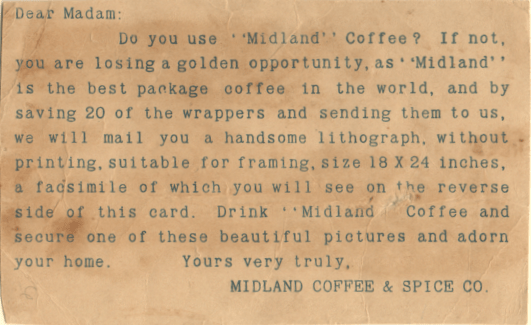
And contained your ad on the other.

These ranged from highly expensive, thoroughly colored embossed items to cheaper ones like this one, which has obviously been cut from a larger sheet. Some businesses bought these printed sheets and then put their business’s ad on the back (this variant appears on the back of a card with the same picture. Going straight to the child was NOT an idea limited to the twentieth century. Asking kids what kind of coffee they like seems to be a nineteenth century thing, though.)

Any business that could scrape up a couple of bucks to print cards went into the trade: funeral homes, baseball teams, laxative makers….everyone wanted in on it. Because Victorians, it developed, were fanatics about pasting things in scrapbooks. So many people yearned for the pretty little cards that companies completely flipped their ad strategy. Trade cards started as handouts to advertise your wares: at the height of the craze, you advertised your wares by letting people know you were giving out trade cards. Savvy sellers put trade cards INSIDE the package (leading to the development of cigarette cards and bubblegum cards.)

Businesses willing to put more money into the cards began to publish series (gotta catch ‘em all)–pictures of the Presidents, illustrations of famous poems–often having nothing to do with the product. Some, on the other hand, were like Fairbank Lard, which went fully into trade cards featuring cartoons and verses to show how badly pigs wanted to become QUALITY lard.

Some cards did feature calendars or coupons on the back, but the trade card had become something produced solely for collecting and pasting in scrapbooks. (The trade card itself was merely the tip of the scrapbook iceberg. Thousands of scrapbooks were assembled, and, going the trade card one better, some printers simply advertised packages of “Scrap”: pretty pictures for cutting and pasting. A museum out east boasts a set of scrapbooks believed to be haunted by the original owner, who may still be trying to add more scraps.)

The fad died at roughly the same time as Queen Victoria, and the culprit is an old friend of ours. Postcards were moving in: unlike trade cards, postcards could be MAILED to your friends in distant places without putting them in an envelope, making the swapping and scrapbooking even more alluring. Kids scorned their parents’ manias and flocked to the newfangled collectible. So did businesses. The advertising postcard continues to this day, though the postcard collecting craze of the early twentieth century was itself succeeded by other collectibles (Dixie Cup lids, say.)

However, if you look around, you can still find things shaped like postcards which are not made for mailing but for picking up and putting in a safe place.
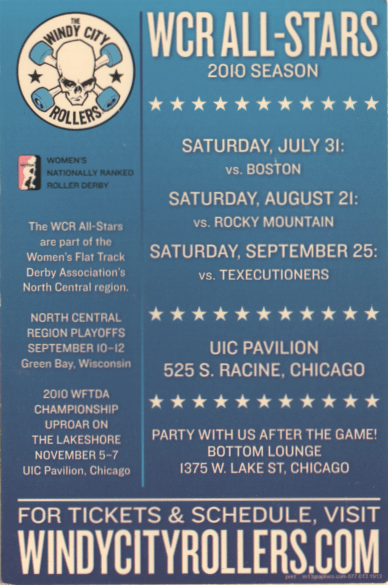
So if the last thrilling blog made things sound hopeless, remember: Old collectibles never die. They just collect dust for a while.
***
(Fair’s Fair note: the alternate—second—flipside of the Midlands Coffee card, which features the same little girl and St. Bernard, is offered for sale by Obscura Postcards, while the alternate message from Hatchet Baking Powder, which is on the back of another picture entirely, is currently on sale by Emeralds Books and Treasures. Everything else here can be found for sale by the author, at time of writing.)
 Blogsy Babbles