
Once again, dear reader, your faithful bloggist has come through. Prompted by the seventh online expert in one week to tell me that the original jack-o-lantern was carved from a turnip (something they told us every year in grade school, thank you all) I looked up one or two questions no one was telling me about. These are of no use to you at all, but the Interwebs would not loom so large in our lives without that sort of information.
Whilst eating popcorn, a major part of my healthy diet, I wondered if people still refer to the unpopped kernels as ‘old maids”. The quick answer is that yes, they do, in spite of warnings I found online for people learning English as a second language that this phrase is considered offensive in some places.
The phrase derives, of course, from ‘old maid’ as a term for a spinster or unmarried woman, which became current somewhere during or before the fifteenth century. HOWEVER, in spite of those not very fine old jokes inevitably made about the kernel being unpopped, the older phrase is only the first step. There is another old maid which needs to come first.
In the 1830s, the world was taken by storm with a new game by Eliza Leslie. It was played with a regular deck of cards and, if girls were playing, was called Old Maid, but Old Bachelor if it was played by boys. The game had its day and was starting to fade when in 1883, a publisher brought out a version with a special deck of cards with funny characters on them. This game was called Merry Matches, but was so similar that it took on the name(s) Eliza Leslie gave it.
Around the same time, those unpopped popcorn kernels got their nickname. My own guess is that this came about because people ate popcorn and played games on family evenings. Historic slang dictionaries indicate that in some places, the unpopped popcorn was called Old Bachelors, which I think shows the line of descent from the original Old Maid (who was not expecting….. let’s move on.)
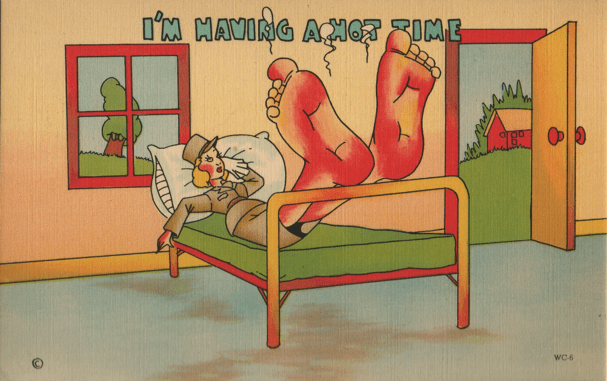
I also wondered whether anybody still makes jokes about needing their “beauty sleep”, and when we started using THAT phrase. I had to fight past all the Beauty Sleep and Beauty Rest mattresses, but it turns out the phrase is even older than the old maids.
It starts appearing in the 1810s and 1820s and even in those days was used primarily as a light-hearted joke. This was an era when parties often started around midnight and ran for several hours, and a nap was often resorted to around 7 P.M. (Only a few people–influencer…well, writers—took it seriously declaring, that sleep before midnight was better for you than sleep after midnight.)

And then I worried about this postcard, and that spelling. It is entirely legit.
A Scottish term, Colsie, first recorded in the seventeenth century, meant much the same thing. It went on to be spelled Cozy, Cosy, Cosey, Cozie, or anything else within reason. In the 1850s, some ingenious soul made a verb of it, and to “cose” meant to make oneself comfortable, alone or as one of a couple. A generation after THAT, people turned it into a noun, as a knitted cover to keep something warm—a tea cozy or, less often, an egg cozy.
Where would the Interwebs be within controversy, though. Online, where an expert is defined as “anybody with a blog”, there is argument over whether ‘cozy’ led to the word ‘cushy”, meaning something simple and no problem that the person at the next cubicle got as their assignment. One or two experts claim they are closely related, if not actually mother and daughter.
MOST dictionaries, however, claim they’re barely acquainted, saying that ‘cushy’ was originally a military term employed by the British Army in India, where the Hindi word ‘khush’, which also gives us “cushion”, was used to mean either an easy job or an easy-going person. (Or simply a weakling, depending, apparently, on the tone of voice of the speaker.
So you are now in possession of a load of data at LEAST as important to your daily life as that business about turnips (and, by the way, nobody to this day has answered the question that fretted me as a child: were they really big turnips or really small candles?)
 Blogsy Babbles