
As you will of course recall from our last thrilling episode, we were considering what vintage postcards had to show us about women in the workforce, especially in jobs traditionally associated with men. The main conclusion we drew from the examples was that the postcard artists were less interested in reviewing current societal norms than looking for an excuse to produce a card which people would buy.
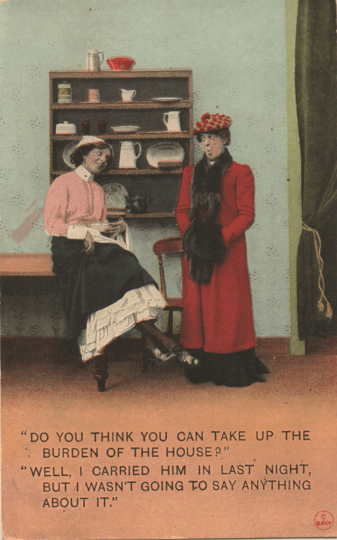
We can see that in postcards covering more traditional female jobs as well. This card, for example, has less to say about the roles of men and women or jobs for female workers than it was an excuse for a good old Bamforth gag. (As this is a Bamforth card, the lady on the right is almost certainly being played by a man. But a discussion of cross-dressing in postcards is a whole nother blog.)
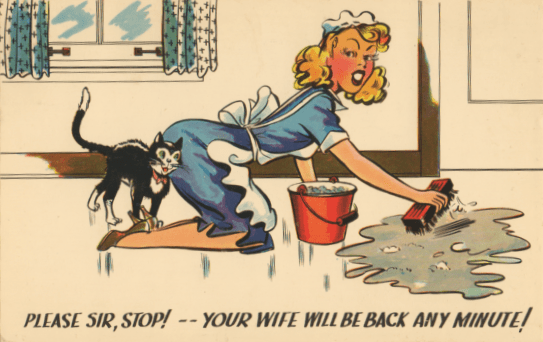
And this artist was not making a comment on the indignities endured by servants. The card was going for the double market for cards with shapely women on them AND cards with cats.
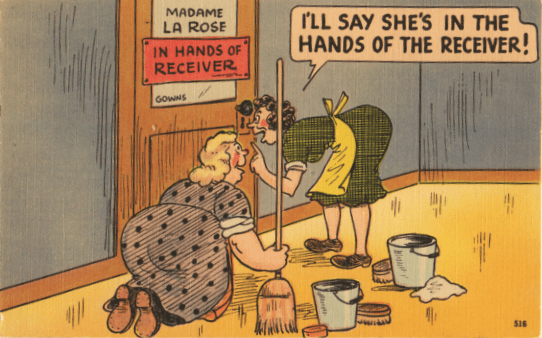
Women who indulged in cleaning floors in larger operations were generally large and ungainly…and watching through the keyhole. The ideal customers for this card weren’t looking at the cleaning women but wishing they could see what the women were seeing.
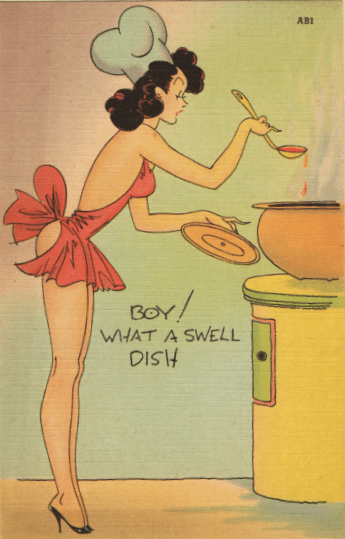
Cooking, of course, was as homely a job as cleaning the floor, whether at home or for a larger concern. (Surely she wouldn’t be wearing a chef’s hat at home, where she could be less formal in her attire.)
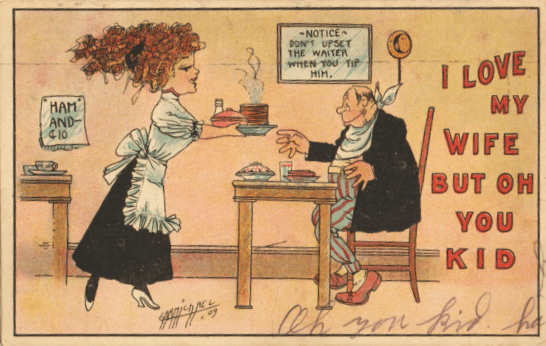
While the pretty waitress was as standard in postcards as in popular song. (The waitress snarking back at travelling salesmen at lunch can be seen in “My Mother Was a Lady”, a hit from 1896.)
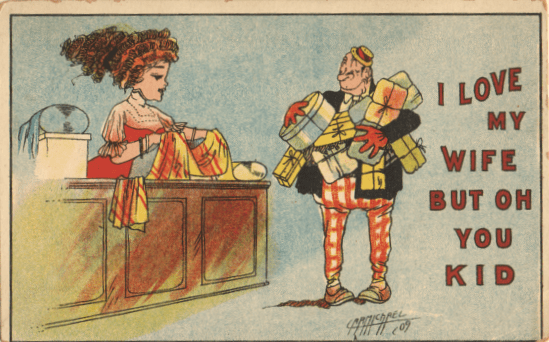
And the attractive shopgirl was also a staple in pop fiction and postcard jollity.

All of these stock characters were familiar to the potential buyers, and made the joke easy to understand and appreciate. That meant a sale. Exactly how many businessmen were sent postcards featuring an elderly executive hiring a charming secretary cannot be estimated. What the businessman thought of this, especially if the card was sent to the office by his wife, is also lost to history.

Therefore, in search of postcard purchses, artists did not neglect the nurse….

The schoolteacher….
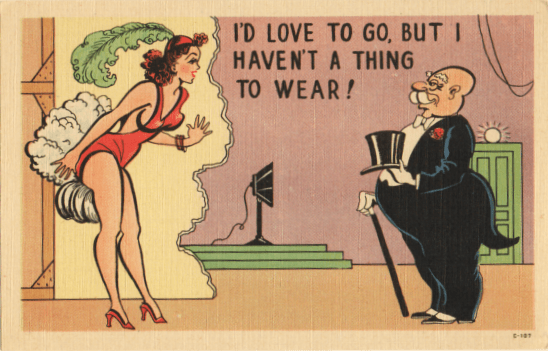
Or the showgirl. What we can pick out of these little tableaux depends more on our own angle when we seek historical data. We must remember is that the artist was not striving to preserve an insightful or even accurate picture of conditions at the time. In looking for a gag that would help them pay the rent, they did hold up a mirror to the thoughts in their heads, which reflected times they lived in. But, like a mirror, what they show should not be taken as a perfect picture (the best mirrors still get everything backward.)

So we must try not to read too much into their depictions of women pursuing their professions. The things you see depend at least partly on the thoughts in YOUR head.
 Blogsy Babbles