In the golden wage, when there were no cats, and geese occasionally laid expensive but inedible eggs, a woman known to her neighbors as Madame Klotsch owned a very successful apple orchard. She sold apple cider, apple fritters, apple chips, apple dumplings, apple pies, and, when the occasion arose, plain apples. And because Mistress Klotsch was the kind of person who liked things precisely perfect, her goods were good goods, and she did very well for herself.
She made so much money one year that she started in to think about moving into other areas of commerce. “I wonder,” she wondered to herself, “If a body fed apples to a cow, would one get apple butter?”
Mistress Klotsch resolved to send her son, Coffey, to the market in town to buy a cow. She could not do this herself because that would have left Coffey to tend the apple stand. Coffey was a good boy, but kind of worthless, really. He sat around a lot, reading books; when in charge of the apple stand, he tended to get so deep in his book that the neighbor kids would sneak up and swipe dumplings. Books and swiped dumplings were not what had made Mistress’s Klotsch’s Apple Stand the landmark it had become.
So she counted out the money carefully, tied it up in a handkerchief, and handed the bundle to her son. “Sin,” she said. (She always called him “son” in the hopes this would make him brighter.) “Son, take this to the market and buy a cow. Get a nice brown one to match the trunks of our trees, and be sure to ask for a good milker. I’d try at Tattersall’s first. They’ll likely cheat you less than anyone else. And don’t talk to strangers.”
Coffey set off down the road, carrying a book to read on the way, as this was the golden age before cracked sidewalks and traffic lights. He was just getting to an exciting part in the story when a voice called, ”Howdy, son! Off to market?”
Looking up from his book, Coffey saw a tall smiling man who was walking the same direction. “Yep,” said Coffey.
“My name’s Dave,” the man said. “I’m walking that way myself. You going to market to buy, or to sell?”
Coffey remembered he had been warned not to talk to strangers. But this was not a stranger. This was Dave, for Dave had told him so. And Dave had called him “Son” which was what his mother called him.
So he said, “I’m off to town to buy a cow.” After all, for all he knew, Dave might have a cow somewhere to sell, which would save him the long walk to town in bare feet.
Dave nodded. “Cows cost a pretty penny,” he said. “Lots of pretty pennies. Are you sure you have enough money?”
“Oh, yes,” said Coffey, and untied the handkerchief to show him.
Dave looked at the money and whistled. “Is that all you’re going to buy? Just one cow for all that money?”
Coffey had known his mother his whole life, and knew her pretty well. She would have given him just barely enough to buy one cow, and little enough that he’d probably have to do a lot of talking to get a cow for that much. So he said, “That was what we had in mind.”
Dave shrugged. “Well, I’m not from around here so I don’t know how people do business in these parts. But I can’t see how someone would just buy a cow when, for the same amount of money, they could buy they could buy houses, hotels, fine food, land, aldermen, elderberries, gems, jewelry, jerseys, fish, fruit, flugelhorns, clothes, coaches, pumpkins, pearls, plums….” Dave had to stop for a breath. “AND cows!”
By this time, Coffey knew that Dave had no cow to sell, and was just having a little joke. So he laughed in a polite way and opened his book to read some more.
Dave reached out a hand and set it on the page. “I mean it. Why walk all the way into town and put that money down for a cow when you could stop right here and buy some magic beans?”
Coffey stopped in the middle of the road. “Magic beans?”
“Magic beans,” said Dave.
Magic beans! Why, that was one of Coffey’s favorite stories! You took the magic beans home to your mother, she threw them out the window, and the next day you climbed into the clouds and brought down all kinds of gold and goodies! Dave was right! Coffey could buy all kinds of things once had the magic beans. There was a giant involved, to be sure, but this was a detail which could be taken care of later. You just needed to keep an axe handy at the base of the beanstalk in case of emergencies.
“Just supposing I might think of buying magic beans,” said Coffey, “How many magic beans would I be getting for this much money?”
“Well, now,” said Dave, with a shrug, “It depends on the beans. Some beans are just a little magic, and some are a lot magic. Now, I have some nice magic beans, and I’d trade you a handful of them for that, if you really wanted to buy and I really wanted to sell.”
“A handful!” said Coffey. “Why, there’s two handfuls of money right here!”
“Well, seeing as how it’s you,” said Dave, “I could sell you two handfuls of beans for two handfuls of money.”
“All right,” Coffey said. “That’s better.”
Mistress Klotsch was not entertained to find two handfuls of beans where she expected to see a cow. “Beans1” she said, “Beans! I suppose you’re going to get up first thing in the morning and milk these now! Shame on you: a young man as old as you are and so empty-headed. Why I had a son when pigeons are so much smarter, I’m sure I have no notion!”
None of this bothered Coffey, because he knew all along she’d say these things. And when she took and threw the beans right out the window, it was all he could do to keep from cheering. Now the beans would land in the dirt, grow into the clouds, and lead him to excitement and treasure. He went off to finish his book, to give him something to do while he waited to be rich.
So he did not realize that his mother was so upset she forgot what she was doing and let a whole pan of grease for the apple fritters burn. The grease was ruined, so she threw all of it right out the window as well.
So when morning came and Coffey strolled outside to get rich, there was nothing to be seen in the dirt outside the window but row upon row of broken, shriveled beansprouts, killed by the hot grease just as they were poking their heads above ground.
“Oh dear,” said Coffey. “I’ll never be able to buy Mother all those cows now.”
Vexed, he flopped down in the dirt and pulled at one of the shriveled beansprouts. He was more than surprised when it pulled back. Coffey found himself being pulled right down through the dirt, without even a chance to yell for help unless he wanted his mouth filled with mud.
“I had no idea beans had such long roots,” he thought. “To be sure, these were magic…oopf!”
He had landed hard on a stone floor. Looking up, he saw soft green moss on tall walls, and small white chairs on the floor. It was a tunnel, and rather a comfortable tunnel, though when he stood up, he decided that the ceiling was rather too low.
“Something lives here,” he thought, walking along among the chairs. “I wonder if it’s friendly.” He walked until he saw a tall white clock between two chairs, at the same time he heard footsteps. He slipped quickly behind the clock, just in case whatever lived here did not feel like being friendly.
A little old woman with blue hair was making the footstep sounds. Coffey thought at first that she was walking with a cane, but then saw the sharp point at one end, and realized it was a spear. There were sharp points on her teeth, too, and the way they stuck out below her chin on both sides of her mouth made him hope she was friendly, and not hungry.
It seemed for a moment that she would walk right past the clock and Cogffey, because she was looking at the floor. But as she came to the clock, her head came around. Great glowing eyes met Coffey’s eyes. Coffey knew at once everything he wanted to know about this woman, and he ran.
The woman had very short legs, and Coffey had long ones, so he could run faster. But since he had no idea at all where he was going, he realized this wasn’t helping.
After running for some time, he found himself in a kitchen full of bright blue stoves and dark green cupboards. This was not where Coffey wanted to be. It was some comfort that he wouldn’t be eaten raw, at least, but still, he felt the situation left something to be desired. He spotted a table with a long, hanging tablecloth, and slid underneath. If he rested here for a while, he thought, he might see something that could help him escape.
Coffey was not alone under the table. Resting in one corner he saw a furry orange creature with slanted green eyes, and hair sticking out on both sides of its nose. Coffey had never seen anything like this creature. It was not so very big, and it had no spear, but it looked so calm and comfortable here that he thought it best to be polite.
“May I sit here and not be eaten?” he inquired. “If I’m not in your way, that is?”
“All right,” said the animal.
Coffey would have said more, but he heard the little footsteps again. He peeked out from under the tablecloth and saw not one but two little women with blue hair, sharp teeth, and spears. They hinted through the kitchen, poking their spears into various cupboards, but did not bother the table. Coffey sighed with relief when they walked back out g the kitchen.
He turned to the animal, which had sat quietly while the women searched the kitchen. “My name is Coffey,” he said.
“Oh.”
This was not very helpful. Coffey tried again. “Er, I beg your pardon. I don’t mean to pry into your personal business, but what…who are you?”
The animal blinked. “I am a cat. Have you never seen a cat, then?”
“I’ve never seen one in the village,” Coffey admitted. “But it is a very small village.”
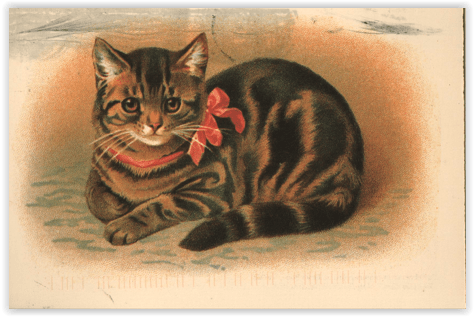
The animal yawned, showing it, too, had very sharp teeth. “To be sure. Well, I am a cat, and I watch the trells.”
This sounded perfectly reasonable, but after a moment’s thought, Coffey inquired, “What are trells?”
“They are.” The cat yawned again, rolling its tongue out and back. “My job is to make sure they don’t grow to rich because they would then buy the world and run it to suit themselves. When they have too much gold, I take some out to the leprechauns.”
“Gold?” said Coffey.
“Metal stuff,” the cat said. “Those who go on two legs seem to like it, so it….”
“I know what it is, though I’ve not seen much,” said Coffey. “The…trells have a lot of it, do they?”
“They have all kinds of it,” said the cat. “On the stove there you can see their magic frying pan. It fries normal eggs into gold.”
”Ah.” Coffey peeked from under the tablecloth again and saw a frying pan on one of the stoves. He thought this over and turned to the cat again.
“Of someone were to take that frying pan away, the trells would not have so much gold.”
“Very likely.” The cat yawned again.
The cat didn’t seem to be getting the idea. “Can you help me escape with it?” Coffey inquired. “I wouldn’t bother you, but I don’t know the way out.”
The cat studied Coffey for a long moment, and then said, “What’s in it for me?”
Coffey studied the cat right back, but since he’d never seen a cat before, he couldn’t think what to offer it. “What do I have that you want?”
The cat blinked. “Good question. Since you’re in a hurry, I’ll help you now and we can talk about payment later.”
“I’m not in a hurry,” said Coffey.
“No?” The cat looked past Coffey at the tablecloth. Coffey peeked out again and found one of the blue-haired women had come back, and was poking her spear under the kitchen counters.
The cat yawned and stretched, and, rising, heading for the tablecloth. “Won’t she hurt you?” whispered Coffey.
“No, I chase the rats away from their chickens.” Not in the least hurry, the cat stretched again and passed under the tablecloth.
The trell glanced down as the cat rubbed against her ankles, but said nothing, continuing to jab the pointy end of her spear under the counters and stoves. “What’s the matter, Baba?” asked the cat.
The trell turned fierce eyes on the cat. “Cheedle, Chidle, Chadle, Choke: I smell the blood of a human bloke. Human people make me shudder: I’ll grind his bones to peanut butter!”
The cat’s face crunched up. “Oh, please.”
“What’s wrong?” The trell’s voice was like rocks grinding together.
“What kind of talk is that?” demanded the cat, upper lip curling into a sneer. “Cheedle, Chadle…oh, I can’t even say it. And ‘bloke’? Nobody says ‘bloke’ these days.”
“I thought it was kind of cute,” growled the trell.
“Well, you’ve got to do better,” the cat told her. “You’re going to be running the world one day, right? You should come up with something more elegant than that cheedle choodle whatever it was. Anyhow, you need peanuts to make peanut butter.”
“I’ll try.” Grumbling, the trell stomped out of the kitchen.
Coffey hurried out from under the table and grabbed the frying pan. “Now, how do I get out?”
“How did you get in?” yawned the cat.
It sounded so silly, Coffey hated to talk about it. “Well…I grabbed a magic beansprout and it pulled me down.”
“Where?”
“Well, it was back this way.” Coffey walked back up the hall, watching for trells. Soon, he recognized a rough patch of ceiling. “Those are the beansprouts.”
“Take hold of the root of one beansprout,” the cat told him, “And you’ll be pulled back up. But you can use each beansprout only once, so be careful. You have to come back, remember, with my reward.”
“I will,” Coffey promised. He set the frying pan down, but remembered in time that he wanted to take it with him. He took it in one hand, and jumped on a chair to grab a beansprout with the other. Sure enough, soon he was shooting through dirt as he had before, only in the other direction.
His head whanged against his mother’s rake. Mistress Klotsch had come to tear the unsightly beansprouts out of the yard. “Land!” she exclaimed, amazed not only to see her son up that early but to find him percolating up through the dirt. “Where have you been?”
“I was pulled underground by a magic beansprout,” Coffey explained, kicking his legs free of the dirt, “Down where the trells live. And this strange animal called a ‘cat’ helped me steal this magic frying pan and told me how to get out.”
Mistress Klotsch looked from her muddy son to the hole in the ground. “Magic beansprout,” she said. “Trells. Cat. Magic frying pan.”
Coffey took her hand. “Here, I’ll show you. Where’s an egg?”
He set the pan on the stove, and let it get hot. Mistress Klotsch added some grease and THEN handed Coffey an egg. Coffey cracked it into the pan. Mother and son stood watching the egg fry.
“Um,” said Coffey. “The cat didn’t tell me exactly how to….”
The egg jiggled, shook, and changed color, looking for all the world like a solid gold fried egg. Coffey reached for it, but then let go.
“We’ll let it cool first, I guess,” he said, turning it out onto a plate. “But anyway, Mother, you see….”
Mistress Klotsch was nowhere to be seen. Coffey searched the kitchen, not neglecting to look under the tablecloth, but found his mother outside, spreading her best coverlet over the shriveled little beansprouts. “We wouldn’t want anything to happen to our little magic garden, would we?” she said.
 Blogsy Babbles