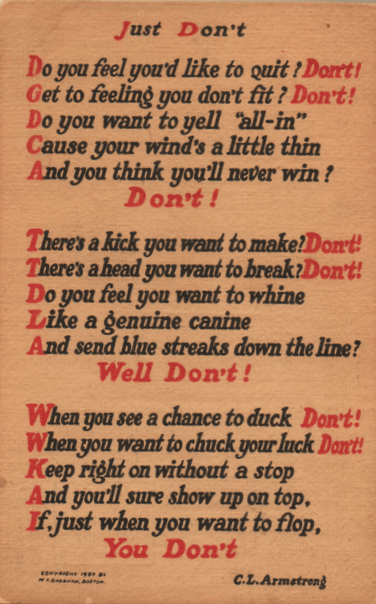
It has been a while since we have considered the motivational verse found on postcards of yore. Why should we bother to look again? I don’t know whether that’s any of yore business.

I wish I had talked an acquaintance of mine, who had read every motivational classic of the last century, to go ahead with a project of constructing a sort of family tree which would show which writer got his ideas from which predecessor. He was a great believer in these self-help heroes, though he admitted you could probably boil them all down to a few basic principles: optimism, perseverance, and self-reliance. Every generation picked out its favorite preachers of such virtues, and every generation as well saw the same principles available on postcards for those who couldn’t pause in their daily grind…perseverance to read a whole book.

Each of these principles, by the way, has had its critics. Thorne Smith spoke of a businessman determined to show his grit and smile the Depression away (and nearly smiled his firm into bankruptcy, but for unsmiling underlings who worked overtime.) Optimism and perseverance were served, or parodied, in a little booklet I used to see donated all the time about a boy who lost a foot in a bicycle accident and forced himself to work out and try to walk every single day, confident that as long as he believed in himself and kept working, he would grow a new foot. (I think he won the big football game for his high school and went on to be elected Senator, but never did grow another foot. My impression was that the author was taking the mock, but other people said they found the story a guide in times of trouble and passed it along to their grandchildren…which may be why so many copies were donated to the book fair.)
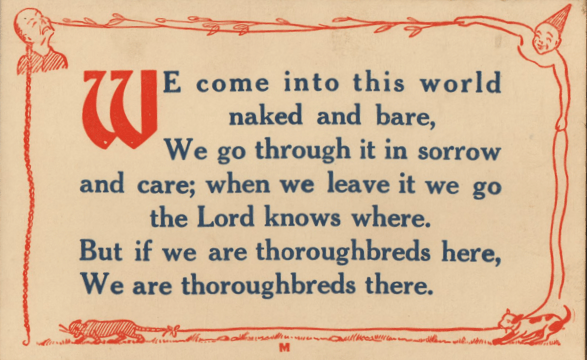
In any case, postcard artists tried to provide guidance to their fellow travelers, urging the value of the popular ideals of the day (along with, in this case, horse sense, I guess. Unless the point is that this is all a matter of good breeding.)

My personal brain prefers it when the poets get more specific. This poet is, more or less, presenting the ideal of self-reliance, only applied to the case of one’s financial habits. I know I speak with the benefit of hindsight, but the poet’s ow finances would probably have been better served with a children’s book. “Don’t Be a Billy Borrow” sounds as if it would have sold thousands of copies to doting grandparents.
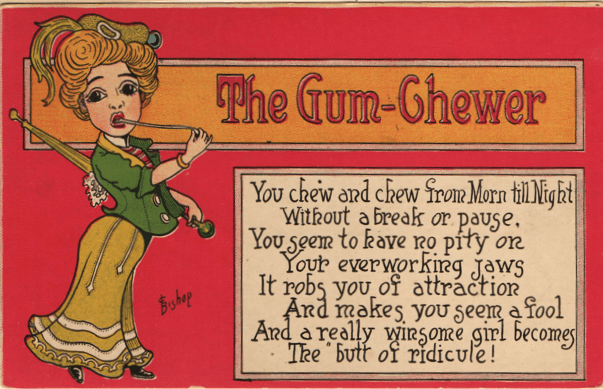
This poet takes up the cause of making sure young ladies remain demure and mindful. Chewing gum was considered a great evil because it got in the way of one’s accomplishments. People were urged by advertisers to buy something that had no nutritional value, looked bad, contributed nothing to society beyond the profit made by uncaring industries. (There was a similar campaign against cigarettes at the time. Remind me how that one worked out.)

Speaking of the profit made by producers of addictive products, THIS is one of the numerous verses written to remind people that their friends were yearning to get a postcard. But we have discussed this phenomenon hereintofore.
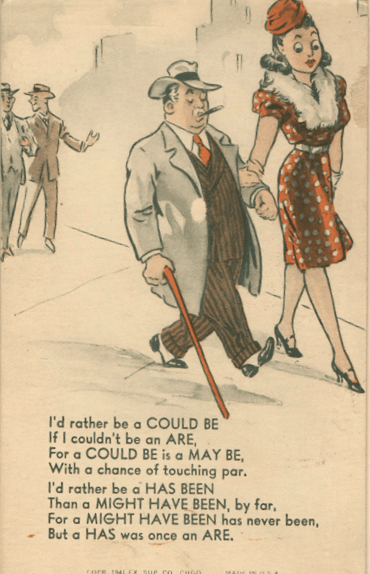
Let us conclude with this work by a poet not known for contemplative moods (Milton Berle). I thought about writing an article about the school of motivational verse whose moral was “Well, anyhow, he tried.” But I’ll have to put that off while I run to the store. I just realized I’m all out of chewing gum.
 Blogsy Babbles