As I have been learning (and hope I have communicated) old postcards can be a great peek into how our ancestors talked. The slang of the day, plus whatever pop culture was up to, was grist for the mill of the cartoonists. They weren’t trying to preserve current speech for the future; they just wanted to say something that a reader would understand at once.
So I have pulled out a few more examples of colloquial speech, some of which are not as old-fashioned as saying “grist for the mill”, and have arranged them into a quiz. Some ARE now old enough to be obscure, while others just gave me a chance to fill up a space and maybe get a laugh. (Hey, that’s why the original cartoonists used ‘em.)

1.What is the “bunco game” the cowboy is warning you against?
a.Marital infidelity (switching “bunks”)
b.A con artist’s scheme (selling ‘bunk’ or nonsense)
c.Buying bootleg whiskey (served from a ‘bung” in a barrel)
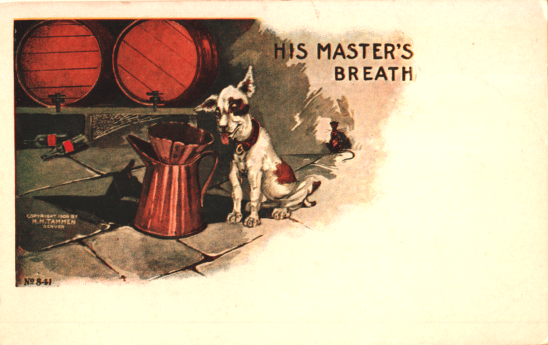
2.This is a reference to what was, for a long time, one of the world’s best-known advertising slogans. The original was “His Master’s _______”
a.Death
b.Memory
c.Voice

3.”Feed the brute” mentioned here, was traditional advice for wives. What was the desired result?
a.A well-fed husband would be better in bed
b.A well-fed husband would be more amiable
c.A well-fed husband would fall asleep sooner

4.What does it mean in this caption to be doing something “on the fiddle”?
a.The speaker intends to connive money out of the other person
b.The speaker is just wasting time in a pleasant way
c.The speaker is doing this covertly, or “on the sly”
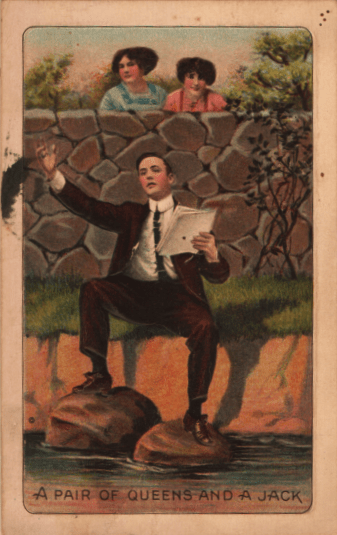
5.Why is this man a jack?
a.The ladies think he is foolish (a jack of all trades but….)
b.The ladies think he is doing a great, or “crackerjack” job
c.The ladies suspect he has lots of money (jack)

6.This pair of postcards make the same joke on a popular political phrase. Who is credited with originating the phrase “white man’s burden”, turning conquest of non-white populations into a matter of unpleasant duty?
a.Rudyard Kipling
b.Theodore Roosevelt
c.Charles Sumner
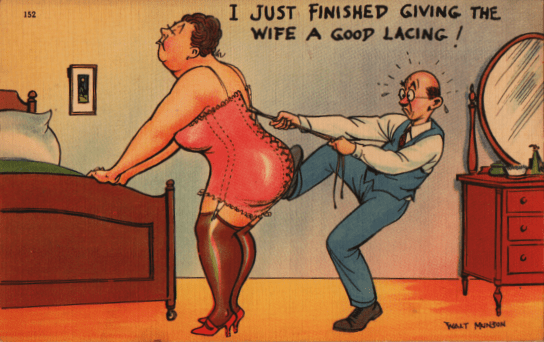
7.The man is actually lacing his wife’s corset, but is suggesting in his statement that he gave her
a.A good strong drink
b.A new pair of shoes
c.A fierce scolding
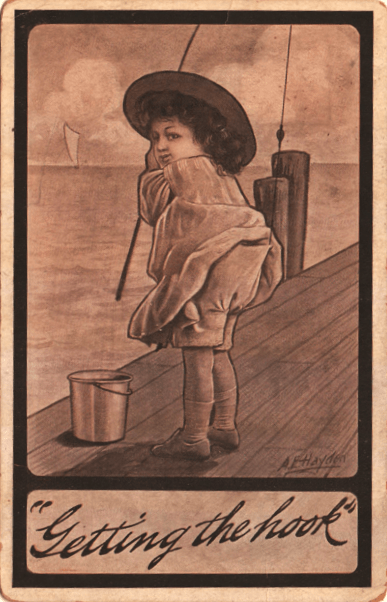
8.Still used today, the phrase “to get the hook” originated in
a.Fishing
b.Theater
C.Baseball
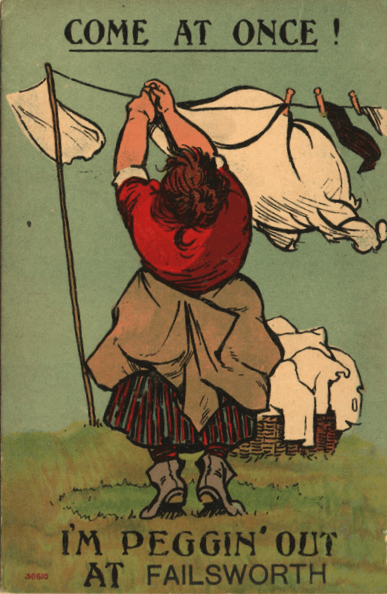
9.Besides putting clothespins (or “pegs”) on the laundry, what ELSE does pegging mean in this context?
a.Something we daren’t discuss in a family blog
b.Exhausting oneself
c.Enjoying a nice breeze on a warm day
ANSWERS
1.b.Joe Friday used this a lot on the original Dragnet
2.c.Nipper was the terrier who posed for Victor, or RCA Victor, or, in England, His Master’s Voice records
3.b and/or a. The Interwebs, which is as trustworthy about these things as facts spray-panted on a hydrant, claims that, going back to the nineteenth century, American writers preferred the b answer but the more robust British expected answer a
4.c. The word has been used in phrases meaning all three of the possibilities given (and more) but this seems the most likely for this fiddle case
5.a. The word jack was, among other things, an abbreviation for “jackass”
6.a. Kipling did not, however, invent the phrase, which had been used by writers since the 1860s
7.c. Depending on where and when the word was used, the scolding might include a beating as well
8.b. Performers who displeased an audience would be yanked offstage with a long hook
9.b. Amazing what some phrases grow into as time goes by
 Blogsy Babbles