I picked out a number of postcards which referred to bygone issues and inventions to provide questions of that quiz last week which skyrocketed to instant acclaim. (According to the data on this website, I am the only person to read it so far. This is part of the world’s attempt to remind me that what I write is not necessarily considered urgent reading. Unless I reference a Kardashian, of course.)
In any case, I picked out several that eventually involved such long or disappointing answers that they were unsuitable for the quiz format. This does NOT mean I can’t force them before you, of course. This will keep YOU out of a few rabbit holes.

Ella Wheeler Wilcox started writing poetry at the age of eight, and kept on with it for sixty years to acclaim from the public and sneers from critics. (The poem Sinclair Lewis despised—“The Man Worth While”—can be found on numerous postcards, too.) Her most famous poem was “Solitude”, which starts like this. I was planning to sneer myself that the postcard artist got the line wrong. Turns out that those of us who quote it as “Cry, and you cry alone” are the ones who are wrong.
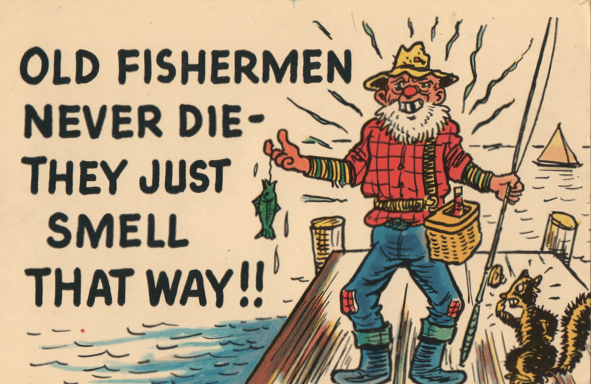
This postcard is part of an avalanche of jokes made after Douglas MacArthur’s farewell speech, in which he used the phrase “Old soldiers never die; they just fade away.” Parts of that would have made a good quiz question on their own, but no, I was going to ask where HE got the line. And the answer is simple enough: it comes from a song that was popular in the army when MacArthur was a young man. No one seems to know EXACTLY when it came about or where it came from, and that sort of answer is better spelled out in a plain boring article. Note to quiz writers: be very sparing of answers which are longer than the questions. Your audience will just fade away.
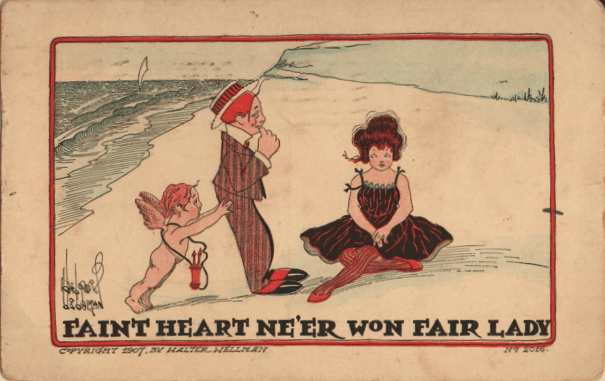
Nobody knows where this phrase comes from at all. It is often attributed to the Bard of Avon, but apparently existed at least a generation before William Shakespeare picked up his pen. No, we will NOT be discussing whether Shakespeare or somebody else wrote “Wherefore art thou Romeo?”
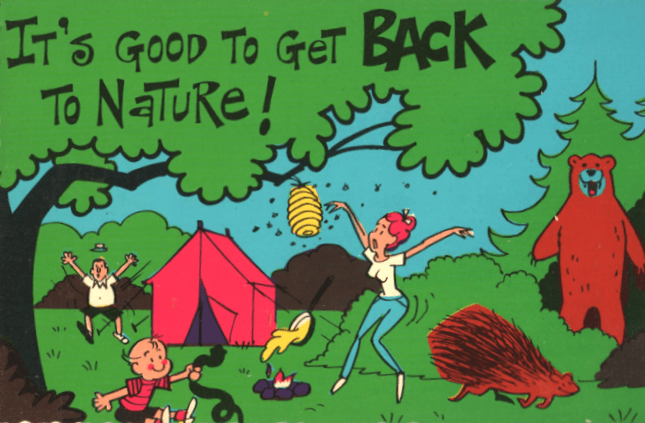
“Back to Nature” was the battle cry of a movement before it was a cliché. Usually an admonition to return to a simpler life in the woods (but sometimes also a nudist slogan), it comes from a notion philosophers have batted around for centuries. The latest “Back to Nature” push started in the late nineteenth century, mainly in Germany. But experts cannot find anyone using the actual phrase before 1915, and even they aren’t eager to claim that it never appeared before that. “Nobody knows” is frequently the answer to trivia questions but it does not make for the sort of award-winning puzzles found around here.

If you can’t make out the faded caption, this card says “Harmony, with apologies to Frank Dicksee”. We have lost interest in making catchphrases based on popular paintings, partly because we don’t bother nowadays with popular paintings. Sir Frank Dicksee was a painter best known for “The Funeral of a Viking” who also, in 1877, painted “Harmony”, which has nothing at all to do with the image here. A young woman plays the organ as light pours through stained glass and a romantic young man looks on. The joke was funny only to those who knew the painting, its artist, and title a generation after the painting hit the public imagination. The possibility that it wasn’t very funny even then does exist.

This catchphrase was popularized in 1932 by Franklin D. Roosevelt, referring to ignored souls who found themselves at the bottom of the economic pyramid. This represented a complete flip from the meaning intended by a whole nother politician. Charles Sumner wrote a novel, published posthumously, in which he used “the Forgotten Man” to describe the poor middle class dub forced by higher-ups and better-offs to pay for the needs of the man at the bottom of the pyramid.
So there is your allowance of forgotten men and women and factoids for today. Try not to use them all up at once on whatever social media platform you choose, lest you duffer my fate and find mankind beating a path to your door. (And no, we will NOT be studying THAT quotation.)
 Blogsy Babbles