
We were so busy in history class in my schooldays that we hardly ever got past about 1928. The older and more cynical I get, the more I wonder if this was intentional. In my day, kids were exposed to an ongoing debate on the relative merits of Herbert Hoover and Franklin Roosevelt among our elders, and the teachers may simply have wanted to keep out of it. So Fashion History was neglected beyond a few pictures which gave the impression that voluminous fashion as seen above was universal until World War I, when everyone realized that was silly and shifted immediately to something lighter.
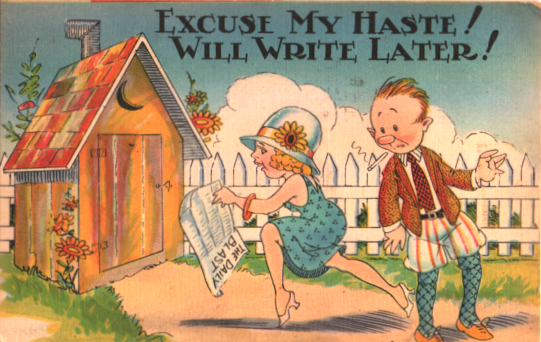
Like this. It was as if the ladies cut their skirts and hair short one evening in early summer and never looked back.
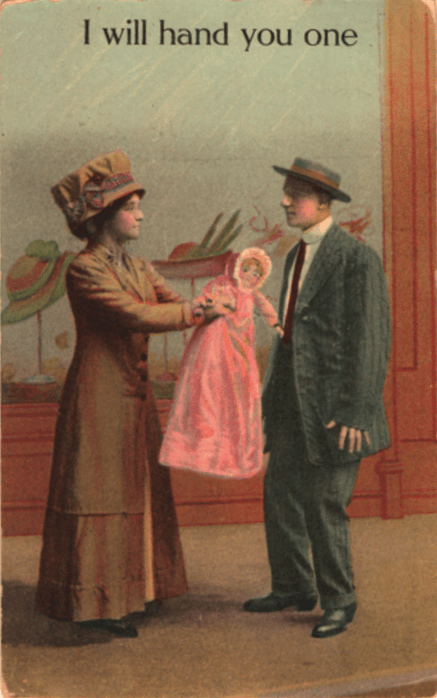
The facts, which we could have found at the library, was that there was an intermediate period, during which silhouettes slimmed down. (No, we are not going to discuss whatever that is on her head. Hats are a whole nother species for discussion.)

As our postcard cartoonists were well aware, this was the era of the S Curve. That slender silhouette was excellent for emphasizing two particular erogenous zones, and designers (as well as cartoonists) were game to make both obvious.
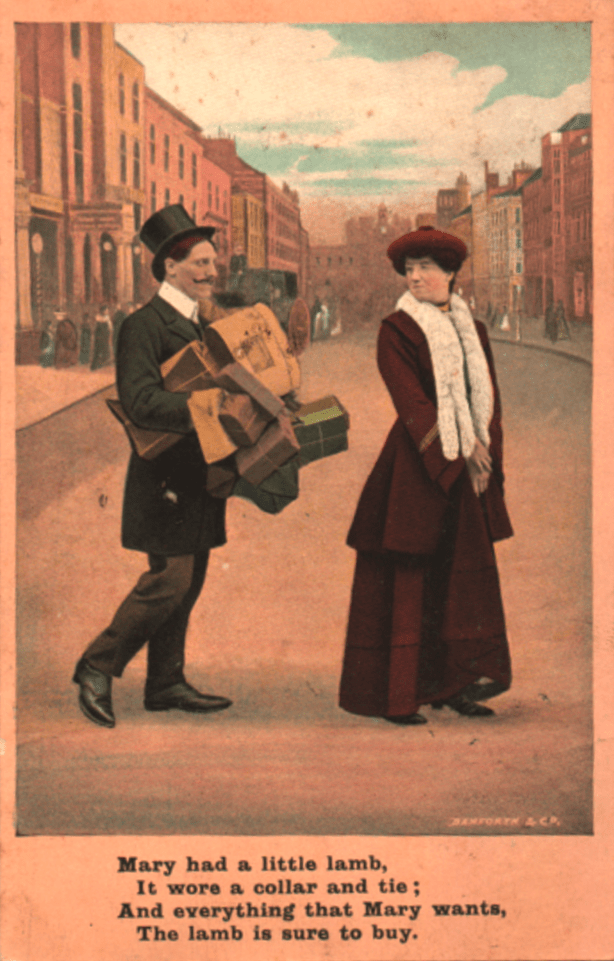
Even conservative fashions kept the backside firmly pushed back, as it had been in the grand days of the bustle. The only difference now was that there was less scope for strapping on reinforcements. (Designers were eager to help out with that too, of course.)

Within the bounds of human construction and variation, however, that wasn’t really where added material was required. It was above the waist where the S Curve could become difficult.
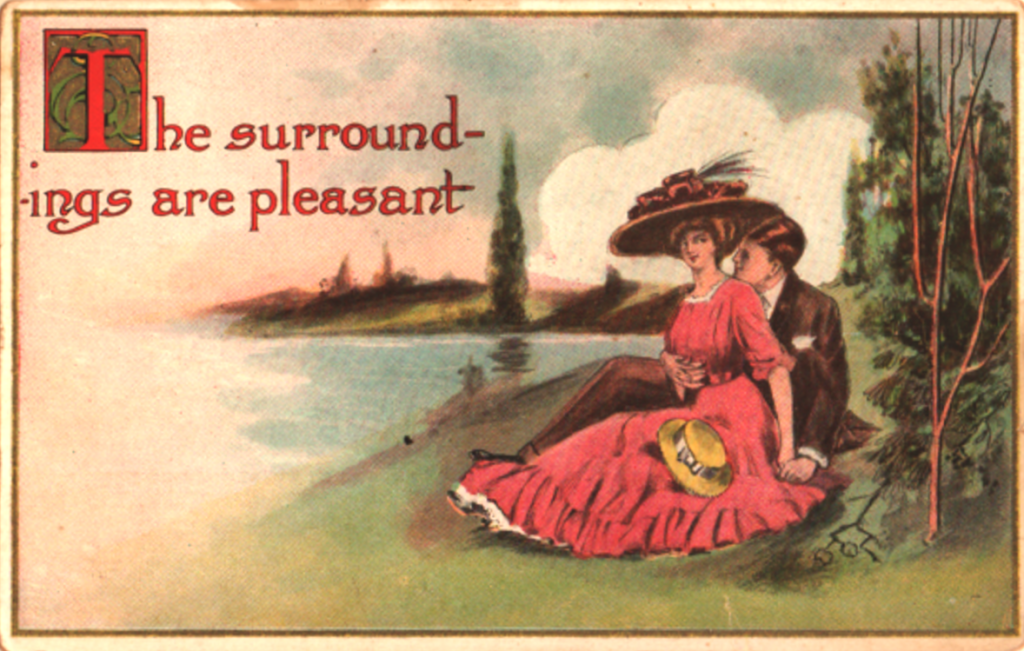
To balance the S Curve, more material was needed topside. So designers obliged with the Pigeon, or Pouter Pigeon, design. This added bulk to balance the S. (Yes, I had to say that, but I’ll do my best to behave now.)

Wherever fashion goes, cartoonists are sure to follow, so postcards began to boldly push chests where no chests had gone before. The not very subtle S Curve became even less subtle in their hands.

As mentioned hereintofore, no artist was more entertained by what other fashion historians call the “drooping monobosom” than Walter Wellman who, adding the flared skirt and pompadour, turned the S Curve into a kind of feminine cavatappi.
This, by the way, is what the blouse looked like in repose, in a less cartoony style.
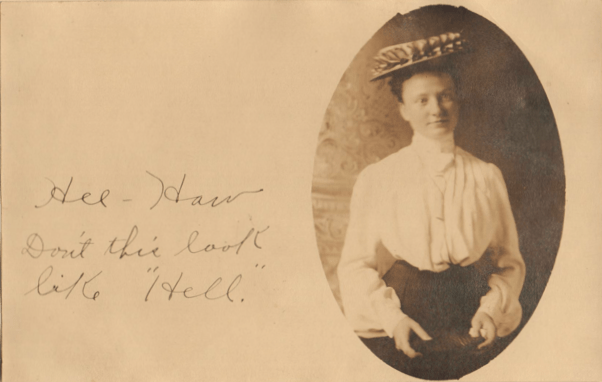
You may, if you are that sort of person, be congratulating our fashion designers in rendering the chest as unthreatening, subdued, and unerotic. I would call this type unobservant, since you haven’t been considering the cartoons seen above. You are also reckoning without the male mind.

AND you are selling our designers short. Here is the Peekaboo Blouse of the era, which shows you can have your cheesecake and…I forget what I was going to say. Anyhow, this allowed for massive amounts of fabric where fashion required while still providing eye candy.

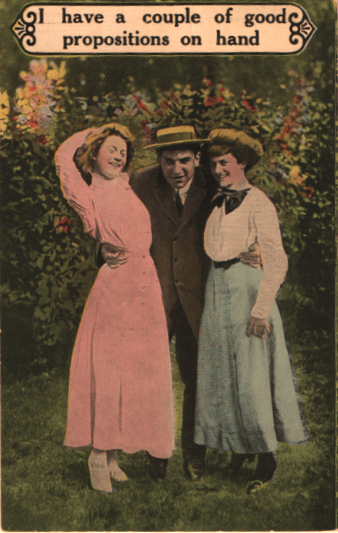
You are also reckoning without the fact that people move around. If you look at this playful couple from the waist up, you will have no trouble picking out Adam from Eve. Eve knew this.

World War I probably did have something to do with the finish of the fashion: people had to cut back on the amount of fabric they needed during austere times. The S Curve DID linger until the 1920s. At that point, when suddenly everyone was considering the erotic suggestions of knees, ladies were finally allowed to stand up straight and we moved on to the extremes of the Boyishform Bra. But we will fuss about that some other day. At least we got this off our chests.
 Blogsy Babbles