
I was old enough when I found out about it that I was more surprised than shocked. The distance between what we are shown and what really is was known to me from an early age, at least to that time in second grade when I picked up the little cup of cherry Kool-Aid and found out it was tomato juice. As always, part of the blame for that is mine: why on earth would our lunch ladies be giving us cherry Kool-Aid anyhow? What we WANT to see takes precedence over what’s really there.

So today we are going to talk about scenic landscape postcards which have been somewhat amended to show the world as postcard publishers think we want to see. We will NOT be discussing pure works of art, like the collage “Water Tank” by Michael Langenstein at the top of this column, nor the massive Brooks Catsup bottle in Collinsville, Illinois, which is really there and has not been touched up at all in this postcard.

What tipped me off was a series of Our City at Night postcards like this one. If you have ever tried to get a glowing and romantic a picture like this on your own camera, digital or otherwise, you know it takes patience and care. But postcard companies put these things out by the dozens. Were their photographers that good, or did each company have one picture-taker who specialized in night scenes? Even more complex are the night-time street scene postcards, where a busy district in town has been photographed during the evening theatre hours. How was this even possible, given the unpredictability of tragic and weather?
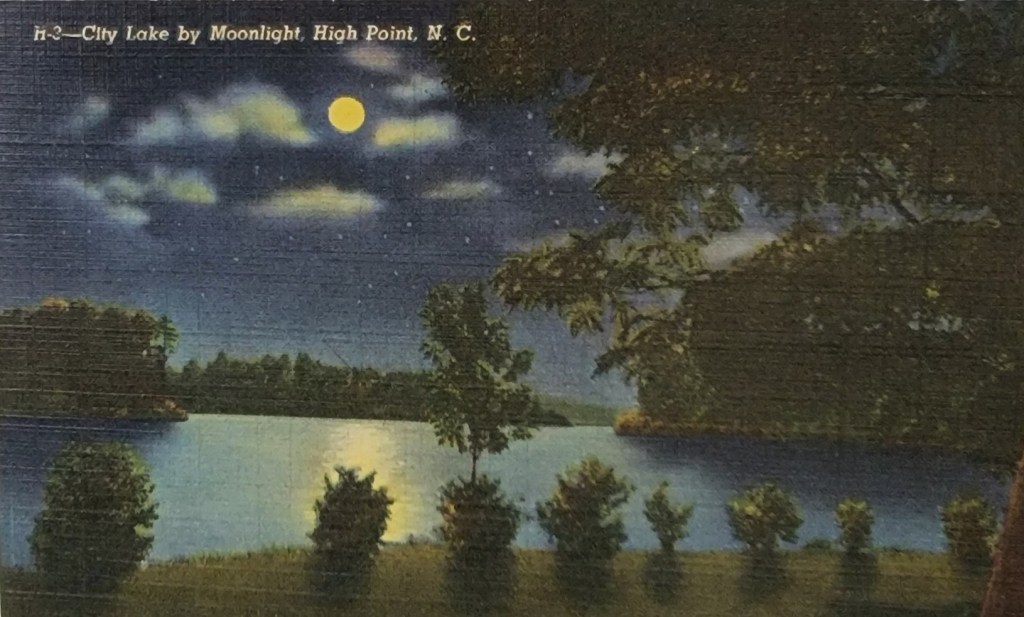
Well, you can go into the archive of some of these companies and find out. (Curt Teich did a lot of this work, beautifully.) They DID have great photographers. These photographers would take a picture by daylight and then have the artists in the design department paint the sky a nice midnight blue and draw in a brilliant moon. Or take that photo of the theatre district and paint lights in the windows and a beautiful evening sky.

Our ancestor discovered the process for portrait paintings in the nineteenth century. It takes a long time for a person to sit still and be painted, so why not take a photo, blow it up to a size suitable for hanging on the wall, and have an artist paint OVER it. Properly done, no one can tell how much of the picture comes from the original, and how much from the mind of the artist. More authentic than leaving the whole picture up to the painter and more flattering than the version from the camera. (I’m not sure I’m seeing ANY of the original photo in this beautiful sunset.)
Of course, once one has discovered the process, anything is possible. A company in New England produced dozens of small town city views presented as photographs of what the town would look like in a hundred years, with subway entrances added to quiet corners on Main Street, airships and aeroplanes above. Similar enjoyment of the joke goes on to this day, with some improvement in technology.

None of these postcard companies are trying to lie to us. Especially with those night photographs, the goal is to show us reality while omitting the details of actuality that get in the way. I am not at all certain this view of San Francisco is an honest to goodness photo. But as Vincent Starrett wrote, after all, “Only those things the heart believes are true.”
 Blogsy Babbles