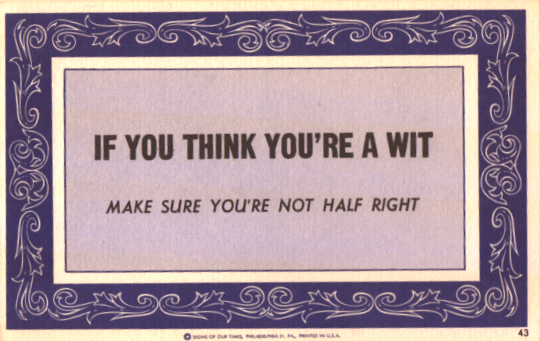
The problem with archaeology is that the world wants answers, not just simple answers, but answers which are simple and absolutely fascinating. For every person who is interested in controversies about pharaonic Egyptian paint composition, there are a thousand who want to know how many ancient Egyptian temple maidens were blonde. This is a problem with joke archaeology as well. I see that this year I have written two columns on postcard jokes which require some context to understand. I could do this because I felt I had the answers. But, um, there ARE some fine old jokes where I have to admit I don’t quite git it. I cannot promise that any of these involve temple maidens at all.
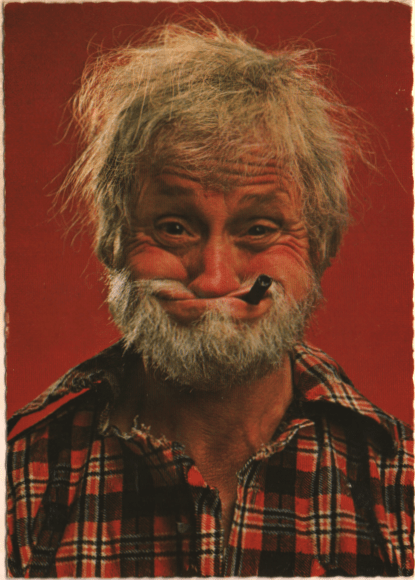
Here is Buchsenmacher (Gunsmith) Sepp. What I have learned on the Interwebs is that this is about it. This portrait was all over everywhere in Germany in the 1970s or thereabouts. But I can learn nothing else: the portrait did not spin off into a line of cartoons or jokes or comic books. He DID have a wife, who is also a postcard icon, but…what’s it all about, Deutschland?
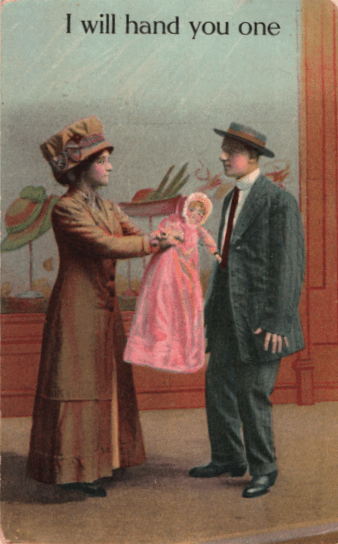
If you are enough of an archaeologist to look over the oldest days of this blog, you will see that I did a column on “handing you one”. But in all those postcards, what was being handed over was a lemon. (I never did QUITE get to the bottom of why handing someone a lemon was the equivalent of a later generation’s “giving you the raspberry”.) Are we just taking an everyday occurrence and relating it to the lemon gag, or am I missing something here? (Please don’t write in about the phrase “to give him one”, which is entirely other.)

I put this up for sale as a Mother’s Day card, but that may be original with me. This comes from an era when I’m told we did not make jokes about infidelity, but I may, like Rick, have been misinformed.
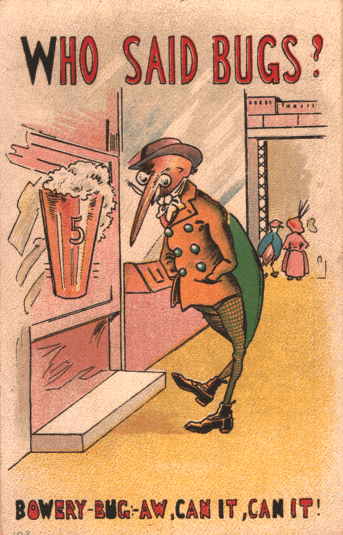
Someday I will discuss another catchphrase of a bygone era: “Who said rats?” which usually involves a postcard showing very alert dogs. So I know a LITTLE about this joke. Now, “bugs” was once a description of someone crazy, taken from “seeing bugs”, a phrase for having the D.T.s (a state in which we moved on to “seeing snakes” and “seeing pink elephants”. “Can it” may have started in the Bronx, but is still used in some places for “Cut it out. Stop it.” But how does this all work together? Or doesn’t it? Maybe we assume too much: some jokes didn’t even work at the time they were made and we sure won’t figure them out now. This artist may just have wanted to draw a big bug. No, canned beer was not available at this point, except in the can, or growler, used to haul it. And yes, what we said earlier does explain how Bugs Bunny got his name.
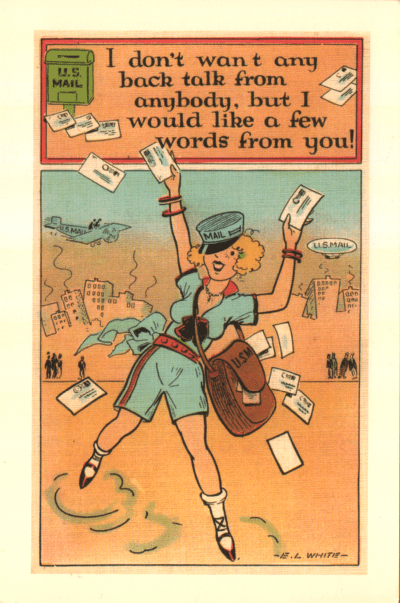
Why is the postal lady throwing mail around? What does this have to do with the caption? Or do we just assume, as above, that the author simply wanted to draw a lady in shorts and filled in the rest later?
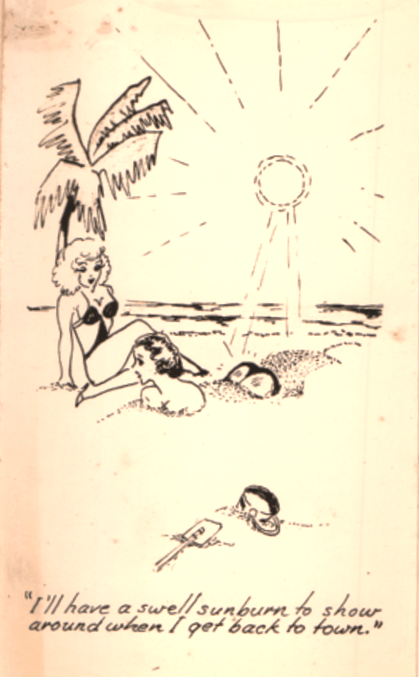
Why is…what’s her suit…does she…. What I really mean is where is she going in town and why don’t I ever get invited?

And this is obviously some sort of gag mocking the Temperance movement and some paricular Temperance group. But I’m not sure what specific group we’re mocking as the “Wee wee Club”, and I DO wonder (given their expressions and their drinking habits) whether “wee wee” meant in 1909 what it does today. But that is a WHOLE nother blog. If I find out, I’ll let you know, as with the others. Unless the authorities come to find out why I am Googling “wee wee” so much.
 Blogsy Babbles