I hang out with a number of Luddite intellectuals: that is, these are people who still read books and watch television, and wonder about some of the things they learn in these places. But since they do not believe in allowing the Interwebs into their homes, they then tell these things to me, knowing I have access to a world of answers.
The trouble with getting your answers on the Interwebs is not so much that you find ten times as many false answers as true, as that there is no answer, right or wrong, which cannot be made much longer if you keep looking.
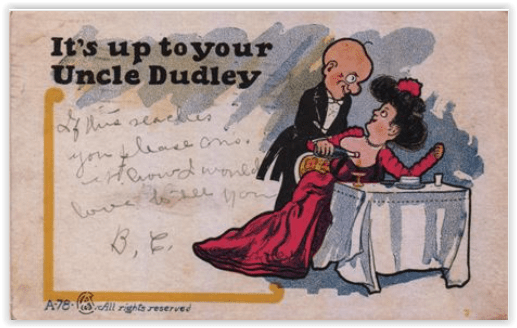
For example, one of these ladies asked me, “Why do people cry ‘uncle’ when they give up? Why not cry for mommy? Is it related to ‘Who’s your daddy’?”
Now, there IS a short answer to that question. That answer is “Well, nobody knows, exactly.” But if you work on it, you will find that researchers have found possible answers, all possible, all as likely to have been provided after the fact, just to answer the question. There’s the ancient Roman game where kids would punch each other until one called the winner “my best of uncles”, or the ancient Irish version, related to the word “anacol”, meaning refuge. And you can always take on the fine old joke about the man who strangled his parrot because it wouldn’t say “Uncle”, tossed the supposedly dead body out the window, and next morning found all his chickens had been killed by an angry parrot that kept screaming, “Say ‘Uncle’, you filthy beggar!” Up to you.
Another day, the inquiry was “Do we call ‘em oyster crackers because people ate them in oyster stew, or because when they’re floating in the soup, they look like oysters?”
The short answer to that is that “No one knows”. A longer answer is that either of her suggestions may well be true. (Or not.) If you want a deeper die into oyster waters, you find that they are especially connected with a city in Pennsylvania or another one in New Jersey, and are sometimes called “water crackers.”
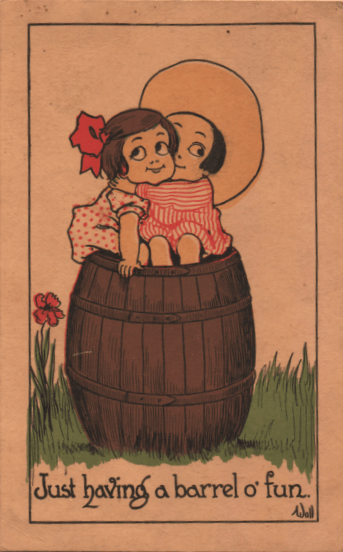
Before you ask, the “soda cracker” was called that shortly after the invention of baking soda made their manufacture simpler. And there are roughly half a hundred different derivations for “cracker” as an ethnic label, from the use of “crack” to mean “brag” and the use of cracked corn in the diet, though I kind of like the one that traces it to the loafers who hung around the cracker barrel in the general store.
Another of the crew amazed themselves when I noted that a strange product name at least made you look at them, by exclaiming, “Made you look, you dirty crook: stole your mamma’s pocket book. Turned it in, turned it out, turned it into sauerkraut.” What startled them was how rhymes can be handed down for decades on the playground, but I wondered where the (what’s the opposite of a nursery rhyme?) came from.

Well, the short answer is “Um, nobody knows”. But MY, the playground has evolved since I was there being dared to walk up the slide the wrong way. For one, thing, the earliest citation of the poem online (at least where I was looking) traces it all the way back to 1977, when I had reached an age to be dared to go over and talk to that cute sophomore girl at the bowling alley. Another claimed the CORRECT version, traced all the way back to 2001, is “Made you look, you dirty CHOOK”, and the verse ends with “Stole a dime and bought some wine and now you look like Frankenstein.”
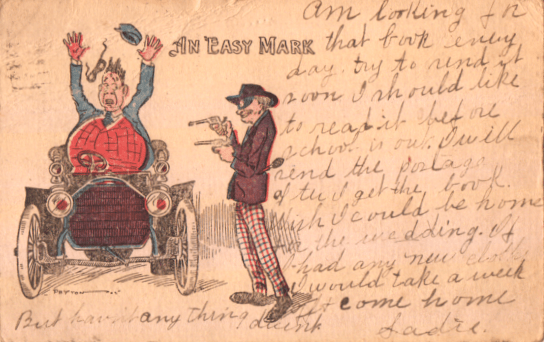
About the only information I found which can really be regarded as solid fact is that pocketbooks make crummy sauerkraut. Now, if everyone will leave me to my own devices, I will return to my ongoing struggle to find out why movie gangster slang made “Roscoe” a word for a gun. I suspect Fatty Arbuckle is involved, but the Interwebs continues to hide the True Facts from me.
 Blogsy Babbles