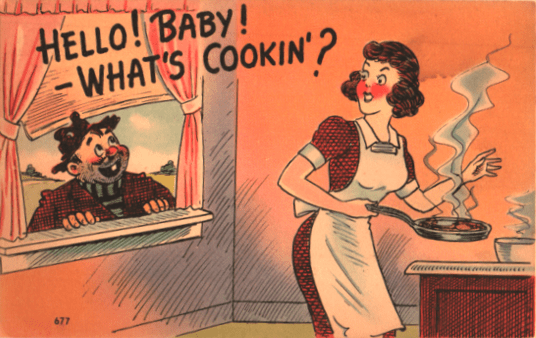
I have been known to complain about people paying no attention to this column, but the alternative has its drawbacks. Someone looked over the last expulsion of words about the difference between pork rinds and cracklin’s, considered the mention of “fatback”, and inquired, “So what about pork belly? That’s just bacon that hasn’t been sliced, right?”

Before I recalled that I do NOT write a food blog, I decided to look this up. And learned that more than one rabbit hole leads to the pig barn.
So here goes. Pork belly is the basic cut of meat. Bacon is pork belly which has been cured, and smoked, and sliced. So no, pork belly is NOT just a big chunk of bacon. Pork belly has become popular in dining establishments because it is mildly cheaper (since not as much has to be done to it), a bit softer and, perhaps least important, way better for you (because not so much has been done to it,)
Before we continue, let’s make a slight detour to specify that pork belly comes from the general stomach area of a hog. I mention this only because the popular roast known as pork butt comes from the hog’s shoulder, as does pork shoulder. (A pig’s butt is almost entirely used for ham.) The pork butt and the pork shoulder are similar, but the butt comes from the THICK part of the shoulder. One way to tell, which is not infallible, is that if your cut of meat includes the shoulder blade bone, then you know for sure it’s the pork butt. (Those of you who use the butt to make burnt ends are simply making matters worse.)

To return to pork belly and bacon, the bacon made from pork belly is what is known in the United States as bacon, and just about every other English-speaking country as streaky bacon. Apparently, in these realms, bacon is made from another part of the pig, and is thus known as back bacon, which does not (as you might guess) contain all those streaks of fat. (There are other types of bacon, which are made from pork shoulder, but let’s just shrug and move away from the shoulder, okay?)
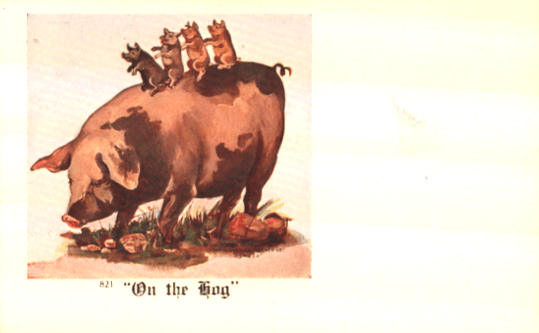
Back bacon is also one of the names given in Canada to what we know as Canadian bacon, which is or is not exactly the same. The world of information on Canadian bacon requires a great deal more study than a poor postcard seller who does NOT write a food blog can manage. Canadian bacon, as we in the US understand it, was invented in “the mid-1800s” OR in 1875. Now, what was invented in 1875 by William Davies of Toronto is often specifically called peameal bacon, as Mr. Davies rolled his bacon in a meal made from peas for preservation. Dealers in New York City who imported from Mr. Davies came up with the name Canadian Bacon, UNLESS, as other experts state, that was done by British dealers who imported it because of a massive pork shortage in those mid-1800s. I am not familiar with the Pork Famine, but this may be my ignorance. Anyway, whether Mr. Davies was responsible for it, this is NOT the same as the Canadian bacon we buy now in the United States, which everyone agrees is an inferior product because we aren’t allowed REAL Canadian bacon.

Americans confused by the whole concept are warned NOT to refer to Canadian bacon as ham, which it closely resembles AND, by the way, is the name some renegade Canadians use for Canadian bacon. There are also Canadians who call it Real Bacon, as opposed to the fatty, low class, and altogether superior streaky bacon.

Several experts also rebuked me for ever thinking pancetta is bacon; This startled me because I always thought pancetta was ham. Silly me. Pancetta is pork belly which has been cured differently and then often rolled up so it can be sliced into those baconlike rounds. No, pancetta is NOT prosciutto: prosciutto is a special kind of ham. Porchetta is a pork roast seasoned with a lot of rules, depending on where your recipe comes from.

That is enough for today. I know we have not yet discussed guanciale, currently very popular in Italian restaurants, where they are careful not to give it its British name, pig’s cheek, or the American equivalent, hog jowls. This does come from the pig’s cheek, is smoked and cured like bacon, but comes out much smoother and softer than other streaky bacons because pigs don’t grimace much, and their jowls don’t get much use. But this is NOT< after all, a food blog. So we will leave for some advanced instructor any course work on cheeks, chitterlings (chitlins), or pig’s knuckles. (By the way, if their butts are in their shoulders, where are their knuckles? Drat! Back to the Interwebs.)
 Blogsy Babbles