
We are not given, on this troubled spinning globe of ours, to decide when or where we are going down a rabbit hole. It is not among our powers to choose what rabbit hole we enter. I am probably wrong in the first place for even calling it a rabbit hole. Because I fell into it by following a cat.
The adventure started innocently. Someone who realized she was probably not the first person to ask the question inquired, “Why do we say ‘copycat’? Why isn’t it ‘copymonkey’ from the old line about ‘monkey see, monkey do?’”
Uncharacteristically, I had my phone with me, and was able to check the online theories. “They claim it’s based on how kittens always copy their mothers.”
She frowned. “I’m not buying it. Why not ‘copykitten’ then? Or ‘copypuppy’? Are kittens the only baby animals that copy their mothers?”

I promised to look into this more deeply. I am not exactly sorry I did this, but I was very sorry to have to tell her later, “The truth is that everybody is just guessing.”
The word “copycat”, according to a multitude of online sources (who may all be stealing from a single source, of course.) give credit for the word “copycat” to the state of Maine. Two writers in that state published books in the late 19th century using the word, without, as one source wisely pointed out, using quotation marks to indicate it was modern slang. “Copycat” was a word they were used to, so it must have been in common use among the folks in Maine by the middle of the nineteenth century.
(There IS one online source which traces the word to Thomas Otway’s play “The Widow”, from 1692. I always meant to study Restoration drama, but I haven’t gotten to that, so I can’t say EXACTLY that this may be incorrect. But I can’t find anywhere that Thomas Otway ever wrote a play called The Widow, and as he died in 1685, the possibility that he produced this play in 16982 seems unlikely,. But, as I say, this is not my area of expertise, and I may be missing something.)
Anyway, with all due credit to Sarah Orne Jewett, an author known for excellent regional fiction about Maine, the FIRST author to use “copycat” would seem to be Constance Cary Harrison in an 1887 memoir called Bar Harbor Days. Mrs. Harrison was one of the leading lights of literary society in Maine, though she was originally from Virginia, and led a spectacularly eventful life there. Her house was seized and demolished during the Civil War, so she wrote her early works as Refugilia or Refugetta. She and two of her cousins, forming a trio called the Cary Invincibles, sewed the first Confederate battleflags, at least one of which still exists, and she eventually married Burton Harrison, Jefferson Davis’s secretary. You see what happens when you start down a rabbit hole?
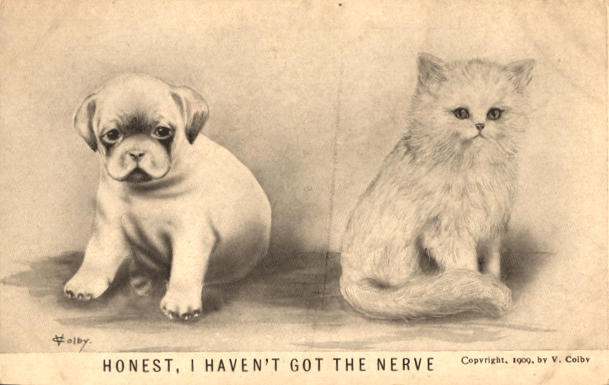
Anyway, she eventually fell in love with Bar Harbor, Maine, wrote dozens of stories and articles and books (and, while we’re discussing rabbit holes, a stage version of Alice In Wonderland). AND, as we were saying before I made that side trip to Virginia, mentioned in Bar Harbor Days someone being warned people might think them a copycat.

As noted, the phrase was used as if it was well-known, a common word in conversation, meaning there was no reason to explain what it meant and how cats got involved with it. I could do some more hunting, I suppose; surely if the word was in common use in 1887 it must appear in a newspaper article around, say, 1868. Maybe THERE we would get the answer to “Why a cat?” But as I recall what somebody said about cats and curiosity, I think I’ll leave it at that. You may not feel you’ve had the hole story, but that’s the way it goes with these things.
 Blogsy Babbles