
I was told over and over as a child—it was one of those things teachers felt we should know—that jack o’lanterns were originally made of turnips, not pumpkins. We all wanted to know whether they had birthday cake candles in those days, but that was all we ever got: in the olden days, people used turnips. I imagine one day when I that the device in this postcard was a camera, children will cry. “But how did she hold it to her ear to make calls?” I will just move on to some other bizarre fact, like how they’ll be glad when they grow up that they had to study geometry.

Some of you complained about the most recent column in this space (which is nice, since I was unaware anybody was still reading anything in this space.) I wrote about bygone technology seen in old postcards and I just left out everything that mattered. “Where are the phone booths? Did you see that recent Superman movie where Christopher Reeve tries to change but all he can find is a small phone kiosk?” So, without even HINTING that this recent movie was made in 19678 (some twenty years ago, now, allowing for Daylight Savings), I thought we could cover a few omitted items. Here, for example, is a classic alarm clock, beloved in movies and postcards and now also replaced by phones and other bellowing electronic devices.
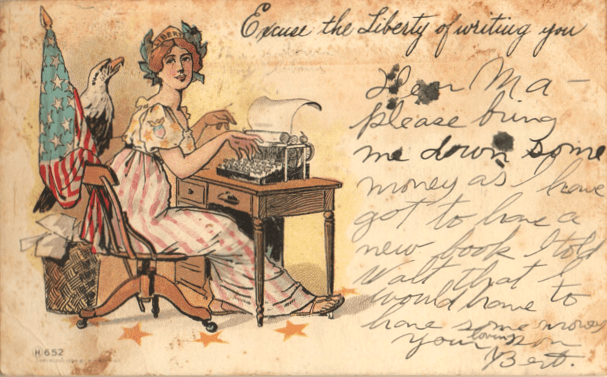
When I was working the used book line, I would defend putting out typing textbooks by pointing out that even if the typewriter was leaving us, we could still sell the textbooks, since now everyone was “keyboarding”. But that was when the keyboard itself was not an endangered species. What do they call the method of texting? Thumbing? Does it all work the same way?
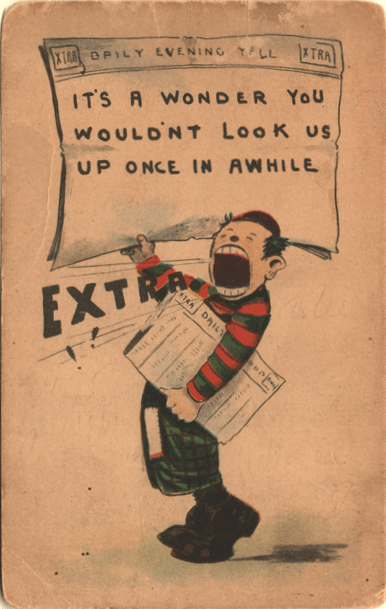
When I first lived in the Big City, there were still lads selling newspapers on street corners. “TREE-bune!” they would bellow. “GITcher TREE-bune!” I suppose this kind of work would now be child endangerment. (I know I was occasionally tempted to shove a loudmouth under a bus.)

Yes, somehow we still make toys, but as noted in our latest column, when we discussed sheet music departments in stores, when did you last see a toy department…WITH counters, and with some clerk BEHIND every counter? Not only could the stores cut costs by getting rid of the attendants, more treasures could be put out on view without those old one-sided displays.
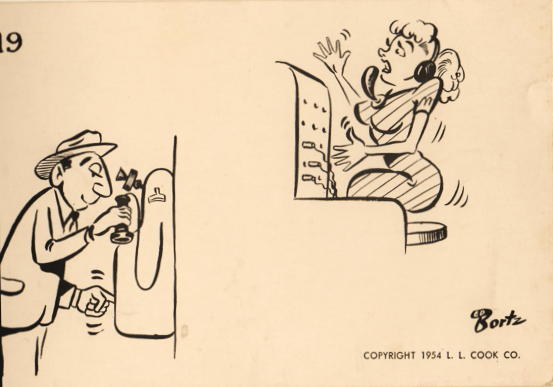
Once upon a time, LOTS of cartoonists for naughty magazines used this now wildly incomprehensible gag. The viewer has to know what a pay phone is, what the coin return slot looked like, AND understand that once people—mainly women—sat at something called a switchboard and answered questions and connected callers. All, all gone in our new efficiently electronic world. (Naughty jokes especially are ruined if they need footnotes to explain the point.)
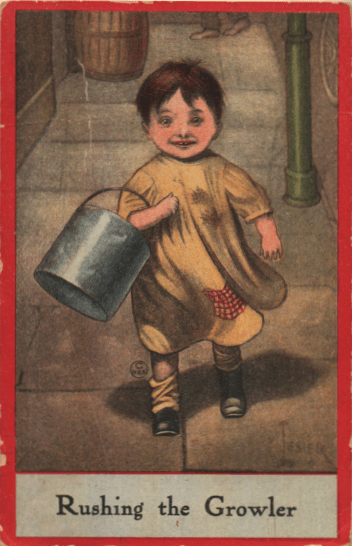
A lot of the preceding involve items recent generations MIGHT recognize, but this object, seen without being named by most postcards, was obsolete even in my boy days during the Mid-Pleistocene. The growler, as mentioned hereintofore, was the family beer can, and one rushed it by taking it to the local bar to be filled with the day’s supply of beer. (Fresh milk and running water were little known in most of the Big City, and beer was freshly brewed and nutritious—both factors which were discarded, like the growler, when canned beer became the norm.)

Is anyone ASKED to bring music to a party these days? In those primitive days I inhabited, people were sort of sliding from bringing a book filled with 45 RPM records with one’s name in big letters o them, to the efficiency of bringing albums. But a people decades before, used to being told to bring their ukulele or guitar and some sheet music, would have recognized that THIS chap is hauling over a street musician’s hurdy-gurdy: once again, a victim of electronic media (and how many people regret that?)
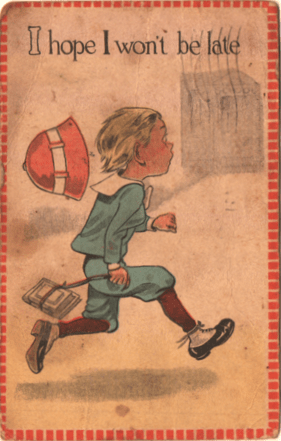
I can only vouch for the old movies and cartoons which showed us kids strapping their schoolbooks together with a small leather belt, frequently endangering their educations by running like this (if one book slips loose, they ALL slip loose.) They had to do something before backpacks came along I suppose.

If you are tired of contemplating the human rush to change and replace the fabric of everyday life, let’s look at something completely else. THIS postcard comes from that early day when messages had to be written on the PICTURE side of the postcard (which came to an end in 1907) and yet…the safety pin of that distant day is still familiar. I’m not saying any of our works is immortal, but we DO sometimes make something right the first time.
 Blogsy Babbles