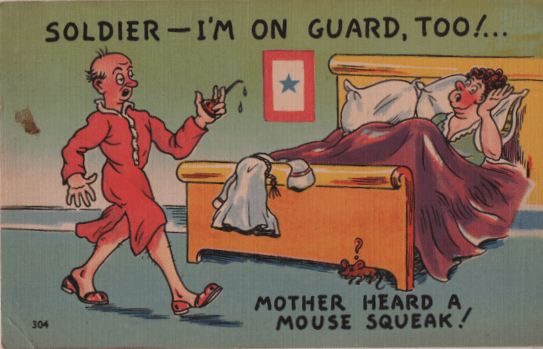
I do not have all that many postcards in my inventory which feature rats. This is not something I ever expected to have to apologize for, but in my most recent column, in which I told the thrilling tale of my courage in the face of a nonexistent rat, I used as illustration a postcard featuring mice. And I was called out for this inaccuracy by one of the perhaps three people who actually read this exploit from the days of my youth. (Maybe I should have started with the story of the bat. Or the curlew: now THAT was a tale of someone with the courage to simply retreat to a neutral corner and allow nature to…where were we?)

Anyhow, I DO have lots of postcards which involve mice, and it occurs to me that I have not yet considered the attitude of our ancestors and their postcard cartoonists to this small visitor known to people of city and farm. (I KNOW that guy’s going to point out that the brown mouse of the countryside is quite separate from the gray mouse seen in more urban areas. Well, if it makes him a loyal reader to criticize my omissions, it counts as a hit in the analytics.)
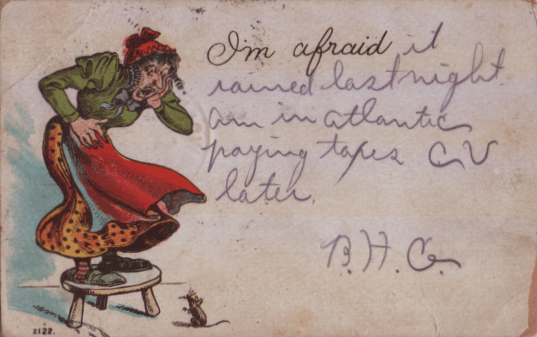
Leaving aside for now the natural opposition of cats and mice, which we can always save for another blog, the most usual nemesis of the mouse in the house is the lady of said house. I may have that backward. As we see from these examples, the mouse is actually the nemesis of the resident female. Women were considered especially susceptible to attacks by mice back in the day because they had long dresses and plentiful underskirts, which meant that if a mouse took refuge somewhere in the folds, there was no telling how far it might go. Frantic dancing with wild shaking of skirts was the only remedy, and if that did not chase the intruder away, one might be faced by the necessity to undress (which would involve putting your hands among folds of cloth where a mouse—with teeth—might be lurking.)

So the natural clash was real, and serious, and had nothing to do with a cartoonist knowing that showing a lady’s ankles as she pulled her skirts out of the way would sell a lot of postcards.
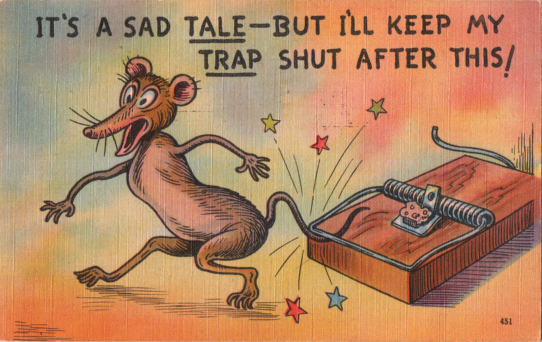
But a mouse in the house had a life of its own, and even when not interacting with the human foe, had a tale of its own. (Yeah, but the cartoonist used it first.)
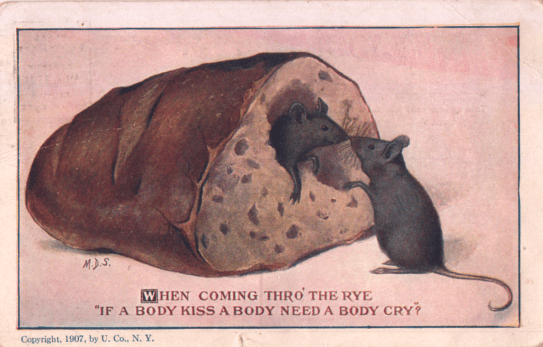
Left to its own devices, the mouse could be romantic, even musical, as it ravened through stored and unwatched food around the place.
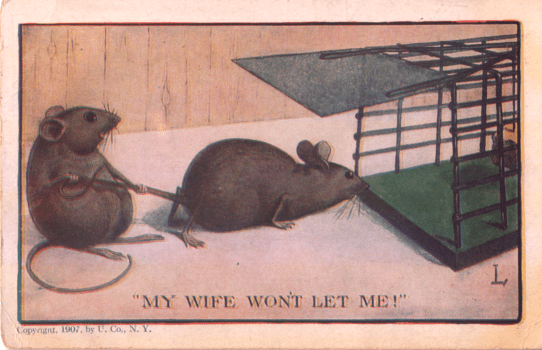
Romance led to marriage, apparently. (And to expanded waistlines. Do you think she’s worried about the trap, or about what cheese is said to do to the blood pressure of the common house mouse?)
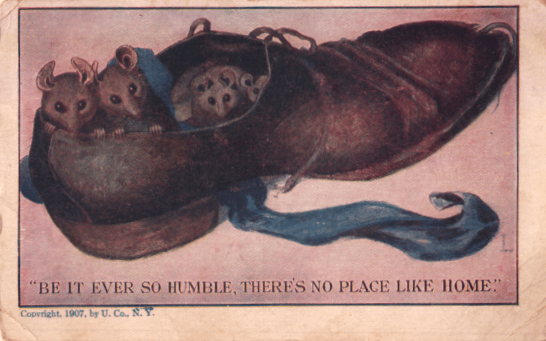
And, eventually, families to support, and a cozy little home where a worried mouse could rest his sole. (All right, I’ll stop now. By the way, if that fan of mine who likes to criticize is worried about it, that title at the top is a salute to animated cartoon cat Mr. Jinks, who famously hated meeses to pieces. No data on whether this influenced the makers of Reese’s pieces. The whole influence of mice on our culture deserves further…oh, I’m going to need to do another blog, aren’t I? Not only have we not discussed cats, but there are some animated mice—one in particular—whose influence…. Okay, shutting my trap.)
 Blogsy Babbles