I never knew my Great-Uncle Walter. According to my grandfather, who seemed to like his brother-in-law, Walter was one of the finest mechanics in that corner of Iowa, a man who could repair an engine in moments and understand at a glance why a furnace had stopped giving off heat. But Walter felt he was wasted on such a job.
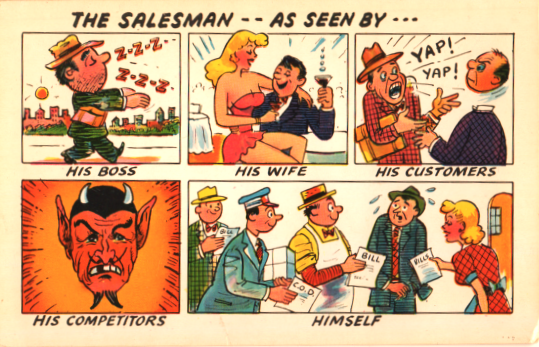
What Walter WANTED to be was a farmer, one of those souls who must gauge the humor of nature, dealing with good weather and bad, and then estimate the needs of the market. My grandfather felt Walter was fair-to-middling at growing crops, but an utter failure at selling them. Once the crops were harvested, he would hold off on the selling. This week was too early, for Walter, always. NEXT week, demand would be higher, and he’d win a much better price for his year’s work.
And every year, at least according to his brother-in-law, he would be the last to market, selling when buyers were glutted with product, and get a lower price than anybody else. My grandfather never knew why Walter didn’t go back to fixing engines, or try to repair his own timing.
Great-Uncle Walter came to mind while I was reminiscing about one of the many people who tried to tell me how to do things in the days when I sold used books. In a way, he was like a lot of my unpaid advisors, who liked to tell me not to sell things. It seemed sometimes that everyone in the world who was willing to share their business acumen with me felt I could make more money by selling less. From bestsellers (there are way too many of those) to books more than five years old (no yuppie would ever pick up something like that), their advice told me my big mistake in selling books was trying to sell books.
What made this chap different was that he was all for selling books: he just felt I should hold back on CERTAIN books. “Hang onto that,” he’d tell me. “You’ll get a better price for that in two or three years.”
Barring the fact that I had not been allocated any spaces for boxes labelled “Books To Sell Three Years From Now”, I pointed out that in most cases where he gave me this advice, the books were very much in the news, and the time to strike was now. He would shake his head and explain the dangers of my situation.
The first book he advised me on was a signed first edition of Salman Rushdie’s Satanic Verses, famous at that moment due to the fatwah decreed against the author. Letting word out that I even possessed this signed copy would bring people rushing to the Book Fair for all the wrong reasons. (This was advice I had from a number of other sources on all kinds of things I wanted to offer for sale: publicity would be impossible, as it would bring thousands of protestors to ring the building. I waited and never did see this phenomenon, but it may have been something about our publicity. We didn’t advertise to the right crowd, I reckon.)
But the sum of his advice was “Much better to wait until AFTER he’s been murdered.”
As a reasonably modern marketer, I am not averse to capitalizing on someone else’s tragedy, but this struck me as perhaps a bit iffy. I also did not have a shelf in storage listed “Boos To Be Sold After the Author Dies.”
This was not the only time he made the same suggestion There was a tell-all book on Chicago crime, a book of poetry in which the author accused her father of molestation…his advice was always that I wait for the inevitable murder. He was absolutely adamant in 2009, when a book arrived which, as it turned out, was verifiably inscribed to an old friend by the new President of the United States. “You set that away,” my advisor told me. “It may be worth a lot now, but it’ll be worth a hundred times as much after the assassination.” African-American himself, he refused to believe that Barack Obama could make it through four years in the White House.
I sold the book that year. My business practices were never beyond question (“You want to put out ALL those copies of the Divine Secrets of the Ya-Ya Sisterhood?”) but, unlike Great-Uncle Walter, I was content to grab the money and run. On the other hand, my advisor still has HIS job (he’s hanging onto it until his paintings really sell, though they’re too advanced for today’s critics), so use your own judgement.
 Blogsy Babbles