
The postcard shown here came into inventory with a number of other World War II postcards, and it attracted my attention for a number of reasons, including, but not limited to, where a pilot might encounter a cavalryman trying to execute a jumpy, why the pilot is wearing a parachute (unless he’s going to be next on the horse), why we have THREE people in full uniform, and, most of all, what is that woman doing on the scene anyhow?
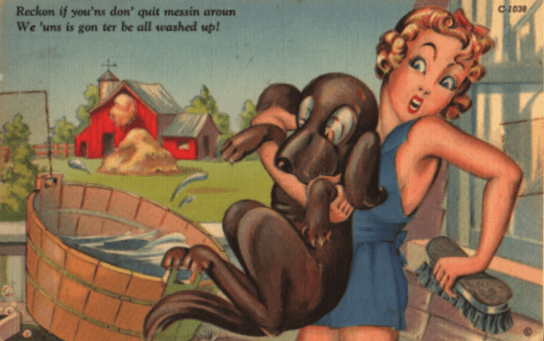
The answer to that last one is simple, really. She’s there to help sell the postcard, rather like the young lady shown here trying to wash her dog. The joke doesn’t have anything to do with WHO is washing the dog, nor how that person should be dressed. But at least she is a part of the gag, unlike the lady in the first postcard. And that rather scanty outfit is practical, as anyone who has washed a large dog will understand.

There are plenty of postcards ABOUT good-looking young women. What I was wondering about was how often the ladies walked into a joke where they were not essential, but just helpful in catching the eye of the customer. Here, for example, all we REALLY need for the gag are the cows. Having someone to milk the cows helps focus the joke. Having someone in high heels is not positively essential.

And there are some jokes which are just funnier, really, if the punchline goes to a woman. A man could just as easily have been walking Fido here. But he would have seemed either inconsiderate or just stupid, whereas this young lady can just be classified under, say, “Blonde Jokes” as we take the postcard to the cash register to buy it.

This joke didn’t particularly REQUIRE a woman either, or a very tiny woman (look at her height compared to that of the mailbox and/or newspaper. Of course, this was during World War II, when men overseas were thinking of the “little woman” back home.)
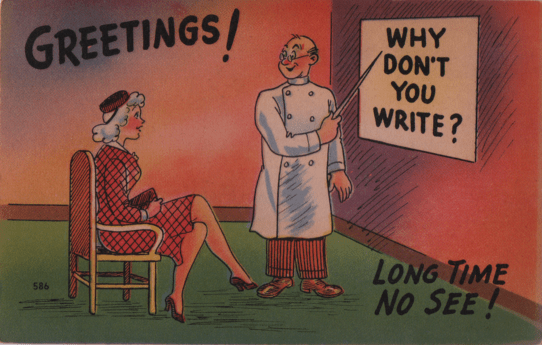
There is no reason for a female patient crossing her legs for this card. Would anybody have bought it without her?

And anybody at all could have been picking a peach. (At least she’s doing something. What is the SCOTTIE doing there? Are we going for double the market?)

The phenomenon does not begin at mid-century either. This joke from thirty years earlier could have been done—in fact WAS done—with two men in the role. But the artist wanted to draw a shapely female golfer, and I bet his sales figures corresponded with hers.
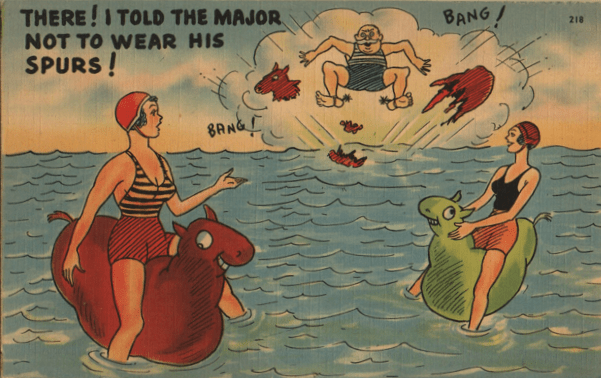
None of these ladies is quite as pointless as the bysitter in the first postcard. Somebody HAD to be around to deliver, and receive, this joke, and since we’re at the beach, why NOT a couple of healthy young women in 1930s bathing costumes?

And here, the speaker must really be female, to fit the punchline.

But, as people who used the same pun in different contexts pointed out, it did not necessarily have to be the pinup model type preferred by other artists.

The shapely ladies who produce the punchline (or, as here, the straight line) are simply there to nourish the sales figures, to help profits grow. We could call them womanure. But I don’t think we will.
 Blogsy Babbles