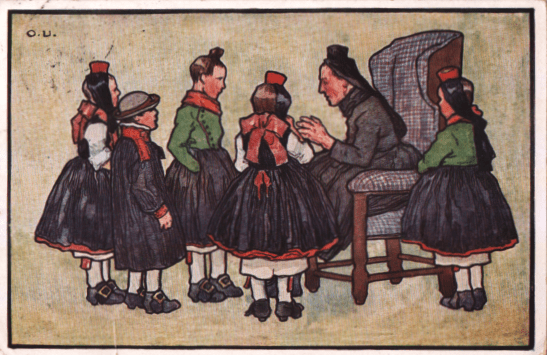
Folklore has been passed on in many ways throughout the years, from Grandma’s tales to the Interwebs. By “folklore” I mean to suggest any sort of knowledge passed on outside of classroom, from stories of Jack and his adventures with princesses and/or giants to that limerick about the Young Lady from Ryan. Such information may be intoned by Grandma, as above, or scrawled on the restroom wall.
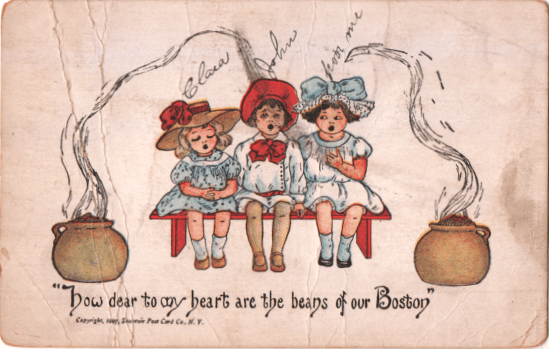
Over the centuries, people have tried to catch this folklore as it passes, lest it be dropped and lost by a heedless generation. Sometimes folk collectors are scholars who hang out in bars to document tales of big fish or traditional song parodies. But sometimes it is the postcard artist who does the job. The song above, for instance, is referenced on a number of postcards, but only the first line. The rest of it is lost, at least as far as I can determine on the Interweb sources.

Some postcard artists, like Hansi, in the reproduction shown here, went out of their way to give us their local lore. Those headdresses, unique to Alsace, can be seen in postcards by other artists (they are that fun to draw) but the girl in the middle is also offering up Kugelhopf, a traditional (and impressive) Alsatian dessert. (Alsace is one of the first parts of Europe to be invaded in time of war, and Hansi had the distinction of facing trouble from enemy soldiers in both World Wars.)

More often postcard artists just used current folklore as a key to entertaining the readers. Here, for instance, we get a happy ending to the story of someone who was thinking about the verse that “Everybody hates me; Nobody loves me” and having to go out in the yard and eat worms. (Now largely forgotten, except among bloggers who may not know the poem, but know the feeling.)
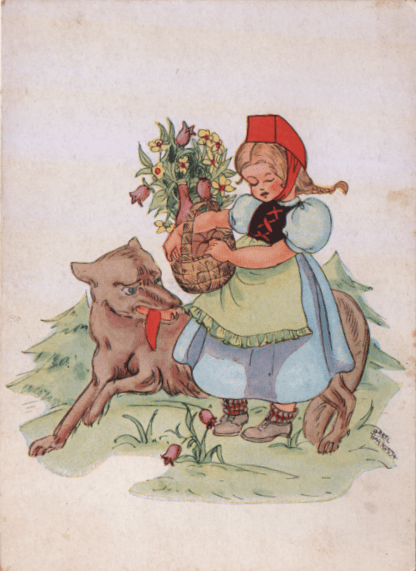
Postcard folklorists are likely, though, to take a turn for the grim. (Sorry about that.) Here we see not only an artist’s rendering of a famous tale, but also a reminder that it is only in English that Little Red wears a “hood”.
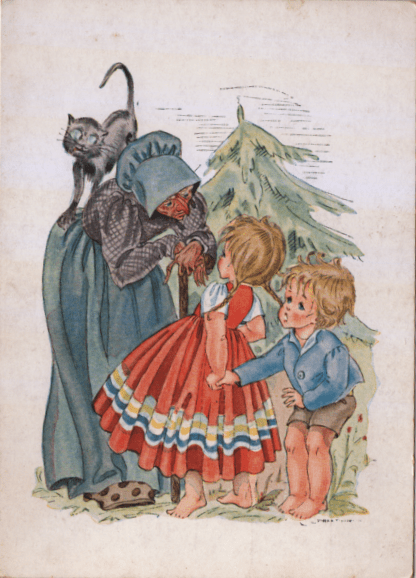
This artist is showing us a dramatic point in the tale of Hansel and Gretel, though we see no tempting candy house (and I don’t recall the cat. Maye ALL the witches in folktales had cats, who never got any billing. Note to those still looking for dissertation topics—Forgotten Folktale Cats would get you funding in no time.)

Here’s a rendition of a popular bedtime poem simply meant to be warm and comforting and cute and inspirational.
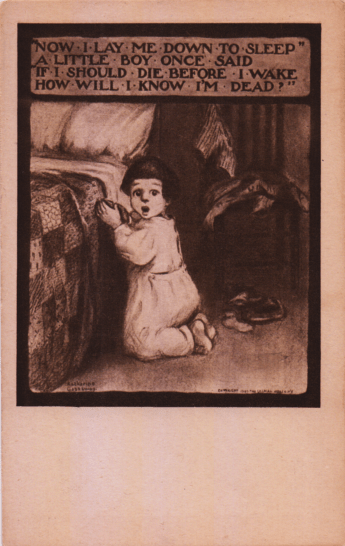
The artist seems to have given it more thought and produced this version, bringing out the was menace in this folk poetry.
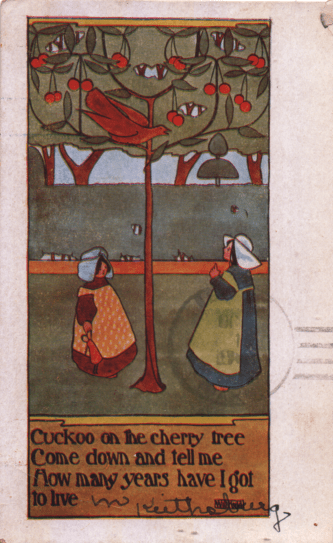
Death is a dramatic and fascinating subject, as far as I can recall from my own bloodthirsty childhood in a bygone century. There were all sorts of formulae handed down on the playgroud to figure out when your own death would take place, and previous generations were no different. I was NOT taught this one until I saw this postcard, but that may simply be because cuckoos (the bird kind) did not hang out in my neighborhood. Back in the day, not one but three of these rhymes gave me the same date in April, 2001 as my date of demise, which was fun because that year was so far away as to be unimaginable. Finding myself in 2001, I had to remind myself several times that this was, after all, merely playground science, like not locking your knees while singing in Chorus.

I did NOT die in 2001, if you were curious, and I cannot even credit any of the counter-spells taught us in folklore, as in this bit of verse which tells us if we smile three times every morning, do not grumble at lunchtime, and sing every night until the worlds rings around us, we will live to be one hundred. I might just try it, though like any other fitness program I didn’t get around to it today, and may just start tomorrow. I wonder which playground savant taught me THAT.
 Blogsy Babbles