
We have spoken, hereintofore, of the postcard as an early form of social media, as a repository of bygone songs and jokes, and as a certificate for travelers to verify the places they had visited. The postcard had many more roles in our history than as a means of saying “My Room Marked With X.” But have we spoken of it sufficiently as a guidebook to parts of life so hidden, so dark, that travel guides, advice columnists, and even Wikipedia will not address? Where else can we go for a description of the real dangers of the beach vacation?

Oh, sure. Anyone will tell you about sunburn, mosquito bites, and even jellyfish stings. But to the person…let’s not mince words here. To the woman who has donned that bathing suit of this summer’s frolics, will no one speak of the hazards presented by local wildlife and the seasonally-exposed posterior?
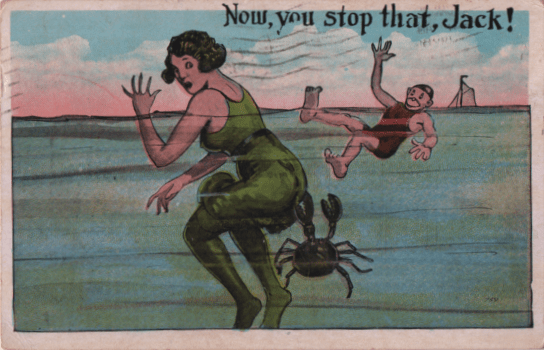
I have researched the question extensively (I asked both Google AND Bing) and nowhere can I find any statistics about the number of merry vacationers who joyfully headed into the water and wound up being unable to sit down for the rest of their stay because of crab attacks. This can only be conspiracy. The crustacean lobby has gotten to the purveyors of information on the Interwebs and concealed this threat, for fear of cutting off this source of entertainment for crabby influencers, whom we shall call the Deep Blue C.
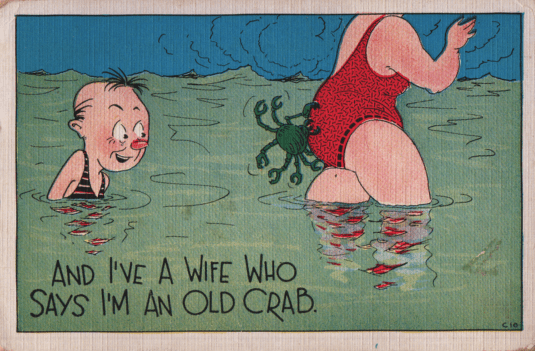
But (and I use that word with some trepidation) our friends the postcard cartoonists are looking out for us. THEY are not afraid to depict the truth of matters suppressed by our so-called information sources.

They alone are willing to show us the shock and horror of the situation, the sheer terror of…oh, sure, maybe some people will tell us they just thought butts were a quick provider of cheap laughs. But the truth sticks out in their efforts.
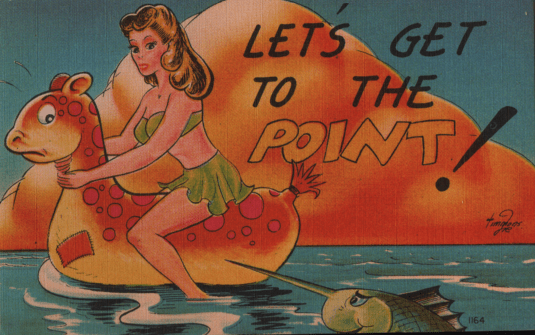
It isn’t just the crabs, of course. Lobsters indulge in molestation of the female situpon, and fish are serial offenders (possibly even searial offenders, if my spellcheck will allow that. I think the spelling and grammar programs on computers are part of the conspiracy, too, but that won’t surprise anybody.)
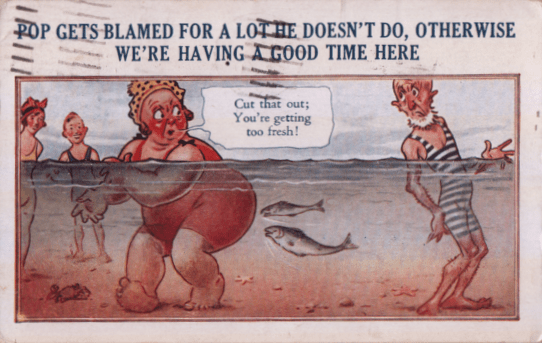
Fish may be a little more subtle than their neighbors with pincers, but they do, according to the postcard artists, accomplish just as much damage, especially to married felicity, as any lobster.
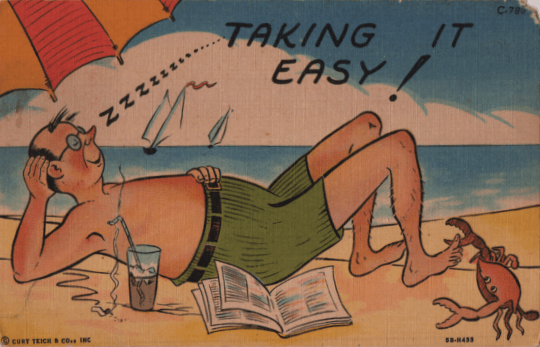
And they know what they’re up to. Over and over, we see the same critters attacking men. But here they go for other targets. “Toe of Man But Lady’s Rump: That’s the Way to Make Them Jump” is one possible translation of cryptic engravings on rocks found at the bottom of the sea. (Provided I can find a picture of some rocks with cryptic inscriptions. If I do, I dare you to prove that’s NOT what the cryptic lettering says. Never mind the work of Professor Fossilthwaite in 1927, who claimed these writings—which were lost but which he made replicas of in his lab, using Play-Doh—said “Ask Any Mermaid You Happen to See” OR the subsequent pamphlet by Dr. Phoeble, which translated the cryptic script as “There Once Was a Gal In the Ocean, Who….” Where were we?)

And then we have experts like Herman Melville, who pointed out that when one of these watery predators go after men from behind, they may have other things in mind entirely. But (and there’s that word again. Coincidence? I think not.) our postcard artists are right there wherever situpons are in peril, to bring us the True Facts, give us fair warning, and, incidentally, provide us with an excuse to show off their postcards (an artform where the fullest message was on the back side. Another Coincidence? Ha!)
 Blogsy Babbles