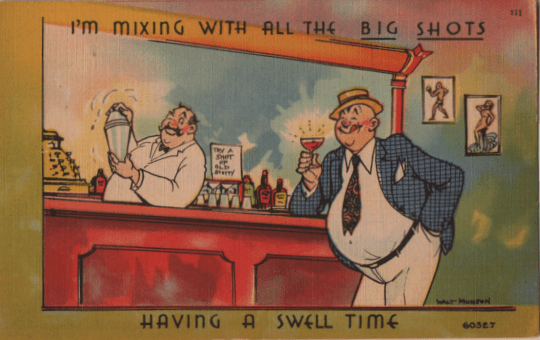
Earlier this week, we considered the classic saloon, as portrayed vintage postcards. We considered particularly the swinging doors, the bar rail, the spittoon, and free lunch. And we allowed as how there was one feature we needed to consider in a blog, that indispensable dispenser, the bartender.
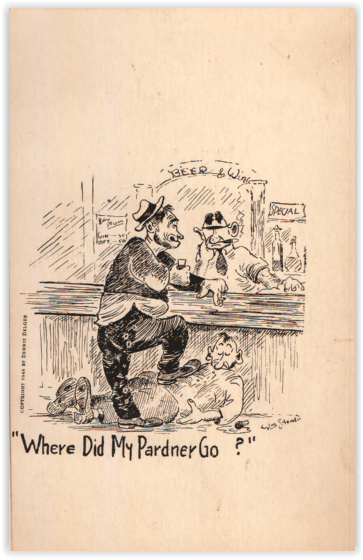
The customer, of course, is the only really indispensable human feature of the bar in cartoons (and to the establishment’s accountants, to be sure.) But the bartender runs a close second. Waiters and cigarette girls belong to postcards set in nightclubs, and the barmaid, or female bartender, is seldom seen. Postcards set in bars generally demand a man behind the bar, frequently a robust soul in a white shirt, with a handlebar mustache above a ready smile. This depends on the kind of bar being portrayed, of course.
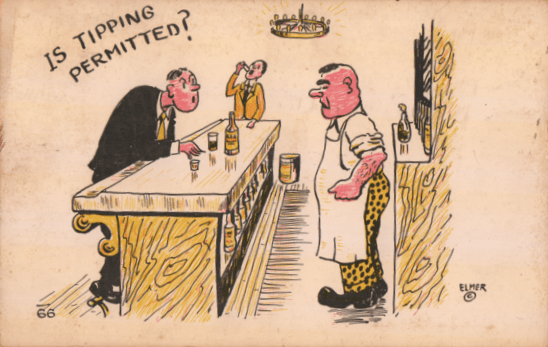
The bartender’s role in most postcards is similar to the job he performs in the three-dimensional world: straight man. He is there to react to what the customer says. Sometimes this is a mere question of etiquette and custom.
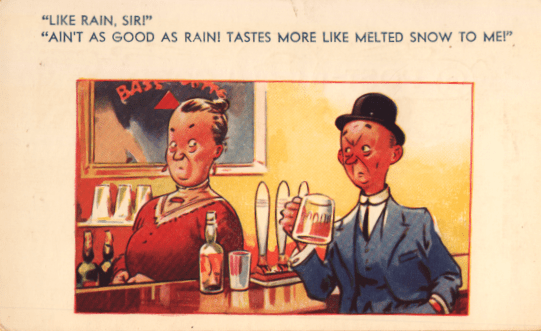
Sometimes it’s an observation on the weather, or the service, or the beverages on sale.

When a customer offers advice, the bartender is there to nod.

Action is reserved for times of need: as when a customer orders another drink and the bartender has a faint suspicion that this would be a bad idea. Knowing when and how to cut off a customer is nearly as important to a bartender as knowing what kind of glass to use for an Old-Fashioned. The postcard, as opposed to poems and songs in American literature, usually takes the side of the bartender in these discussions.
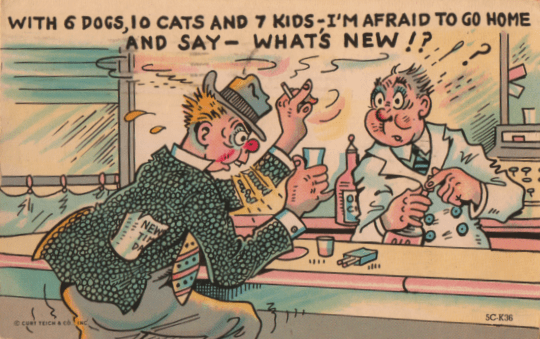
But the most important job of the retail mixologist is that straight man role. Listening to the concerns, worries, and opinions of the customers is the way to encourage return trade. The best bartenders have developed an ability to read body language without actually listening. The customer’s gestures and tone can tell a skilled listener whether they are telling a joke, sounding off about politics, complaining about their kids…it may be necessary to listen long enough to catch up a word or two for guidance (Is he complaining about his kids, his wife, his girlfriend, his boss?) but the best can respond with sympathetic nods or grunts and never take in the cascade of lubricated monologue.

The stress of actually listening might spill over otherwise. (I herewith apologize to any bartenders and/or bartender substitutes whose attention I may have monopolized over the years…though one of them said my conversation was very cost-effective. It saved them the expense of turning on the radio to provide background noise.)
 Blogsy Babbles