
We have several times in this space considered the actions of alcoholic beverages on the people seen on vintage postcards. This alcohol appears in many roles depending on the angle the artist has decided to take: the toast at a banquet, the beer keg in the cellar, those cans and bottles in the fridge, the still up in the hills. But no artist could produce pictures for picture postcards without being able to draw the good old saloon.

The good old saloon, which had become a vision in American nostalgia somewhere around World War I had certain features essential for its portrayal. One was the entrance: a set of double-hinged swinging doors to push through on your way in or be thrown through on your way out.
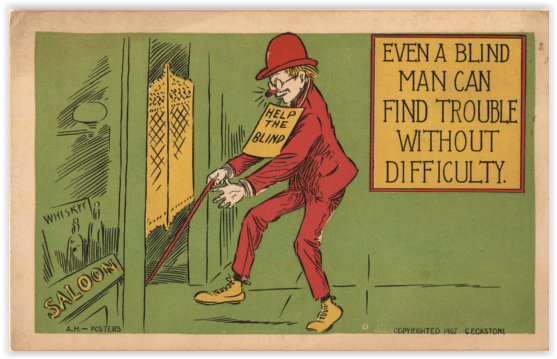
Known in the trade as “café doors” or “batwing doors”, these seem to have become associated with bars in the wild west and migrated eastward. They had a certain practical appeal: a LOT of saloons, despite what you’ll see in the movies (or on postcards) were tiny hole-in-the-wall establishments with packed crowds and no ventilation, so they allowed for a little air circulation. They also did not obstruct the sounds of laughter and song, which helped guide strangers to an establishment.

If you were wondering, the trademark saloon entrance did not make up the entire door system. In winter, or during closing hours, there was usually a second pair of doors that filled the whole doorway to keep the cold or the after-hours intruder, on the outside.
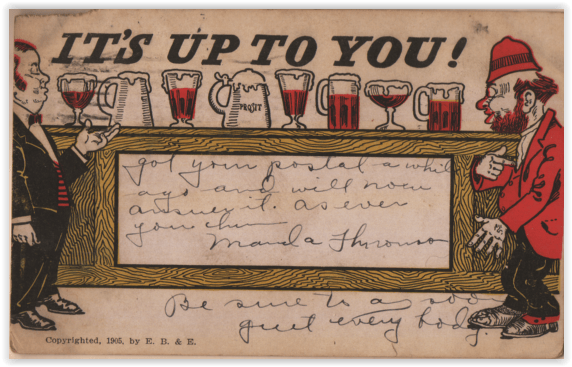
The smallest bars generally had the smallest variety (in the early days of the west, you paid for a shot of whatever they had on hand) but the tradition of different vessels for different beverages was essential at any saloon which wished to be considered a “drinking establishment”. (If this were a worthwhile column, we would consider the differing expectations of people who went to a “bar”, a “pub”, a “tavern”, a “saloon”, or…well, maybe after I get that genius grant I’ve applied for.
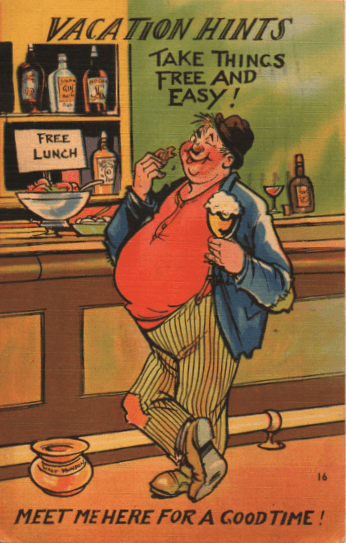
But people who reminisced about the good old saloon were less likely to recall what they drank than what they ate. The “free lunch” was a feature which New Orleans claims as its own invention, but which spread throughout the United States, becoming almost as essential to saloon nostalgia as those swinging doors. This “free lunch” was not free: you had to order a drink before you had access to it (the restrooms worked on the same principle). The pale descendants of the Victorian free lunch can be seen in the bowls of peanuts or pretzels or chips now seen in drinking establishments (often brought to the table AFTER you order.)

Once upon a time, though, there were wedges of cheese with a knife in them, big joints of meat with a knife there, sausages, eggs hardboiled or pickled, sauerkraut, pickles, pickled onions, stewed tomatoes, boiled potatoes…the variety was limited to the imagination of the owner, the ethnic makeup of the neighborhood, and the budget. This food array did, if you were wondering, cost more than the price of one beer would cover. But if you look over the possible menu items, you’ll see that salt was a major ingredient: starch was also important. The owners counted on their customers eating something to go with their drink and then having to order more drinks to wash down the food. The art of turning a profit by putting out free sides was delicate and arcane.
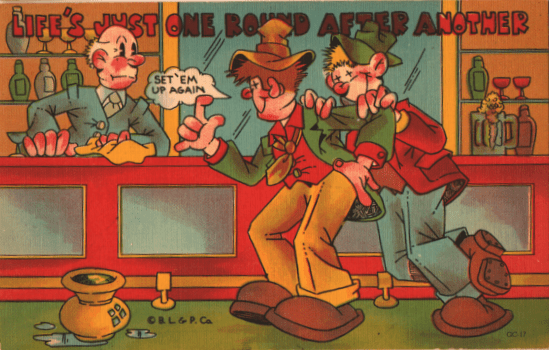
Coming down toward the floor, we find two more articles essential to a postcard saloon. One of these is the cuspidor, or, more vulgarly, the spittoon (there were less pleasant names for it, but we were just discussing food, after all.) The custom of chewing tobacco, at one time apparently nearly universal among Americans (visitors from Europe were always commenting on this), was on the wane, partly because cigarettes had become cheaper and more acceptable socially. But even though tobacco spitting gags were pretty much retired by the time postcards came along (thank goodness), the habit itself never disappeared, and the saloon liked to be known as a place where men could relax and indulge in habits that society (and or wives) didn’t care to see could be indulged. (This also explains all the pin-ups you see tacked to walls in postcard bars, but that’s a whole nother blog.)

And no self-respecting cartoon bar could do without the footrail any more than they could the spittoon. These were designed to make it more comfortable for a man to stand for hours at the bar, and went right on to the Modern Era (defined as the time when it became legal for women to order a drink right at the bar. Before that they had to sit at a table while a man brought the drinks over.)
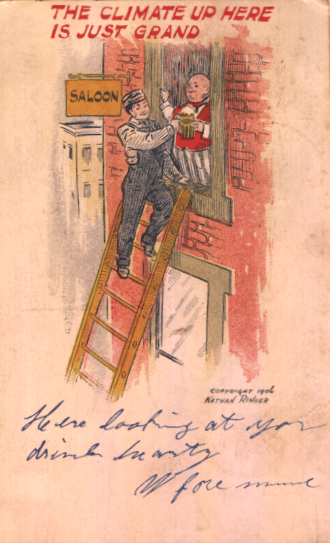
We have not hit ALL the cliches of the old-time saloon, of course: there’s that big mirror, the piano player, the poker tables, the “two doors” (restrooms), the…but it is important to recall that not EVERY drinking establishment had all these things at the time, as seen above. All a saloon really needed was alcohol, a counter to sell it across, and one other thing. But that will be discussed on Friday.
 Blogsy Babbles