
There are those who yearn for the good old days. They give assorted reasons: prices were lower, people were more civil, there were not electronic devices beeping at us to tell us that a friend has uploaded another video of her performing bunny to TikTok. But there is a frequent refrain to all of this, that “Life was simpler then.”
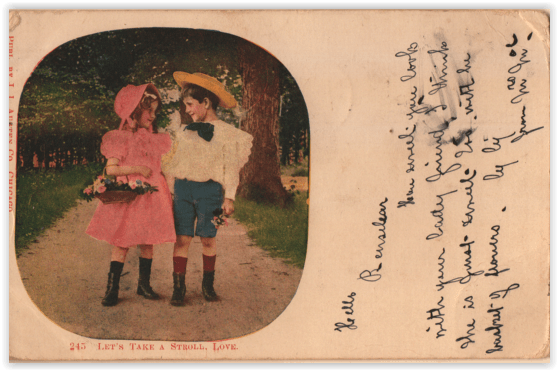
I don’t get it, myself. I don’t at all remember a serene, unflustered distant era. I may worry today about different stuff than I did eons ago, but I don’t see that things I worry about now are any more complicated. And the good old days had their own sets of rules, especially where children were concerned. Children were, according to some experts, supposed to be fed on a steady diet of bread and milk and reminded that they were to be seen and not heard. Only at puberty (a word not uttered among children at the time, of course) would a child start to become an adult. A rite of passage might or might not occur (Bar Mitzvah, First Communion, heading off to a more rigorous school) around the age of 12. It was time, a child was told, to take up the knowledge and responsibilities of an adult. It was time to become aware of a wider world, to look ahead (or around) to gainful employment, to prepare for marriage.

It was, in short, time to cover your shins.
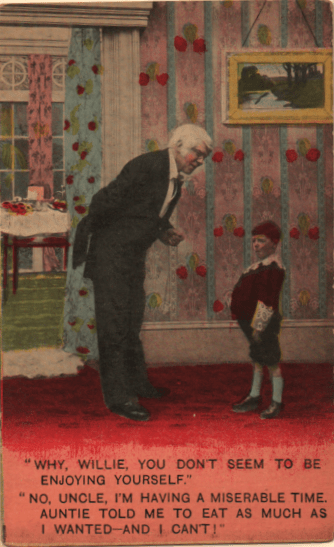
The custom of requiring children to wear short pants and short skirts until puberty was not universal, of course. Many working-class children, a lot of whom had jobs, HAD to wear long pants: work on the farm or in the factory presented constant dangers to the knees.

Yet, we see it again and again in the middle and upper classes. Growing up meant it was time to “put on long pants.” A common remark to girls whose knees were showing was “Pull your skirt down; you’re a big girl now.” As soon as you turned twelve, or thereabouts, your knees and ankles disappeared.
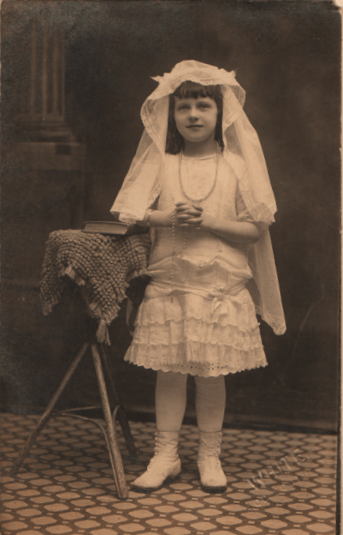
There are plenty of rppcs showing children on the crux of this moment: that rite of passage where one got a really fancy new dress

Or a highly polished new suit. Note that knees are still visible at this point (even if covered by stockings). The ritual has not occurred yet; one is still an awkward fledgling.

Or not awkward (I swear she’s about to deliver a lecture on hermeneutics) but still not old enough to qualify for floor-length wardrobes.

The day would come when changing fashion meant there were fewer inches of fabric between the grown-up and the child. And yet, as seen in the postcard at the top of this column, the perception that boys wore shorts and girls wore skirts which barely reached the knees. Many cartoonists kept this up long after the custom had passed (Richie Rich has not, as far as I can tell, donned long pants to this day) and the realities of life had changed completely. (MY grade school sent out a note every spring to parents that children in school were NOT allowed to wear “shorts, cut-offs, or culottes”. Not one of us knew what “culottes” were: it was just one more thing for us to worry about.)
 Blogsy Babbles