
Last week in this space we discussed those informational postcards which informed you about candidates who knew you were the right kind of citizen and would vote for them. These are considered by most of America to be part of a larger subclass of educational material known as “junk mail”.

The custom of sending this sort of useful information to prospective buyers goes back to the invention of the post office, basically. Postmasters were allowed to send mail for free as part of their job; companies eagerly sent bulk mailings to these overworked souls and told them to pass these along (all for free) to any customer who might like it. As advertising became bigger and bigger business, the postmasters were cut out, since postage rates were low enough to make it possible to send out millions of postcards duplicating your magazine ads. (I suspect it was the magazines, and not the postcards, which were responsible for the dozen or so copies of each of these books donated to the Book Fair.)
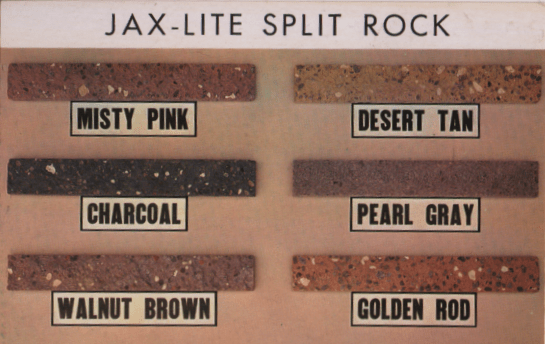
Companies with lower budgets might skip the magazine ads and go straight to “targeted mail”, as some advertisers prefer to call it. Some of these were extremely specialized.
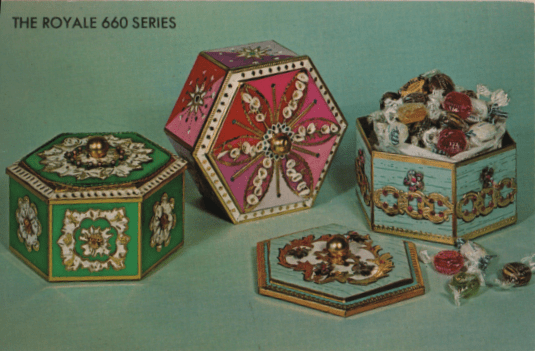
While others became a trifle obscure. This may LOOK like an ad for fancy boxes of holiday candy, and so it is. But it was not meant for the customer looking for a present to give on Valentine’s Day. No, this postcard was for department store managers looking for something pretty to display in the candy section during the critical months of sale.
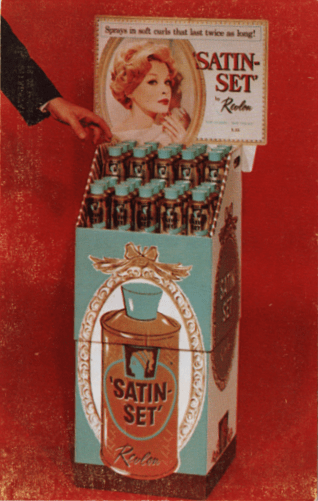
Similarly, this is NOT an ad for Revlon’s Satin-Set. It calls to you on behalf of Interstate Boocheyer, a major company for producing store displays. Interstate Boocheyer was not worried about whether anyone would buy Revlon. Of course customers would buy it, because Revlon had had the sense to ask Interstate Boocheyer to design the displays.

The whole principle of showing something besides the product is favored by some advertising experts. This postcard which appears to show some oddly-dressed tourists on their vacations, probably an ad for some travel service, is, as it says here, is a picture to demonstrate how Olive Garden chefs visit Italy for instruction.

From the turn of the current century, we have this postcard which is NOT telling you to buy a new CD, but is instead warn you to steer clear of pre-marital sex. By suggesting there’s a band they’ve never heard of, the card was expected to hit musiclovers of just that dangerous age, and convince them to “just Say No”. (Sorry, wrong ad campaign.)

Similarly, this is not an ad for the Volkswagen Bus, but, as you can see from the license plate, for elevator music. The connection between elevators and Volkswagens may not at first be obvious, but you’re not an advertising executive.

This postcard, as you can plainly see from the picture, is an ad for a book. A trivia quiz book published a quarter of a century ago, asked if people could remember things like the removable tabs on cans of Tab or Kick. I wonder how this worked: if you NOTICED “Hey, that’s an old-fashioned can!”, you were probably too young for the book.

I also wonder about this ad campaign, which is for a new cigar from an honored old purveyor of tobacco. Maybe it’s my reliance on translation services found on the Interwebs, but as far as I can tell, the slogan expressed by this cigar smoke genie (completely unnoticed by those below) is “BE the Pelvis of the Panther!” Whether it went over or not it surely deserves SOME kind of award.
 Blogsy Babbles