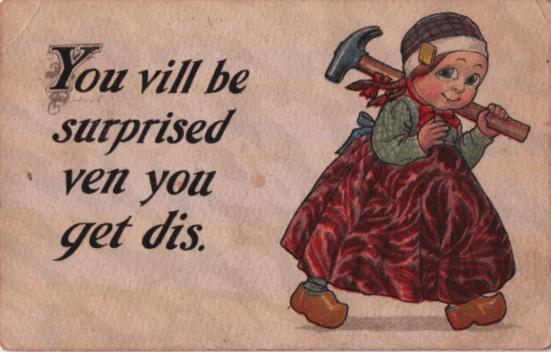
We are ALMOST a week into the New Year, and like the rest of us who swore off procrastination last year, some of you have not gotten around to making your resolutions yet. I know I offered you a great deal of selfless and unselfish advice (it’s easy to be unselfish if you’re giving away something you don’t want to use yourself) but I feel that perhaps we did not consult the ultimate gurus of life coaching for advice on how to build a wonderful new life in the wonderful New Year: the Dutch Kids!
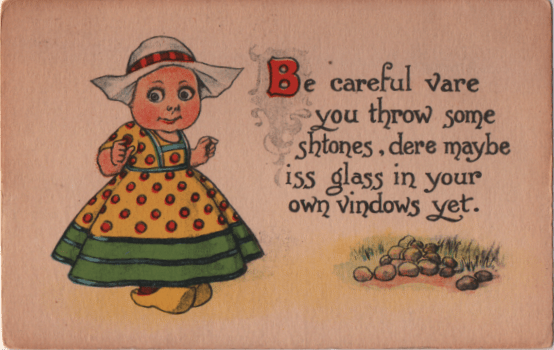
For those who are coming in late, children who dressed in Dutch attire were the hit of the postcard world between roughly 1910 and 1918, especially in the United States, where they spoke a patois based on Pennsylvania Dutch (which is based on English as spoken by German immigrants.) Wooden shoes and fractured syntax created an amazing durable fad which could be attempted by any postcard cartoonist and any company, because who can trademark a generic kid? About a third of the resulting postcards deal with romantic advice, and another third nag you to write a letter or send a postcard, but the rest offer advice which can be easily turned into resolutions.
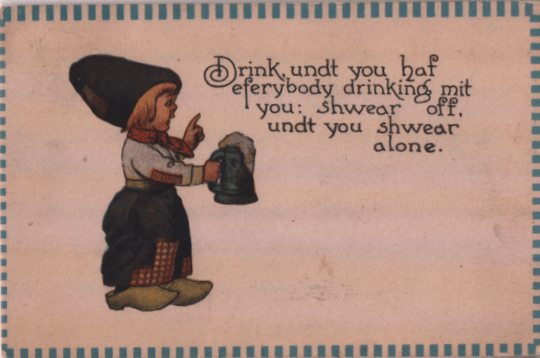
There are guidelines on what vices to give up, and which NOT to give up, New Year or not.
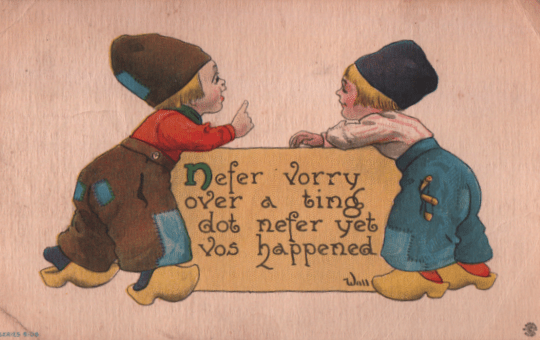
For all their light air, however, the Dutch kids seem to spend a lot of their time worrying and reflecting on their problems. So it is perhaps natural that they should point out to us all how useless a lot of this is.

A REAL New Year’s resolution, as my friends always remind me when I tell them I have resolved not to win a Lottery Jackpot this year, is supposed to be something difficult, a distant goal to be achieved. The Dutch kids feel that way as well. They’re not saying it’ll be all that easy to stop glumping about your world.

Although some of them TALK about how easy it is, you can tell by his face he doesn’t really put much stock in this plan.

F. Scott Fitzgerald recorded getting advice similar to this from someone else he was hoping would say something funny. I don’t recall how he said it worked out for him.
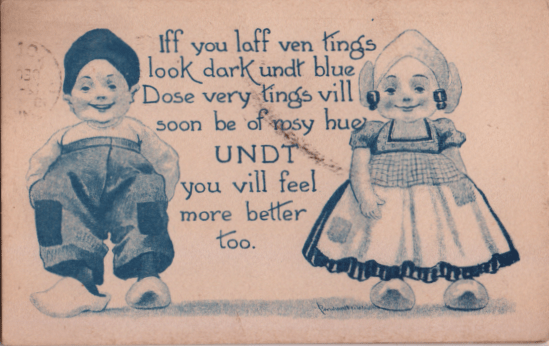
In literature of the same era but different reputation, Thorne Smith recorded what he thought of THIS method of dealing with your problems. (His opinion was along the lines of how, if you let a smile be your umbrella, you’ll wind up soaking wet. Not every resolution was meant for every resolver.)
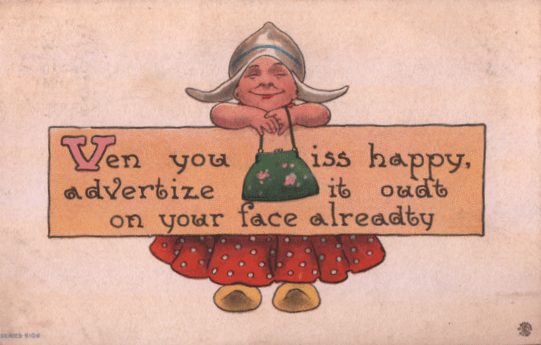
But it’s worth a try, I suppose. If you’re going to quit glumping, replace it with sumping like a smile. (Hey, look at that. If I had really worked on that I could have made a song out of it. But I didn’t. Surely THAT makes you feel better.)
You could compromise. Practice looking happy when you actually ARE happy. A smile does a lot to soothe this glumpy, suspicious world. After all: remember our class motto: “Keep Smiling. It Makes Them Wonder What You’re Up To.”
 Blogsy Babbles