
I try, Heaven knows, to run a lighthearted blog, which tries to avoid current issues and the dark side of life. (Okay, we just had a blog where the hero considers a corpse. Yes, we did discuss profanity a few columns ago. If you’re not going to work with me on this, you’ll get nothing but turkey sandwiches for the rest of this week, too.)

But the time has come to address a pressing problem: is there too much violent crime on postcards? What is it teaching our young people? (Whom we must protect from every possible influence we disagree with, even if that influence is over a century old and would not have even been noticed by them unless we told them not to look, and…sorry. Got stuck in the twenty-first century there for a moment.)

Aside from public drunkenness, and the occasional pickpocket, as seen at the top of this column, crime generally involved a thug with a gun. Sometimes it was an urban thug and sometimes a bandit from the Old West tradition. This one is also unusual in that it involves a more practical plan than most: one man to hold the mark steady with the guns while another goes through those pockets.

This masked malefactor, for example, could be in trouble if that rather robust victim decides to take a swing at the weapon involved (admittedly a fifty-fifty proposition, and he IS a bigger target. Still, he looks as if he could do it and is just waiting for the right moment.)

Another practical consideration which you see being practiced more often on postcards is choice of victim. The victim is almost always better dressed than the crook (A man who was dressed for the city was guaranteed to be a weakling, lacking the strength and moxie of the rough-dressed denizen of the underworld. AND he was unlikely to be packing a gun himself. There is the faintest hint in a lot of these postcards that our sympathy is supposed to be with the daring bandit, and not the wimpy victim. This may be why you almost always see a MALE victim. Robbing a woman–unless she was the crook’s wife, of course–would have roused a chivalric impulse and spoiled the joke.)
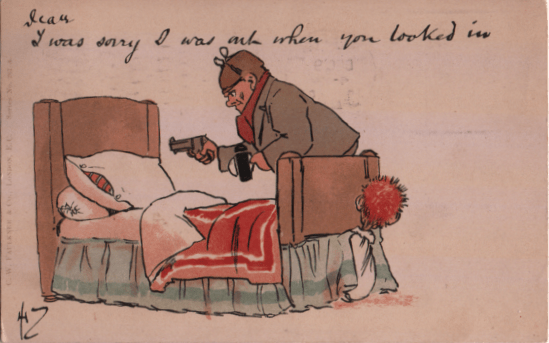
In postcards of the nineteen-oh-somethings, you almost never see the cartoonist letting the victim catch a break. Some of this continues in later postcards.
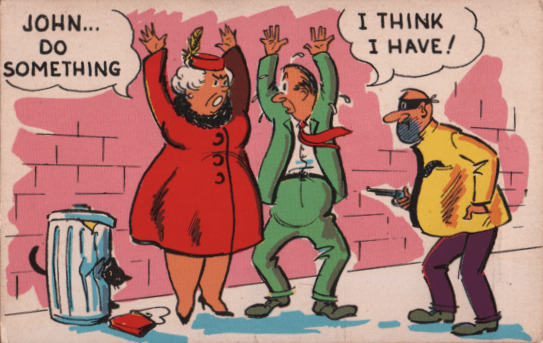
This gag, for example, exists in numerous cards by numerous artists.
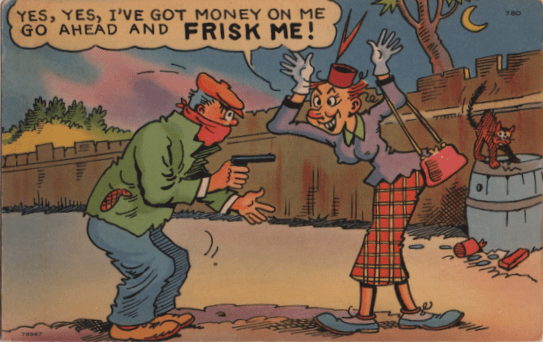
But as the world moved toward the era of the daring bank robber and powerful gangster, the Dillinger and/or Capone years, we begin to see more postcards where the joke is on the bandit. Maybe this was more acceptable if the victim was female, because this turning of the tables often features a woman.

Approaching a point at which we have to wonder just who the victim is. (Note, also, that the gun and the punchline are almost always on the same side. I suppose humor depends on who gets the last shot.)
 Blogsy Babbles