
Sigmund Spaeth, best known for what people regard as a misguided attempt to teach children instrumental classics by setting lyrics to them, wrote a LOT about music. One of his wisest observations was about how audiences react to performance of a medley. It is true, as he states, that whenever a new song starts in the medley, the audience applauds. They are not, he said, applauding the song, or the performer. They’re applauding themselves for recognizing the song.

There is a similar phenomenon in comedy, in which we see only the lead-up to the payoff, and get our joy not only out of the plight of the character headed for disaster (it’s usually disaster) but also from our anticipation of what comes next. (I’m not sure, but I think about HALF the postcard depictions of people in canoes show the canoe about to go over a waterfall. Canoes apparently do not come with instruction manuals.)

This works especially well in a static medium, like the cartoon. In a movie, we MIGHT feel cheated if we don’t get to see the payoff.

In fact, if enough work is spent drawing the setup, the joke gets a little better. Here we can glory in the man whose maneuver with his mustache automatically makes us want to see him come to grief. But the impact we imagine is much more satisfying than anything the cartoonist could have drawn.
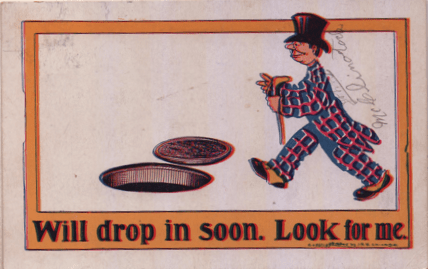
We enjoy the suspense, as Alfred Hitchcock pointed out, of knowing what the hero does not: that danger lies in wait.
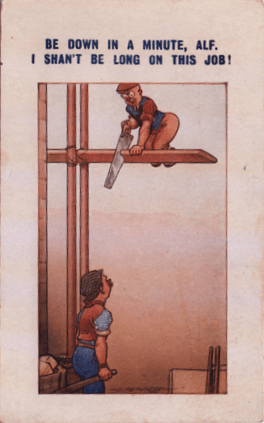
As when we recognize that song coming in the medley, we are uplifted by our own sense of superiority to the clueless protagonist.

Another ploy used in comedy is to cut from the set-up of the catastrophe directly to the aftermath, leaving the event in our imagination as we look at the consequences. Once again, we are allowed to feel a glow of intelligence because we know what happened without actually being shown the event itself.

Some cartoonists provided postcards with just the aftermath shot, taking advantage of just this human tendency.
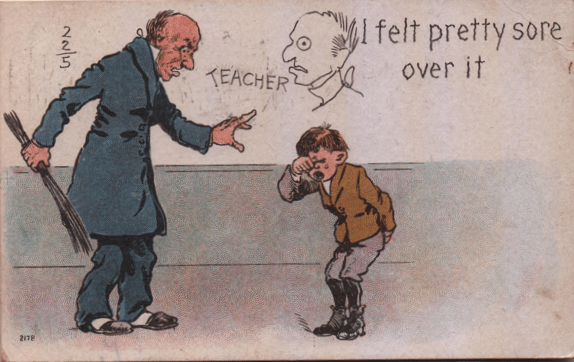
It may just be the postcards in MY inventory, but it does seem to me that an awfully lot of this kind of comedy involves the sitting section of the human body.

Perhaps this added a layer of sympathy to the gag. Or maybe, as some comedians have pointed out, that’s just the funniest end of the body.

But (and I use the word with some trepidation) perhaps this involves another issue. The cartoonist COULD not show the actual calamity, or knew that this would never go through the mails, anyhow. (It would also be less funny, but that’s the opinion of a twentieth century brain.)

If you want to apply your own intellect to a joke, I will leave you with this one, and you can decide for yourself whether this depicts something which is ABOUT to happen, or which HAS happened. Which is funnier, really? Or have you already shuddered and moved on to listen to a YouTube medley of golden oldies from the 2010s?)
 Blogsy Babbles